Northeast
Kathy Hochul blasted for knocking ICE as DHS offered federal help during NY blizzard

NEWYou can now listen to Fox News articles!
As this weekend’s blizzard blew through the Empire State, New York Gov. Kathy Hochul received blowback for her response to an offer of federal assistance from Homeland Security Secretary Kristi Noem, whose office oversees FEMA.
State snowfall totals topped 22 inches in West Shokan, Ulster County, outside Saugerties, while New City received 17.5 inches, Golden’s Bridge near the Connecticut line in Westchester County received 16.5 inches, Huguenot on Staten Island received 14 inches, and Levittown on Long Island received 13 inches, according to the National Weather Service.
Instead of confirming she accepted DHS’s offer to help, Hochul indicated she took the opportunity to criticize federal immigration enforcement:
“Secretary Noem offered assistance to New York ahead of the impending snowstorm,” Hochul said over the weekend.
POTENTIAL GOP CHALLENGER WARNS HOCHUL THAT A CORPORATE TAX HIKE WOULD BE A ‘DISASTER’ FOR NEW YORK’S ECONOMY
“I shared that the fastest way to help is for ICE to back off so people feel safe accessing warming centers, shelters, hospitals, and houses of worship.”
Her response was not well received by several prominent New Yorkers and New York entities.
“Worst governor in history,” the Staten Island Young Republicans said in a statement on X.
TRUMP BRIEFED ON BORDER PATROL-INVOLVED SHOOTING AS MINNEAPOLIS MAYOR DEMANDS END TO ENFORCEMENT OPERATION
NYC Scoop, a popular account sharing events and happenings in New York City, similarly fumed at the governor.
“You literally just told a U.S. Cabinet Secretary offering FREE blizzard relief to f— off because ICE might make your illegal alien constituents feel ‘unsafe’,” NYC Scoop said.
“You’re not a governor. You’re a border checkpoint for cartels. Resign, you treasonous ice queen.”
LARA TRUMP SLAMS TIM WALZ, JACOB FREY FOR ‘FANNING FLAMES’ WHILE RED STATES COOPERATE WITH ICE
Conservative strategist and former Ted Cruz staffer Steve Guest said the governor is “prioritizing politics over her constituents, and people are already dying.”
Guest included a screenshot of a WNBC report of three New Yorkers who had died from the sub-freezing temperatures during the storm.
When asked about the tweet, White House spokesman Kush Desai rebuked the governor:
“What a surprise — while President Trump and his entire Administration have taken steps to ensure all Americans have the resources they need to recover from this historic winter storm, Democrats instead are, once again, prioritizing the well-being of criminal illegal aliens.”
Republican Nassau County Executive Bruce Blakeman responded in a statement, saying that the governor — who he is challenging this year — “actually rejected federal assistance that was offered to help keep people safe.”
MILLIONS BRACE FOR ‘CATASTROPHIC’ ICE AS 18 STATES DECLARE EMERGENCY AMID HISTORIC WINTER STORM
“When lives are at risk, you don’t turn down help,” Blakeman said.
Another X critic compared the situation to New York’s underuse of military medical ships docked off Manhattan during COVID-19, saying that Democrats did not want to dignify them because President Donald Trump sent them.
However, a source familiar with the situation said Hochul never rejected federal assistance and that all storm-related requests from local governments were supported by Albany.
Hochul later tweeted a call for U.S. Border Patrol Cmdr. Gregory Bovino to be fired and for Noem to resign.
HOCHUL CONFRONTED ICE AGENT, SAID HE WAS ‘TERRORIZING PEOPLE’ BY WEARING A MASK
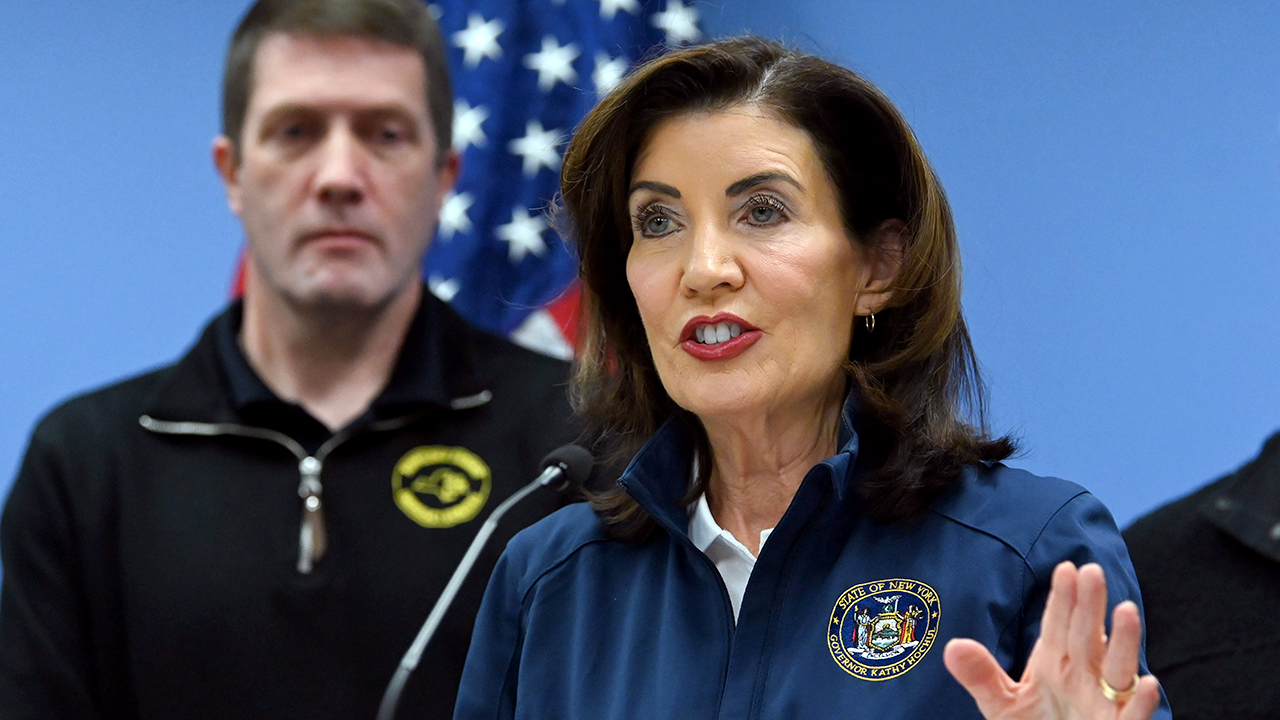
NYS Div. of Homeland Security commissioner Terry O’Leary, left, listens, as New York Gov. Kathy Hochul, right, briefs New Yorkers on snow preparedness. (Lori Van Buren/Albany Times-Union via Getty Images)
“[Noem] has forfeited her right to lead,” Hochul said, further suggesting Bovino is acting as if he is “above the law.”
Later Monday, she also said that President Donald Trump’s dispatch of Border Czar Tom Homan to Minnesota won’t undo “harm” done by his administration.
In a lighter message, Hochul quipped that as a “governor from Buffalo,” she knows how to handle a snowstorm.
The eyes of the nation often see the kind of hefty snowfall that accumulates in the western New York area during televised Buffalo Bills games in the NFL playoffs.
CLICK HERE TO DOWNLOAD THE FOX NEWS APP
“Push it out of the way — no strain on the back doing that… don’t lift much; smaller bits, OK — don’t do a big pile and fill this up because that can lead to a heart attack,” Hochul said in the clip.
In response to Blakeman’s retort, Hochul campaign spokesperson Ryan Radulovacki told Fox News Digital, “After blaming Renée Good for her own killing by ICE, Bruce Blakeman is showing New Yorkers yet again that there’s no low he won’t stoop to for Donald Trump – no matter how far he goes to trample over Americans’ rights.”
“New Yorkers want a governor with a backbone who will protect our state from Trump’s abuses of power, not a spineless coward who defends violence against Americans when it suits him politically,” Radulovacki said.
Fox News Digital reached out to Hochul for comment on the criticisms, and to DHS for comment on the situation.
Read the full article from Here



HARRISBURG, Pa. (WPVI) — Pennsylvania Governor Josh Shapiro signed the state’s overdue 2026-2027 budget on Sunday.
The $50.8 billion spending plan was passed by state lawmakers with bipartisan support.
It is smaller than Shapiro’s initial $53 billion plan proposed back in February.
“We managed, as the math indicates, to find compromise without compromising our core values,” said Shapiro. “If you go back and look at the goals we all set together way back in 2023 – funding our schools, making our communities safer, growing our economy….four years later, this budget reflects those continued priorities.”
Lawmakers say this spending plan expands workforce development initiatives, devotes significant new funding for basic education, and increases funding for special education and early intervention services.
Copyright © 2026 WPVI-TV. All Rights Reserved.
Rhode Island
Rhode Island Foundation is offering three composers $30,000 grants — applications due Aug. 10 – What’s Up Newp

Rhode Island composers have until August 10 to apply for $30,000 fellowships from the Rhode Island Foundation, with three grants available to emerging and mid-career musicians looking to advance their work.
The grants come through the Foundation’s Robert and Margaret MacColl Johnson Fellowship Fund and are unrestricted — meaning recipients can use the money however best serves their artistic growth, whether that’s creating new work, purchasing equipment, traveling, researching, or training in new technologies and techniques.
Applicants must have lived in Rhode Island for at least 12 months before the deadline. Current high school and college students, graduate students enrolled in degree programs, and composers at advanced levels of career achievement are not eligible. Submissions may be in any genre, including chamber, choral, contemporary, electronic, experimental, jazz, opera, musical theater, symphonic, and world music.
Recipients are selected by a panel of out-of-state industry professionals managed by the Artist Communities Alliance. Previous fellows include cellist Adrienne Taylor, multi-instrumentalist and vocalist Courtney Swain, and electroacoustic composer Kristina Warren.
The MacColl Johnson Fellowships rotate among composers, writers, and visual artists on a three-year cycle; next year’s round will go to writers. The fund was established in 2003 in honor of Rhode Islanders Robert and Margaret MacColl Johnson, both devoted to the arts throughout their lives.
More information and applications are at artistcommunities.org.

Dozens of dairy farmers from across the state drove to Grand Isle on July 2 with the intention of talking about a recent dairy plant closure. Instead, a larger issue emerged: Some dairy processors are giving up on Vermont, and the state is failing to cash in on a national investment in dairy amid a craze for protein.
A recent wave of three dairy plant closures in just two months has highlighted pressures facing the local industry, including high overhead costs and aging infrastructure. As large processing plants move West, where land is cheaper and production is more dynamic, Vermont farms are buckling under consolidation, increased prices and low profitability.
The result? Vermont dairy farms are being left in the dust by the competition from states like Texas where the economics of dairy farming are more favorable.
VTDigger analyzed U.S. Department of Agriculture data and found that dairy farming costs exceed sales by the largest margin in Vermont compared with 18 other states. Vermont farmers face a $8.65 loss per 100 pounds of milk produced, while California farmers, for instance, see $2.49 in profit.
For one Vermont farmer, the costs of overhead stack up to as high as $72,000 per month.
“I’ve spent a lot of time trying to figure out how to budget those numbers, and I can’t move them. It’s really just because of where we’re located,” Kylie Chittenden, who operates a family dairy farm in Shoreham, said at the meeting. Lt. Gov. John Rodgers and other elected officials and state agency representatives turned up to listen to farmers’ concerns.
Chittenden said she pores over the numbers each month when she financially benchmarks her farm against dozens of others across the country. Steep fees unique to operating in Vermont, including transportation surcharges due to poor road quality in the state, leave her at a disadvantage, she said.
As the concerns reach a flashpoint, larger questions loom about the future of the hallmark industry in a state built heavily around it, where dairy racks up $5.4 billion in annual economic impact — nearly 12% of the state’s gross domestic product.
“Vermont is definitely at a tipping point, and it’s heartbreaking to see, and I don’t know what the answer is, other than the farmer just can’t meet the demands of the overhead anymore,” said Kassie Stannard, who produces small-scale dairy products for her Vermont homestead.
Dairy in Vermont had a big setback in June when Dairy Farmers of America, a national farmer-owned cooperative, announced that it would shut down operations at its St. Albans milk processing plant and the adjoining St. Albans Creamery & Supply in August, putting roughly 80 employees out of work. The news from the large facility came after similar announcements from other dairy production plants, including HP Hood, which in April closed the Booth Bros. dairy manufacturing plant in Barre, and Franklin Foods, which announced in June plans to shutter its plant in Franklin County. Perrigo, which uses dairy for its products, also said in March that its infant formula production facility in Franklin County would close, affecting more than 400 workers.
“We potentially may continue to see an exodus of dairies from the state,” said Kevin Kouri, chair of the Vermont Dairy Producers Alliance and director of nutrition and sales at Phoenix Feeds & Nutrition. “And the trickle-down effect that that has not only to local communities and what these dairies bring in terms of employment opportunities in rural Vermont, but also the infrastructure and the allied businesses like mine.”
‘Increasing pressures’
For years, the dairy industry has been on the decline in the state, with the number of cow dairy farms decreasing nearly 50% over the past decade.
“I remember when my husband’s grandfather was still alive, he wrote down 54 names he could call off the top of his head of dairy farmers in the town of Corinth in his lifetime — 54 farms. Now we are just one of two operating dairy farms,” Stannard said.
The trend of consolidation — fewer farms but larger remaining ones — has largely been fueled by high overhead costs, leading smaller farms to struggle from low profitability while larger operations are able to produce milk at a lower per-unit cost.
As farms have consolidated, the cooperatives that market the milk have too. DFA, the large cooperative, is one of a few co-ops that control nearly 85% of all milk marketed by U.S. producers, according to one study, and it covers large regions, leaving some members to feel a loss of local control.
DFA said its decision to close the St. Albans plant was driven by broader operational and network changes. Tom Bellavance, who represents Vermont on the DFA board, provided more specific reasoning at the Grand Isle meeting: Milk production rates have been flat over recent years in Vermont, while demand from Americans for protein — including protein powder and yogurt — has risen.
American dairy consumption, in pounds, has increased by around 60% from 2010 to 2024, according to USDA data on per capita dairy product consumption.
Vermont needs more cows to compensate for stagnant production, Bellavance said, and while farms out West have increased their ability to meet the new demand, in New England capacity is shrinking.
“The idling of the St. Albans plant is just an example of changing dynamics in the milk market,” Bellavance said.
To meet demand for milk-based protein, dairy processors throughout the country have invested $11 billion in 19 states through 2028, according to the International Dairy Foods Association. Vermont was not one of those states, with aging infrastructure among the reasons processors choose to go elsewhere where it’s less expensive to build.
As Vermont lags behind the protein craze, Bellavance said the state should “embrace those changes,” because they will “deliver higher value,” putting more money into farmers’ milk checks.
But right now, for farmers’ checks, the processing plant closure does not seem like a positive.
The St. Albans plant’s “idling,” as DFA put it, means day-to-day production will end, but the group will retain ownership of the facility. What’s more, farmers have to pay to transport their milk out of Vermont to DFA facilities in nearby states, adding an unknown sum of money to members’ hauling fees.
“I guess our immediate concern is this is going to probably lead to some financial stress on some smaller dairies within the state, and we don’t want to see our dairy population, in terms of licensed dairies, shrink any further,” said Kouri, of the Vermont Dairy Producers Alliance.
Vermont DFA members also raised alarms about the money they have already poured into the facility.
As farmer-owners, DFA members financially contribute to the cooperative. Vermont dairy farmer Josh Blake questioned how members can trust the cooperative with their money given the shutdown, especially as DFA previously invested $30 million in an upgrade to the St. Albans plant that will now sit idle.
“How does an upgraded plant of $30 million invested into it now have water quality problems? That makes zero sense to me. And who do we hold accountable in DFA for this?” Blake asked.
The St. Albans plant has faced significant environmental enforcement over recent years, including more than $200,000 in civil penalties for dumping milk into the local wastewater system. DFA admitted to the allegations to settle the case last year.
Aging infrastructure, such as pipe infrastructure to handle wastewater volumes, is cited as a reason why, despite large investments, plants still struggle under regulatory pressure.
“We have a lot of aging infrastructure, but you go to places like Texas, where you can build a brand-new facility, and it’s going to cost them a lot less to do that than to try to invest in an old building here,” said Mary White, a Vermont dairy farmer and president of the Vermont Farm Bureau. “And that’s regulations again. That’s based on what you need for climate, regulatory, etc.”
Dairy farms and processing plants are, in fact, increasing in Texas, and the West at large, while many die out in the Northeast. Of 66 new dairy processing plants that are currently underway or recently opened across the country, funded by the $11 billion investment, none are in New England, while several are concentrated in Texas and the Midwest. As DFA closes up shop on its plant in St. Albans, and in May closed another in Connecticut, the cooperative is simultaneously investing in the Midwest, recently opening a plant in Michigan that produces in-demand products like whey protein powder.
Profitability is especially hard to come by for small farmers because they do not set their prices for their products. Milk prices, which are the minimum prices dairy processors must pay farmers for their milk, are established by the USDA in a multi-step process. Although prices have risen over the years, some farmers say they have not increased enough to keep pace with inflation.
“Our family works pretty hard, and we take very little salary away from the farm,” Tim Taft, a dairy farmer in Huntington, said in a statement at the Grand Isle meeting. “We reinvest it for the future. It’d be nice if the state felt the same. Currently, they say they are a farm first state? I think they need to prove it to us.”
‘What can we do?’
As farmers bring their concerns to the fray, elected officials and local agencies say they are seeking to make reforms to support the local dairy industry.
U.S. Sen. Peter Welch, D-Vt., and U.S. Sen. Bernie Sanders, I-Vt., recently introduced legislation aimed at combating consolidation in the industry by creating a government program that helps small and midsize dairy farms manage milk supply and demand. The bill would also match the national dairy production to national demand in an attempt to fight against volatile milk prices.
“The idling of the DFA’s St. Albans plant is heartbreaking news for the plant’s workers, Vermont’s dairy farmers, and this community,” Welch wrote in a statement to VTDigger ahead of introducing the bill. “I’m working with local, state, and federal partners to support plant workers and Franklin County as they navigate next steps.”
Rodgers, the lieutenant governor, said at the Grand Isle meeting that he thinks “there is opportunity sometimes when the door closes,” referring to the national craving for protein, though he didn’t offer a specific plan.
Rep. Lisa Hango, R-Berkshire, is worried about the lingering impacts of the plant closures, particularly on the state’s tourism and overall brand.
“Vermont tourism, which is one of our biggest revenue drivers in Vermont, depends on aesthetics, upon what our state looks like,” Hango said. “If that landscape changes due to declining working lands, tourism will most certainly suffer.”
Stannard has already seen it change.
“You always see pictures like grazing cows, grazing on the mountainside, and that’s the way it used to be when I was a kid,” she said. “There was so many more farms in the area, and I would just turn down any road and there’d be a farm. It is not like that anymore.”
___
This story was originally published by VTDigger and distributed through a partnership with The Associated Press.
-

 Pennsylvania50 seconds ago
Governor Josh Shapiro signs overdue Pennsylvania state budget with bipartisan support
-

 Rhode Island7 minutes ago
Rhode Island Foundation is offering three composers $30,000 grants — applications due Aug. 10 – What’s Up Newp
-

 South-Carolina13 minutes ago
LIVE: South Carolina governor to announce new appointment after Sen. Graham’s sudden death
-

 South Dakota19 minutes ago
South Dakota ends 2026 fiscal year with $69 million surplus
-

 Tennessee25 minutes ago
Everything Tennessee Basketball Assistant Coach Gregg Polinsky Said During Summer Practice | Rocky Top Insider
-

 Texas31 minutes ago
Talarico, Paxton campaigning in Texas this week. See events
-

 Utah37 minutes ago
KSL News Daily: The nuclear debate Utah can’t avoid – KSLNewsRadio
-

 Vermont43 minutes ago
The nation is craving protein, but Vermont dairy isn’t cashing in

