Sign up for our Boston Marathon newsletter
Get Boston Marathon registration information, start times, live runner tracking, road closures, live updates from race day, special features, and more.

The earthquake that struck the East Coast earlier this month was felt by an estimated 42 million people and luckily caused little damage, but what are the chances of a bigger, more powerful quake striking the area? And if it does, what could it look like — and are we prepared?
The April 5 phenomenon was a 4.8 magnitude earthquake centered near Whitehouse Station in New Jersey, which is about 40 miles west of New York City.
Shaking was felt from Washington D.C. to Maine, according to the U.S. Geological Survey (USGS), and it followed a much smaller, 1.7 magnitude earthquake in New York City on Jan. 2.
Earthquakes are rare along the East Coast, with the most powerful one in the last 100 years hitting in August 2011, clocking 5.8 on the Richter scale. It was centered in Virginia and felt from Washington, D.C. to Boston.
4.8 MAGNITUDE EARTHQUAKE STRIKES NEW JERSEY, SHAKING BUILDINGS IN SURROUNDING STATES
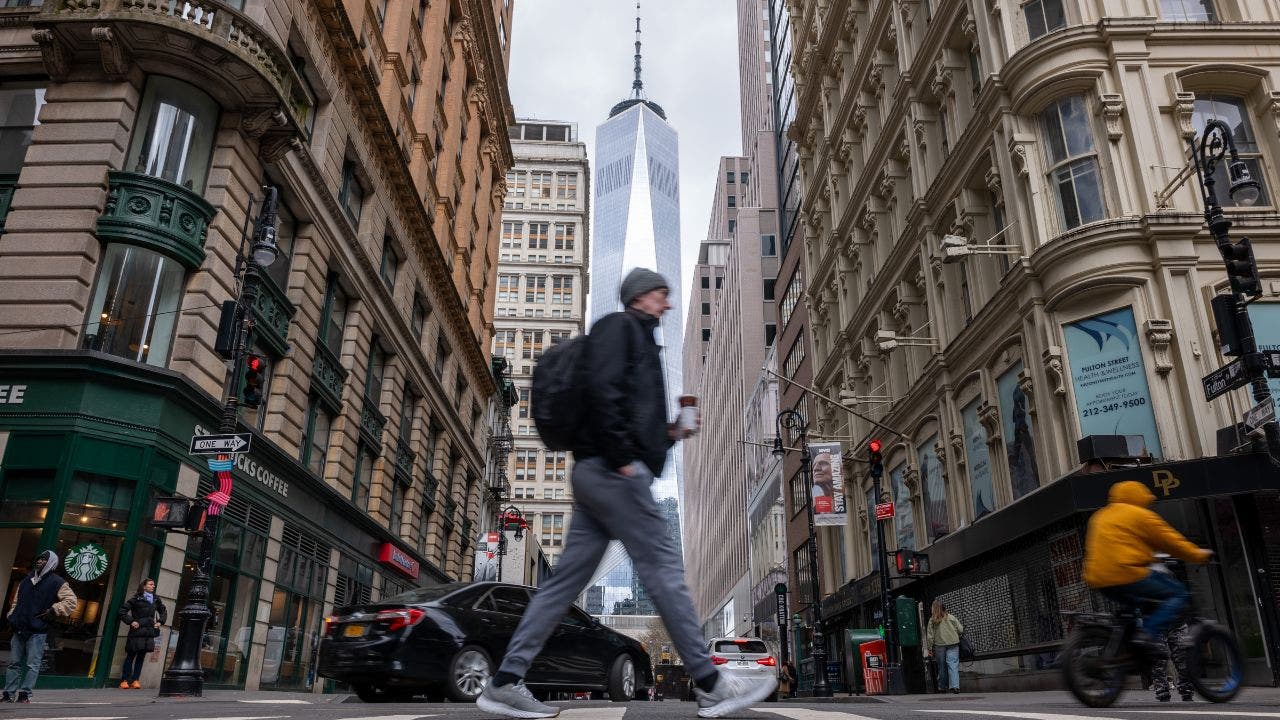
A man walks through Lower Manhattan moments after New York City and parts of New Jersey experienced a 4.8 magnitude earthquake on April 5, 2024.
Before that, an earthquake in South Carolina in 1886 is understood to have measured between 6.6 and 7.3 on the Richter scale. There is no definitive measurement of that quake since the Richter scale has only been around since the mid-1930s, but the tectonic shift still killed 60 people.
Professor John Ebel, a seismologist in the Department of Earth and Environmental Sciences at Boston College, tells Fox News Digital that when quakes start breaking 5.0 on the Richter scale, damage begins to occur.
For instance, the devastating earthquake that hit Turkey and Syria last year measured 7.8 and resulted in the death of nearly 62,000 people as tens of thousands of buildings were either destroyed or severely damaged.
California’s Loma Prieta earthquake in 1989, meanwhile, measured 6.9 and caused 69 deaths, and the 1994 Northridge earthquake in the Golden State clocked 6.7, killing 57 people. Thousands more were injured.
“As you go above magnitude five, the shaking becomes stronger and the area over which the strong shaking is experienced becomes wider,” Ebel says. “So if you get a magnitude six, the shaking is ten times stronger than a magnitude five. So had this month’s earthquake been a 5.8, rather than a 4.8, then we would be looking at damage to unreinforced structures in the greater New York City area.”
The front of an apartment building in the Marina District in San Francisco is ripped off after a quake erupted in October 1989. (Photo by JONATHAN NOUROK/AFP via Getty Images)
“Now I have to qualify this and say that in the past few decades, New York City has had an earthquake provision in its building code while New Jersey, New York and Connecticut have all adopted some version of earthquake provisions in their building codes,” Ebel explained. “So modern buildings that are put up today will actually do quite well, even in strong earthquake shaking… If you have a magnitude 6 or even a magnitude seven.”
In terms of the Tri-state area, Ebel says that the region has had smaller earthquakes, but it’s been spared anything that’s been significantly damaging.
An 1884 quake in Brooklyn did cause limited damage and injuries. Seismologists estimated it would have measured in the region of 5.0 and 5.2, while a quake jolted Massachusetts in 1775 in the region of 6.0 and 6.3.
WHAT TO DO DURING AN EARTHQUAKE AND HOW TO PREPARE
“In 1884 there were things knocked from shelves, some cracks in walls that were reported, particularly plaster walls, which crack very easily if a building is shaken,” Ebel said. “There were some brick walls that had some cracks and people panicked because of the very strong shaking.”
A magnitude five earthquake hits the tri-state area once every 120 years, says Ebel, who penned the book “New England Earthquakes: The Surprising History of Seismic Activity in the Northeast.”
A map shows the location of Whitehouse Station, New Jersey, which the U.S. Geological Survey reports was the epicenter of a 4.8 magnitude earthquake on April 5. (Fox News)
“The question is, can we have something bigger? And in my opinion, yes we can,” he said. “We can’t predict earthquakes, and we don’t know when the next one is going to occur, but we do have a low, not insignificant probability of a damaging earthquake at some point.”
Ebel said that the April 5 earthquake has left seismologists baffled since it didn’t occur on the Ramapo Fault zone, highlighting just how hard it is to predict the phenomenon from occurring. The Ramapo Fault zone is a series of small fault lines that runs through New York, New Jersey and Pennsylvania. Spanning more than 185 miles, it was formed about 200 million years ago.
“Right now it’s a seismological mystery,” Ebel said. “We have some earthquakes in our region where we don’t have faults mapped. But that’s even true in California. Not every earthquake occurs on a known or mapped fault in California, so there are still a lot of seismologists have to learn about the exact relationship between old faults and modern earthquakes.”
Ebel noted that buildings aren’t the only thing to consider when earthquakes strike. In the California quakes, overpasses crumbled while the electrical grid can go down too, causing electrical surges and fires.
Local residents walk in front of a destroyed building in Nurdagi, southeastern Turkey, on Thursday, Feb. 9. (AP/Petros Giannakouris)
Toxic chemicals were knocked off of the shelves of a chemistry building in 1989 and the building had to be evacuated, Ebel said.
“And you think about hospitals and some industrial facilities having that situation,” he explained. “So you have these things that are not catastrophic necessarily, but are going to be a real problem.”
And an earthquake doesn’t necessarily have to rattle land in order to cause destruction.
A jolt out at sea could trigger a dangerous tsunami, like the one on the edge of the Grand Banks of Newfoundland in Canada in 1929. It was felt as far away as New York City.
Waves as high as 23 feet crashed on the shore, according to the International Tsunami Information Center, with up to 28 people losing their lives.
“A tsunami is not necessarily a very high probability event, but it’s one that we have to think about also,” Ebel says in relation to the East Coast.
The Fukushima nuclear accident in 2011 was triggered by an earthquake and subsequent tsunami.
Damage caused by the 2011 tsunami is seen from a hill overlooking the city of Kesennuma. ( Phillipe Lopez/AFP via Getty Images)
Ebel says a tsunami similar to 1929 could cause a storm surge along the lines of Hurricane Sandy in 2012, where 43 people died in New York City.
“The threat of an earthquake is not as great as in California, but it’s something that we have to take into account and have emergency plans for and have building codes for,” Ebel says. “Our state and local emergency management agencies in all the northeastern states do earthquake planning — what we call tabletop exercises — where they pretend an earthquake occurs.”
“So those kinds of preparations are made on a regular basis,” he concludes. “Building codes are constantly being reevaluated and approved, not just for earthquakes, but for fires and chemical spills and all kinds of things. So we’re getting more prepared all the time.”
Marina Beach in southern India after tidal waves hit the coast in 2004.
Read the full article from Here


Boston Marathon
In our “Why I’m Running” series, Boston Marathon athletes share what’s inspiring them to make the 26.2-mile trek from Hopkinton to Boston. Looking for more race day content? Sign up for Boston.com’s pop-up Boston Marathon newsletter.
Name: Brianna Poehler
City/State: Granby, Mass.
I am running the 2026 Boston Marathon with Miles for Miracles in support of Boston Children’s Hospital. The Boston Marathon is deeply personal to me and my family.
My daughter is a liver transplant survivor, and at just 11 months old, she received a life-saving liver transplant at Boston Children’s Hospital.
What could have been the most devastating chapter of our lives became a story of hope, resilience, and extraordinary care because of the BCH team.
When our daughter was so small and so sick, the doctors, nurses, and staff at Boston Children’s carried us through the unimaginable.
They combined world-class medical expertise with compassion that went far beyond treatment plans and hospital rooms. They cared for our daughter as if she were their own. They supported us as anxious, exhausted parents. They gave us answers when we had questions, and reassurance when we were overwhelmed.
Most importantly, they gave our daughter a second chance at life.
Today, she is thriving because of that gift. Every milestone she reaches is a reminder of the miracle she received and the team that made it possible. Running the Boston Marathon is my way of honoring that gift and saying thank you in the most meaningful way I can.
The marathon is a test of endurance, determination, and heart — qualities I saw in my daughter during her fight and in the Boston Children’s team every single day.
With every mile I run, I will be thinking of her strength, her transplant journey, and the families who are walking similar paths right now.
By running with Miles for Miracles, I hope to raise funds that will support groundbreaking research, life-saving treatments, and compassionate care for children like my daughter. This race is more than 26.2 miles — it is a celebration of survival, gratitude, and hope.
Editor’s note: This entry may have been lightly edited for clarity or grammar.
Get Boston Marathon registration information, start times, live runner tracking, road closures, live updates from race day, special features, and more.

Along with the best football prospects the season has to offer, the NFL Draft promises to bring hundreds of thousands of visitors to Pittsburgh from April 23 to 25.
If the turnout approaches that of Detroit in 2023, those descending on the North Shore and Downtown could reach 700,000 over the three days. For reference, that’s more than 10 times Acrisure Stadium’s 68,400 seats, and more than double the city’s roughly 308,000 residents.
Where will they stay? How will they get around?
Event planners at VisitPittsburgh say the city is up to the task.
“They picked us out of several cities because we have the infrastructure,” said Perry Ivery, general manager of the Oaklander Hotel and board chair of VisitPittsburgh.
Last year, Wisconsin’s Green Bay comfortably accommodated a unique visitor count three times its 106,000 population, according to residents and local leaders.
Ivery said there are some 26,000 hotel rooms across the Pittsburgh Metropolitan Statistical Area, the bulk of which are concentrated in and around Downtown.
Even if each room holds two to four people, the total still appears to fall short. But Ivery said many attendees will be locals, whether from Pittsburgh, surrounding counties or neighboring states within a day’s drive.
Plus, a high proportion of out-of-town guests could have Pittsburgh roots and a free bed to claim in a family home, he added.
There are also around 3,500 units available for short-term rental in and around Pittsburgh through platforms like Airbnb and VRBO.
“We’re all working together to make sure everybody has a great hospitality experience in the City of Pittsburgh,” Ivery said.
Infrastructure from roads to parking, and bus and light rail routes, will also feel the strain.
Pittsburgh Regional Transit normally services around 100,000 riders on an average weekday, across its entire network. Spokesperson Adam Brandolph said the agency is prepared for the transit demands of what’s expected to be the biggest event the city has hosted.
“We’re confident that we’ll be able to meet the needs of visitors to the draft as well as daily riders,” he said, noting “no major closures or detours” are planned for the event other than the University Line project, which may see less construction during that week.
Brandolph said the agency is finalizing plans and intends to make more information public soon.
A spokesperson for VisitPittsburgh said a local committee is working with a range of stakeholders including transportation agencies, engineering partners and local government “to deliver a coordinated and comprehensive plan for the region.”
“This includes collaboration with public transit agencies on adjusted service plans, clearly marked detour routes, designated rideshare zones and proactive communication with residents, businesses and commuters,” said Alex Kenzakoski, communications director for VisitPittsburgh.
“Our shared goal is to minimize disruption, keep the region moving and make travel as predictable and seamless as possible for both fans and locals.”
Kenzakoski said details on road closures, transit adjustments and travel guidance will be made known ahead of the draft, and encouraged fans to download the NFL OnePass app for transportation information and updates.
Ivery said a successful draft week execution could line Pittsburgh up for future hosting prospects.
“There’re going to be folks that come in that have never been to Pittsburgh … This is a case to showcase our town, and our hotels,” he said.
“We’re friendly, we have grit, we’re very excited to showcase that we can do large-scale activities.”
This story first appeared in Pittsburgh’s Public Source. Read the original here.

Marked by a ceremonial ribbon cutting and attended by Governor Ned Lamont, state legislators, Waterbury officials, and community leaders, UConn Health celebrated the acquisition of Waterbury Hospital which as of today is now the UConn Health Waterbury Hospital.
“This is a defining moment for healthcare in Connecticut,” said Dr. Andrew Agwunobi, CEO of UConn Health Community Network. “We now have the opportunity to take the award -winning academic quality and service of UConn Health and share it with the wonderful employees, doctors and community of Waterbury.”
Connecticut Governor Ned Lamont described the initiative as a forward-looking investment in the future of healthcare access across Connecticut.
“Connecticut is leading with innovation,” said Connecticut Governor Lamont. “The UConn Health Community Network reflects a proactive approach to strengthening community-based care by connecting it directly to the capabilities of our state’s public academic medical center. What begins in Waterbury today, represents a new model designed to expand opportunity, access, and excellence for communities statewide.”
In addition to UConn Health Waterbury Hospital, the Network includes UConn Health Community Network Medical Group and UConn Health Waterbury Health at Home. The model preserves each member’s local identity and will grow thoughtfully over time to improve quality, expand access, and reduce the total cost of care.
“This reflects a bold step forward in how we think about healthcare in Connecticut,” said John Driscoll, Chair of the UConn Health Board of Directors. “Today we celebrate the beginning of a new approach to community-based care. We move forward with clarity of purpose and shared commitment to serve our communities better together.”
Comptroller Sean Scanlon highlighted the significance of the model for the long-term evolution of healthcare delivery in Connecticut.
“This partnership represents thoughtful leadership at a pivotal time for healthcare,” said Connecticut Comptroller Sean Scanlon. “By aligning community hospitals with academic medicine, Connecticut is building a modern framework that positions our healthcare system to meet the needs of patients today and into the future.”
“Hosting this celebration on our campus is deeply meaningful for our staff, physicians and the families we serve,” said Deborah Weymouth, President of UConn Health Waterbury Hospital. “Waterbury’s legacy of care continues, and we are tremendously proud to have a strong partner who is deeply committed to our community and help lead this next chapter for healthcare.”
Welcome UConn Health Waterbury Hospital!





Exclusive: DeepSeek withholds latest AI model from US chipmakers including Nvidia, sources say


Mother and daughter injured in Taunton house explosion


Setting sail on iceboats across a frozen lake in Wisconsin


10 acres charred, 5 injured in Thornton grass fire, evacuation orders lifted


Wildfire near Gum Swamp Road in Livingston Parish now under control; more than 200 acres burned


AM showers Sunday in Maryland


Florida man rescued after being stuck in shoulder-deep mud for days


2026 OSAA Oregon Wrestling State Championship Results And Brackets – FloWrestling