Northeast
I'm Bob Casey: This is why I want Pennsylvania’s vote for Senate

NEWYou can now listen to Fox News articles!
Every day I’ve had the honor of representing the people of Pennsylvania. I’ve fought for the people of our Commonwealth – our workers, children, seniors and people with disabilities. I’ve worked to protect American workers, to make our border more secure, and to lower costs. I have fought corporate greed and supported working families. And I have always put Pennsylvania first, no matter what.
That means being willing to work across the aisle to deliver for Pennsylvanians. I have been ranked one of the most effective and bipartisan senators in Washington because of the work I have done to cap the cost of insulin at $35 a month for seniors, provide healthcare to veterans who were exposed to toxic burn pits, and help create tens of thousands of jobs in Pennsylvania.
I took on the insurance and pharmaceutical companies to cap out-of-pocket costs for those on Medicare and allowed Medicare to negotiate lower prescription drug costs for the first time ever. I also fought back against efforts to cut Social Security, Medicare, and Medicaid benefits, and I am currently working to protect and expand Social Security benefits for more than 1 million Americans.
FOX NEWS POLL: IT’S NECK-AND-NECK IN PENNSYLVANIA PRESIDENTIAL RACE
Our veterans have made the greatest sacrifices, and they deserve the highest level of care and respect, which is why I joined with Pennsylvania veterans to pass the PACT Act. It has since helped more than 32,000 veterans in Pennsylvania get access to the health care they deserve after being exposed to toxic burn pits. More than 1 million veterans across the country have taken advantage of the expanded benefits.
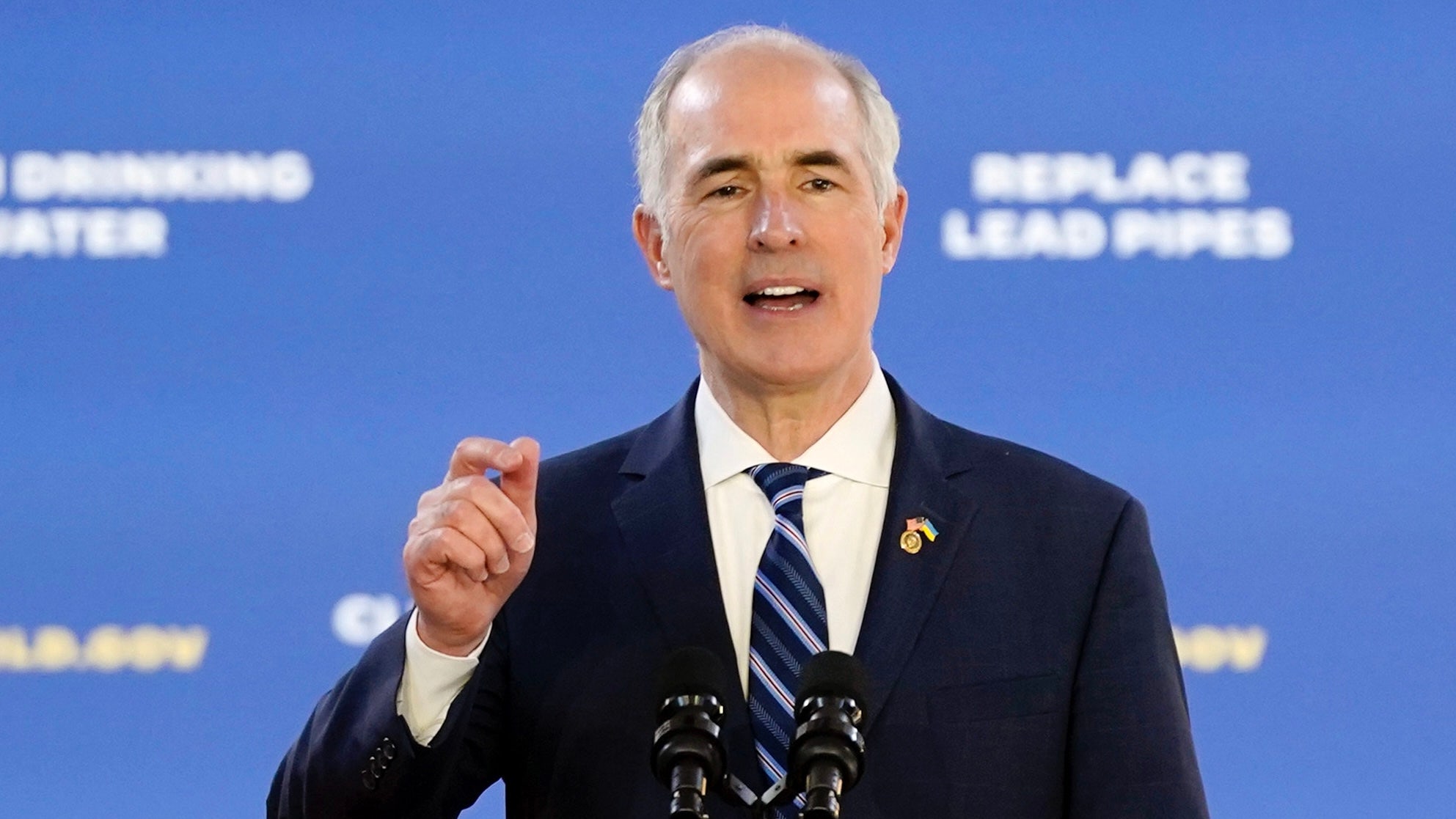
Senator Bob Casey, D-Pa., is fighting against what he calls corporate greedflation. FILE: Casey speaks before President Joe Biden about his infrastructure agenda while announcing funding to upgrade Philadelphia’s water facilities and replace lead pipes, Friday, Feb. 3, 2023, at Belmont Water Treatment Center in Philadelphia. (AP Photo/Patrick Semansky, File)
I have made sure that Pennsylvania is able to take advantage of opportunities to bring jobs to our communities. I fought against an administration plan and saved 1,200 jobs for energy workers at Cleveland Cliffs in Butler.
Now, I’m fighting for lower costs for Pennsylvania families by taking on corporate greed that has hurt working families. There is no question families are seeing higher prices at the grocery store. Big companies have been getting away with increasing the price of food and household items while raking in record profits.
For two years during the pandemic, corporate profits were up 75% – that’s five times the rate of inflation. I call it greedflation, and I’m fighting back with legislation to crack down on corporate price gouging and go after companies that deceptively shrink their products at the grocery store, making families pay more for less product.
CLICK HERE FOR MORE FOX NEWS OPINION
I am also fighting to secure the border, a critical part of keeping our country safe. I have voted more than 25 times to invest in border security, like more border patrol agents, additional fencing, and screening technology to detect fentanyl in vehicles — unlike my opponent, who opposed a bipartisan border deal that was supported by border patrol and called one of the toughest immigration laws in modern history.
I also helped pass the FEND Off Fentanyl Act this year, which hits fentanyl traffickers where it hurts — their bottom line. And I worked with Republicans to pass the bipartisan STOP Act to combat the smuggling of fentanyl and other drugs from China.
While I have been fighting for Pennsylvania, my opponent, David McCormick, has been fighting for himself and his wealthy friends. He said he lived in Pennsylvania, when in reality he was taking a private jet from Connecticut for multiple campaign events. He didn’t even vote in Pennsylvania for 15 years.
As the CEO of Bridgewater, my opponent invested millions in Chinese military companies that produced fighter jets, bombers, aircraft carriers, and missiles. He invested in China’s largest producer of fentanyl, when we know most of the fentanyl that is trafficked in Pennsylvania originates in China.
I have made sure that Pennsylvania is able to take advantage of opportunities to bring jobs to our communities. I fought against an administration plan and saved 1,200 jobs for energy workers at Cleveland Cliffs in Butler.
While he was enriching himself, he was hurting Pennsylvanians. He shorted Pennsylvania companies like U.S. Steel and bet against their success. He laid off hundreds of workers in Pittsburgh and even helped teach other companies how to outsource jobs. The contrast between my opponent and I on women’s rights is clear. My opponent called overturning Roe v. Wade a “huge victory” and said that it made him “very, very happy.” I support restoring Roe v. Wade.
“All public service is a trust, given in faith and accepted in honor.” Those are the words inscribed on the Finance Building in Harrisburg where I started my work in public service, and the words that still guide me today. The people of Pennsylvania have an important choice to make between a proven fighter for the middle class and a Connecticut hedge fund executive who has only ever fought for himself, his own bottom line, and the billionaires funding his campaign. I will continue to work to lower costs, create jobs, and bring investments to Pennsylvania communities. I respectfully ask for your vote on November 5th.
Read the full article from Here


Scott A. Harrison, Ed.D., M.B.A., is a senior advisor at The Harrison Group, a consultancy based in Yarmouth.
Maine has long valued local control in education. That tradition reflects an important belief that communities should have a strong voice in shaping their schools. But local control should not prevent us from asking a harder question: Are there core functions that could be delivered more effectively through a single statewide framework?
One of the most important is educator evaluation and professional growth. Maine law already recognizes the importance of this work. Under Title 20-A, Chapter 508 (Educator Effectiveness), districts must implement performance evaluation and professional
growth systems that evaluate educators, assign effectiveness ratings and support
professional growth.
The law further requires superintendents to use those ratings to inform key human capital decisions, including recruitment, hiring, induction, mentoring, professional development, compensation, assignment and dismissal. In short, educator evaluation is not intended to be a compliance exercise. It is intended to be a primary lever for the continual improvement of teaching and learning.
In 2012, LD 1858 sought to advance that vision by giving districts broad flexibility to design their own systems. Districts could choose instructional frameworks, establish measures of effectiveness and determine how evaluators would be trained and calibrated. The goal was to balance local autonomy with professional accountability.
More than a decade later, however, the evidence suggests that flexibility alone has not produced consistent results.
My research involving 130 educators across four Maine school districts found only modest perceptions of performance evaluation and professional growth systems’ effectiveness.
On a four-point scale, average ratings ranged from 2.48 to 2.99. While educators generally agreed that districts provide individualized growth plans and can differentiate levels of instructional effectiveness, they rated several critical implementation areas notably lower, including instructional coaching, evaluator training, feedback quality, evaluator calibration and the use of evaluation data to inform professional learning and personnel decisions.
Although the sample was relatively small, the findings closely mirror what I have observed while working with predominantly rural Maine districts over the past decade.
The qualitative findings were equally revealing. Teachers and administrators described systems that are often cumbersome, inconsistently implemented and difficult to sustain. Educators reported spending significant time developing goals and documenting evidence, while administrators acknowledged that competing priorities frequently reduce evaluation to a compliance exercise rather than a meaningful opportunity for growth.
Participants cited insufficient training, inconsistent expectations, limited coaching support and weak connections between evaluation results and professional learning. Perhaps most significant, though not surprising given the realities of today’s schools, the primary obstacle appears to be not commitment, but capacity — the time, expertise and tools required to implement these complex systems with fidelity.
Designing and sustaining high-quality evaluation systems requires expertise in instructional leadership, observation and feedback, adult learning, professional development, data use and evaluator calibration. While some districts have built this capacity, many — particularly smaller and rural systems — have not. Even where expertise exists, time remains a major barrier.
Effective evaluation depends on regular observation, coaching, feedback and calibration. Yet for principals balancing instructional leadership with the daily demands of running a school, carrying out these responsibilities consistently can be extraordinarily difficult.
As a result, Maine has effectively asked more than 250 districts to independently build and maintain highly complex educator effectiveness systems. The outcome is predictable: uneven quality and implementation, and variable impact on teaching and learning.
This raises an important policy question: Should every district continue to design, train, calibrate and maintain its own evaluation system, or would educators and students be better served by a common statewide framework supported by regional and state expertise?
A statewide approach would not eliminate local control. Districts would continue to make decisions about hiring, staffing, curriculum, budgeting and school improvement priorities. Instead, the state would provide shared infrastructure: a common instructional and evaluation framework, validated tools, evaluator training, calibration supports, professional learning resources and implementation assistance.
The benefits extend beyond evaluation. A common framework would create stronger alignment across Maine’s educator pipeline. Colleges and universities could align coursework, clinical experiences and assessments to the exact same standards used in schools while sharing responsibility for educator success beyond initial placement.
Preparation programs, districts and the state would become partners in a continuous system of educator development, creating mutual accountability for results and a stronger return on Maine’s investment in teacher preparation.
Such alignment matters. As systems thinker Peter Senge observed, people working within the same system tend to produce similar results. If we want more consistent outcomes for students, we must pay closer attention to the systems shaping educator practice.
A statewide approach would not eliminate local control. Districts would continue to make decisions about hiring, staffing, curriculum, budgeting and school improvement priorities.
A common framework would establish a shared language and clearer expectations throughout the career continuum. It would also make continuous improvement easier. Rather than asking hundreds of districts to independently revise complex systems, the state could evaluate implementation, refine practices, share lessons learned and respond to emerging research. Educators have experienced too many short-lived initiatives that consume considerable time and effort before fading away.
A coherent statewide system would provide greater stability and more meaningful long-term improvement. The question is not whether local control matters. It does. The question is whether every district should be expected to independently build and sustain complex systems that require specialized expertise, significant resources and ongoing refinement.
If Maine is serious about improving outcomes for students, it should rethink which functions are best managed locally and which are better supported through statewide infrastructure. Educator effectiveness is one example. There are likely others.
In a previous op-ed here, I argued that Maine should reconsider whether teacher compensation is best negotiated district by district. The same question applies here. When critical human capital systems are essential to student success, a coherent statewide framework may be better positioned to advance equity, efficiency and effectiveness while preserving local decision-making where it matters most.
The goal is not less local control, but a smarter balance between local autonomy and statewide support — one that strengthens schools and improves outcomes for every student, regardless of geography.
Massachusetts
Fisherman reels in white shark off Massachusetts, then snags the hook from its toothy mouth

BILLERICA, Mass. (AP) — Elliot Sudal didn’t need a bigger boat, but he did need to find a way to get a hook out of a shark’s mouth.
Sudal, a veteran angler and boat captain, reeled in the nearly nine-foot shark — also commonly known as a great white shark or a great white — on June 7 on Nantucket. White sharks are a protected species in the U.S. and must be released immediately when accidentally caught.
That presents a nasty problem for a fisherman because the white shark is a formidable apex predator best known for the 1975 movie Jaws, in which Roy Scheider utters the famous line “You’re gonna need a bigger boat” upon seeing the big fish. Sudal, who caught the shark while fishing from shore, decided to use his encounter to demonstrate how to respond to such a situation.
Sudal posted a video of himself removing the hook to his social media accounts. In the video, Sudal climbs onto the back of the shark, secures the fish in the surf, and removes the hook from its mouth. By the end of the short video, the shark is back in the water.
White sharks typically have about 300 teeth arranged into five rows, so speed was key.
“Hooks out and back on her way in 15 seconds, not sure how to do it better,” Sudal wrote in an Instagram post that included a video of the shark release.
Sudal is no stranger to sharks, and has caught and tagged hundreds of them over the years. He said in a social media post that this month’s encounter with a white shark was the first time he has ever caught one of them in more than a decade of the work.
Sudal’s practices have sometimes attracted the attention of the National Oceanic and Atmospheric Association, such as in 2017, when the agency investigated his handling of a smalltooth sawfish, an endangered species, in Florida. The agency said in 2018 that it sent Sudal a letter “informing him of the Endangered Species Act issues and the safe handling protocol for sawfish.”
White sharks are not listed under the federal Endangered Species Act, but are subject to special federal protections. The International Union for Conservation of Nature considers them vulnerable globally.
Sightings of white sharks off New England have ticked up in recent years, and some scientists have pinned that to the greater availability of the seals that they prey on. Dangerous encounters between white sharks and humans are extremely rare, and only a few dozen fatal white shark bites on people have ever been recorded.
___
Whittle reported from Portland, Maine.
Copyright 2026 The Associated Press. All rights reserved.

SALEM, N.H. — A Lowell High School freshman was identified on Friday as the victim of a fatal shooting in Salem, where authorities say the 15‑year‑old was found dead outside a home during the pre-dawn hours.
New Hampshire Attorney General John Formella’s office said in a press release that police responding to a 911 call discovered the teen, identified as Wichai Saksene, just outside the residence on Orchard Terrace.
An autopsy later determined he died from a single gunshot wound to the chest, and his death has been ruled a homicide.
Authorities said the circumstances remain under active investigation but noted there is no known threat to the public, as all involved parties have been identified.
In a message that began “sad news for your awareness,” Lowell Public Schools Superintendent Liam Skinner told School Committee members that Saksene was a Lowell High freshman and former student of Stoklosa Middle School and Lincoln Elementary School.
He added that central office staff are assisting Lowell High with communications to staff and families and that Student Support Services has activated a critical incident team to be at the high school on Monday.
The Salem Police Department stated in a social media post that they are working with the New Hampshire State Police Major Crimes Unit and Formella’s office to investigate the shooting.
Follow Aaron Curtis on X @aselahcurtis, or on Bluesky @aaronscurtis.bsky.social.
-

 Kentucky4 minutes ago
Opinion – Caleb Franz: Cassiuis Marcellus Clay – Kentucky's original free speech champion
-

 Louisiana7 minutes ago
Talent, fitness honors awarded on Preliminary Night 2 of Miss Louisiana
-

 Maine12 minutes ago
Local control is holding education back in Maine | Opinion
-

 Maryland19 minutes ago
Maryland Lottery Mega Millions, Pick 3 results for June 19, 2026
-

 Michigan22 minutes ago
Defenseman Cam Reid commits to Michigan
-

 Massachusetts27 minutes ago
Fisherman reels in white shark off Massachusetts, then snags the hook from its toothy mouth
-

 Minnesota34 minutes ago
Lynx rally with defense to down Golden State for 11th win in 12 games
-

 Mississippi37 minutes ago
Mississippi Lottery Mississippi Match 5, Cash 3 results for June 19, 2026

