Northeast
'Heroic' firefighters use rare rope drill to rescue 3 people from burning NYC building

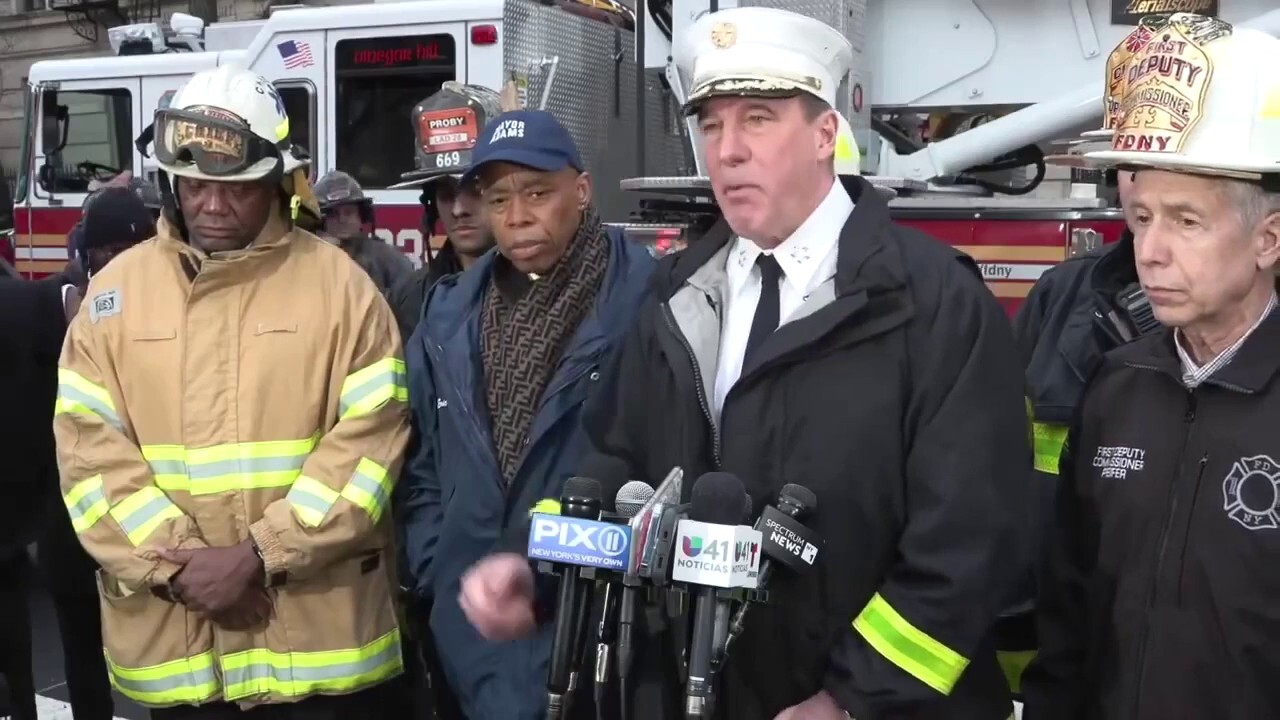
The FDNY has released heart-stopping footage of its firefighters using a rope in a rarely used maneuver to dramatically rescue three people from a burning New York City building on Friday. The fire left one person dead and 17 others injured.
The incredible footage shows a courageous fireman dangling on the rope against the side of the Harlem apartment building with a rescued resident in his arms as smoke billows up into the air.
In an aerial scene captured in night vision mode, firefighters can be seen setting up the daring rescue effort atop the six-story building at 2 St. Nicholas Place which involved firefighters grabbing hold of one end of the rope as another crew member slides down the rope to a window to grab a despaired resident.
“Our members attach themselves to a rope and then another member goes on to the rope and goes off the side of the building, goes down to the window and grabs the person that is trapped by the fire, FDNY Chief of Operations John Hodgens said during a press conference at the scene flanked by his firefighters and New York City Mayor Eric Adams.
Incredible video has captured the moment courageous FDNY firefighters rescue three people from a fast-moving residential fire in New York City on Friday. (FDNY)
E-BIKE BATTERY EXPLODES, BURNS OUT NYC STORE: VIDEO
“This happened three times at this fire. Three firefighters performed this evolution. We usually have one of these a year or two. This was three at one fire, a very heroic action,” Hodgens said.
Hodgens said the fire was “very challenging fire” and that his team were on the scene within three and a half minutes of receiving a 911 call for the inferno which broke out at around 2:15 p.m.
They found three unconscious victims on the floor of the upper hallways after beating back some of the flames while three more residents were at the window screaming for help.
The three residents had fled to the window as the hallways and stairways were blocked by the smoke and flames only to find out that there was no fire escape.
Firefighters had difficulty reaching the trio and then decided to deploy the rescue method Hodgens described as “the life-saving rope evolution.”
Firefighter Jason Lopez, centered, who was lowered down to carry out the daring rescue. New York City Mayor Eric Adams is pictured on the far left. (Michael Appleton/Mayoral Photography Office)
DEMOCRATS’ FAVORITE GREEN MODE OF TRANSPORTATION IS CAUSING EXPLOSIONS, DEATH
Firefighter Jason Lopez said his team practices the drill twice a week in case they need to use the life-saving measure.
“We always train like the real thing so when the real thing happens, we know what we’re doing,” Lopez said. He thanked his colleague who was on the rooftop clinging onto the rope, saying “I trust him with my life.”
Witnesses told Fox 5 they saw one person jump out of the burning residential building. It is unclear if this was the person who died.
“They were on the window sill, and they were trying to escape, but it’s all the way on the top floor … they were hanging onto the window. I guess they couldn’t hang on for long, and they fell to the ground,” witness Michelle Paradis told FOX 5 NY.
The FDNY has not confirmed the cause of the fire yet, but FOX 5 NY reports seeing e-bikes and their batteries being pulled from the building. E-bike batteries have been responsible for a surge in fires in the city over the past few years. E-bikes sparked 267 fires which caused 18 deaths and 150 injuries in the city in 2023, according to the FDNY.
Blown out windows of the Harlem building that caught fire on Friday and where the rescue took place. (Michael Appleton/Mayoral Photography Office)
Resident Regina Shaw, who lives on the top floor, told the New York Post that she said she and her son grabbed their dogs and ran down the fire escape when their fire alarms began going off.
“My three firearm alarms went off and then all the alarms in the building,” the 58-year-old retired train operator said.
“There was smoke coming out of the windows. Smoke everywhere. I heard people screaming, just screaming.”
Read the full article from Here

Rhode Island
New bilingual school blocked from opening under R.I.’s new charter school ban – The Boston Globe

LaPlante and the school’s board chair, Carol Aguasvivas, had pleaded with lawmakers not to include the bilingual school in the three-year charter school ban, since it had already received an initial approval from the state in January. They met with McKee and asked him to veto it, citing his longstanding support for charter schools. He signed the bill the next day.
“I didn’t think that we were going to have to fight this hard for dual language,” Aguasvivas said. In the workforce, she noted, “Everyone wants you to be bilingual. But how are we going to prepare these children for the future when we’re not giving them the basics to be able to do that?”
The school leaders said they are exploring their options, including litigation, now that it’s been blocked from opening.
De La Comunidad was planning to open in Providence with 140 students in kindergarten through second grade to start, and then expand over nine years into a K-12 school with more than 600 students from Providence, Pawtucket, and Cranston.
The school would have taught both native English and Spanish speakers, with classes taking place in both languages throughout the school day. The goal is for students to become fluent in both languages.
“The only population that’s being affected here are the children,” Aguasvivas said. “Because the school was definitely going to make a difference. And the doors were shut on us before we could even open.”
The school had the backing of state education commissioner Angélica Infante-Green, and its leaders argued it was meeting the needs of Rhode Island’s exploding population of multilingual learners, the term for students learning English as a Second Language.
“We are responsible to going back to those families and telling them that they no longer have a choice,” Aguasvivas said.
The fierce opposition to De La Comunidad was not necessarily about the school itself, or any of its planned bilingual programming. Officials in Cranston and Pawtucket argued another charter school serving their cities would pull even more resources from strained public school budgets. Both cities sued to try and block the school from opening after it received preliminary state approval. (The lawsuit is still pending.)
The teachers unions that pushed for the charter ban also did not cite any specific issues with De La Comunidad’s curriculum or programming, but said local school districts simply cannot afford to send any more money to charter schools.
“They’re laying off large numbers of teachers in some districts,” said Maribeth Calabro, the president of the Rhode Island Federation of Teachers and Health Professionals, one of two major unions. “It’s time for a thoughtful pause of charter expansion, period, full stop.”
“The dual language is absolutely not the issue,” Calabro added.
Tuition at charter schools is paid by the school district where the child lives.
Aguasvivas said she understood the need for a charter pause, but said it should not have applied to a school that was already in the pipeline to open.
“De La Comunidad Bilingual School was not going to be the one school that was going to take away so much funding that it was going to cripple the entire system,” she said.
Brand new charter schools require two approvals by the Rhode Island Council on Elementary and Secondary Education. After an application and hearing process, the preliminary approval allows them to prepare to open, including getting a lease for premises and posting jobs. Once the school is ready to launch, they go back for final approval.
Existing charter schools that are expanding require only one vote of the council, which is why the Greene School in West Greenwich — which got a favorable vote from the council on the same day as De La Comunidad — will be allowed to move forward with its plans to open a new middle school during the moratorium.
Aguasvivas and LaPlante noted that most children in Rhode Island don’t have access to dual language programs. In the three communities they planned to serve, Providence has dual language programming available to about 10 percent of the total school population, Cranston doesn’t have any, and Pawtucket has only a limited program.
“District schools should have dual language programs,” LaPlante said. “But we’re at 30 years of the same conversation, and they’re not there.”
Cranston Superintendent Jeannine Nota-Masse told the Globe the district doesn’t have the money to start a program, and charter schools are making it harder.
“Frankly, I would love to start a dual language program,” Nota-Masse said. “I have to cut programs, and I have to cut staff, because of the financial problems municipal districts have. I don’t have the program because I can’t afford it.”
She said Cranston lost $8.7 million last school year to charters.
“It’s not about that school in particular,” Nota-Masse said of De La Comunidad. “No matter the charter school, the way the funding formula works, every single opportunity a charter has to pull kids away from Cranston, I have to be concerned.”
No families were officially enrolled in De La Comunidad yet, as it was slated to be part of Rhode Island’s annual charter school lottery in the spring. But many parents had expressed interest, Aguasvivas said.
One of them was Marlena Stachowiak, also a city councilor in Pawtucket, who was hoping to sign her youngest son Truman up for kindergarten at De La Comunidad next fall.
“It was definitely something we were looking forward to,” she told the Globe. She hoped to enroll her two older children once the school expanded to middle and high school.
One of her sons, 9-year-old Braelyn, had been enrolled in a dual language program in Pawtucket from kindergarten until second grade at Nathanael Greene Elementary School, but he lost access when the program was cut and moved to Baldwin Elementary, she said.
The family only speaks English at home, but Braelyn was learning Spanish and using it around friends and neighbors.
“It abruptly stopped,” Stachowiak said. “He was really enjoying it. It’s been over two years and it’s slipping away,” she said.
Pawtucket Superintendent Randy Buck said the reason the district could not maintain dual language programs at both schools was because of staffing. There are not enough teachers certified in bilingual/dual language to meet the demand, he said.
Infante-Green, an enthusiastic supporter of dual language programs who recommended the approval of De La Comunidad’s application last year, did not respond to requests for comment.
When her department was considering the application, it received 1,778 letters of support, 99 percent of which were in favor of the school, according to RIDE.
The school had been approved for startup funding from the state and other grants worth about $1 million that it now must forfeit, LaPlante said.
Another $70,000 in funds came from the Rhode Island Education Collective, an education nonprofit where LaPlante also works.
Victor Capellan, the founder and CEO of the collective, said the group’s funding comes from local and national backers including the Papitto Opportunity Connection, Bank Newport, Centreville Bank, The City Fund, Bloomberg Philanthropies, and individual donors.
McKee had years ago vowed to veto a charter moratorium. After signing it into law last month, he told the Globe the situation had changed; public school enrollment is dropping, causing serious funding issues.
He confirmed that he met with De La Comunidad leaders the day before he signed the bill, but they didn’t change his mind.
“If they feel strongly that they have support in the General Assembly, they should go back in the next session,” McKee said. “Go deliver your case.”
Steph Machado can be reached at steph.machado@globe.com. Follow her @StephMachado.

Mountain bike enthusiasts have been working for years on an ambitious 485-mile multi-use trail known as the Velomont that will span the length of Vermont.
When finished, the collaborative project will knit together existing trail networks, connect 27 communities, and include 30 new huts and five downtown hostels for overnight stays.
New trail construction is finally ramping up after years spent on permits, plans and public input. And organizers say they’re focused on ensuring the Velomont is accessible for everyone.
“For us, it’s not a huge lift to just be mindful when we’re trying to build trail or improve trail to think about the adaptive rider,” said Angus McCusker, the Velomont trail director with the nonprofit Vermont Huts and Trails.
McCusker is referring to the growing number of athletes with disabilities who mountain bike with specially designed equipment.
“The challenge,” he said, “is we’re connecting to existing trail networks that were never intended for adaptive bikes. So, where we can, we’re trying to do adaptive assessments.”
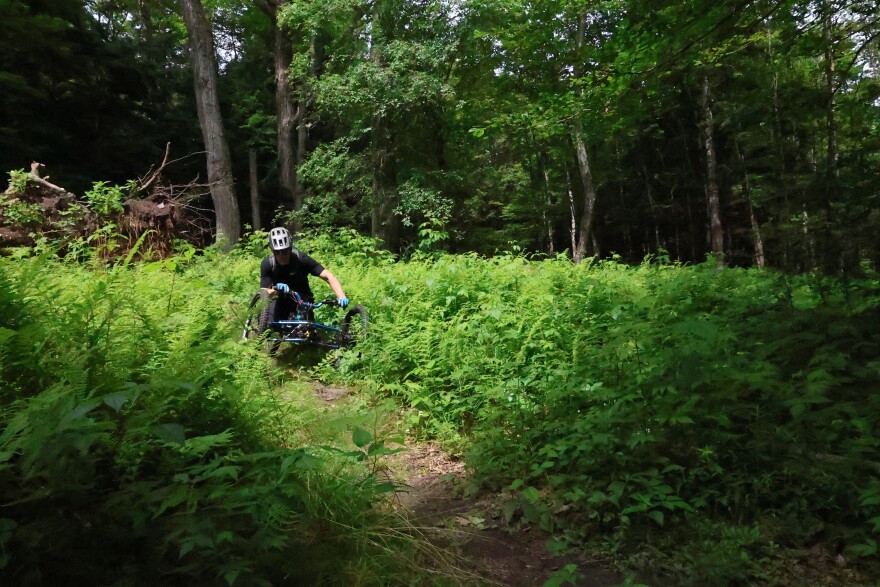
Louis Arevalo of Essex Junction is one of several adaptive athletes helping with that, most recently on some slightly overgrown trails in the Randolph Town Forest.
Zoe McDonald
/
Vermont Public
Arevalo was paralyzed in a skiing accident six years ago. An avid mountain biker before, he now rides a recumbent-style three wheeler that sits low to the ground. Arevalo pedals and steers with his arms, and gets a boost from an electric motor.
“Once you realize what these bikes are capable (of) or this equipment actually opens up, it kind of blows your mind,” he said.
But adaptive rigs like Arevalo’s are wider and heavier than regular mountain bikes, and not all trails are user-friendly.

Zoe McDonald
/
Vermont Public

Zoe McDonald
/
Vermont Public
Nick Bennette, who tested a different type of adaptive bike that day, got hung up on several tight turns.
Bennette is executive director of the Vermont Mountain Bike Association, another nonprofit spearheading efforts around the Velomont. He and others involved in the assessment have been taking detailed notes on ways to make the trails more accessible.
“Just scalloping out a bit of material on the outside of that corner,” said Bennette, pointing to the area the bike got caught. “That will allow adaptive bikes to make that corner without really changing the way the trail rides.”
This type of work is not just happening on the trails. Organizers are also trying to reduce barriers at overnight accommodations along the network.

Zoe McDonald
/
Vermont Public
This summer, contractors are turning an old office building near the trail in downtown Randolph into an ADA accessible hostel. And two remote huts along the trail in Stratton and Chittenden will have locked sheds with off-road wheelchairs so bikers don’t have to haul their own.
At the Chittenden Brook Hut, McCusker highlighted a new ramp and wider driveway.
“So if you’re an adaptive rider, you can imagine rolling right up here and you can transfer to your chair that’s available here, and then roll down the ramp and go down to the fireplace, to the privy, to make your meal,” he said.

Zoe McDonald
/
Vermont Public
Louis Arevalo stayed at the hut last summer with other adaptive riders — his first camping trip since his accident.
“It was really refreshing to have easy access to a beautifully built hut that was easy to navigate, and then have these world-class trails right out the door,” he said. “And with these Velomont trails, I can actually plan a hut-to-hut trip with other people.”
Jeff Alexander is counting on it. He’s director of strategic partnerships with Vermont Adaptive Ski and Sports, a nonprofit that helps people with disabilities access outdoor recreation.
An economic impact analysis the group commissioned estimates their programming generated more than $10 million last year.
“So the adaptive community has money, they travel, they want to travel and they want to play with everybody,” Alexander said. “We just need to level the playing field so that everyone can play together.”
Zoe Mcdonald
/
Vermont Public

You made it time. If you want to look a little longer, just scroll back up and press “Continue.”
Look up.
Before you commute home to suburbs like Tarrytown and Larchmont, or race toward the next stop on your tourist map, take a minute.
Look up to see the stars.
One hundred and twenty-five feet above you are 2,500 stars and six signs of the zodiac along the ecliptic, a line that represents the path of the sun across the sky:
The signs are joined by a few others: Orion, Pegasus, Triangulum and, in the center of it all, Musca Borealis (the Northern fly, or sometimes called Apis, the bee). The Milky Way streaks across the ceiling in the opposite direction. The whole thing is ringed by intricate plaster moldings along the clerestory windows. Fifty-nine of the stars twinkle.
Who says there isn’t magic in Midtown?
The original early 1900s plan for the ceiling was to build a massive skylight so commuters could look up at the actual stars:
But time and money were short, so the architects asked the artist Paul Helleu to design a version of the sky on the ceiling instead. Helleu took inspiration from star atlases from the 1600s. His main resource was the Uranometria from 1603, a lushly illustrated volume that was the first detailed cataloging of individual stars, their positions and brightness. See how similar the figures are. This is Aries:
Here’s Taurus, the bull:
A heart balloon — one of several — had floated up the day we took this photograph, nestling between Orion’s club and Taurus’s horn (maybe an earthly sign that this heavenly hunt might finally resolve).
Converting the flat drawings of a spherical sky re-projected onto a semi-cylindrical vaulted ceiling would have been no easy task. The design work was done by a famous scenic designer and muralist, James Monroe Hewlett, and was overseen by the Columbia astronomy professor Harold Jacoby, who in 1910 assured a panicked public that Halley’s comet would not hit Earth.
Dozens of painters got to work. The terminal opened at midnight on Feb. 2, 1913. The New York Central Railroad boasted “that many school children will go to the Grand Central Terminal to study this representation of the heavens.”
Two weeks later, a commuter from New Rochelle (and a hobby astronomer) looked up at the ceiling and realized that west was east and east was west and the sky was not, actually, in a proper arrangement. Only Orion was shown in the “correct” orientation. He wrote a “wrathful” letter to the station. As The New York Times reported in 1913, officials at Grand Central “did not deny the charge that things were a bit mixed, but held that it was a pretty good ceiling for all that.”
How this happened is still a matter of debate, given Professor Jacoby’s astronomical blessing.
Michael Allison, a former NASA planetary scientist at the Goddard Institute for Space Studies (and a former adjunct in the Columbia astronomy and astrophysics department), met me last month at the great clock under the ceiling to explain his theory.
“I’ve stared at the ceiling I don’t know how many hours,” he said. “I keep hoping I can discover one more thing.”
The liberties taken, Mr. Allison said, like re-sizing the constellations to fit the space and flipping Orion (in relation to the rest), were carefully done. Ultimately, a good marriage of art and science. He thinks Jacoby was a victim of big project bureaucracy, that it was all a mixup.
Jacoby probably expected the design he approved to be projected overhead, where the result would match the plans if you held them above you. The painters put them on the floor instead. Hence, the flip.
But this “heavenly view” — the stars as if they could be seen from above, looking down — may not be a bad view at all.
“There are just so many bad things happening in the world now that I think the sky offers a perspective that can lift us above that,” Mr. Allison said.
For Deirdre Newman, the great-granddaughter of the muralist Hewlett, who painted the ceiling, the imperfection “is what art is.”
Ms. Newman, it turns out, is also a painter of murals and ceilings. But these days, if she has to flip an image, she just hits a button on the projector.
“Anytime I make a mistake painting, I’m like, this proves that it’s art,” she said. “It is not perfection, and it shouldn’t be — it would be a sad thing if it was.”
The stories that we’ve given to the stars over millenniums, some of the most retold tales in history, are hardly orderly — stories of fate, violence, betrayal, revenge, sex and punishment. Cancer helps Hera in pinching a rival’s foot. Orion, son of Poseidon, is placed in the stars by Zeus, locked in an eternal hunt. The two fish of Pisces (Aphrodite and Eros) are linked together to escape the monster-of-all-monsters, Typhon.
Or the stories are totally different if you were Babylonian or Egyptian, Greek or Roman. Today, the stars mean something else again to a devoted user of the horoscope app Co-Star, seeking reassurance after a breakup. And to a commuter standing in Grand Central, looking up while waiting for the train, the stars might just be a momentary diversion, a decorative way to pass the time. Or more.
Take what you want. Take what you need.
***
By the 1940s, the ceiling had fallen into disrepair, so they painted a whole new one on four-foot-by-eight-foot asbestos sheets over the old one. This is the version that exists today. Eventually that second ceiling, too, grew dark with grime and had to be cleaned from 1996 to 1998. The difference was stark. As you were zooming in, you may have noticed a little dark square by Cancer. They deliberately left one bit of the uncleaned ceiling here:
The best time to take all of it in — the ceiling, and the majesty of the station — might just be coming this weekend. The setting sun will line up with Manhattan’s street grid and should (pending clouds) bathe the terminal in a beautiful golden glow Saturday at 8:19 p.m. and Sunday at 8:20 p.m. I plan to be on the east balcony looking west on Sunday for that moment.
See you there.
How we took the photograph
To generate a high-resolution panorama of the ceiling, The Times captured 232 close-up images. We then used software to stitch these photos into an equirectangular projection, to approximate the curve of the ceiling. We also developed custom computer vision software to ensure consistent color blending across varying lighting conditions. To optimize for display efficiency and clarity during navigation, the image was then re-projected into the shape of a cube. We think it’s still a pretty good picture for all that.
This is an installment in our series of experiments on art and attention. If you liked this one, you may like these past exercises: a finished, unfinished portrait; a sudden rain over a bridge; a unicorn tapestry; some buckets from Home Depot; and a Whistler painting.
Sign up to be notified when new installments are published here. And let us know how this exercise made you feel in the comments.
-

 Rhode Island3 minutes ago
New bilingual school blocked from opening under R.I.’s new charter school ban – The Boston Globe
-

 South-Carolina6 minutes ago
What triggers a heat advisory in South Carolina?
-

 South Dakota11 minutes ago
Water hampers growth near Sioux Falls but solution near
-
Tennessee18 minutes ago
Tennessee reduced training in IV placement in new lethal injection protocol
-
 Texas20 minutes ago
Texas abortion stories fail to sway Congress post-Dobbs
-

 Utah26 minutes ago
Chicago breaks Utah’s 10-game unbeaten streak – Equalizer Soccer
-
Vermont33 minutes ago
The Velomont bike trail is getting more accessible – one trail at a time
-
.jpg?w=400&resize=400,240&ssl=1 "On Virginia’s Crooked Road, the Hills Are Alive—With Bluegrass, Old-Time, and Country Jams")
.jpg?w=80&resize=80,80&ssl=1 "On Virginia’s Crooked Road, the Hills Are Alive—With Bluegrass, Old-Time, and Country Jams") Virginia36 minutes ago
Virginia36 minutes agoOn Virginia’s Crooked Road, the Hills Are Alive—With Bluegrass, Old-Time, and Country Jams


