Northeast
Here's what you need to know when polls close in battleground states on Election Day

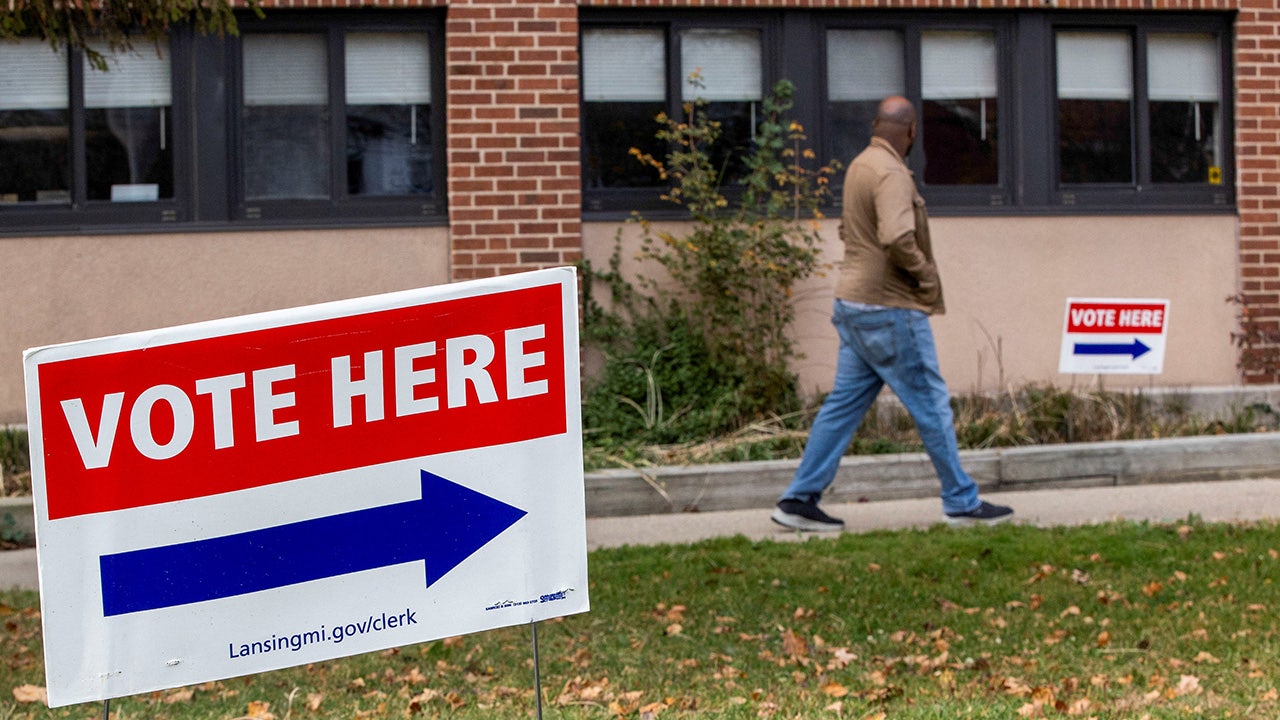
When the polls officially open across the country on Election Day, residents who have yet to cast their votes in the seven key swing states are allowed different times when they can visit a polling place.
Each swing state also has a different process for when they are allowed to start counting votes, whether that be prior to or on Election Day, a major factor in the time it takes for results to be finalized.
Arizona
The polls will open at 6 a.m. MST on Tuesday in the Grand Canyon State. Voters will have until 7 p.m. to cast their ballots, according to the Arizona secretary of state.
REPUBLICANS CUT INTO DEM VOTER REGISTRATION ADVANTAGE IN CRUCIAL SWING STATE AS EARLY VOTE WRAPS UP
Ballots are counted at the Maricopa County Recorder’s Office in Phoenix on Oct. 23. (Matt York)
Ballots cast before Election Day can immediately be counted by election officials upon when they are received in an effort to help speed up the voting process.
Georgia
Polls open at 7 a.m. and close at 7 p.m. EST. However, those in line by 7 p.m. can still cast their ballots.
Election officials can begin processing ballots during the state’s early voting period.
Nevada
Voters in Nevada will have from 7 a.m. to 7 p.m. to cast their ballots on Election Day.
THE KEY TO VICTORY IN BATTLEGROUND STATES COULD LIE IN THE ‘MARGINS,’ NATIONAL REVIEW EDITOR-IN-CHIEF SAYS
Nevada election officials can start counting ballots 15 days before Election Day. However, ballots postmarked on Election Day can be counted four days after the election on Nov. 5, which could draw out the state’s voting process.
Voters cast their ballots during the last day of early voting in Gwinnett County, Ga., on Nov. 1, 2024. (Nathan Posner/Anadolu)
North Carolina
Voters in the Old North State can visit polling places from 6:30 a.m. to 7:30 p.m. EST on Election Day.
Election officials cannot start officially tabulating ballots until Nov. 5.
The State Board of Elections anticipates that about 98% of all ballots cast in the election will be counted by the end of election night.
Pennsylvania
Polls are open from 7 a.m. to 8 p.m. EST. However, those in line at the time the polls close will still be allowed to cast their votes.
Officials cannot begin counting ballots until 7 a.m. on Election Day, which could result in several days of vote counting. In 2020, it took several days for Pennsylvania to call the state for President Biden.
Michigan
Voters in Michigan can hit the polls from 7 a.m. to 8 p.m. EST on Election Day.
A person arrives to cast their early ballot on the last day of early voting in Michigan at a polling station in Lansing on Nov. 3, 2024. (Carlos Osorio)
Election officials can start tabulating mail ballots on Oct. 28. Election workers cannot start counting ballots until 7 a.m. on Election Day.
Wisconsin
The polls open at 7 a.m. and close at 8 p.m. CST.
Election officials cannot start counting ballots until Election Day.
Read the full article from Here


PORTLAND (WGME) — It’s now a three-way race for the Blaine House.
After more than a week, the ranked choice tabulation was run very early Friday morning, with Hannah Pingree declared the winner for the Democrats, and Bobby Charles the winner for Republicans.
Democratic candidate for governor Hannah Pingree (WGME)
Moving forward, Independent Rick Bennett is also in the governor’s race.
As a moderate, Bennett could draw votes from both parties.
If Friday is any indication, the next four and a half months will be contentious, with the three candidates pointing fingers at each other.
Charles criticized ranked choice voting and says if elected, he will end it.
“Maine voters deserve to know the results of their elections on the day that they cast their vote,” Charles said.
Pingree disagrees, saying election officials made sure every vote counted.
“Maine’s election officials did their job, and they did it right,” Pingree said.
The two nominees traded jabs Friday.
“The Democrats have just nominated an insider,” Charles said. “A deep Augusta insider.”

Republican candidate for governor Bobby Charles (WGME)
It was Charles’ own primary opponents who labeled him a Washington insider.
“I will say it’s ironic that Bobby Charles is talking about positive change,” Pingree said.
Then there’s State Senator and former head of the Maine Republican Party Rick Bennett, running as an Independent.
Charles calls him a Democrat.
Pingree calls him a Republican.
“I think the choice here is clear,” Bennett said. “We have Hannah Pingree, who I respect, but she’s a continuation of the Mills administration. She was in charge of housing policy. We still have a housing crisis. Bobby Charles, as you know, has spent most of his life in the bureaucracy in Washington and then lobbying for corporate interests in Washington. Maine people are tired of a political system that puts the parties first and results second.”
Independent candidate for governor Rick Bennett (WGME)
Charles says he wants to bring integrity to the State House.
“You either want change, integrity, lower taxes, the drug traffickers out of here, the needles out of here, the energy costs down,” Charles said. “No more fraud. I am sick and tired of all the things we’re putting up with. In my view, a betrayal of trust and a betrayal of integrity.”
Pingree says Congressional Republicans and the President are the ones making life difficult for Maine families.
“This is about healthcare that we can afford, whether you’re in a rural hospital in Houlton or urgent care in Portland. It is about Maine’s potential,” Pingree said. “A real future for our kids and the people who are working all across Maine just to get by. It’s also about continuing to stand up to Donald Trump. His attacks, his wars, his economic chaos that is making life harder for every single Mainer every single day.”
As an Independent, Bennett did not have to compete in a primary.
Also, unlike the primary, there is no ranked choice in the general election for state races, so no ranked choice this fall in the governor’s race.

Just as the summer travel season heats up, gas prices are finally dropping, with the national average falling below $4 a gallon.
It marks the first time since March 30 prices are that low, and follows nearly four straight weeks of declines, according to data from AAA.
Massachusetts and the northeast as a whole are still above that average, at $4.09 a gallon, but it’s down sharply just in the past week.
Prices are lower south of Boston, such as in Bristol and Plymouth counties, and some wholesale clubs are selling at $3.60 a gallon.
Mark Schieldrop, spokesperson for AAA Northeast, says the highest price paid at the pump in Massachusetts during the war was $4.50 a gallon.
Schieldrop said the decrease comes on the heels of the U.S. agreement with Iran to end the war and open the Strait of Hormuz, causing crude oil prices to fall.
“We’ve seen a nice steady decline in prices that really started more than three weeks ago,” he said, “Markets anticipated this happening, and that really led to prices beginning to fall.”
Since prices can vary, he recommends drivers shop around and avoid convenient locations.
“You are going to see those higher gas prices right off that highway exit at that first gas station that you see, because they know that they’re going to catch a lot of stray travelers,” he said.
Decreasing gas prices comes as millions of Americans prepare to travel for July 4 in record numbers starting next weekend.
“When prices are on a downward trajectory, that certainly is conducive to encouraging folks to travel,” Schieldrop said. “We do expect strong travel over the July Fourth holiday. And people are still very interested in travel.”
While gas station owners are sometimes accused of price gouging, Schieldrop said most are trying to navigate a volatile market themselves, and are looking to stay competitive when prices drop and they have a surplus.
“They have to be very careful about sort of using a price buffer to ride that volatility so that way you’re able to make money, but you’re not gouging customers, and you’re being competitive in a market because the retail gasoline market is very competitive, ”he said.
Prices a year ago were $3.05 a gallon, but he said we won’t be getting anywhere near those prices this summer.
New Hampshire
Transgender former New Hampshire state representative sentenced to 33 years for child sex abuse: report

NEWYou can now listen to Fox News articles!
A transgender former New Hampshire state representative will spend more than three decades in federal prison after admitting to receiving nude photos of children at a Massachusetts daycare.
Stacie Marie Laughton, 41, of Nashua was sentenced to more than 33 years behind bars after pleading guilty to sexual exploitation of children, according to a report from local outlet WCVB.
Laughton received the explicit images from his former intimate partner, Lindsay Groves, 40, of Hudson, New Hampshire, who was sentenced earlier this month to 22 years in prison, according to the report.
FORMER SUBSTITUTE TEACHER AND BOYFRIEND FACE 38 CHILD SEX CHARGES AS BOND NEARS 9 MILLION
Former transgender Democrat New Hampshire Rep. Stacie Marie Laughton pleaded guilty to sexual exploitation of children, according to the Nashua Police Department. (Nashua Police Department)
Groves, who previously pleaded guilty to three counts of sexual exploitation of children and one count of distribution of child pornography, was employed at the Creative Minds daycare in neighboring Tyngsborough, Massachusetts, according to a statement from the U.S. Attorney’s Office for the District of Massachusetts.
Authorities said that between May 2022 and June 2023, Groves took multiple photos of prepubescent children in a private bathroom during routine diaper and pull-up changes prior to nap time.
WASHINGTON STATE TEACHER CHARGED WITH INCEST AFTER ALLEGEDLY HAVING SEX WITH TWO TEENAGE BOYS SHE ADOPTED
Stacie Marie Laughton was sentenced to 33 years in prison. (Citizens Count)
Groves then sent the photos to Laughton via text message, according to the U.S. Attorney’s Office.
A forensic review of Laughton and Groves’ cellphones uncovered more than 10,000 text messages sent between the two over a one-month period in 2023.
Court documents revealed the messages included discussions about and transfers of explicit images of children, including victims as young as 3 to 5 years old.
Lindsay Groves used her position at a daycare to take illegal photos that were later shared with Laughton, authorities said. (Nashua Police Department)
The U.S. Attorney’s Office confirmed all the children in the case were identified, and their families were contacted by law enforcement.
CLICK HERE TO DOWNLOAD THE FOX NEWS APP
Hillsborough County jail officials confirmed to NH Journal that Laughton has been housed in the male population.
Creative Minds Early Learning Center and the U.S. Attorney’s Office did not immediately respond to Fox News Digital’s requests for comment.
-
 Idaho4 minutes ago
Mountain Home neighbors kickoff Juneteenth celebrations as Idaho marks 25 years of recognition
-

 Illinois11 minutes ago
Illinois has already broken the record for number of tornadoes in a year — and it’s only June
-

 Indiana13 minutes ago
Hamilton County teen is youngest delegate at Indiana Republican convention
-

 Iowa19 minutes ago
Reynolds orders flags lowered for funeral of Iowa Sen. Julian Garrett
-
Kentucky29 minutes ago
Louisville celebrates Juneteenth with parade honoring history and culture
-

 Louisiana34 minutes ago
From ‘not pageant people’ to Miss Louisiana stage: Addison J…
-

 Maine41 minutes ago
Maine gubernatorial candidates trade barbs on first day of general campaign
-

 Maryland44 minutes ago
Maryland governor celebrates Juneteenth in historically-Black Montgomery County community – WTOP News


