Northeast
FBI agents have boarded vessel managed by company whose other cargo ship collapsed Baltimore bridge

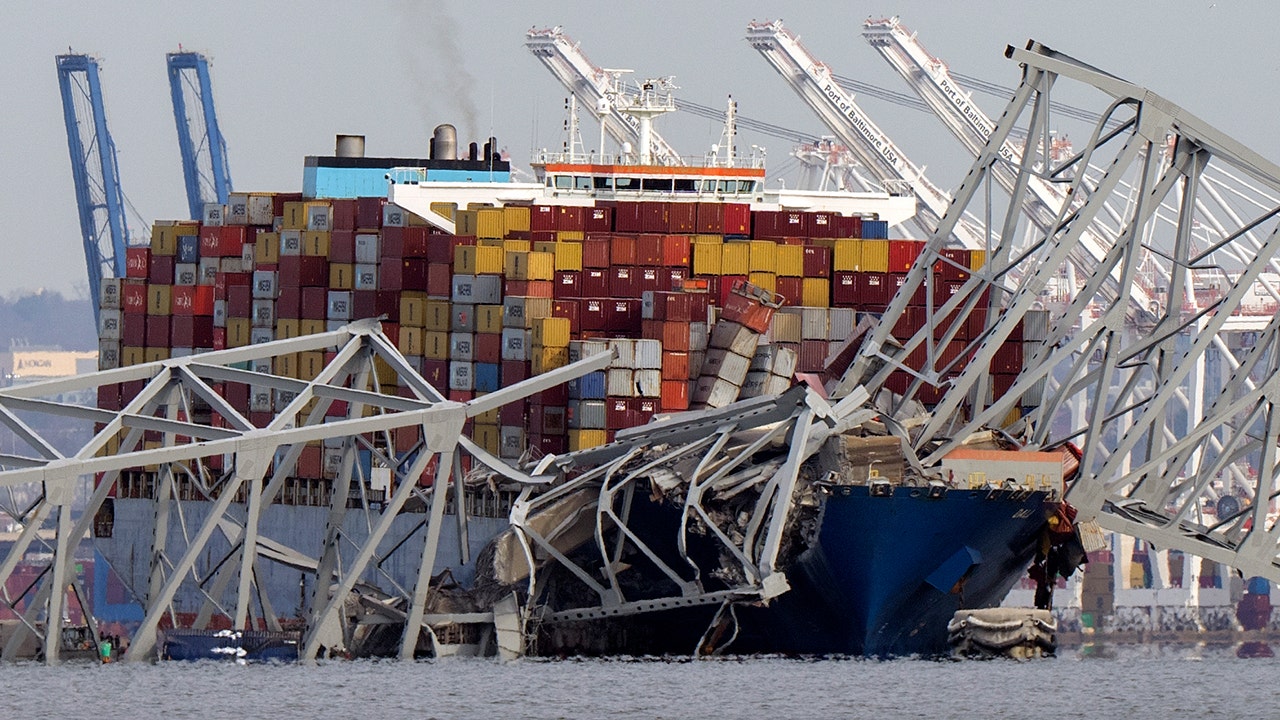
Federal agents on Saturday boarded a vessel managed by the same company as a cargo ship that caused the deadly Baltimore bridge collapse, the FBI confirmed.
In statements, spokespeople for the FBI and the U.S. Attorney’s Office in Maryland confirmed that authorities boarded the Maersk Saltoro. The ship is managed by Synergy Marine Group.
JUSTICE DEPARTMENT FILES $100M LAWSUIT AGAINST OPERATOR OF VESSEL IN BALTIMORE KEY BRIDGE WRECK
“The Federal Bureau of Investigation, U.S. Environmental Protection Agency’s Criminal Investigation Division and Coast Guard Investigative Services are present aboard the Maersk Saltoro conducting court authorized law enforcement activity,” statements from both the FBI and U.S. Attorney’s Office said Saturday morning.
Authorities did not offer further specifics. The Washington Post first reported on federal authorities boarding the ship.
The raid came several months after investigators conducted a similar search of the Dali, the cargo ship that crashed into the bridge.
The cargo ship Dali is stuck under part of the structure of the Francis Scott Key Bridge after the ship hit the bridge, Tuesday, March 26, 2024, as seen from Pasadena, Md. (AP Photo/Mark Schiefelbein, File)
In a lawsuit filed Wednesday, the U.S. Justice Department alleged that Dali owner Grace Ocean Private Ltd. and manager Synergy Marine, both of Singapore, recklessly cut corners and ignored known electrical problems on the vessel, which lost power multiple times minutes before it crashed into a support column on the Francis Scott Key Bridge in March.
The Justice Department said mechanical and electrical systems on the massive ship had been “jury-rigged” and improperly maintained, culminating in the power outages and a cascade of other failures that left its pilots and crew helpless in the face of looming disaster. The ship was leaving Baltimore for Sri Lanka when its steering failed because of the power loss.
Six members of a road work crew were killed when the bridge crumbled into the water. The collapse also snarled commercial shipping traffic through the Port of Baltimore for months before the channel was fully reopened in June.
The Justice Department is seeking to recover more than $100 million the government spent to clear the underwater debris and reopen the city’s port.
The companies filed a court petition days after the collapse seeking to limit their legal liability in what could become the most expensive marine casualty case in history. Justice Department officials said there is no legal support for that bid to limit liability and pledged to vigorously contest it.
In its lawsuit, which also seeks punitive damages, the Justice Department argued that vessel owners and operators need to be “deterred from engaging in such reckless and exceedingly harmful behavior.”
That includes Grace Ocean and Synergy themselves because the Dali has a “sister ship,” authorities wrote in the claim.
The two companies “need to be deterred because they continue to operate their vessels, including a sister ship to the Dali, in U.S. waters and benefit economically from those activities,” the lawsuit says.
Darrell Wilson, a Grace Ocean spokesperson, confirmed that the FBI and Coast Guard boarded the Maersk Saltoro in the Port of Baltimore on Saturday morning. Wilson has previously said the owner and manager “look forward to our day in court to set the record straight.”
Like the Dali, the Singapore-flagged Saltoro was built by Hyundai in 2015.
According to the Justice Department lawsuit, major issues with the Dali’s electrical system may have resulted from excessive vibrations on the ship that can loosen wires and damage connections. A prior captain of the vessel had reported “heavy vibration” in his handover notes in May 2023, saying he had made similar reports to Synergy in the past, according to the complaint.
The lawsuit noted cracked equipment in the engine room and pieces of cargo shaken loose. The ship’s electrical equipment was in such bad condition that an independent agency stopped further electrical testing because of safety concerns, according to the lawsuit.
The ship had also experienced power outages while it was still docked in Baltimore. Those blackouts are considered “reportable marine casualties” that must be reported to the U.S. Coast Guard, which authorities say never happened.
CLICK TO GET THE FOX NEWS APP
The Dali, which was stuck amid the wreckage of the collapse for months before it could be extricated and refloated, departed Norfolk, Virginia, on Thursday afternoon en route to China on its first international voyage since the March 26 disaster.
Justice Department officials refused to answer questions Wednesday about whether a criminal investigation into the bridge collapse remains ongoing. FBI agents boarded the Dali in April.
Read the full article from Here



It’s a scheme made famous by a nearly 30-year-old episode of the sitcom Seinfeld.
Hoping to earn a quick buck, two characters load a mail truck full of soda bottles and beer cans purchased with a redeemable 5-cent deposit in New York, before traveling to Michigan, where they can be recycled for 10 cents apiece. With few thousand cans, they calculate, the trip will earn a decent profit. In the end, the plan fell apart.
But after Connecticut raised the value of its own bottle deposits to 10 cents in 2024, officials say, they were caught off guard by a flood of such fraudulent returns coming in from out of state. Redemption rates have reached 97%, and some beverage distributors have reported millions of dollars in losses as a result of having to pay out for excess returns of their products.
On Thursday, state lawmakers passed an emergency bill to crack down on illegal returns by increasing fines, requiring redemption centers to keep track of bulk drop-offs and allowing local police to go after out-of-state violators.
“I’m heartbroken,” said House Speaker Matt Ritter, D-Hartford, who supported the effort to increase deposits to 10 cents and expand the number of items eligible for redemption. “I spent a lot of political capital to get the bottle bill passed in 2021, and never in a million years did I think that New York, New Jersey and Rhode Island residents would return so many bottles.”
The legislation, Senate Bill 299, would increase fines for violating the bottle bill law from $50 to $500 on a first offense. For third and subsequent offenses, the penalty would increase from $250 to $2,000 and misdemeanor punishable by up to one year in prison.
In addition, it requires redemption centers to be licensed by the state’s Department of Energy and Environmental Protection (previously, those businesses were only required to register with DEEP). As a condition of their license, redemption centers must keep records of anyone seeking to redeem more than 1,000 bottles and cans in a single day.
Anyone not affiliated with a qualified nonprofit would be prohibited from redeeming more than 4,000 bottles a day, down from the previous limit of 5,000.
The bill also seeks to pressure some larger redemption centers into adopting automated scanning technologies, such as reverse vending machines, by temporarily lowering the handling fee that is paid on each beverage container processed by those centers.
The bill easily passed the Senate on Wednesday and the House on Thursday on its way to Gov. Ned Lamont.
While the bill drew bipartisan support, Republicans described it as a temporary fix to a growing problem.
House Minority Leader Vincent Candelora, R-North Branford, called the switch to 10-cent deposits an “unmitigated disaster” and said he believed out-of-state redemption centers were offloading much of their inventory within Connecticut.
“The sheer quantity that is being redeemed in the state of Connecticut, this isn’t two people putting cans into a post office truck,” Candelora said. “This is far more organized than that.”
The impact of those excess returns is felt mostly by the state’s wholesale beverage distributors, who initiate the redemption process by collecting an additional 10 cents on every eligible bottle and can they sell to supermarkets, liquor stores and other retailers within Connecticut. The distributors are required to pay that money back — plus a handling fee — once the containers are returned to the store or a redemption center.
According to the state’s Department of Revenue Services, nearly 12% of wholesalers reported having to pay out more redemptions than they collected in deposits in 2025. Those losses totaled $11.3 million.
Peter Gallo, the vice president of Star Distributors in West Haven, said his company’s losses alone have totaled more than $2 million since the increase on deposits went into effect two years ago. As time goes on, he said, the deficit has only grown.
“We’re hoping we can get something fixed here, because it’s a tough pill to be holding on to debt that we should get paid for,” Gallo said.
Still, officials say they have no way of tracking precisely how many of the roughly 2 billion containers that were redeemed in the state last year were illegally brought in from other states. That’s because most products lack any kind of identifiable marking indicating where they were sold.
“There’s no way to tell right now. That’s one of the core issues here,” said state Rep. John-Michael Parker, D-Madison, who co-chairs the legislature’s Environment Committee.
Parker said the issue could be solved if product labels were printed with a specific barcode or other feature that would be unique to Connecticut. Such a solution, for now, has faced technological challenges and pushback from the beverage industry, he said.
Not everyone involved in the handling, sorting and redemption of bottles is happy about the upcoming changes — or the process by which they were approved.
Francis Bartolomeo, the owner of a Fran’s Cans and Bart’s Bottles in Watertown, said he was only made aware of the legislation on Monday from a fellow redemption center owner. Since then, he said, he’s been contacting his legislators to oppose the bill and was frustrated by the lack of a public hearing.
“I know other people are as flabbergasted as I am because they don’t know where it comes out of,” Bartolomeo said “It’s a one sided affair, really.”
Bartolomeo said one of his biggest concerns with the bill is the $2,500 annual licensing fee that it would place on redemption centers. While he agreed that out-of-state redemptions are a problem, he said it should be up to the state to improve enforcement.
“We’re cleaning up the mess, and we’re going to end up being penalized,” Bartolomeo said. “Get rid of it and go back to 5 cents if it’s that big of a hindrance, but don’t penalize the redemption centers for what you imposed.”
Lynn Little of New Milford Redemption Center supports the increased penalties but believes the solution ultimately lies with better labeling by the distributors. She is also frustrated by the volume caps after the state initially gave grants to residents looking to open their own bottle redemption businesses.
“They’re taking a volume business, because any business where you make 3 cents per unit (the average handling fee) is a volume business, and limiting the volume we can take in, you’re crushing small businesses,” Little said.
Ritter said that he opposed a move back to the 5-cent deposit, which he noted was increased to encourage recycling. However, he said the current situation has become politically untenable and puts the state at risk of a lawsuit from distributors.
“We’re getting to a point where we’re going to lose the bottle bill,” Ritter said. “If we got sued in court, I think we’d lose.”

Posted inSports, Varsity Maine
Press Herald sports writers nominate high school athletes from the prior week’s games.
Readers vote for their top choice and the winner will be announced in the newspapers the following Sunday all season long!

San Diego State moves back into NCAA Tournament field in latest ESPN Bracketology

Sheriff’s Office backpedals on controversial facial recognition deal

Soccer Frenzy: Cities, Fans, and What to Know | Futbol HQ

Fan behind Anthony Edwards’ orange bracelet has beaten cancer

New bridge over 96th Street adds to Nickel Plate Trail connections

Florida High School Football Rankings: Top 25 teams – Oct. 21

Cleary's 21 help Le Moyne down Central Connecticut State 69-64 in OT

How old is Bo Nix? What to know about Oregon quarterback ahead of 2024 NFL Draft

99th annual Pony Swim held in Virginia

Indiana Members Credit Union announced as new anchor tenant at Bottleworks District

Where Iran’s ballistic missiles can reach — and how close they are to the US

Has India’s influence in Afghanistan grown under the Taliban?

Bill Clinton to testify before House committee investigating Epstein links

Read Judge Schiltz’s Order

Vulnerable House Dem lashes out at Trump’s ‘racist’ SOTU challenge: ‘That was uncomfortable’
-

 World2 days ago
Exclusive: DeepSeek withholds latest AI model from US chipmakers including Nvidia, sources say
-

 Massachusetts2 days ago
Mother and daughter injured in Taunton house explosion
-

 Montana1 week ago
2026 MHSA Montana Wrestling State Championship Brackets And Results – FloWrestling
-

 Oklahoma1 week ago
Wildfires rage in Oklahoma as thousands urged to evacuate a small city
-

 Louisiana5 days ago
Wildfire near Gum Swamp Road in Livingston Parish now under control; more than 200 acres burned
-

 Denver, CO2 days ago
10 acres charred, 5 injured in Thornton grass fire, evacuation orders lifted
-

 Technology6 days ago
YouTube TV billing scam emails are hitting inboxes
-

 Technology6 days ago
Stellantis is in a crisis of its own making