Northeast
Families of hostages taken in Israel on Oct. 7 plead for peace at interfaith conference in NYC

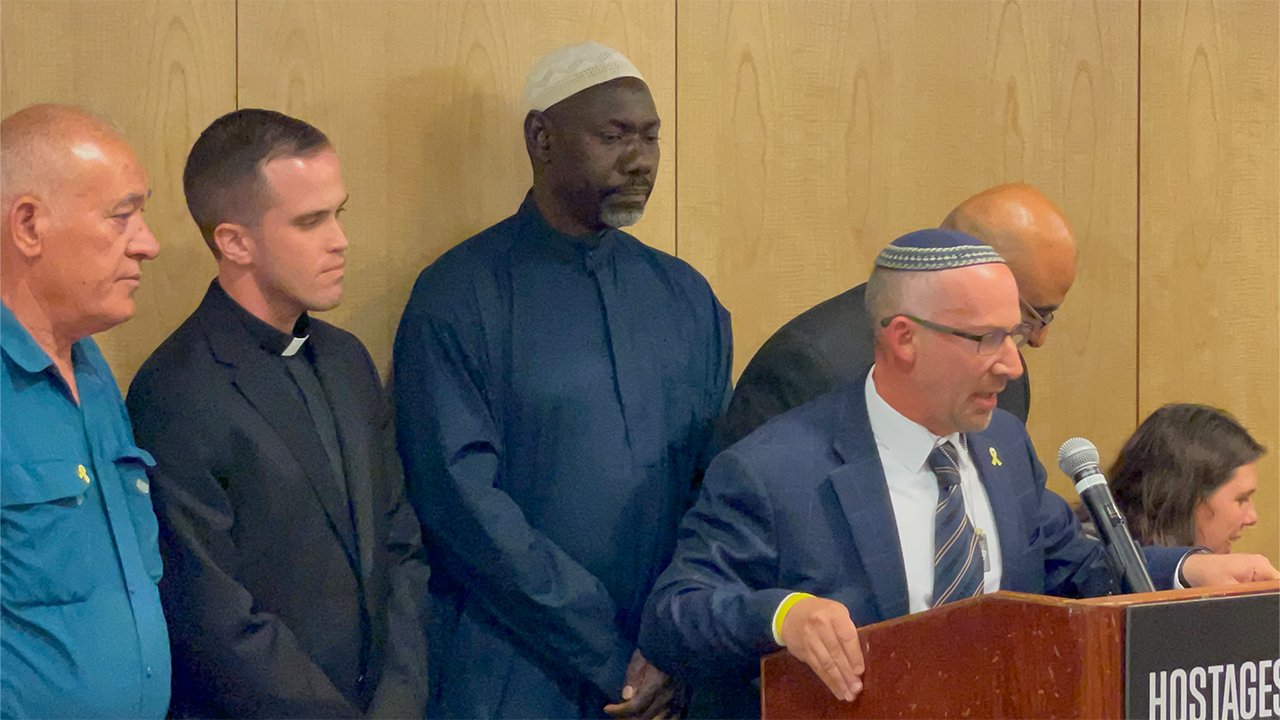
Families of hostages taken by Hamas on Oct. 7 came together with religious leaders for an interfaith conference in New York City Monday amid the ongoing war in Gaza.
The attendees, comprising the family members of Jewish and Muslim hostages as well as pastors, rabbis, and imams, pleaded for peace at the discussion hosted by UJA-Federation of NY.
“It’s time to bring this suffering to an end. It’s time to work out a deal that will bring our children, our fathers, our sisters, our mothers back and we urge everybody to do everything that they can to press in all directions to bring this deal to fruition,” said Ronen Neutra, the father of American hostage Omer Neutra. “We need them back. It’s urgent.”
Rabbi Joel Levenson, Midway Jewish Center, Long Island (speaking), shares the stage with, Sheikh Musa Drammeh and Father Ryan Muldoon, Director of Office of Ecumenical and Interfaith Dialogue of Archdiocese of New York (Fox News Digital)
Former hostage Aviva Siegel, whose husband is still being held despite her release from captivity, said she still wanted the people of Gaza to have a better life too.
“Last week somebody came up to me and said, ‘I don’t believe you. How could you want a good life for the people in Gaza after what you went through?’” Siegel said. “I am going to stay a good human being. So, I want everybody to be good, and believe that everybody deserves a better life. Also for the people [in Gaza].”
MALDIVES BANS ISRAELIS FROM ENTERING COUNTRY DURING WAR IN GAZA
Notable attendees of Monday’s event included, Rabbi Menachem Creditor, Pearl and Ira Meyer Scholar in Residence at UJA-Federation New York; Rabbi Marc Schneier, President of the Foundation for Ethnic Understanding; Rabbi Joel Levenson of the Midway Jewish Center, NYPD Detective Mohamed Amen; Danyal Khan, Deputy Director of the Muslim American Leadership Alliance; Zach Erdem, Restaurateur & Television Personality; Father Ryan Muldoon, Director of Office of Ecumenical and Interfaith Dialogue of Archdiocese of New York; and comms exec Matthew Hiltzik, who coordinated the event with the hostage forum and these religious leaders.
Family members of hostages taken on Oct. 7 in Israel attend an interfaith discussion in New York City. (Fox News Digital)
Monday’s event came after the Israel Defense Forces (IDF) confirmed that four more hostages kidnapped on Oct. 7 have died while in Hamas captivity. Three of those men were in their 80s and seen previously in a Hamas video begging to be released.
About 80 hostages in Gaza are believed to be alive, alongside the remains of 43 others. In the days since President Biden announced the cease-fire proposal Friday, Israel has seen some of its largest protests calling on the government to bring them home. Although Biden said the proposal came from Israel, the Israeli leadership has appeared to distance itself from the plan, vowing to keep conducting military operations against Hamas until the militant group is destroyed.
NETANYAHU AND TRUMP FACE SIMILAR ‘POLITICIZED PROSECUTIONS,’ LEGAL EXPERT SAYS
Hundreds of people, including relatives of the captives, gathered outside Israel’s Defense Ministry and military headquarters in central Tel Aviv late Monday, calling for a deal. Smaller protests took place across the country.
Family members hold up images of their loved ones still in Hamas captivity. (Fox News Digital)
About 100 captives were released during a week long exchange of hostages for Palestinian prisoners in November. Three of the men declared dead Monday had female relatives who were released during the exchange.
Israeli bombardments and ground operations in Gaza have killed more than 36,000 Palestinians, according to Gaza’s Hamas-run Health Ministry, which does not distinguish between combatants and civilians. Israel has blamed Hamas for civilian deaths, accusing the terrorist group of operating from dense residential areas.
Israel has been expanding its offensive in the southern city of Rafah, once the main hub of humanitarian aid operations. The Israeli invasion of Rafah has largely cut off the flow of food, medicine and other supplies to Palestinians facing widespread hunger.
Fox News Digital’s Peter Aitken and The Associated Press contributed to this report.
Read the full article from Here


As someone who is completely obsessed with oysters, summer seafood spots, and the excitement of trying a brand-new restaurant, I’ve been counting down the days for Ladyfish to open in Portland. There’s just something about a seasonal pop-up that makes it feel extra special, and Ladyfish already feels like the place everyone will be talking about this summer.
Where Is It Located?
Located at 425 Fore Street in Portland’s Old Port, the restaurant officially opened on May 13 and has already been drawing major attention from locals and visitors looking for fresh seafood and fun summer vibes.
What Makes Ladyfish Stand Out From Other Restaurants?
What makes Ladyfish stand out is how playful and exciting the menu feels while still keeping Maine seafood at the center of everything. The scallops in a blanket are already becoming one of the must-order dishes, balancing buttery richness with fresh coastal flavor. The eggplant dip is unbelievably good and adds a unique twist to the menu, while the steamed buns are soft, flavorful, and honestly addictive. On top of all that, the seafood is incredibly fresh, which is exactly what you want from a summer restaurant in Portland.
Since opening, Ladyfish has quickly become one of the hottest new dining spots in the city, proving that Portland’s restaurant scene continues to thrive with creative concepts and unforgettable seafood experiences.
22 Seasonal Maine Restaurants Worth Visiting for a Delicious Meal
Gallery Credit: Sean McKenna
10 Maine Lobster Pounds You Need to Try This Summer 🦞
Summer plans = eating your way through these 10 Maine lobster pounds!
Gallery Credit: Arlen Jameson

The trial of Alvin Campbell Jr., accused of sexually assaulting and attacking nine women from 2017-2019, is set to get underway on Monday.
Campbell is the older brother of Massachusetts Attorney General Andrea Joy Campbell.
The 45-year-old faces a number of charges for allegedly sexually assaulting and attacking nine women between 2017-2019 in Boston. According to court records, he would intentionally seek out young women late at night near bars and restaurants, posing as a rideshare driver.
While most of the attacks happened in his car, there is one account of a 26-year-old woman who says Campbell Jr. drove her from Boston to his Cumberland, Rhode Island, apartment, where he assaulted her.
Right now, he is in custody. He has been held without bail since his arrest in 2020. He continues to insist that all of the encounters he had with the women in question were consensual.
On Monday, he will finally begin the process of trying to prove his innocence to 17 jurors. The jury was selected over the last week. The trial is expected to last several weeks.
Opening statements will lead off Monday’s proceedings.
When asked about the trial, Andrea Joy Campbell said, “I am praying for the survivors and all those affected. It takes extraordinary courage to come forward, and they deserve dignity and respect.”

A 21-year-old New Hampshire woman was arrested after she allegedly drove the wrong way on Route 101 and collided with a responding state trooper’s cruiser.
State police say Cassandra Aldecoa, of Dover, is facing felony charges of reckless conduct, second-degree assault, and criminal mischief, as well as misdemeanor charges of aggravated driving under the influence and driving under the influence.
There were multiple calls to state police around 1:47 a.m. Sunday reporting a Nissan Kicks that was traveling east in the westbound lanes of Route 101 in Exeter.
Trooper Shane McClure was among those to respond, when he encountered the Nissan between Exits 8 and 9. According to state police, McClure made the decision to place his fully-marked state police cruiser in the path of the wrong-way driver in an effort to end the possibility of tragedy to anyone else.
His cruiser was then struck by the Nissan.
Authorities said Hernan Marrero was driving the wrong direction on Route 1 in Lynnfield when he hit Massachusetts State Police Trooper Kevin Trainor.
McClure, Aldecoa, and her passenger, identified as 21-year-old Zachary Lapierre, were all evaluated by medical personnel, and it was determined they did not have any significant injuries.
Lapierre, of Lebanon, Maine, is also facing misdemeanor charges in connection with the crash, including disorderly conduct, contempt, and violating conditions of release. Aldecoa and Lapierre were both held on preventive detention and are scheduled to be arraigned in Brentwood District Court at 11 a.m. Monday. It’s unclear if either one has obtained an attorney.
An investigation is underway, and anyone with information that could assist state police is asked to contact Trooper Cameron Vetter at Cameron.S.Vetter@DOS.NH.GOV.
-

 Illinois5 minutes ago
Pritzker family tree: Illinois’ richest dynasty
-

 Indiana11 minutes ago
From Bright to Bestseller Dreams: Local Author Writes Thriller Series Around Moores Hill
-

 Iowa17 minutes ago
Storms cause significant damage to Kingsley in Northwest Iowa
-

 Kansas23 minutes ago
Kansas Hispanic Education & Development Foundation offers more than scholarships
-

 Kentucky29 minutes ago
Kentucky Wildcats News: Jamal Crawford dream lives on
-

 Louisiana35 minutes ago
Louisiana primary narrows field for open utility commission seats
-

 Maine41 minutes ago
This New Maine Seafood Restaurant Just Opened in the Former Bar Futo in Portland
-

 Maryland47 minutes ago
Most Maryland sheriffs drop arrest agreements with ICE despite vows to fight a new state law – WTOP News

