Northeast
Fake Yale student scandal raises alarms over academic fraud, foreign influence risks

NEWYou can now listen to Fox News articles!
An Ivy League student accused of making up an entire life story to gain admission was expelled earlier this semester, prompting fresh concerns over academic fraud and gaps in university vetting that experts say could also expose elite institutions to foreign influence and espionage risks.
At Yale University in Connecticut, administrators recently kicked out an undergrad student identified as “Katherina Lynn” after she allegedly lied about her background, according to the Yale Daily News, a student-run paper.
She reportedly comes from California’s Bay Area but adopted a “Western name” to distance herself from her Chinese-American roots, the online magazine Air Mail reported, and allegedly concocted a fake origin story, reinventing herself as a daughter of rural North Dakota.
MULTI-COLLEGE STUDY CLAIMS OVER 80% OF STUDENTS LIE ABOUT THEIR VIEWS TO APPEASE LIBERAL PROFESSORS
Cleanup crews work on an oil spill just north of Tioga, North Dakota, Oct 24, 2013. The town is where an alleged Yale fraudster claimed to be from. She was really from California’s wealthy Bay Area. (Ken Cedeno/Corbis via Getty Images)
“She knew that… when it comes to diversity, it’s not just about race,” said Adam Nguyen, founder of Ivy Link and a former Columbia admissions advisor. “Diversity for colleges has a much broader definition. It also includes socioeconomic diversity… and geographic diversity. So she made herself into basically a White applicant with a very Caucasian-sounding name from a little town in North Dakota.”
Next, she spent years plotting to fool Ivy League admissions teams and forging paperwork until she wound up as a Yale freshman. It was a suspicious roommate who uncovered the scheme, according to the report — by looking at her luggage tags and finding another name and address.
“As with any institution, whether it’s elite universities like Columbia, Harvard, Yale or workplaces, any employer, you’ll see that if someone has the intent and the talent to do it, they can get through the screening process, whether it’s faking your transcript, faking employment record, faking even testimonials from former employers or teachers, etc.,” Nguyen said. “So you’re seeing that here, this particular individual went through great lengths, right, and knew how to do all the right things. That said, the college admissions process is essentially trust but verify. Right now, they use different things like software, they do spot checking, but at the end of the day, it’s not 100% foolproof.”
US DIPLOMAT FIRED FOR ROMANTIC RELATIONSHIP WITH WOMAN WITH TIES TO CHINESE COMMUNIST PARTY
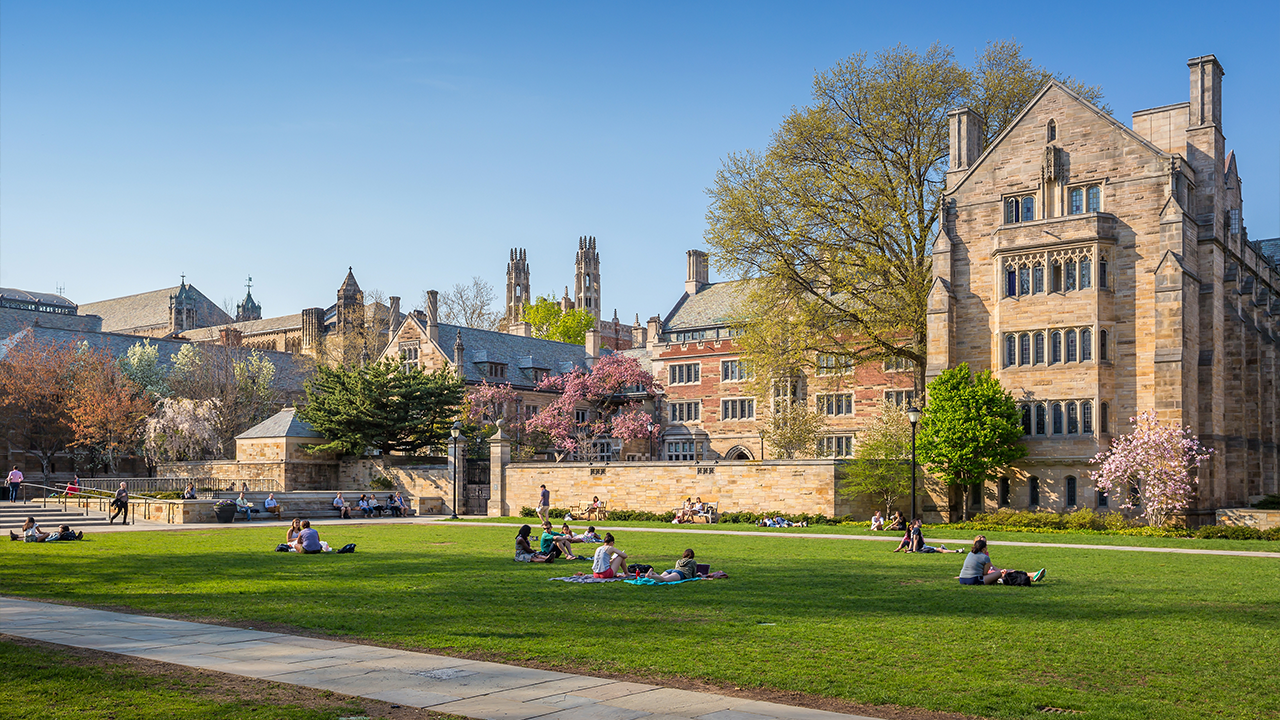
Yale University in New Haven, Connecticut, which recently expelled a freshman student after reportedly learning that she’d misrepresented her academic credentials to get accepted. (Plexi Images/GHI/UCG/Universal Images Group via Getty Images)
While there’s no evidence she has ties to a foreign government, the scandal raises questions about keeping schools safe from bad actors.
The State Department has been warning of Chinese influence on American and Canadian university campuses going back to at least 2020, when officials said Chinese government-linked groups were using academic partnerships and exchange programs to collect sensitive research and influence U.S. students and faculty.
And the Heritage Foundation lists the infiltration of the Chinese Communist Party into American education as a threat at “all levels” of academia, from kindergarten classrooms up to elite universities.
ANCIENT RARE CHINESE MANUSCRIPTS STOLEN IN ALLEGED SCHEME BY MAN USING MULTIPLE ALIASES
The Old Campus Courtyard at Yale University on Sept. 28, 2022, in New Haven, Connecticut. (Stan Godlewski for The Washington Post via Getty Images)
Nguyen said graduate programs could pose the highest risk, because students often gain access to sensitive research and laboratory systems.
The recent exposure of an Iowa superintendent as an illegal immigrant with a criminal record and allegedly falsified academic background is yet another example of lax vetting in education.
Ian Roberts, who had been superintendent of Des Moines Public Schools, was making $270,000 a year. And the district announced a lawsuit this month against the consulting firm that helped hire him.
Former Des Moines superintendent Ian Andre Roberts, who was detained by ICE and federally charged. (Polk County Sheriff)
US UNIVERSITIES TRAINING CHINESE MILITARY SCIENTISTS ON TAXPAYER DIME, COMMITTEE WARNS
Last year, after a web sleuth exposed a student from India as an academic fraud, Lehigh University in Pennsylvania launched an internal investigation into its admissions process, according to The Brown and White, a campus newspaper.
The student, identified as then-19-year-old Aryan Anand, allegedly outlined his scheme in a Reddit post that described using a sock puppet email to pose as his high school principal, faking his father’s death to get more financial aid money, editing his transcripts and tax fraud, the student outlet reported.
And then the internal probe led to criminal charges against four more students from Ghana who were accused of financial aid fraud.
SURVIVOR OF CHINA’S CULTURAL REVOLUTION WARNS AGAINST LETTING 600,000 CHINESE STUDENTS STUDY AT US COLLEGES
Yale University campus in New Haven, Connecticut, on April 7, 2024. (Joe Buglewicz/Bloomberg via Getty Images)
The Lehigh scandals prompted the Center for Immigration Studies, a Washington think tank that advocates for lower immigration levels, to urge Homeland Security Investigations to launch a wider review last year.
“If a random slacker can pull off this scam, terrorists and the Chinese government can, too,” the think tank warned, while also noting one of the 9/11 hijackers had been in the U.S. on a student visa, and immigration authorities denied entry to five other would-be conspirators, finding they were not students or tourists as they claimed.
The Yale University campus on April 4, 2015. It is a private Ivy League research university in New Haven, Connecticut, founded in 1701. (iStock)
“There’s always going to be some successful fraudster that will make it through,” Nguyen said. “That will make for a good story, but the vast majority of students are legitimate.”
CLICK HERE TO DOWNLOAD THE FOX NEWS APP
And if “Katherina Lynn” had put as much effort into her studies as her fake background story, she could probably have gotten into an elite school on her own merit, he said.
Fox News’ Alec Schemmel contributed to this report.
Read the full article from Here



A person who was reported missing late Friday night in Brookfield has been found dead.
Police received a report of a missing person around 11 p.m. As officers were searching the area, they said they found an ATV off of the roadway and in the woods on Candlewood Shores Road.
According to investigators, the sole occupant of the ATV was found dead at the scene. The person’s identity has not yet been released.
The investigation is active and ongoing. Anyone with information is asked to contact Officer Brian Flanagan at (203) 740-4169.
The Maine Marine Patrol has launched the newest and largest patrol vessel in its fleet, the 57-foot P/V Allegiance, which will support safer and more effective offshore patrols, according to the Maine Marine Patrol, in a news release. The vessel was officially put into service on Thursday, June 11, during a christening event at Perry’s Lobster in Surry.
“Maine Marine Patrol routinely patrols commercial fishing activity offshore and hauls and inspects tens of thousands of lobster traps annually,” said Marine Patrol Colonel Matt Talbot, in the news release.
“While still capable of supporting Marine Patrol’s mission near shore, the new vessel will better position Marine Patrol to conduct offshore commercial fisheries enforcement, including the ability to safely haul and inspect large lobster trawls in federal waters,” said Colonel Talbot.
The vessel will also be used to respond to search and rescue incidents, monitor fisheries in addition to Lobster including scallop, Atlantic Herring, Menhaden, and Groundfish, and others.
The P/V Allegiance will be based in Boothbay Harbor and assigned to Marine Patrol Specialist Evan Whidden. It replaces the 29-year-old, 35-foot P/V Vigilant.
The P/V Allegiance was constructed and finished by Wesmac Custom Boats in Surry.
“This is the fifth patrol vessel built or refitted by Wesmac and we are once again very pleased with the quality of work and attention to detail by the Wesmac team,” said Colonel Talbot.
The P/V Allegiance is powered by a low-emission Tier 4 Man Diesel V-12 1450hp engine which can cruise in excess of 20 knots. It is equipped with state-of-the-art Furuno navigation electronics, and a heavy duty 17-inch hauler. It has significant deck space and an open stern which will allow Officers to safely handle and set back the larger offshore lobster trawls Marine Patrol Officers will be inspecting. The vessel is also equipped to carry a 15-foot Ribcraft Rigid Hull Inflatable boat on deck, which can be used for at-sea boardings to check vessels for compliance with marine resources laws.
Massachusetts
Could ‘Golden Girls’-style homesharing solve the state’s housing woes? – The Boston Globe

Take the 1980s sitcom, “The Golden Girls.” The four older women sharing a home in that series formed close friendships. But homesharing — the practice of renting out a bedroom in one’s home — can also be a practical way to save money and take full advantage of a property.
Advocates seeking to promote homesharing estimate that leasing just 10 percent of the state’s 500,000 unoccupied spare bedrooms would be the equivalent of building $25 billion in new housing. And proponents, including community development financing organization BlueHub Capital, the Environmental League of Massachusetts, and Associated Industries of Massachusetts, are pushing for new laws that aim to turn homesharing from a niche practice into a genuine solution.
And amid burgeoning interest in homesharing, several companies have created platforms to facilitate it, like HomeShare Online, Nesterly, and SpareRoom. Some of these companies provide a website for potential roommates to find each other while others also offer background checks, personalized matching, help crafting legal agreements, and assistance navigating disputes.
Usually, homesharing involves sharing common areas in addition to having a private bedroom. Sometimes, a guest will exchange domestic tasks for reduced rent. A typical host might be an older adult who lives alone and wants help or extra income. A guest might be a student or single adult seeking inexpensive rent.
But sharing space with strangers can be tricky.
Honey Donegan, 77, who works part-time as a nanny, lives in a 2,500-square-foot home in Quechee, Vermont, and has turned to homesharing for companionship.
Her first guest didn’t work out — she was an older woman who ultimately decided to live with a family member. But then Donegan matched with Kayla Mazza, 31, through the nonprofit HomeShare Vermont. Mazza is a data and systems manager at a social services nonprofit who had trouble finding inexpensive housing near her job. They’ve lived together for two years. “It’s wonderful,” Donegan says. “It’s like having a daughter you’re not angry with.”
Most evenings, Donegan and Mazza watch “Jeopardy” together. They share a kitchen and occasionally a meal. Donegan loves hearing the younger woman’s perspective on work and politics. “We have separate lives, but we enjoy one another,” Donegan says.
Homeshare Vermont spokesperson Ric Cengeri said the organization conducts background checks, matches people by hand, negotiates contracts, and provides case management. At the moment, the program has matched around 300 people living in homesharing agreements, with the average match lasting 21 months.
One reason the Vermont program may have succeeded is that it is relatively small and has a human touch, with staff working closely with the host and guest to craft contracts and resolve disagreements. It’s also heavily subsidized with money from a state legislative appropriation through the Vermont Department of Disabilities, Aging and Independent Living, federal government matching funds, and foundation grants, so the fees are affordable: A one-time fee of between $60 and $500 when a match is made is applied on a sliding scale, based on income.
The Vermont program, modest as it is, suggests that homesharing could have a future. But the struggles of other pilots point to some of the model‘s limitations.
Although homesharing appeals to some, others worry about living with strangers. An older adult’s health needs can get in the way, if a host expects or needs more help than a guest is prepared to give. Sometimes, there are personality clashes.
Martha’s Vineyard might seem like a perfect place for homesharing. Cindy Trish, executive director of Healthy Aging Martha’s Vineyard, said the island is filled with older adults with large homes, while younger professionals can’t find housing. And in June 2022, Healthy Aging launched a homesharing pilot program.
The surprising conclusion: It wasn’t viable. Program staff interviewed 13 hosts and 30 guests and identified just four potential matches, who were referred to a mediation agency to negotiate agreements. Only one pair signed a contract.
Trish said hosts often had more home health care needs than guests could meet, and the accommodations frequently didn’t meet guests’ expectations.
Elsewhere, the state of Maine partnered with Nesterly on a two-year pilot program, which ended in early 2026. Erik Jorgensen, senior director of government relations at Maine State Housing Authority, said because the program was statewide and lacked sufficient marketing, it had trouble attracting a critical mass of guests and hosts in any one location. Jorgensen said more than 500 potential hosts and guests created profiles, but only 11 homeshares were actually booked.
Nesterly CEO Noelle Marcus said the organization continued making matches after the pilot ended and has made about three dozen matches altogether. She’s seeking funding from local organizations to continue the program.
Nesterly also ran a pilot program in Boston in 2017 under Mayor Marty Walsh, which was paused during COVID-19 and not renewed by Mayor Michelle Wu.
There is talk of some legal changes that might make homesharing more attractive — making it easier for landlords to evict lodgers, for instance. Financial incentives — either to incentivize homeowners to rent rooms or to cover administrative costs for homesharing organizations — could help, too.
Portland, Ore. just launched a 12-month pilot program giving grants to homeowners who rent out spare rooms. HomeShare Vermont relies, in part, on $318,000 in state grants to cover its overhead expenses.
But ultimately, it may be a different kind of homesharing that takes hold — one that caters to the instinct for privacy.
Massachusetts has had early success with new laws encouraging construction of accessory dwelling units (ADUs), small living units located on the same property as a single-family home. In 2025, around 1,200 new units were permitted, according to state data. For renters seeking private living units or seniors concerned about sharing common space, renting an ADU could provide privacy for both parties while still letting a guest swap some household tasks for a discount.
Homesharing, or really any attempt to squeeze more out of our existing properties — allowing for ADUs, rezoning single-family lots to allow two-family homes — will not completely solve Massachusetts’ housing crisis. Ultimately, we need to build more housing.
But done right, homesharing can contribute in a small way. And we could use any contribution we can get.
Shira Schoenberg can be reached at shira.schoenberg@globe.com. Follow her @shiraschoenberg.
-
Colorado2 seconds ago
What’s really killing a lot of cattle in Colorado? Hint: wolves aren’t the culprit (Opinion)
-

 Connecticut3 minutes ago
Person reported missing found dead in Brookfield
-

 Delaware8 minutes ago
Delaware ranks among top ice cream-loving states, study finds
-

 Florida15 minutes ago
Missing Florida diver found after multi-agency search
-

 Georgia18 minutes ago
Heat wave expected to bring potential dangerous conditions to South Georgia
-

 Hawaii23 minutes ago
University of Hawaii study finds San Andreas Fault stress at 1,000-year high | Honolulu Star-Advertiser
-

 Idaho30 minutes ago
Idahoans left to deal with rat problem in the Treasure Valley for another year
-
 Illinois33 minutes ago
Illinois in the trenches again to protect fair housing

