Northeast
Democratic governor faces pushback from lynching research commission over reparations stance

NEWYou can now listen to Fox News articles!
Members of the Maryland Lynching Truth and Reconciliation Commission pushed back against Gov. Wes Moore’s objection to creating a reparations commission, asserting that their work ties directly to the immediate action he calls for.
“I mean, we’re doing it,” Nicholas M. Creary, a member of the commission, told Fox News Digital.
“If it goes according to plan. We’re going to be getting draft legislation introduced into session this year. So whether he thinks we need to talk about it or do more, my guess is that the reparations commission isn’t just going to necessarily study, but they’re also going to make recommendations for things to do,” Creary added.
The Maryland Lynching Truth and Reconciliation Commission released its final report last month after being established in 2019. The report is described as the first state-sponsored effort in the United States to investigate, document and “reckon with the history of racial terror lynching within its own borders.”
The Maryland Lynching Truth and Reconciliation Commission released its final report last month after being established in 2019. (Getty)
MARYLAND RECOMMENDS $100K PAYMENTS TO DESCENDANTS OF LYNCHING VICTIMS AFTER STUDY
Moore vetoed an effort to establish the Maryland Reparations Commission. His reasoning for vetoing the commission stemmed from a need for immediate action. The governor penned a letter stating that it was a “difficult decision” and also that “now is not the time for another study.”
In an interview with “The Breakfast Club’s” Charlamagne tha God, Moore explained that he is a “person of action.”
“Exactly. I mean, listen, what I said was, ‘I’m a person of action. I don’t need more studies.’ I’m like, ‘We’ve done four studies over the past 20 years on similar types of elements,’” Moore said in October. “By the way, one of which my wife worked on. And, so, when we’re now talking about doing a two-year study on something that I already know the answer to, I’m like, ‘What are we studying?’”
The governor’s veto was overridden by state lawmakers. The Maryland Reparations Commission would appoint 23 members to assess local, state and federal policies from the Reconstruction and the Jim Crow eras. The commission will recommend reparations ranging from cash compensation to a statement of apology.
While the members told Fox News Digital that the Maryland Lynching Truth and Reconciliation Commission is separate from the Maryland Reparations Commission, they defended their work, as it is similar.
Charles Chavis, who is part of the state’s Lynching Truth and Reconcilation Commission, said that their work could help address the more immediate issues the governor seeks to solve in regard to racial justice.
Among 84 recommendations, the Maryland Lynching Truth and Reconciliation Commission proposed that state leaders atone for the past through cash payments. The commission recommended that $100,000 per person be issued to descendants of lynching victims after a state-sponsored lynchings study. (OZAN KOSE/AFP via Getty Images)
“When we look at homelessness on the eastern shore – the various issues that have been plaguing Maryland’s eastern shore and other areas, there’s a direct line that can be drawn with some of these incidents of racial terror and racial violence that have yet to be addressed,” Chavis said. “The state has been aware of this. And so to take the governor more on this point, yes, let’s do something about it. And I think that is what the legislation is dealing with.”
UNIVERSITY OF ILLINOIS HOSTED STATE-FUNDED COMMITTEE MEETING WHERE PROFESSORS ADVOCATED FOR REPARATIONS
In their report, the commission concluded that state officials and institutions were complicit in 38 lynchings that followed the Civil War and that the perpetrators were never held accountable in any of the deaths. Among 84 recommendations, the group proposed that state leaders atone for the past through cash payments. The commission recommended that $100,000 per person be issued to descendants of lynching victims.
The recommendations consist of nine categories, including apology and acknowledgment of responsibility, symbolic reparations, material reparations, criminal justice, community healing, mental health, education, media and implementation.
MARYLAND GENERAL ASSEMBLY CALLED OUT FOR OVERRIDING GOVERNOR’S VETO ON ‘FOOLISH’ REPARATIONS COMMISSION
The commission members said that reparations are bigger than monetary compensation. Commission member David Fakunle said there is no cost to educating the public about the truth of Maryland history.
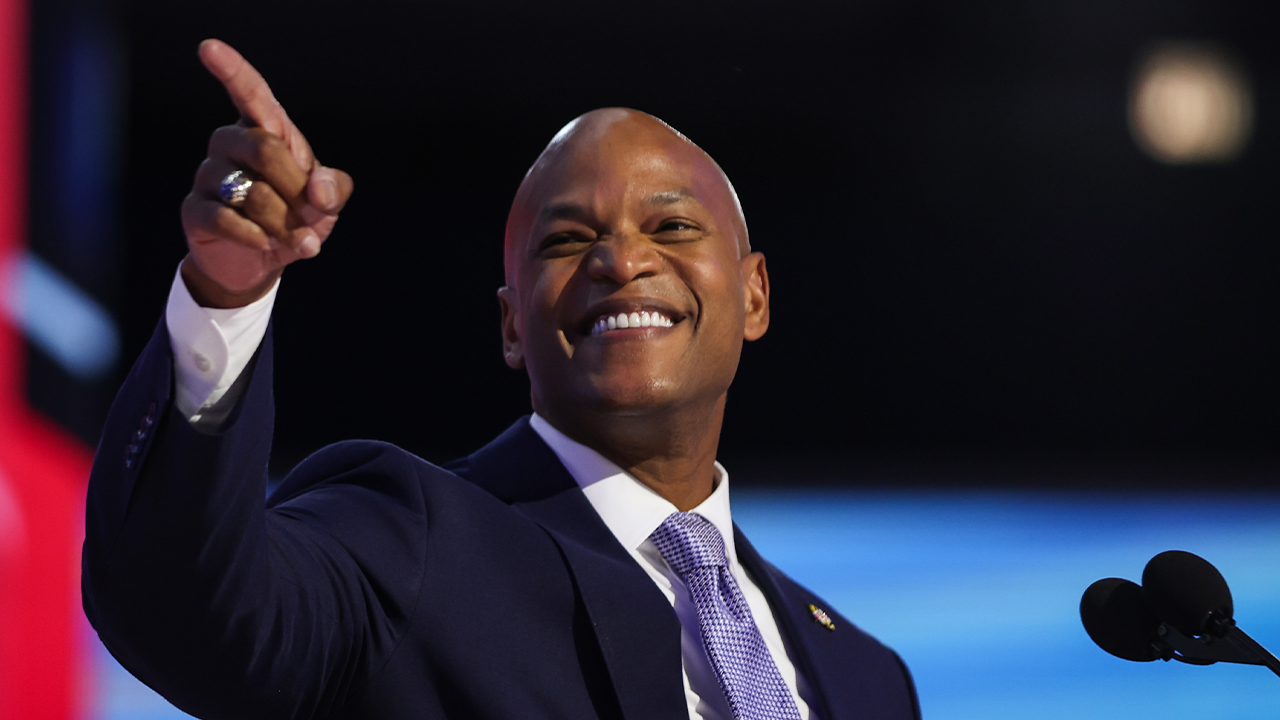
Maryland Gov. Wes Moore vetoed an effort to establish the Maryland Reparations Commission. His reasoning for vetoing the commission stemmed from a need for immediate action. The governor penned a letter stating that it was a “difficult decision” and also that “now is not the time for another study.” (Andrew Harnik/Getty Images)
“There are a lot of these things that can happen with no cost at all, and can certainly be the utilization of resources that are already being applied to certain elements of the state’s running, so to speak. And so we have to be patient. We know about patience when it comes to this work,” Fakunle told Fox News Digital. “We don’t want people to reduce the repair of this legacy to money. That is very limiting, because first and foremost, we should not put a price tag on a person’s life, although we are doing it in this case. But what we are acknowledging is that there are so many things that allow this to happen without any accountability.”
Chavis said one of the reasons he’s proud of the report is because it addresses the issues Moore has expressed.
“Our report should do nothing more than provide additional evidence as to why the present day reform is needed. But we can’t pretend like these injustices and this harm and the community issues have just happened out of nowhere. They have a history and there’s a legacy attached to the community’s suffering that needs to be alleviated,” Chavis said.
Moore’s office did not immediately respond to a request for comment.
Read the full article from Here



Maine’s average price for regular gasoline rose to its highest point since August 2022, as the conflict in Iran continues to drive up global oil costs.
A gallon of regular gas averaged $4.03 here Tuesday, ticking up more than 6 cents overnight, according to data aggregated by motor club AAA. That price has risen 38.5% — about $1.12 — since Feb. 28, when the United States and Israel struck Iran, triggering a conflict that has since spilled into the broader Middle East.
Maine’s average price crossed the $4 threshold a week after the national average did so. The national average was up to $4.14 Tuesday, AAA data shows.
Premium gas was up to $5.07 per gallon in Maine, topping $5 for the first time in nearly four years. Diesel, meanwhile, averaged about $5.90 per gallon Tuesday.
Collectively, those figures mark the state’s highest average gas prices since the summer of 2022, when the Russian invasion of Ukraine drove gas prices to record highs. A gallon of regular gas peaked at $5.09 that June, the highest ever recorded by AAA.
This week, Maine’s prices were the 21st highest among the 50 states and Washington, D.C., according to AAA. California, Hawaii, Washington, Nevada and Oregon all saw average prices above $5 per gallon Tuesday.
This is a developing story.

Food insecurity is rising in Massachusetts while assistance programs are falling short, according to the latest annual report from the Greater Boston Food Bank and Mass General Brigham. The sixth annual Massachusetts Food Access Report finds that a record 40% of Massachusetts households experienced food insecurity during 2025. According to the authors, that equates to 1.1 million households across the Bay State. Additionally, the report finds that 25% of households report regularly missing meals or going hungry. Their conclusions are based on a survey of more than 3,000 adults across the state. The authors said the survey was conducted from October through December in three languages. “Our results are sobering: more people are struggling, and while they report accessing food and nutrition assistance programs like food pantries, SNAP, and WIC, they also say these programs are not enough. Every population—from families with young children to seniors—is struggling to afford food,” Dr. Lauren Fiechtner, who advised the research, wrote in a statement. Affordability remains a key challenge, with 88% of food-insecure households reporting difficulty paying for at least one basic expense and needing an average of $500 more per month to meet basic needs, according to the report. The report found 75% of Supplemental Nutrition Assistance Program participants said they still need additional food support, while 78% receive less than $300 per month in benefits, according to the report. Meanwhile, the authors state that charities are playing an “increasingly essential role,” serving more than half of the state’s food-insecure households. “The call to action is clear: we must continue to invest in our emergency food system to meet this urgent and growing demand. And we must work together on implementing long-term solutions to poverty to empower everyone to live better, healthier, and more productive lives,” the Greater Boston Food Bank’s outgoing CEO, Catherine D’Amato, wrote in a statement. Among the recommendations included in the report are calls to increase state funding for nutrition programs, strengthen food insecurity screenings through the health care system, investments in local food systems and legislative changes to address societal issues that contribute to hunger, including income and housing inadequacy.WCVB partners with the GBFB for an annual day of giving.
Food insecurity is rising in Massachusetts while assistance programs are falling short, according to the latest annual report from the Greater Boston Food Bank and Mass General Brigham.
The sixth annual Massachusetts Food Access Report finds that a record 40% of Massachusetts households experienced food insecurity during 2025. According to the authors, that equates to 1.1 million households across the Bay State.
Additionally, the report finds that 25% of households report regularly missing meals or going hungry.
Their conclusions are based on a survey of more than 3,000 adults across the state. The authors said the survey was conducted from October through December in three languages.
“Our results are sobering: more people are struggling, and while they report accessing food and nutrition assistance programs like food pantries, SNAP, and WIC, they also say these programs are not enough. Every population—from families with young children to seniors—is struggling to afford food,” Dr. Lauren Fiechtner, who advised the research, wrote in a statement.
Affordability remains a key challenge, with 88% of food-insecure households reporting difficulty paying for at least one basic expense and needing an average of $500 more per month to meet basic needs, according to the report.
The report found 75% of Supplemental Nutrition Assistance Program participants said they still need additional food support, while 78% receive less than $300 per month in benefits, according to the report. Meanwhile, the authors state that charities are playing an “increasingly essential role,” serving more than half of the state’s food-insecure households.
“The call to action is clear: we must continue to invest in our emergency food system to meet this urgent and growing demand. And we must work together on implementing long-term solutions to poverty to empower everyone to live better, healthier, and more productive lives,” the Greater Boston Food Bank’s outgoing CEO, Catherine D’Amato, wrote in a statement.
Among the recommendations included in the report are calls to increase state funding for nutrition programs, strengthen food insecurity screenings through the health care system, investments in local food systems and legislative changes to address societal issues that contribute to hunger, including income and housing inadequacy.
WCVB partners with the GBFB for an annual day of giving.

Two people have died following separate law enforcement-involved shootings in New Hampshire over the past three days, marking the first such fatalities in the state this year.
The most recent incident occurred in the early hours of Monday morning, when officers responding to a domestic disturbance call at a private residence in Northfield, N.H., shot and killed an adult woman.
According to the New Hampshire attorney general’s office, the woman died at the scene. The victim’s name will be released after the next of kin have been notified.
No additional details have been released, as the investigation remains active.
Another shooting took place on Saturday night, which was the culmination of an hours-long manhunt in Raymond, N.H.
Law enforcement responded to a call shortly after 1:30 p.m. that reported Matthew Masse, 38, was shooting a rifle at his family members at a home on Ham Road, according to a news release from the attorney general’s office.
During the initial response, Masse shot and wounded a Nottingham, N.H., police officer, who is being treated for non-life-threatening injuries.
Masse then fled into the surrounding woods.
After an hours-long search and shelter-in-place advisory, officers made contact with Masse around 10:06 p.m. and attempted to arrest him, which resulted in a shootout.
Law enforcement then approached Masse and found him dead, authorities said.
Warrants had been issued for Masse’s arrest following an incident two days earlier, according to reporting by NHPR. But, police hadn’t located him until they responded to the call on Saturday.
Family members told WMUR that Masse struggled with his mental health.
In both incidents, autopsies are yet to be conducted.
The attorney general’s office has opened an investigation into both incidents, as it does for all shootings that involve police officers. The officers involved have not been publicly identified.
Last year, the state recorded nine officer-involved shootings, only one of which involved a female victim, making Monday’s incident in Northfield a particularly rare occurrence.

Flood Watch issued across Hawaii as kona low system brings risk of heavy rain and flood

Volunteer organizes massive cleanup effort to remove huge piles of garbage from the Idaho high desert

Kinston woman arrested in months-long fraud investigation in Illinois

Galveston Town Marshal placed on administrative leave

Inside Iowa Politics: Candidate Jim Carlin doesn’t want American troops on the ground in Iran

Florida High School Football Rankings: Top 25 teams – Oct. 21

How old is Bo Nix? What to know about Oregon quarterback ahead of 2024 NFL Draft

Cleary's 21 help Le Moyne down Central Connecticut State 69-64 in OT

99th annual Pony Swim held in Virginia

Indiana Members Credit Union announced as new anchor tenant at Bottleworks District

Ilhan Omar calls Trump an ‘unhinged lunatic,’ urges booting him out of office
Between Budapest and Brussels: Péter Magyar’s political tightrope

Michigan muscles its way to program’s 2nd NCAA basketball title, beating UConn

Map: Minor Earthquake Strikes Near San Diego

Trump claims he’d win as the president of Venezuela — just needs to ‘quickly’ learn Spanish
-

 Atlanta, GA2 days ago
1 teenage girl killed, another injured in shooting at Piedmont Park, police say
-

 South-Carolina1 week ago
South Carolina vs TCU predictions for Elite Eight game in March Madness
-

 Movie Reviews5 days ago
Vaazha 2 first half review: Hashir anchors a lively, chaos-filled teen tale
-

 Vermont1 week ago
Skier dies after fall at Sugarbush Resort
-

 Politics1 week ago
Trump’s Ballroom Design Has Barely Been Scrutinized
-

 Politics1 week ago
JD Vance says he was ‘obsessed’ with UFOs, believes aliens are actually ‘demons’
-

 Politics1 week ago
Jeffries declines to break with indicted Democrat after ethics panel’s guilty verdict
-
 Entertainment5 days ago
Inside Ye’s first comeback show at SoFi Stadium