Northeast
Death penalty off the table for Luigi Mangione after judge agrees to dismiss federal murder charge

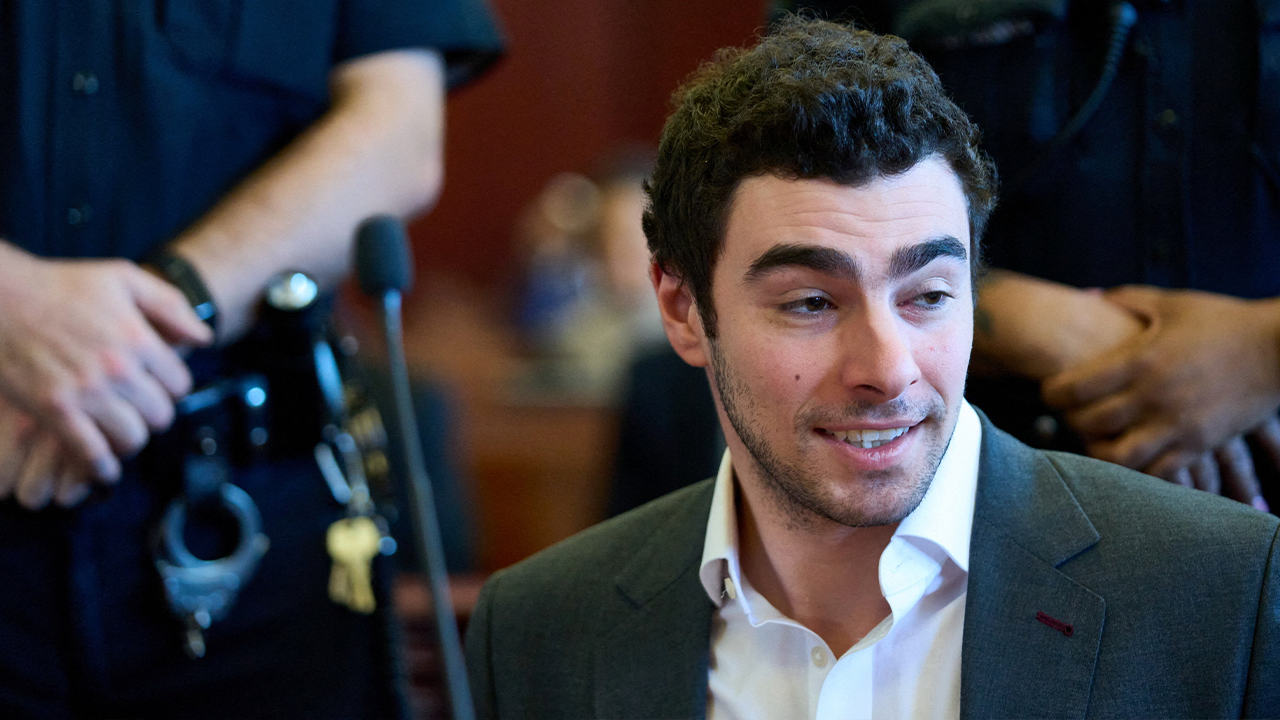
Judge rules Luigi Mangione won’t face death penalty
Fox News’ Nate Foy reports as a judge agreed to throw out the most serious charge against Luigi Mangione and denied the defense’s request to suppress some evidence. Legal editor Kerri Urbahn discusses the judge’s decisions.
NEWYou can now listen to Fox News articles!
A federal judge in New York has agreed to dismiss federal murder charges against Luigi Mangione. This takes the potential death penalty off the table.
Lawyers for accused assassin Luigi Mangione had continued to bolster their legal arguments to have the most serious charges against him thrown out.
Judge Margaret Garnett conceded to some “absurdity” in her decision.
“The Court would be remiss not to note at the outset the apparent absurdity of the inquiry,” she wrote. “The Defendant is charged with selecting a stranger to be killed based on his employment; carefully planning the killing, including identifying where and when the selected victim would be most vulnerable; traveling across multiple states to carry out that killing; and then gunning the victim down on a public street in midtown Manhattan, using a handgun equipped with a silencer. No one could seriously question that this is violent criminal conduct.”
ALVIN BRAGG’S ‘UNREALISTIC’ TIMELINE IN LUIGI MANGIONE CASE SETS UP SHOWDOWN WITH TRUMP DOJ
Luigi Mangione, charged with the murder of Brian Thompson, the CEO of UnitedHealthcare, appears in State Supreme Court in Manhattan alongside attorney Karen Friedman Agnifilo during an evidence suppression hearing in his case on Friday, December 12, 2025. (William Farrington for New York Post via Pool)
The ruling was one of two that came shortly before the 27-year-old was due back in court Friday morning for a status conference.
A separate motion to suppress evidence alleging police violated Mangione’s constitutional rights with the search of his backpack was denied. According to investigators, the suspected murder weapon and a manifesto were in the bag.
The defendant arrived around 11:10 a.m. in a tan jail jumpsuit and without handcuffs. The hearing kicked off a few minutes later.
Prosecutors said they were not yet ready to make a decision on whether they planned to appeal the judge’s decision. Much of the rest of the hearing focused on scheduling and questions about jury selection.
Read the judge’s order:
Although oral arguments already took place, the defense aggressively argued in subsequent filings that prosecutors failed to allege an underlying “crime of violence” necessary for the top charge of murder through use of a firearm. That was the only charge Mangione faced that carried the potential death penalty.
Prosecutors countered in an opposition filing that the defense is relying on irrelevant precedent, but the judge disagreed.
SEND US A TIP HERE
UnitedHealthcare CEO Brian Thompson is pictured in an undated portrait provided by UnitedHealth. The executive was shot from behind and killed on his way to an investor conference in New York City in what prosecutors have described as a politically motivated assassination. (AP Photo/UnitedHealth Group via AP)
In order to charge Mangione with the federal charge of murder through use of a firearm, prosecutors need an underlying crime of violence. They have alleged that crime to be stalking. However, according to legal analysts, if stalking can be done without violence, even if it wasn’t in the case alleged, the charge could fall apart.
Garnett wrote that she was bound by Supreme Court precedent.
“Over the course of the last two decades or so, the Supreme Court has embarked upon a legal journey, explained herein, that now requires lower courts to engage in an analysis totally divorced from the conduct at issue and centered on the hypothetically least serious conduct that the charged crime could possibly cover,” she wrote.
Luigi Mangione attends an evidentiary hearing in the murder case of UnitedHealthcare CEO Brian Thompson, at the Manhattan Supreme Court in New York, U.S., December 18, 2025. (Shannon Stapleton/Pool via Reuters)
JUDGE REVEALS EARLIEST POTENTIAL START TIMES FOR LUIGI MANGIONE’S FEDERAL MURDER TRIAL
Mangione is accused of stalking UnitedHealthcare CEO Brian Thompson before shooting him in the back outside a New York City hotel on the morning of a planned business conference.
SIGN UP TO GET TRUE CRIME NEWSLETTER
“It’s like a series of dominos — the only way that the federal government can get to a death penalty charge in their case is if the murder was committed during the course of a violent felony,” Joshua Ritter, a Los Angeles criminal defense attorney, previously told Fox News Digital. “And the reason that they need that is because they need what’s called a federal hook to get them federal jurisdiction.”
Thompson, a 50-year-old father of two from Minnesota, had come to the Big Apple to meet with Wall Street investors.
FOLLOW THE FOX TRUE CRIME TEAM ON X
Suspect Luigi Mangione is taken into the Blair County Courthouse on Tuesday, Dec. 10, 2024, in Hollidaysburg, Pa. (Janet Klingbeil via AP)
Surveillance cameras recorded the slaying. Video shows Thompson walking down the sidewalk outside the hotel when a man approaches from behind and opens fire.
Thompson suffered multiple gunshot wounds and collapsed to the ground. The gunman fled and was later spotted making his way uptown on a bicycle. There was at least one eyewitness, who appeared to be unharmed.
LIKE WHAT YOU’RE READING? FIND MORE ON THE TRUE CRIME HUB
Police arrested Mangione five days later at a McDonald’s in Altoona, Pennsylvania, where customers and staff said they recognized him from a wanted poster released in connection with Thompson’s murder.
Luigi Mangione is confronted by Altoona, Pennsylvania police in a McDonald’s shortly before his arrest for allegedly murdering UnitedHealthcare CEO Brian Thompson. (Altoona Police Department)
Police said they found the suspected murder weapon and handwritten notes that were critical of the health insurance industry and may indicate Mangione’s alleged planning and a motive.
Jury selection is scheduled for Sept. 8, with a trial expected to kick off on Oct. 13.
CLICK HERE TO DOWNLOAD THE FOX NEWS APP
Separately, Manhattan prosecutors have requested a July 1 start date for Mangione’s state trial, which his lawyers have objected to as “unrealistic.”
In a letter to New York Judge Gregory Carro Wednesday, Assistant Manhattan DA Joel Seidemann wrote that the state has an interest, protected by federal law, in taking Mangione to trial first.
“That case is none of my concern,” Judge Garnett told the parties in court Firday.
This is a breaking news story. Stick with Fox News Digital for updates.
Read the full article from Here



Scott A. Harrison, Ed.D., M.B.A., is a senior advisor at The Harrison Group, a consultancy based in Yarmouth.
Maine has long valued local control in education. That tradition reflects an important belief that communities should have a strong voice in shaping their schools. But local control should not prevent us from asking a harder question: Are there core functions that could be delivered more effectively through a single statewide framework?
One of the most important is educator evaluation and professional growth. Maine law already recognizes the importance of this work. Under Title 20-A, Chapter 508 (Educator Effectiveness), districts must implement performance evaluation and professional
growth systems that evaluate educators, assign effectiveness ratings and support
professional growth.
The law further requires superintendents to use those ratings to inform key human capital decisions, including recruitment, hiring, induction, mentoring, professional development, compensation, assignment and dismissal. In short, educator evaluation is not intended to be a compliance exercise. It is intended to be a primary lever for the continual improvement of teaching and learning.
In 2012, LD 1858 sought to advance that vision by giving districts broad flexibility to design their own systems. Districts could choose instructional frameworks, establish measures of effectiveness and determine how evaluators would be trained and calibrated. The goal was to balance local autonomy with professional accountability.
More than a decade later, however, the evidence suggests that flexibility alone has not produced consistent results.
My research involving 130 educators across four Maine school districts found only modest perceptions of performance evaluation and professional growth systems’ effectiveness.
On a four-point scale, average ratings ranged from 2.48 to 2.99. While educators generally agreed that districts provide individualized growth plans and can differentiate levels of instructional effectiveness, they rated several critical implementation areas notably lower, including instructional coaching, evaluator training, feedback quality, evaluator calibration and the use of evaluation data to inform professional learning and personnel decisions.
Although the sample was relatively small, the findings closely mirror what I have observed while working with predominantly rural Maine districts over the past decade.
The qualitative findings were equally revealing. Teachers and administrators described systems that are often cumbersome, inconsistently implemented and difficult to sustain. Educators reported spending significant time developing goals and documenting evidence, while administrators acknowledged that competing priorities frequently reduce evaluation to a compliance exercise rather than a meaningful opportunity for growth.
Participants cited insufficient training, inconsistent expectations, limited coaching support and weak connections between evaluation results and professional learning. Perhaps most significant, though not surprising given the realities of today’s schools, the primary obstacle appears to be not commitment, but capacity — the time, expertise and tools required to implement these complex systems with fidelity.
Designing and sustaining high-quality evaluation systems requires expertise in instructional leadership, observation and feedback, adult learning, professional development, data use and evaluator calibration. While some districts have built this capacity, many — particularly smaller and rural systems — have not. Even where expertise exists, time remains a major barrier.
Effective evaluation depends on regular observation, coaching, feedback and calibration. Yet for principals balancing instructional leadership with the daily demands of running a school, carrying out these responsibilities consistently can be extraordinarily difficult.
As a result, Maine has effectively asked more than 250 districts to independently build and maintain highly complex educator effectiveness systems. The outcome is predictable: uneven quality and implementation, and variable impact on teaching and learning.
This raises an important policy question: Should every district continue to design, train, calibrate and maintain its own evaluation system, or would educators and students be better served by a common statewide framework supported by regional and state expertise?
A statewide approach would not eliminate local control. Districts would continue to make decisions about hiring, staffing, curriculum, budgeting and school improvement priorities. Instead, the state would provide shared infrastructure: a common instructional and evaluation framework, validated tools, evaluator training, calibration supports, professional learning resources and implementation assistance.
The benefits extend beyond evaluation. A common framework would create stronger alignment across Maine’s educator pipeline. Colleges and universities could align coursework, clinical experiences and assessments to the exact same standards used in schools while sharing responsibility for educator success beyond initial placement.
Preparation programs, districts and the state would become partners in a continuous system of educator development, creating mutual accountability for results and a stronger return on Maine’s investment in teacher preparation.
Such alignment matters. As systems thinker Peter Senge observed, people working within the same system tend to produce similar results. If we want more consistent outcomes for students, we must pay closer attention to the systems shaping educator practice.
A statewide approach would not eliminate local control. Districts would continue to make decisions about hiring, staffing, curriculum, budgeting and school improvement priorities.
A common framework would establish a shared language and clearer expectations throughout the career continuum. It would also make continuous improvement easier. Rather than asking hundreds of districts to independently revise complex systems, the state could evaluate implementation, refine practices, share lessons learned and respond to emerging research. Educators have experienced too many short-lived initiatives that consume considerable time and effort before fading away.
A coherent statewide system would provide greater stability and more meaningful long-term improvement. The question is not whether local control matters. It does. The question is whether every district should be expected to independently build and sustain complex systems that require specialized expertise, significant resources and ongoing refinement.
If Maine is serious about improving outcomes for students, it should rethink which functions are best managed locally and which are better supported through statewide infrastructure. Educator effectiveness is one example. There are likely others.
In a previous op-ed here, I argued that Maine should reconsider whether teacher compensation is best negotiated district by district. The same question applies here. When critical human capital systems are essential to student success, a coherent statewide framework may be better positioned to advance equity, efficiency and effectiveness while preserving local decision-making where it matters most.
The goal is not less local control, but a smarter balance between local autonomy and statewide support — one that strengthens schools and improves outcomes for every student, regardless of geography.
Massachusetts
Fisherman reels in white shark off Massachusetts, then snags the hook from its toothy mouth

BILLERICA, Mass. (AP) — Elliot Sudal didn’t need a bigger boat, but he did need to find a way to get a hook out of a shark’s mouth.
Sudal, a veteran angler and boat captain, reeled in the nearly nine-foot shark — also commonly known as a great white shark or a great white — on June 7 on Nantucket. White sharks are a protected species in the U.S. and must be released immediately when accidentally caught.
That presents a nasty problem for a fisherman because the white shark is a formidable apex predator best known for the 1975 movie Jaws, in which Roy Scheider utters the famous line “You’re gonna need a bigger boat” upon seeing the big fish. Sudal, who caught the shark while fishing from shore, decided to use his encounter to demonstrate how to respond to such a situation.
Sudal posted a video of himself removing the hook to his social media accounts. In the video, Sudal climbs onto the back of the shark, secures the fish in the surf, and removes the hook from its mouth. By the end of the short video, the shark is back in the water.
White sharks typically have about 300 teeth arranged into five rows, so speed was key.
“Hooks out and back on her way in 15 seconds, not sure how to do it better,” Sudal wrote in an Instagram post that included a video of the shark release.
Sudal is no stranger to sharks, and has caught and tagged hundreds of them over the years. He said in a social media post that this month’s encounter with a white shark was the first time he has ever caught one of them in more than a decade of the work.
Sudal’s practices have sometimes attracted the attention of the National Oceanic and Atmospheric Association, such as in 2017, when the agency investigated his handling of a smalltooth sawfish, an endangered species, in Florida. The agency said in 2018 that it sent Sudal a letter “informing him of the Endangered Species Act issues and the safe handling protocol for sawfish.”
White sharks are not listed under the federal Endangered Species Act, but are subject to special federal protections. The International Union for Conservation of Nature considers them vulnerable globally.
Sightings of white sharks off New England have ticked up in recent years, and some scientists have pinned that to the greater availability of the seals that they prey on. Dangerous encounters between white sharks and humans are extremely rare, and only a few dozen fatal white shark bites on people have ever been recorded.
___
Whittle reported from Portland, Maine.
Copyright 2026 The Associated Press. All rights reserved.

SALEM, N.H. — A Lowell High School freshman was identified on Friday as the victim of a fatal shooting in Salem, where authorities say the 15‑year‑old was found dead outside a home during the pre-dawn hours.
New Hampshire Attorney General John Formella’s office said in a press release that police responding to a 911 call discovered the teen, identified as Wichai Saksene, just outside the residence on Orchard Terrace.
An autopsy later determined he died from a single gunshot wound to the chest, and his death has been ruled a homicide.
Authorities said the circumstances remain under active investigation but noted there is no known threat to the public, as all involved parties have been identified.
In a message that began “sad news for your awareness,” Lowell Public Schools Superintendent Liam Skinner told School Committee members that Saksene was a Lowell High freshman and former student of Stoklosa Middle School and Lincoln Elementary School.
He added that central office staff are assisting Lowell High with communications to staff and families and that Student Support Services has activated a critical incident team to be at the high school on Monday.
The Salem Police Department stated in a social media post that they are working with the New Hampshire State Police Major Crimes Unit and Formella’s office to investigate the shooting.
Follow Aaron Curtis on X @aselahcurtis, or on Bluesky @aaronscurtis.bsky.social.
-

 Delaware2 minutes ago
Delaware history in News Journal archives June 21-27: Sussex flood
-

 Florida5 minutes ago
7 of our favorite Florida restaurants in Vero Beach and Fellsmere
-

 Georgia10 minutes ago
2 Georgia lake towns named among the South’s best places to live
-

 Hawaii17 minutes ago
Hawaii County Surf Forecast for June 20, 2026 | Big Island Now
-
 Idaho20 minutes ago
‘Land back’ gift to Boise Valley tribes celebrated during annual Return of the Boise Valley People
-

 Illinois25 minutes ago
Illinois Tollway proposing increased tolls in 2027 to fund $26.5 billion in road construction
-

 Indiana32 minutes ago
Juneteenth event in Martinsville sparks conversation about city’s history
-
Iowa35 minutes ago
Iowa Lottery Mega Millions, Pick 3 Midday results for June 19, 2026

