Connecticut
Connecticut Sinks Deeper into Debt, Hidden Behind Budget Surpluses


The U.S. and the State of Connecticut are sinking deeper into debt. The skyrocketing national debt receives widespread media attention, Connecticut’s almost none. Uncle Sam’s growing debt is highlighted and explained by huge budget deficits, while Connecticut’s increasing liabilities are hidden behind budget surpluses.
Yet, there’s another reason that growing debt in the Nutmeg State is largely ignored. The increase is caused mainly by overgenerous and underfunded state employee compensation. No one, certainly not union-friendly Democrats, wants to offend public sector unions by exposing this reality.
Actually, Democrats have employed active disinformation and willful indifference to misinform and uninform the public about the last two state labor contracts.
In 2022, Governor Lamont inked the SEBAC 2022 agreement, a four-year deal with three years of 4.5% annual pay boosts (combining wages and “annual increments”). Lamont is now negotiating the fourth year, which was left “open.” The three-year increase accumulates to a robust 14% compound increase. That doesn’t count $3,500 in pensionable bonus payments nor the separate pandemic pay averaging $1,000 per employee in 2023.
When legislators approved SEBAC 2022, the Office of Fiscal Analysis estimated the future cost of the agreement, excluding the impact upon the state employee pension fund. OFA stated “The SERS impact will not be recognized until FY 24.” There has been no official follow-up analysis of SEBAC 2022, even to assess its impact upon SERS.
Contrast this with the treatment of the SEBAC 2017 labor agreement negotiated by former governor Dannel Malloy. Malloy claimed that SEBAC 2017 would save the state $24 billion over 20 years. He and Democrat legislators passed a law requiring the State Comptroller to track the alleged savings on an annual basis over a decade. Every year, the State Comptroller prepares the “SEBAC 2017 Savings Report,”
Almost half ($9.7 billion) of the “savings” were fictional wage concessions that state employees never made.
The fantasy relies upon the preposterous notion that state employees are entitled to raises every year, as if annual raises are the equivalent of a birthright. If employees do not get a raise, the raise they don’t get is called a “saving.”
So, who established the “raise they didn’t get” in 2017? Malloy did. In his budget proposal, he proposed hundreds of millions of raises. Then, he negotiated a better bargain for a few years and called the difference “savings.”
How do we know this? From the documentation that Malloy’s Office of Policy and Management published in support of his claimed savings. Under a header of “Wage Estimates were developed by OPM” (not an independent source), it states “Elimination of potential FY 2017, 2018, and 2019 increases: Removes all of the proposed RSA increase in the Governor’s recommended budget…” [Emphasis added.]
The raises that workers “didn’t get” were figments of Dan Malloy’s imagination – they were “potential,” “proposed” and “recommended.” There was no existing wage contract under which unionized state workers were legally entitled to raises that they gave up in negotiations with Malloy.
Malloy claimed these wage savings in the fiscal 2018-2019 budget – and over the next 18 years. That is how the fantasy number balloons to $9.7 billion. Why not $48.5 billion over the next century?
Malloy’s claim was ludicrous in the first place, but this exercise in make-believe has become embarrassing even to the State Comptroller who wrote in the recent Report “In general, savings estimates of prior policy changes become more tenuous the more time passes…”
Wait, it gets worse. While employees agreed to three years of wage freezes, then they received two healthy 3.5% wage increases. In addition, most still received five years of “annual increments” (aka “step increases”) that average 2% per employee, and Malloy paid a $2,000 bonus to those who did not receive “increments” and $1,000 to those who did. Factoring in “increments” (but not bonuses), employees enjoyed three years of 2% annual increases and two of 5.5%. That accumulates to a compound 13.7% increase over the five-year period. Not bad.
The entire exercise involved sleight of hand where Malloy backloaded wage increases, so he could create the illusion of “savings” at the front end.
While SEBAC 2017 has been distorted by this elaborate exercise in disinformation, Lamont’s SEBAC 2022 deal has simply been ignored.
Except that the Nutmeg Research Institute chose not to ignore SEBAC 2022 and commissioned a study of it by The Townsend Group, which I head. We found that SEBAC 2022 increased the unfunded liability of the SERS pension fund by a whopping $4.5 billion, or 11%, and that it has increased state labor costs to a current annual running rate of $8.5 billion, a level $836 million, or 11%, higher than costs in fiscal 2021 immediately before SEBAC 2022 took effect.
It is time for Lamont to impose a back-loaded wage and increment freeze in the fourth “open” year of SEBAC 2022. Otherwise, the Nutmeg State will fall even deeper in debt.


Connecticut
Florida High School State Bronze Medalist Dajah German Verbals To Connecticut For Fall 2027

Fitter and Faster Swim Camps is the proud sponsor of SwimSwam’s College Recruiting Channel and all commitment news. For many, swimming in college is a lifelong dream that is pursued with dedication and determination. Fitter and Faster is proud to honor these athletes and those who supported them on their journey.
Florida high school state bronze medalist Dajah German has announced her verbal commitment to swim and study at the University of Connecticut beginning in the fall of 2027. She publicized the news on SwimCloud, writing:
I am so excited to announce my verbal commitment to continue my academic and athletic career at the University of Connecticut! I’m incredibly grateful for everyone who has supported me throughout this journey, my family, coaches, teammates, and friends who have pushed me to be my best throughout the years. And a very special thank you to Coach Chris and Coach Nicole for believing in me and giving me this opportunity. I’m so excited for what’s ahead. GO HUSKIES!
A rising senior at Fort Lauderdale High School in Florida, German trains year-round with Swim Fort Lauderdale and primarily specializes in the sprint and middle-distance freestyle events.
German has improved each year of her high school career, most recently dropping from 23.78, 51.39, and 1:50.56 in the 50/100/200 free to 23.54, 51.35, and 1:49.69 during the 2025-26 short course season.
German’s top meet of the season was the Florida Senior Championships in March, where she recorded her current PBs in both the 50 and 200 free. She finished second in the 500 free (4:55.94) and 1650 free (17:02.78), third in both the 50 free and 200 free, and fifth in the 100 free (51.43). She set her current 100 free PB at a smaller holiday meet in December. In the 500 free, she clocked a season-best 4:55.21 at the Speedo Cup in January, with her lifetime best of 4:53.19 coming at the 2025 Florida Senior Championships.
German has qualified for the FHSAA (Florida High School Athletic Association) State Championships for the past three years, with her top performance coming at the 2025 iteration in November. She placed third in the 50 free (23.96), fifth in the 500 free (5:01.12), and helped Fort Lauderdale to fourth place in both the 200 free relay (24.64 leadoff) and 400 free relay (53.08 anchor).
Top SCY Times:
- 50 Freestyle: 23.54
- 100 Freestyle: 51.35
- 200 Freestyle: 1:49.69
- 500 Freestyle: 4:53.19
A Division I Mid-Major program, Connecticut competes in the Big East, with the women’s team placing second out of seven teams at this past season’s conference championships. German’s current lifetime bests would have placed third in the 200 free, fourth in the 500 free, eighth in the 50 free, and ninth in the 100 free, setting her up as an immediate contributor with two full seasons of training still ahead before her first conference meet.
German joins Anna Mumford, Lyla Devlin, Lena Brown, and Louisa Holda in committing to the Huskies’ class of 2031 so far.
If you have a commitment to report, please send an email with a photo (landscape, or horizontal, looks best) and a quote to [email protected].
About the Fitter and Faster Swim Tour
Fitter & Faster Swim Camps feature the most innovative teaching platforms for competitive swimmers of all levels. Camps are produced year-round throughout the USA and Canada. All camps are led by elite swimmers and coaches. Visit fitterandfaster.com to find or request a swim camp near you.

FFT SOCIAL
Instagram – @fitterandfasterswimtour
Facebook – @fitterandfastertour
Twitter – @fitterandfaster
FFT is a SwimSwam partner.

Here are the forecast details for northern Connecticut via the National Weather Service:
Today: Sunny, with a high near 80. Light west wind increasing to 6 to 11 mph in the morning.
Tonight: Partly cloudy, with a low around 56. Northwest wind around 6 mph becoming calm in the evening.
Monday: A chance of showers before 2pm, then a chance of showers and thunderstorms between 2pm and 4pm, then showers likely and possibly a thunderstorm after 4pm. Increasing clouds, with a high near 76. Calm wind becoming southeast around 6 mph in the afternoon. Chance of precipitation is 60%. New rainfall amounts between a quarter and half of an inch possible.
Monday Night: Showers and possibly a thunderstorm. Some of the storms could produce heavy rainfall. Low around 59. Southeast wind around 8 mph becoming southwest after midnight. Chance of precipitation is 90%. New precipitation amounts between three quarters and one inch possible.
-
 Politics58 seconds ago
Supreme Court says ex-LAPD officer may be sued for excessive force in street shooting
-
 Sports9 minutes ago
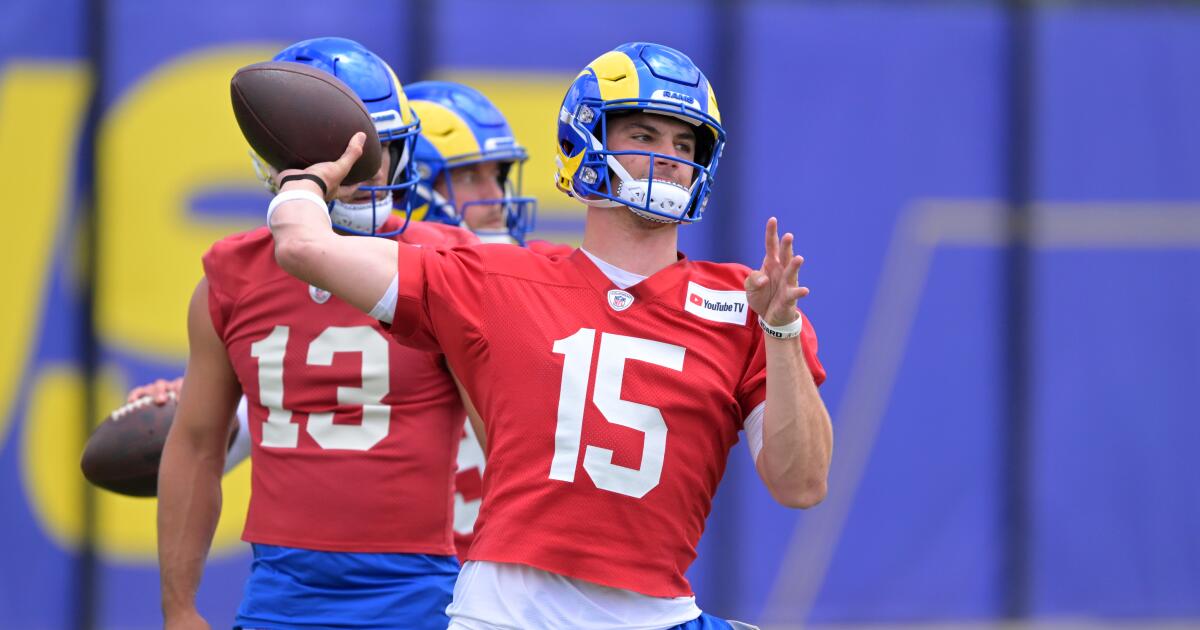
Rams QB Ty Simpson embracing an unusual bedtime routine to spur his development
-

 World19 minutes ago
Lebanon Latest: Israeli attacks surge despite ceasefire efforts
-
 News46 minutes ago
Supreme Court allows a ruling that ends a tool to protect minority voters in 7 states
-

 New York2 hours ago
How a Security Guard Lives on $46,000 a Year in the East Bronx
-

 Los Angeles, Ca2 hours ago
L.A. Tenants Union trying to save business owner given eviction notice ‘without reason or discussion’
-

 Detroit, MI2 hours ago
Grace Hanke crowned Miss Michigan 2026
-

 San Francisco, CA3 hours ago
The U.S. Government Secretly Tested Biological Weapons. The Citizens of San Francisco Paid the Price.

