Northeast
Congress agrees to fully fund Baltimore Key Bridge rebuild in plan to avert government shutdown

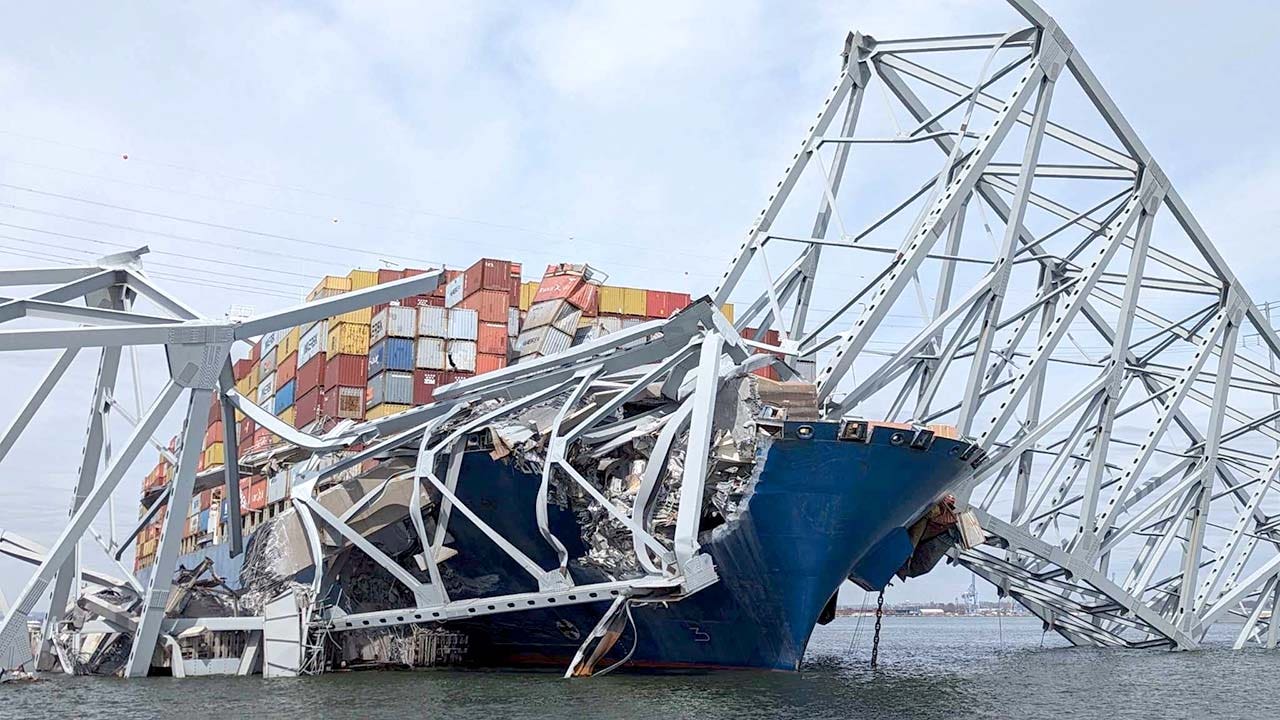
Congressional leaders struck a deal to avert a government shutdown that includes a provision stating that the federal government will fully pay for the rebuilding of the Francis Scott Key Bridge in Baltimore.
The provision also allows the Treasury Department to recoup at least some funds spent through insurance payments, as well as federal and state litigation related to its collapse.
A container ship called the Dali struck part of the Key Bridge in the early hours of March 26.
The incident sent shock waves through both domestic and global supply chains, having blocked a significant amount of shipping to and from the Port of Baltimore for more than two months.
REPUBLICANS GIVE DETAILS FROM CLOSED-DOOR MEETINGS WITH DOGE’S MUSK, RAMASWAMY
Part of a span of the collapsed Francis Scott Key Bridge is suspended on the container ship Dali in Baltimore on March 26, 2024. (Army Corps of Engineers/Handout via REUTERS)
Maryland officials estimated the cost to rebuild the bridge to be between $1.7 billion and $1.9 billion.
The new federal measure is part of a short-term government funding bill to avert a partial shutdown through March 14 to give lawmakers more time to negotiate a spending deal for the remainder of fiscal year 2025.
It is also one of several seemingly unrelated policy measures included in the bill that have angered members of congressional Republicans’ rightmost flank, who said they felt largely blindsided by inclusions.
DANIEL PENNY TO BE TAPPED FOR CONGRESSIONAL GOLD MEDAL BY HOUSE GOP LAWMAKER
House Speaker Mike Johnson, left, and Sen. Chuck Schumer struck an agreement on government funding. (Reuters)
Federal and state Democrats from Maryland, however, praised the Key Bridge’s inclusion in the bipartisan deal.
“This has been a nine-month fight to make sure that Baltimore City and Baltimore County are made whole again. And now, we are able to secure the full funding of the Francis Scott Key Bridge rebuild which the Congress will vote on in the next 48 hours – this means so much to all of us throughout the state,” Rep. Kewisi Mfume, D-Md., said in a statement.
Sen. Chris Van Hollen, D-Md., who also praised the provision and criticized House Republicans for objecting to it on Monday, before the final deal was struck.
Rep. Kweisi Mfume praised the measure’s inclusion. (Chip Somodevilla/Getty Images)
“House Republicans have not signed off on 100% funding for the Key Bridge. The Senate has signed off on that. But we have not been given a good reason why House Republicans continue to object,” Van Hollen told local outlet 11 News. “That is the state of play as we speak.”
The short-term spending bill must pass the House and Senate by Friday, Dec. 20 to avoid a partial government shutdown.
Read the full article from Here


Connecticut lawmakers are again looking to restore Shore Line East rail service to its pre‑pandemic levels, a proposal that could add about 90 more trains per week.
Lawmakers are also weighing a separate cost‑saving proposal to shift the line from electric rail cars back to diesel.
The plan comes as ridership remains well below 2019 numbers, though state data shows those numbers have begun to climb.
The Department of Transportation provided the General Assembly’s transportation committee with the following data:
- 132 trains per week today versus 222 trains per week in 2019, according to the CTDOT commissioner.
- In 2019, most weekday SLE trains traveled between New Haven Union Station and Old Saybrook. This allowed SLE to operate with only five train sets in the morning and four train sets in the afternoon.
- It should be noted that 2019 SLE service levels were very different due to constrained infrastructure; 2019 service levels had a reduced number of SLE trains serving New London (13 trains per day Monday through Friday, as opposed to 20 today), while other stations had increased service (36 trains per day Monday through Friday, as opposed to 20 today).
“2019 levels beyond Old Saybrook to New London would require more crews and more train sets than were used in 2019, requiring significantly more financial resources,” the department wrote in its written testimony.
The department said the governor’s FY2027 budget does not include funding for a full restoration. In other words, even if the legislature requires additional trains, the funds are not included in the current financial plan.
Governor Lamont said on Monday to remember that the state subsidizes the line more than any other rail right now.
“There’s not as much demand as there are for some of the other rail services in other parts of the state, so that’s the balance we’re trying to get right,” Lamont said.
At a public hearing on Monday, concerns about the line’s reliability and schedule were a central focus in the testimony.
“We’re making the line less attractive, some would say. The schedules are very, very difficult to manage,” said Sen. Christine Cohen of Guilford, the co-chair of the committee.
The current schedule for eastbound morning commuters is difficult. The train either arrives in New London just after 7 a.m. or after 9 a.m.
“So obviously not really … conducive to a typical workday,” Cohen said.
Cohen, who represents communities along the line, said she continues to reintroduce the bill to expand service year after year, pushing the state to do more with the line.
She thanked the department for the work it was able to do with the recent funding to establish a through train to Stamford.
“What do we need to do, and what are the challenges that you face in terms of expansion at this time?” Cohen asked.
Commissioner Garrett Eucalitto responded that the biggest hurdle is the cost of labor and access fees to Amtrak, which owns the territory.
“The cost to provide rail service is very expensive,” Eucalitto said.
He said CTDOT knows the current schedule is “not ideal,” but the economics of a work-from-home society are difficult.
“People expect 100% of the trains that they had in 2019, but they only want to take it two days a week,” Eucalitto said.
Asked about the eastbound schedule, the commissioner explained Shore Line East still operates on a model that sends trains toward New Haven in the morning rather than toward New London.
Changing that would require more equipment, more crews, and a second morning operations base, as well as negotiations with Amtrak, which owns the tracks.
Amtrak is “protecting their slots to be able to run increased Northeast Regional service as well as increased Acela service,” Eucallito said. “They’re going to look at us and question, ‘Well, how does that impact our need for Amtrak services?’ They’ll never give you an answer upfront, it’s always: ‘show us a proposal and then they’ll respond to it.’”
Cohen, who chairs the Transportation Committee, touted how a successful Shoreline East benefits the environment, development along the line, and reduces I-95 congestion.
“We need to start talking about how much money this costs us and think about all of the ancillary benefits,” Cohen said during the hearing.
Cohen said there is multi-state support for extending the line into Rhode Island.
“We will need some federal dollars. But as you say, there are other businesses up the line in New London,” Cohen said. “We’ve got Electric Boat. We’ve got Pfizer up that way. If we can get those employees on the transit line, we’re all the better for it.”
Rider advocates said the issue is familiar.
“I’d rather see solutions, and not things that are holding it back,” said Susan Feaster, founder of the Shore Line East Riders’ Advocacy Group.
She said she worries the line is facing a transit death spiral, with reduced service leading to lower ridership and falling fare revenue.
“They have to give us the money,” Feaster said. “It shouldn’t have to be profitable.”
Like other train lines across the country, Shore Line East relies on subsidies.
“We’re not asking for everything to be done overnight, but just incrementally,” Feaster said.
The line received $5 million two years ago, which increased service levels.
The proposal comes as the state reviews whether to return to diesel rail cars that are more than 30 years old.
The state says the switch would save about $9 million, but riders have said it would worsen the passenger experience.
NBC Connecticut asked Cohen whether she’ll ask DOT to reverse that proposal.
“I really want to,” Cohen said. “I appreciate what CTDOT was trying to do in terms of not cutting service as a result of trying to find savings elsewhere. This isn’t the way to do it.”

PORTLAND, Maine (AP) — Maine Democrat Graham Platner has picked up another high-profile endorsement in his bid to flip a key Senate seat blue, marking another sign of the oyster farmer and combat veteran’s political resiliency even as he continues to face controversy throughout his campaign.
Arizona Democrat Ruben Gallego announced Monday that he was backing Platner, saying that the first-time candidate “reflects the grit and independence that defines Maine.”
“Graham Platner is the kind of fighter Maine hasn’t seen in a long time, someone who tells you exactly what he thinks, doesn’t owe anything to the special interests, and wakes up every day thinking about working families,” said Gallego, who won a Senate seat in Arizona in 2024 by more than 2 points while Trump carried the state by nearly 6 points.
Platner has previously been endorsed by Vermont Sen. Bernie Sanders, an independent who caucuses with Democrats, and New Mexico Sen. Martin Heinrich, a Democrat.
However, Senate Minority Leader Chuck Schumer has endorsed Platner’s main opponent, Maine Gov. Janet Mills.
Both Platner, 41, and Mills, 78, are hoping to unseat Republican Sen. Susan Collins, 73, a five-term incumbent who announced last month that she was running for another term. A victory in Maine is crucial for Democrats’ efforts to take back control of the Senate. The Democratic Party needs to net four seats to retake the Senate majority, and they are aiming to do that in Maine, North Carolina, Alaska and Ohio.
READ MORE: Maine’s Graham Platner thinks voters will overlook his past to support a new type of candidate
Platner has gained traction with his anti-establishment image and economic equality message. He’s pressed forward despite controversies over old social media posts and a tattoo resembling a Nazi symbol, which he recently had covered up.
Gallego is among the Democrats named as possible 2028 presidential contenders. Last fall, he stumped in New Jersey, Virginia and Florida, where he campaigned for Democrats who went on to win their elections.
“I have an immense amount of respect for him and I’m looking forward to joining him as a fellow Marine and combat infantryman in the U.S. Senate,” Platner said in a statement.
Kruesi reported from Providence, Rhode Island.
A free press is a cornerstone of a healthy democracy.
Support trusted journalism and civil dialogue.

With a widening conflict in the Middle East after the American and Israeli attack on Iran Saturday, global markets are bracing for a shakeup in the energy supply chain.
So, here at home, what can consumers expect at the gas pump?
An increase in oil prices is almost always followed by an increase in gas prices. And the oil market has already reacted to the war. NBC News reported on Sunday that U.S. crude oil initially spiked more than 10%, while Brent, the international oil benchmark, rose as much as 13%.
Early Monday morning, reports were coming in of black smoke rising from the U.S. embassy in Kuwait City.
While Iran’s oil reserves supply less than an estimated 5% of global production, the main concern is the Strait of Hormuz. This maritime passageway borders Iran at the bottleneck of the Persian Gulf, and more than 20% of the world’s oil passes through. If Iran closes or restricts Hormuz, the oil market could face severe disruptions.
Gas prices rise about 2.5 cents for every dollar increase in crude oil prices. As of Sunday, U.S. crude oil prices had already increased by nearly $5 a barrel.
“I fully expect that by Monday night, you could credibly say that gas prices are being impacted by oil prices having gone up,” GasBuddy analyst Patrick De Haan told NBC News.
GasBuddy characterizes their expectations for price increases as “incremental” rather than “explosive”. The group said to anticipate a potential 10-15 cent increase over the next couple of weeks.

Rep. Kevin Kiley announces run in California’s redrawn 6th Congressional District

How the Colorado Rockies Are Actually Building Its Opening Day Roster

Lawmakers again push to restore Shore Line East service to 2019 levels

Delaware Supreme Court upholds reforms to curb ‘DExit’ concerns

Florida High School Boys Basketball 2026 Playoff Brackets, Schedule (FHSAA) – March 2, 2026

Florida High School Football Rankings: Top 25 teams – Oct. 21

Cleary's 21 help Le Moyne down Central Connecticut State 69-64 in OT

How old is Bo Nix? What to know about Oregon quarterback ahead of 2024 NFL Draft

99th annual Pony Swim held in Virginia

Indiana Members Credit Union announced as new anchor tenant at Bottleworks District

Map: Earthquake Shakes Central California

Gas prices could jump as Middle East tensions threaten global oil supply

Pakistan calls troops, orders 3-day curfew as 24 killed in pro-Iran rallies

US says Kuwait accidentally shot down 3 American jets

House Republicans push Johnson to go to war with Senate over SAVE Act
-

 World5 days ago
Exclusive: DeepSeek withholds latest AI model from US chipmakers including Nvidia, sources say
-

 Massachusetts5 days ago
Mother and daughter injured in Taunton house explosion
-

 Denver, CO5 days ago
10 acres charred, 5 injured in Thornton grass fire, evacuation orders lifted
-

 Louisiana1 week ago
Wildfire near Gum Swamp Road in Livingston Parish now under control; more than 200 acres burned
-

 Technology1 week ago
YouTube TV billing scam emails are hitting inboxes
-

 Politics1 week ago
OpenAI didn’t contact police despite employees flagging mass shooter’s concerning chatbot interactions: REPORT
-

 Technology1 week ago
Stellantis is in a crisis of its own making
-

 News1 week ago
World reacts as US top court limits Trump’s tariff powers