Lifestyle
The bald eagle isn't actually America's national bird — but that's poised to change

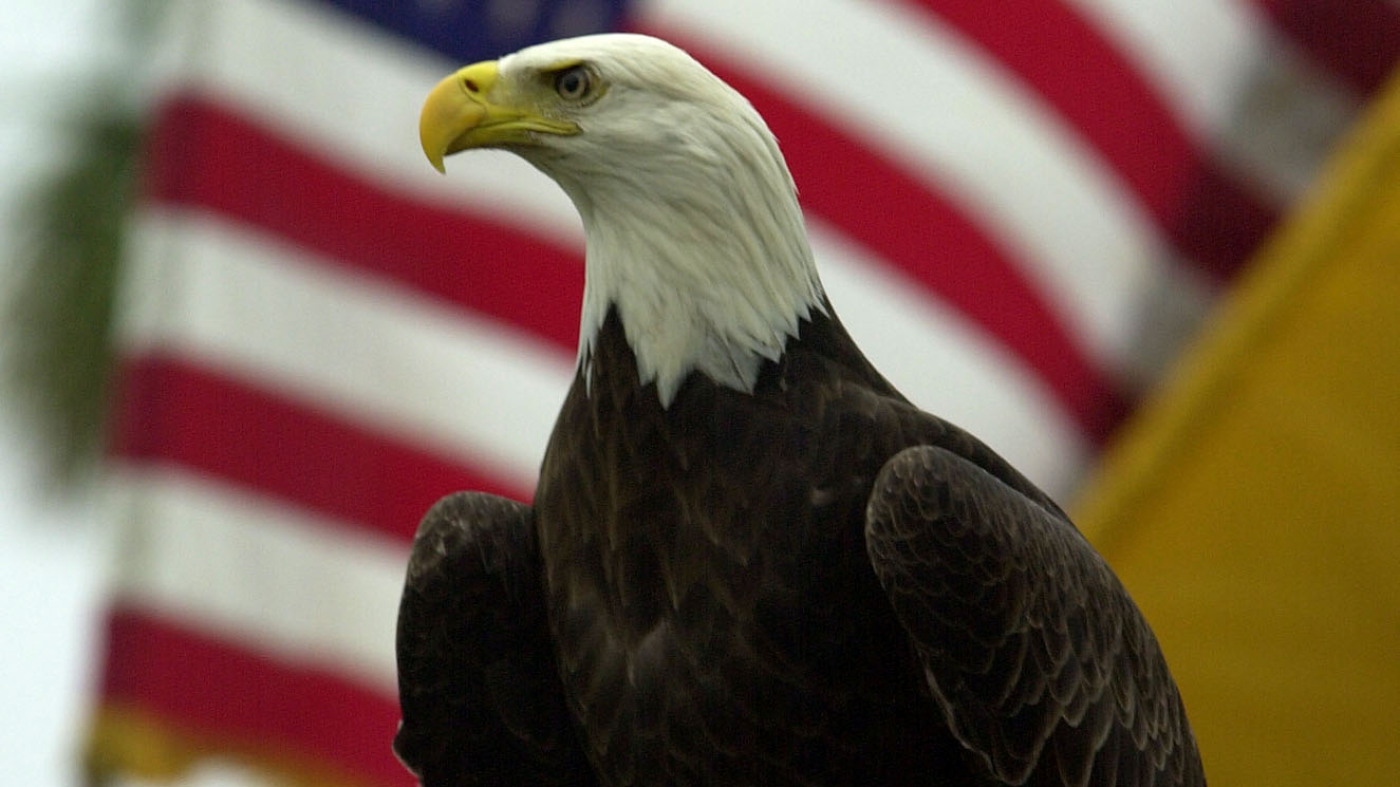
Bald eagles have symbolized America since 1782. But they’re not officially designated the national bird — yet.
Bruce Weaver/AFP via Getty Images
hide caption
toggle caption
Bruce Weaver/AFP via Getty Images
The bald eagle has been a symbol of the United States for centuries, with its iconography plastered across currency, documents, flags, stamps, government buildings, military uniforms and more.
You’d be forgiven for thinking it’s America’s national bird. But the fine print doesn’t officially say so — at least not yet.
On Monday, the House of Representatives passed a bill amending the U.S. Code to officially designate the bald eagle (aka Haliaeetus leucocephalus) as the country’s national bird.
The Senate already passed the bill, with bipartisan support, in July. Now it just needs President Biden’s signature to become the law of the land.
“Today, we rightfully recognize the bald eagle as our official national bird — bestowing an honor that is long overdue,” said Rep. Brad Finstad, the Minnesota Republican who introduced the House version of the bill earlier this year.
So why did the recognition take so long, and how did it finally become a reality? Americans have one dogged eagle enthusiast to thank.
How bald eagles became America’s unofficial bird

The presidential seal, like the logos of many federal institutions, stars a bald eagle.
Mandel Ngan/AFP via Getty Images
hide caption
toggle caption
Mandel Ngan/AFP via Getty Images
Eagles have been used as a symbol of strength since ancient Rome, so it’s not surprising that they soared into American iconography too.
After the U.S.’ founding in 1776, three different committees tried unsuccessfully to come up with an official seal that would satisfy Congress.
Eventually, Charles Thomson, the secretary of Congress, combined elements from all three proposals into what is now known as the Great Seal, featuring an eagle front and center, clasping an olive branch and arrows in its talons.

The original proposal depicted a small, white eagle. Thomson recommended it be replaced with a bald eagle, a species native to North America.
Congress adopted the design in 1782, cementing the bald eagle’s status as an American icon.
The species’ popularity has continued to soar ever since. In addition to its official appearances, the bald eagle can be seen today decorating all sorts of patriotic merchandise, serving as the mascot for hundreds of schools and even flying over major sporting events.
A Minnesota eagle enthusiast lobbied for their recognition
That’s why Preston Cook was shocked to learn that bald eagles aren’t technically America’s national bird.
Cook, 78, has devoted much of his life to studying and honoring the species.
“I saw a movie in 1966 called A Thousand Clowns, and it had one line in it: ‘You can’t have too many eagles,’” Cook told MPR News in November. “And that inspired me. So I left the movie theater thinking, ‘I want to collect eagles.’”
Over the decades he’s amassed more than 40,000 bald eagle items, from pins to paintings to playing cards, a collection that currently lives at the National Eagle Center in Wabasha, Minn. (He doesn’t play favorites, but counts the eagle buttons issued to him on his military dress uniform in 1966 among the most meaningful.)

Around 2010, while doing research for a book about the birds, Cook realized he could not find “anything whatsoever that the bald eagle had ever been legislatively designated as our national bird nor any presidential proclamation,” as he told NPR’s All Things Considered this week.
Alarmed, Cook wrote a letter to the late Sen. Dianne Feinstein of California. She sent staffers to the National Archives, who did more research and ultimately confirmed his hunch.
The U.S. recognizes the rose as its national flower, the oak as its national tree and the bison as its national mammal. But nowhere does it legally establish a national bird.
Cook took it upon himself to change that. After years of lobbying lawmakers, he joined forces with the National Eagle Center last year to write what he calls “a very simple bill.” But getting lawmakers on board wasn’t easy, in part because so many figured bald eagles already held the distinction.
“It was a little bit of a challenge in the beginning because they wouldn’t believe me,” Cook said, adding that Feinstein’s letter helped. “So they did their research and came up with the same conclusion I came up with: It is not our national bird, and we don’t have a national bird.”
Bald eagles are a symbol of resilience in more ways than one

Bald eagles were endangered for many decades before federal protections led to their recovery. They were removed from the Endangered Species list in 2007.
Bruce Bennett/Getty Images
hide caption
toggle caption
Bruce Bennett/Getty Images
Minnesota Sens. Amy Klobuchar and Tina Smith were among the bipartisan co-sponsors of the Senate bill, and Minnesota Reps. Brad Finstad and Angie Craig introduced it in the House.
It makes sense that the proposed bill was popular in Minnesota, as the state has the second-highest number of bald eagles after Alaska, MPR News reports. As Klobuchar said in a statement, “we know a thing or two about eagles.”

An estimated 316,700 bald eagles populated the lower 48 states as of 2020, according to the U.S. Fish and Wildlife Service, which says that number had quadrupled since its last data set a decade earlier.
Bald eagles lived peacefully among Indigenous Americans (who consider them sacred) for generations and were abundant in the U.S. when they were chosen as the star of the seal in 1782. But their population has dwindled dangerously at times since.
For many decades they were considered an endangered species, largely due to “human ignorance and persecution by pesticides, careless shootings, car and powerline collisions and loss of habitat for nesting and foraging,” according to the National Audubon Society.
Congress passed the Bald Eagle Protection Act in 1940, making it illegal to possess, kill or sell the birds. But in that decade, a new threat emerged: the insecticide DDT, which caused eggshells to thin and easily break.
By 1963, there were a record-low 417 nesting pairs in the lower 48.
But federal protections saved the species from near-extinction.
After the U.S. banned DDT in 1972 (and Canada the following year), the bald eagle population increased exponentially. By 2007, they were removed from the Endangered Species list and considered officially “recovered.”
Ed Hahn, the communications director at the National Eagle Center, hopes the bird’s legacy holds lessons for the management of other species, whether they are nationally recognized or not
“When we look at some of the issues that are facing other natural resources today, we can look again at our living national symbol and now our official national bird,” Hahn told MPR News. “It shows what we are able and willing to do when we truly value something, when it’s important to us.”

For Iris van Herpen, couture is a laboratory as much as a runway. Our chief fashion critic, Vanessa Friedman, takes us inside this Dutch designer’s latest Paris show — from sci-fi-inspired gowns to an audacious attempt at a dress made of charged plasma.
Lifestyle
The BoF Podcast | Decoding Paris Haute Couture: Wonder, Restraint and the Call of the Void


-

 Texas6 minutes ago
Texas Rangers investigating City of Trinidad after water issues, controversial arrests, firings
-

 Utah8 minutes ago
President Trump expected to reduce the size of Utah monuments
-

 Vermont14 minutes ago
Vermont marks fourth straight year of July flooding as recovery drags on
-

 Virginia21 minutes ago
Vance leasing part of multimillion-dollar Virginia farm as an additional residence | CNN Politics
-

 Washington24 minutes ago
Washington State Democratic Party draws criticism over reparations, antisemitism language
-

 Wisconsin29 minutes ago
What’s new to eat and drink at the 2026 Wisconsin State Fair?
-

 West Virginia36 minutes ago
West Virginia to launch school clothing allowance program
-

 Wyoming39 minutes ago
Election Q&A: Laurie Longtine for Wyoming House District 59

