Northeast
British painting stolen by NJ mobsters is returned half a century later

Art detective reveals recovered Van Gogh painting
Art detective Arthur Brand retrieved a Van Gogh painting that went missing over three years ago. Security footage shows the heist as it happened. (SOURCE: Reuters/Netherlands Police/Groninger Museum/Arthur Brand)
An 18th century British painting stolen by New Jersey mobsters in 1969 has been returned more than a half-century later to the family that bought it for $7,500 during the Great Depression, the FBI’s Salt Lake City field office announced Friday.
The 40-inch-by-50-inch John Opie painting — titled “The Schoolmistress” — is the sister painting of a similar work housed in the Tate Britain art gallery in London.
Authorities believe the piece was stolen with the help of a former New Jersey lawmaker, then passed among organized crime members for years before it ended up in the southern Utah city of St. George. A Utah man had purchased a house in Florida in 1989 from Joseph Covello Sr. — a convicted mobster linked to the Gambino family — and the painting was included in the sale, the FBI said.
‘DEVIL-LIKE FIGURE’ LOST IN TIME UNCOVERED IN 230-YEAR-OLD PAINTING FOLLOWING RESTORATION
When the buyer died in 2020, a Utah accounting firm that was seeking to liquidate his property sought an appraisal for the painting and it was discovered to likely be the stolen piece, the FBI said.
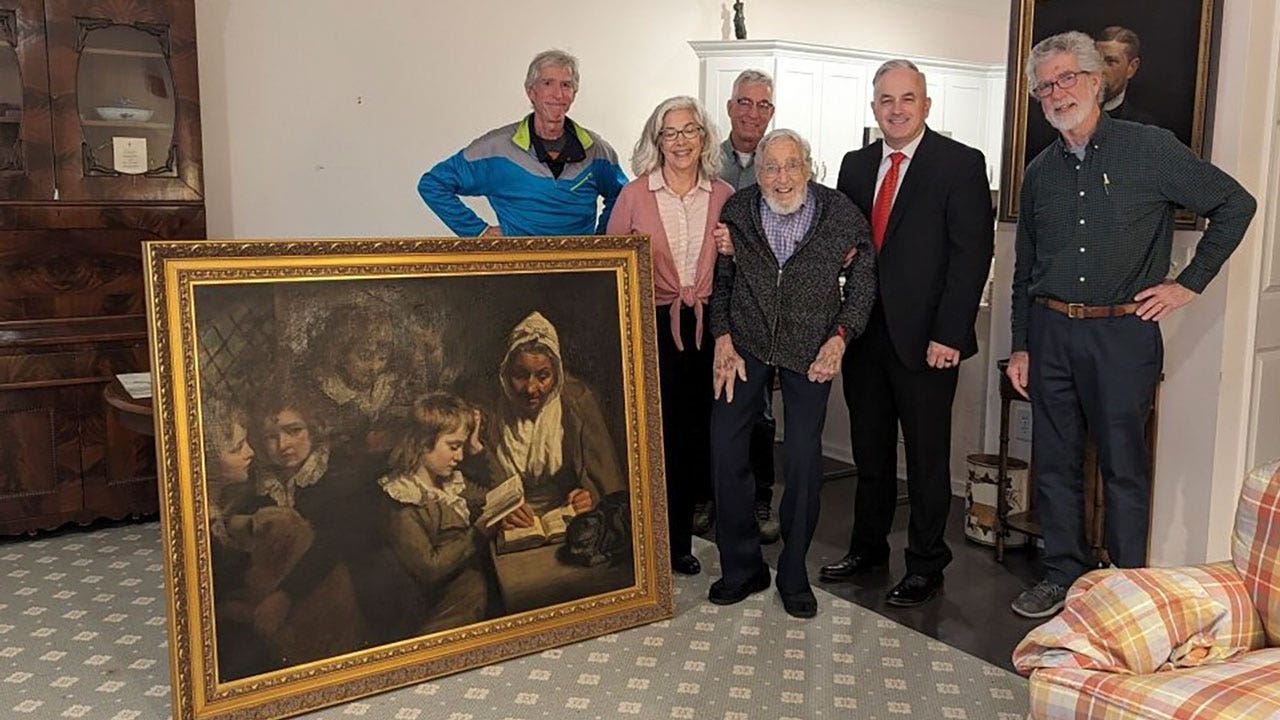
The painting, which dates to about 1784, was taken into custody by the agency pending resolution of who owned it and returned on Jan. 11 to Dr. Francis Wood, 96, of Newark, the son of the painting’s original owner, Dr. Earl Wood, who bought it during the 1930s, the FBI said.
“This piece of art, what a history it’s had,” said FBI Special Agent Gary France, who worked on the case. “It traveled all through the U.K. when it was first painted, and owned by quite a few families in the U.K. And then it travels overseas to the United States and is sold during the Great Depression and then stolen by the mob and recovered by the FBI decades later. It’s quite amazing.”
Special Agent Gary France, second right, stands with Dr. Francis Wood, Wood’s children, and their newly returned John Opie painting on Jan. 11, 2024. The painting was stolen from Wood’s parents’ home in 1969 in Newark, N.J. (FBI via AP)
Opie, who came from the Cornwall region, was one of the most important British historical and portrait painters in his time, said Lucinda Lax, curator of paintings at the Yale Center for British Art in New Haven, Connecticut. His paintings have sold at major auction houses such as Sotheby’s and Christie’s, including one bought in 2007 for almost $1 million.
Opie often portrayed British royals and other members of the elite. But he also depicted scenes from ordinary life, such as in “The Schoolmistress,” which shows an older teacher sitting at a table with a book and surrounded by young students.
“It’s such a compelling painting,” Lax said. “It’s a subject drawn from everyday life and he paints it in a very direct, straightforward way. He’s not artificially elevating it.”
According to the FBI, the painting was taken from Earl Wood’s house by three men working at the direction of former New Jersey state Sen. Anthony Imperiale, who died in 1999. Imperiale, a political firebrand who also served as a Newark city councilman, was in the national spotlight in the 1960s as a spokesman for cracking down on crime. He was also divisive, organizing citizen patrols to keep Black protesters out of Italian neighborhoods during riots in Newark in the summer of 1967.
Authorities say the thieves broke into the house in July 1969 in a bid to steal a coin collection, but were foiled by a burglar alarm. Local police and Imperiale responded to the attempted burglary, and the home’s caretaker told the lawmaker that the Opie painting in the home was “priceless,” the FBI said.
The men returned to the house later that month and stole the painting, the FBI said.
One of the thieves, Gerald Festa, later confessed to the burglary, in the 1975 trial of an accomplice, and said the trio been acting under Imperiale. Festa said the thieves had visited Imperiale prior to the theft and were told by the lawmaker where to find the painting in Wood’s home, the FBI said. Festa also testified that Imperiale had the painting.
The claims against the state lawmaker were not sufficiently corroborated and he was never charged, France said.
No charges have been filed by the FBI since the painting’s recovery because all of those believed to have been involved are dead, France said. The three men who stole the painting were all convicted of other mob-related crimes before their deaths, he said.
Francis Wood’s son, Tom, recalled on Friday how “The Schoolmistress” hung for decades in his grandparent’s dining room, where it loomed over Sunday dinners and other family gatherings until its sudden disappearance. Francis Wood bought another, smaller Opie painting about 25 years ago as a placeholder for the lost piece and was “just thrilled” to get the stolen piece back, Tom Wood said.
It’s now being cleaned and appraised, but remains in good condition with only a few flecks of paint missing from the piece, according to France.
“It has one or two minor blemishes, but for a painting that’s 240 years old and has been on a roundabout journey, it’s in pretty good shape,” Tom Wood said. “Whoever has had their hands on it, I’m thankful they took care of the painting.”
Read the full article from Here


“No Kings” rallies are scheduled in Boston and across Massachusetts on Saturday and are expected to draw large crowds, organizers said.
Organized by the ACLU of Massachusetts, Indivisible Mass Coalition, and Mass 50501, the event is a mass mobilization in protest of the Trump administration.
The No Kings theme was created by the 50501 Movement, a national movement made up of Americans who stand for democracy and against what they call the authoritarian actions of the Trump administration. The name 50501 stands for 50 states, 50 protests, one movement.
“The Trump administration is trying to shred the Constitution; the No Kings movement is an unequivocal statement that we, the people, will not let that happen. This will be the third global No Kings Day, and it’s not just about protesting what’s wrong—it’s about building something better. We intend to show our power, build our power, and power a democracy that advances freedom, equality, justice, and dignity for all,” organizers wrote.
The rally, one of thousands scheduled across the country this weekend, is planned for the Boston Common from 2 to 4 p.m. More than 100,000 people are expected to attend Boston’s rally. Other events are scheduled in Pittsfield, Northampton, Lancaster, Worcester, Framingham, Methuen, Lexington, and towns in southeastern Massachusetts and the Cape. For a map of No Kings events near you, click here.
Speakers include elected officials Attorney General Andrea Campbell, Gov. Maura Healey, Sen. Ed Markey and Congresswoman Ayanna Pressley, and civic leaders Hessann Farooqi Marcelo Gomes Da Silva, Darlene Lombos, president of the Greater Boston Labor Council, Carol Rose, executive director of ACLU of Massachusetts, Jessica Tang, president of the American Federation of Teachers of Massachusetts, and others. It will be moderated by Rahsaan Hall, president and CEO of Urban League of Eastern Massachusetts.
There will also be performances by the Dropkick Murphys, Boston Area Brigade of Activist Musicians, BVOCAL Chorus, and Jimmy Tingle.
A previous No Kings rally in October drew massive crowds estimated in the tens of thousands.
NBC10 Boston NBC10 Boston An aerial view of the crowd at Boston’s “No Kings” rally on the Common on Saturday, Oct. 18, 2025.


Are you from a Connecticut family that grew up eating Toad in the Hole? If so, you probably know it as a quirky breakfast dish — an egg cooked right in a hole cut out of a slice of bread. Just to be clear, no toads were harmed — I simply couldn’t resist using an actual toad photo. But the story behind the name and the dish is a little stranger than you might think.
The original Toad in the Hole comes from England, where it’s a savory meal of sausages baked in Yorkshire pudding batter. No eggs, no toast, just sausages popping out of golden, fluffy batter — the name supposedly comes from the way the sausages peek out like toads in a pond.
When English families settled in New England, they brought culinary traditions with them, and over time, the dish evolved. In the U.S., particularly in some Connecticut households, Toad in the Hole became the breakfast version we know today: an egg nestled in bread, sometimes cooked in a skillet or baked. It’s a far cry from the original sausages-and-batter dish, but it kept the playful name and sense of whimsy.
Read More: Connecticut Zookeeper Explains the Secret Lives of Skunks
What’s fun is that the U.S. version is sometimes called “egg in a basket” or “egg in a hole” in other parts of the country, but in many Connecticut homes, it proudly keeps the Toad in the Hole moniker. For families with multi-generational ties to the state, this little breakfast dish is a taste of history, a nod to old English roots, and a perfect reminder of just how weird and wonderful Connecticut’s food traditions can be.
Before researching this, I’d never heard of it, but you’d better believe I’m making one of these this weekend — both the UK and U.S. versions.
Sources: Wikipedia & Food Science Institute
The Top 10 Shoplifted Items from Connecticut Target Stores…
Luxury Meets Privacy: Discover Old Greenwich’s Exclusive Peninsula
28 East Point Lane is a luxury address in Old Greenwich, CT that happens to rest on a peninsula. If you have a metric f— ton of money I have good news, It recently hit the market for $12.5 Million.
Gallery Credit: Lou Milano
10 Most Dangerous Neighborhoods, in Connecticut’s Highest Crime City
Gallery Credit: Lou Milano

Retired Detroit sergeant faces new sexual assault charge involving 14-year-old victim from 2002

Trump floats sending federal agents to San Francisco to tackle crime

Dallas ISD will offer free pre-K starting next school year

Norwegian Cruise Line offers a first look at Luna, new cruise ship setting sail from PortMiami – WSVN 7News | Miami News, Weather, Sports | Fort Lauderdale

Live: CPAC 2026 Day 2

Florida High School Football Rankings: Top 25 teams – Oct. 21

How old is Bo Nix? What to know about Oregon quarterback ahead of 2024 NFL Draft

Cleary's 21 help Le Moyne down Central Connecticut State 69-64 in OT

99th annual Pony Swim held in Virginia

Indiana Members Credit Union announced as new anchor tenant at Bottleworks District
Live: CPAC 2026 Day 2

Video: Will ICE Change Under Its New Leader?

DHS shutdown breakthrough comes at cost for Republicans as funding fights nears end

Rubio joins crucial G7 talks as Iran war set to dominate second day

A surprise resignation could open the door for an independent to win a Montana Senate seat
-

 Detroit, MI1 week ago
Drummer Brian Pastoria, longtime Detroit music advocate, dies at 68
-

 Science1 week ago
How a Melting Glacier in Antarctica Could Affect Tens of Millions Around the Globe
-

 Movie Reviews1 week ago
‘Youth’ Twitter review: Ken Karunaas impresses audiences; Suraj Venjaramoodu adds charm; music wins praise | – The Times of India
-

 Sports6 days ago
IOC addresses execution of 19-year-old Iranian wrestler Saleh Mohammadi
-

 New Mexico5 days ago
Clovis shooting leaves one dead, four injured
-
 Business1 week ago
Disney’s new CEO says his focus is on storytelling and creativity
-

 Technology5 days ago
YouTube job scam text: How to spot it fast
-

 Tennessee4 days ago
Tennessee Police Investigating Alleged Assault Involving ‘Reacher’ Star Alan Ritchson