Northeast
British painting stolen by NJ mobsters is returned half a century later

Art detective reveals recovered Van Gogh painting
Art detective Arthur Brand retrieved a Van Gogh painting that went missing over three years ago. Security footage shows the heist as it happened. (SOURCE: Reuters/Netherlands Police/Groninger Museum/Arthur Brand)
An 18th century British painting stolen by New Jersey mobsters in 1969 has been returned more than a half-century later to the family that bought it for $7,500 during the Great Depression, the FBI’s Salt Lake City field office announced Friday.
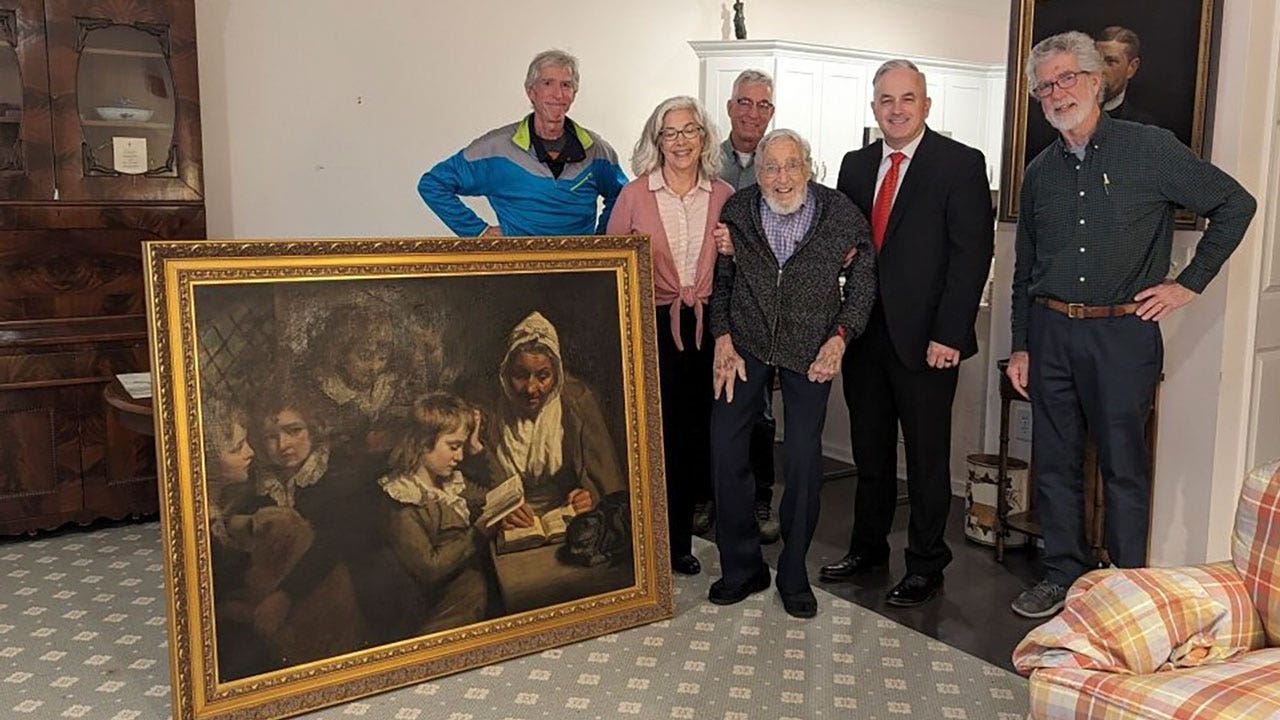
The 40-inch-by-50-inch John Opie painting — titled “The Schoolmistress” — is the sister painting of a similar work housed in the Tate Britain art gallery in London.
Authorities believe the piece was stolen with the help of a former New Jersey lawmaker, then passed among organized crime members for years before it ended up in the southern Utah city of St. George. A Utah man had purchased a house in Florida in 1989 from Joseph Covello Sr. — a convicted mobster linked to the Gambino family — and the painting was included in the sale, the FBI said.
‘DEVIL-LIKE FIGURE’ LOST IN TIME UNCOVERED IN 230-YEAR-OLD PAINTING FOLLOWING RESTORATION
When the buyer died in 2020, a Utah accounting firm that was seeking to liquidate his property sought an appraisal for the painting and it was discovered to likely be the stolen piece, the FBI said.
The painting, which dates to about 1784, was taken into custody by the agency pending resolution of who owned it and returned on Jan. 11 to Dr. Francis Wood, 96, of Newark, the son of the painting’s original owner, Dr. Earl Wood, who bought it during the 1930s, the FBI said.
“This piece of art, what a history it’s had,” said FBI Special Agent Gary France, who worked on the case. “It traveled all through the U.K. when it was first painted, and owned by quite a few families in the U.K. And then it travels overseas to the United States and is sold during the Great Depression and then stolen by the mob and recovered by the FBI decades later. It’s quite amazing.”
Special Agent Gary France, second right, stands with Dr. Francis Wood, Wood’s children, and their newly returned John Opie painting on Jan. 11, 2024. The painting was stolen from Wood’s parents’ home in 1969 in Newark, N.J. (FBI via AP)
Opie, who came from the Cornwall region, was one of the most important British historical and portrait painters in his time, said Lucinda Lax, curator of paintings at the Yale Center for British Art in New Haven, Connecticut. His paintings have sold at major auction houses such as Sotheby’s and Christie’s, including one bought in 2007 for almost $1 million.
Opie often portrayed British royals and other members of the elite. But he also depicted scenes from ordinary life, such as in “The Schoolmistress,” which shows an older teacher sitting at a table with a book and surrounded by young students.
“It’s such a compelling painting,” Lax said. “It’s a subject drawn from everyday life and he paints it in a very direct, straightforward way. He’s not artificially elevating it.”
According to the FBI, the painting was taken from Earl Wood’s house by three men working at the direction of former New Jersey state Sen. Anthony Imperiale, who died in 1999. Imperiale, a political firebrand who also served as a Newark city councilman, was in the national spotlight in the 1960s as a spokesman for cracking down on crime. He was also divisive, organizing citizen patrols to keep Black protesters out of Italian neighborhoods during riots in Newark in the summer of 1967.
Authorities say the thieves broke into the house in July 1969 in a bid to steal a coin collection, but were foiled by a burglar alarm. Local police and Imperiale responded to the attempted burglary, and the home’s caretaker told the lawmaker that the Opie painting in the home was “priceless,” the FBI said.
The men returned to the house later that month and stole the painting, the FBI said.
One of the thieves, Gerald Festa, later confessed to the burglary, in the 1975 trial of an accomplice, and said the trio been acting under Imperiale. Festa said the thieves had visited Imperiale prior to the theft and were told by the lawmaker where to find the painting in Wood’s home, the FBI said. Festa also testified that Imperiale had the painting.
The claims against the state lawmaker were not sufficiently corroborated and he was never charged, France said.
No charges have been filed by the FBI since the painting’s recovery because all of those believed to have been involved are dead, France said. The three men who stole the painting were all convicted of other mob-related crimes before their deaths, he said.
Francis Wood’s son, Tom, recalled on Friday how “The Schoolmistress” hung for decades in his grandparent’s dining room, where it loomed over Sunday dinners and other family gatherings until its sudden disappearance. Francis Wood bought another, smaller Opie painting about 25 years ago as a placeholder for the lost piece and was “just thrilled” to get the stolen piece back, Tom Wood said.
It’s now being cleaned and appraised, but remains in good condition with only a few flecks of paint missing from the piece, according to France.
“It has one or two minor blemishes, but for a painting that’s 240 years old and has been on a roundabout journey, it’s in pretty good shape,” Tom Wood said. “Whoever has had their hands on it, I’m thankful they took care of the painting.”
Read the full article from Here


Three tornadoes have been confirmed across New England so far in 2026, and remarkably, all of them have occurred in Vermont.
Two of those tornadoes touched down during severe thunderstorms on June 18, when a potent weather system swept across the region.
Vermont tornadoes in 2026 (WGME).
The National Weather Service confirmed an EF-1 tornado in Lincoln with peak winds of 105 mph and another EF-1 tornado in Woodstock with winds reaching 100 mph.
Earlier this spring, an EF-1 tornado struck Williamstown on April 16 with estimated winds of 90 mph.
This week’s Climate Chronicles question comes from Kate:
With severe weather last week, how often do we actually see tornadoes touch down in Maine?

Maine tornado activity (WGME).
Historically, Maine averages about two tornadoes each year, with most occurring between June and August.
Most storms develop during the late afternoon and early evening, typically between 3 and 9 p.m., when hours of sunshine have heated the ground and created the instability needed for thunderstorms to form.
The last confirmed tornado to touch down in Maine was in 2023.
Average amount of tornadoes that touch down in each New England state per year (WGME).
Massachusetts and Connecticut also average about two tornadoes per year, with many occurring across the flatter terrain of western portions of both states.
In Massachusetts, the broad Connecticut River Valley stretching through Springfield has earned the nickname “New England’s Tornado Alley” due to its history of tornado activity.
Vermont, on the other hand, typically averages just one tornado annually. With three confirmed tornadoes already in 2026, the state has already exceeded its yearly average by two, making this an unusually active year for tornadoes in the Green Mountain State.
Maine’s tornado history (GoSanAngelo, WGME).
Since 1950, Maine has recorded 140 tornadoes. None have been rated stronger than an EF2 on the Enhanced Fujita Scale, the system used to classify tornado intensity based on the damage they cause.
Unlike hurricanes, tornadoes are not assigned ratings while they are occurring. Instead, National Weather Service survey teams assess damage after the storm has passed, examining impacts to homes, buildings, trees, and other structures.
From that damage, meteorologists estimate the tornado’s wind speeds and assign an EF rating ranging from EF0 to EF5.
While Maine has experienced its share of tornadoes over the decades, the state has never recorded a violent EF4 or EF5 tornado.
Do you have any weather questions? Email our Weather Authority team at weather@wgme.com. We’d love to hear from you!

Gas prices dipped below $4 a gallon in Massachusetts Thursday for the first time in exactly two months.
According to AAA, the average price for a gallon of regular gas in Massachusetts is now $3.99, down from $4.02 on Wednesday.
That’s the first time the average fell below the $4 mark since April 25.
The national average on Thursday was $3.92 a gallon, AAA said. That average was above $4 for nearly three months before it fell to $3.99 a week ago on June 18.
Gas prices rose sharply after the war between the U.S. and Iran started on February 28.
A spokesperson for GasBuddy, which also tracks fuel price data, said the national average has been dropping for six weeks as the “recent U.S.-Iran framework agreement has helped ease supply fears.”
The company said the national average should keep falling to $3.75 by July 4.
“Six weeks of declines sounds like good news, and in some ways it is, but the context matters,” Patrick De Haan, a petroleum expert at GasBuddy, said in a statement Thursday.
“At roughly $3.75, this would be the second most expensive July 4 ever recorded, roughly 65 cents higher than last year and nearly $1 above where prices started in 2026. The U.S.-Iran agreement gives markets hope, but it’s being tested, and any breakdown in those talks could reverse the recent relief quickly. Drivers should use every tool available to find the lowest prices near them before filling up.”
A year ago at this time, the average price for a gallon of gas in Massachusetts was $3.10, according to AAA.
The all-time high in the state is $5.05 a gallon, set back in June 2022.

One-third of Americans support Christian nationalism, report shows
A new report finds about three in 10 Americans back or sympathize with Christian nationalism, according to the Public Religion Research Institute.
New Hampshire has the highest share of adults who identify as atheists in the U.S., at about 11%, according to a Pew Research Center study.
Nearly half of adults in the Granite State (48%) identify as religiously unaffiliated, a group that includes atheists, agnostics, and people who describe their religion as “nothing in particular.”
In the U.S. overall, 5% of adults identify as atheists, meaning New Hampshire’s share is more than twice the national average. About 29% of U.S. adults identify as religiously unaffiliated.
However, regionally, the West has the highest share of adults who identify as atheists among the four major U.S. regions – Northeast, Midwest, South, and West – according to the data.
The Pew Research Center’s Religious Landscape Study (RLS) regarding Americans’ beliefs was conducted in English and Spanish from July 17, 2023, to March 4, 2024, among a nationally representative sample of 36,908 U.S. adults.
What is atheism? 10 US states with the highest percentage of atheists
Atheism is defined by Merriam-Webster as “a lack of belief or a strong disbelief in the existence of a god or any gods.” However, people may interpret and describe the term in different ways.
Here are the 10 U.S. states with the highest shares of adults who identify as atheists, according to data from the Pew Research Center:
- New Hampshire – 11% of residents
- Washington – 9% of residents
- Colorado – 8% of residents
- Massachusetts – 8% of residents
- Montana – 8% of residents
- Oregon – 8% of residents
- Vermont – 8% of residents
- California – 6% of residents
- Idaho – 6% of residents
- Maryland – 6% of residents
New Hampshire religious composition
About 45% of adults in New Hampshire identify as Christian, 5% identify with other religions, and 48% as religiously unaffiliated, according to the Pew Research Center.
Breaking it down even further, 20% identify as Catholic, 13% as Mainline Protestant, 10% as Evangelical Protestant, 1% as Historically Black Protestant, 1% as Latter-day Saint (Mormon), 1% as Orthodox Christian, and less than 1% as Jehovah’s Witnesses or other Christian groups.
Roughly 1% identify as Jewish, less than 1% as Muslim, less than 1% as Buddhist, less than 1% as Hindu, less than 1% as Native American religions, and less than 1% as other world religions. About 1% identify with Unitarian and other liberal faiths, and 1% with New Age beliefs.
Among all adults in New Hampshire, 11% of all adults in New Hampshire identify as atheists, 1% as agnostics, and 29% with “nothing in particular.”
About 3% of respondents did not answer the question, the survey said. Additionally, the margin of error for the 2023-24 figures among adults in New Hampshire is plus or minus 8.0 percentage points.
-

 Illinois11 minutes ago
Man buys winning $1.3 million jackpot ticket at suburban gas station
-

 Indiana14 minutes ago
‘Foul play’ suspected in death investigation on Indiana-Ohio state line, Wayne County officials say
-

 Iowa19 minutes ago
New Iowa program aims to remove barriers to family support
-

 Kentucky24 minutes ago
Can you set off fireworks in Kentucky? See laws ahead of Fourth of July
-
 Louisiana34 minutes ago
Historic Gene Therapy Gives Young Louisiana Man a New Shot at Life
-

 Maine41 minutes ago
Climate Chronicles: How many tornadoes does Maine see a year?
-

 Maryland44 minutes ago
Maryland families are paying the price for failed energy policies
-

 Michigan49 minutes ago
Michigan’s single-stair reform gains as housing package languishes

