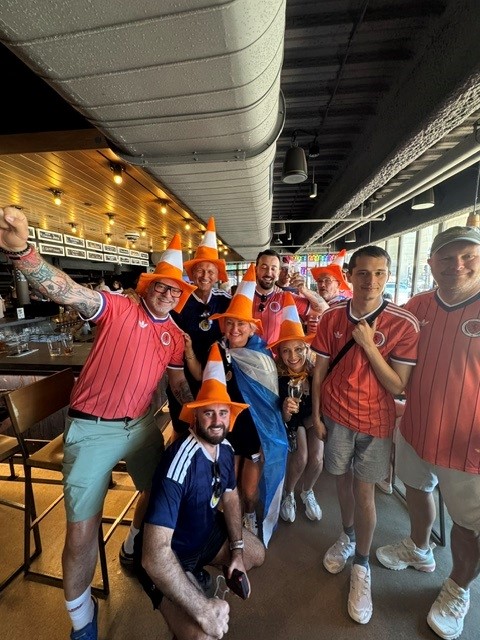
A Scottish man who died after collapsing outside a Boston pub while visiting for the World Cup is being remembered as a devoted soccer fan who was “Tartan Army to his core.”
Thomas Murty, known as “Tam,” died June 19 after collapsing near The Dubliner pub in downtown Boston a day earlier, according to a GoFundMe fundraising campaign to return Murty’s body to Scotland and pay for funeral expenses.Murty was born in 1963.
“Tam was Scotland daft his whole life,” the GoFundMe page reads. “He lived for it — the highs, the heartbreaks, the songs, the hope that never died no matter how many years went by. Following Scotland wasn’t just something he did; it was who he was.”
Murty had waited three decades to see Scotland play in the World Cup. Watching the Scottish team compete in the tournament was “the dream of a lifetime,” the fundraising page said.
Advertisement
Oram McGonagle, who owns The Dubliner, said he was at the pub when Murty collapsed. He said he saw a Scottish fan with an oxygen tube standing by a pillar outside the building. McGonagle said employees called an ambulance when they realized he needed help.
Caitlin McLaughlin, public relations director for Boston EMS, confirmed that medics took a patient from The Dubliner to an area hospital around 4:30 p.m. that day.
McGonagle later learned from a media report that Murty had died.
The Dubliner has donated 1,000 pounds, or about $1,325, to the fundraiser.
“We had a really good few weeks with the Scottish people,” McGonagle said Monday. “This felt like a way to give some back to them.”
Advertisement
Murty is the second Scottish soccer fan known to have died in Boston while visiting for the World Cup tournament. Donny Strathie, 76, died June 14 after collapsing in a hotel in Norwood. Fans paid tribute to Strathie in the 76th minute of Scotland’s game against Morocco in Foxborough on June 19.
About 2,800 people have donated more than$85,000 to the GoFundMe campaign set up for Murty’s family, as of Monday afternoon.
Ariela Lopez can be reached at ariela.lopez@globe.com. Follow her on X @ariela__lopez.
Boston is in for seasonable to cooler highs in the coming days, along with possible showers and storms around mid-week, according to National Weather Service forecasts.
“Our next chance for unsettled weather, like showers, possibly storms, mainly just rain at this time, would be more so late Tuesday, going into Wednesday, and then we dry back out again going into Thursday,” said NWS meteorologist Candice Hrencecin.
The week is set to kick off sunny and seasonably warm, with a high around the low 80s, NWS forecasts. Heading into the night, skies are expected to see increasing clouds and a low in the mid-60s, forecasts show.
Coming out of several hazy days with poor air quality due to smoke blowing down from Canadian wildfires last week, Hrencecin said forecasters will “keep an eye” on the situation in the coming week. Forecasts do not predict more of the poor air conditions for the Boston area “at this time,” she added.
Advertisement
In the early week, air quality is expected to rate good to moderate for the Boston area Monday and Tuesday, according to AirNow.gov.
Over 950 wildfires continued to burn in Canada on Sunday, according to the Canadian Wildland Fire Information System, including many in western Ontario where the smoke originated last week. Smoky conditions lingered over the U.S. Midwest as of Sunday.
Skies are likely to remain mostly cloudy through Tuesday, NWS forecasts, with another high in the low 80s.
Showers and thunderstorms are forecast heading into Tuesday night and expected to continue Wednesday through the late evening, NWS states.
Hrencecin said forecasters will “have to keep an eye out for maybe a rip current risk again” especially towards the middle part of the week. NWS issued a rip current advisory Sunday, the meteorologist said.
Advertisement
Wednesday is expected to get up to a seasonable high in the mid-80s and drop to a low around the mid-60s during the night, as skies remain mostly cloudy.
“Then for the back half of the week, it actually starts to be a little bit lower than normal, generally in the 70s for the most part,” Hrencecin said.
Temperatures are forecast to drop to the high 70s Thursday and Friday, and conditions are expected to be mostly sunny and clear for both days and nights, according to the NWS .
Heading into the weekend, preliminary forecasts show temperatures jumping back into the low 80s and sunny skies through Sunday.
It became a running a joke for weeks. A city known for its more than lively and sometimes raucous nightlife somehow didn’t plan for the Tartan Army’s invasion of local taprooms. Several thousand miles away, a storied barbecue joint had to turn people away—not because they ran out of ribs, but because they ran out of the cups and utensils needed to serve those meats. Meanwhile, a tattoo parlor’s social media giveaway became a permanent souvenir for World Cup fans, from locals to foreign visitors now abroad.
The World Cup saw plenty of cross-cultural culinary diplomacy—foreigners and Americans alike who had never heard of yerba mate, for example, were now sharing gourds with friends—complete with social media posts about foreign visitors expressing excitement over the hospitality they received in this year’s host cities. As fans descended from around the world to support their home countries, they also stumbled into local small businesses, proving the real winner of the World Cup is Main Street, USA.
According to a Bank of America note, card spending spending at brick-and-mortar stores, restaurants and bars across the 11 U.S. host cities rose 5.3% year-over-year in the three weeks ending June 27, compared to 3.8% in the rest of the country. It’s a reversal from the prior three weeks, when host cities had trailed the rest of the country.
Los Angeles and New York were the clearest winners, tied to hosting Team USA group-stage matches and to a run of high-profile games. (New York also saw the Knicks’ championship run, which alone brought in at least $380 million to the city). On the other hand, Seattle barely moved in the data, but that’s because retail spending there was already running strong before the tournament began.
Advertisement
Devon Savage, Samuel Adams Taproom
Boston’s Scottish invasion: ‘Who knew that would be such a fun thing to actually run out of beer‘
Between June 11 and June 21, the Samuel Adams Taproom in downtown Boston ran out of its flagship Boston Lager during the first weekend of Scotland’s group-stage matches. The location sold more than 7,000 pints of Boston Lager, emptied 99 kegs and two full tanks—the equivalent of another 30 kegs—and required five emergency deliveries to keep up.
“We were prepared for the influx of international visitors but could have never prepared for their preference for our flagship, Boston Lager, especially when we have 20 unique beers at the taproom,” said Devon Savage, manager of communications for the Samuel Adams brand. By the time the surge passed, the taproom had served roughly 10,000 pints total—about four times the volume it typically sees over a long holiday weekend like the Fourth of July.
“We thought we were prepared, and again, they just drank us dry,” she told Fortune. “Who knew that would be such a fun thing to actually run out of beer.”
Savage described the relationship between staff and visiting fans, known collectively as the Tartan Army, as more than a sales bump. “They really are our friends,” she said. Staff ordered traffic cones—a nod to the Scottish tradition of wearing them as makeshift headwear during celebrations—and had fans sign them. The bar has now displayed roughly seven signed cones by the tournament’s end.
Advertisement
Devon Savage, Samuel Adams Taproom
A few blocks away, the Glynn Hospitality Group—the family-owned company behind the Black Rose, Coogan’s, and Dylan’s—saw a comparable surge. Coogan’s, known for its $1 and $2 Bud Light drafts, went through more than 500 kegs of Bud Light in June alone; with more than 200 at Coogan’s and another 200-plus at the Black Rose.
“It was like having St. Patrick’s Day for like a week straight,” said Katie Freeman, a third-generation member of the family running the hospitality group. “I’ve never seen anything like it. They were super kind, fun. They were here to party and have a good time, but they did it in a way that was just like fun and respectful.”
Freeman told Fortune the crowds skewed both international and local, with Coogan’s drawing large local crowds during Team USA matches. “We just felt that the Scots really brought a sense of like happiness, community, and fun,” she said. “And I think it kind of trickled down to the locals alike.”
Kansas City translated BBQ menus and showed off yerba mate
Joe’s Kansas City Barbecue, a 30-year-old chain that grew out of a converted convenience store and competition-barbecue roots, is usually closed on Sundays. Expecting large crowds thanks to the World Cup, owners decided to open on Sundays. After receiving those large crowds, the owners then decided to give their employees a break, and go back to closing on Sundays.
But on the final Sunday Joe’s stayed open, the restaurant turned away hundreds of people already in line rather than risk cutting corners on quality. “The owner just opted that crew was more important than the dollars. It’s just more important to make sure we didn’t lose key crew members, that we weren’t overworking them,” Eric Tadda, the chain’s director of marketing, told Fortune.
Advertisement
Joe’s used Kansas City Chiefs games and the Chiefs’ Super Bowl run as the closest benchmark, modeling a 20% to 25% increase in demand, which the tournament easily matched. While a typical weekend sees 300 to 320 slabs of ribs prepped per location, the World Cup topped 400 at each of the chain’s three restaurants. They even translated menus into Spanish and Dutch and equipped order stations with handheld translators, but they still were outpaced by hungry visitors.
“It’s the things you don’t think about, straws, silverware, how many times you change the trash,” Tadda said, although they were well prepared in terms of meat. “That Sunday, the last Sunday, we were pressing where we were running out of bread, running out of silverware, to-go silverware—like that’s again where we kind of knew this is getting to be too much.”
“I don’t think we’ve had anything like that for the length of six weeks,” he continued, adding that Joe’s began preparing months in advance, coordinating with the city and its distributors on staffing and supply, on the theory that every restaurant in town would be placing the same emergency orders at once. Despite the long lines that stretched well around the block, the crowds were “so passionate, but so patient, and so happy to be here.”
Courtesy Cafe Corazon
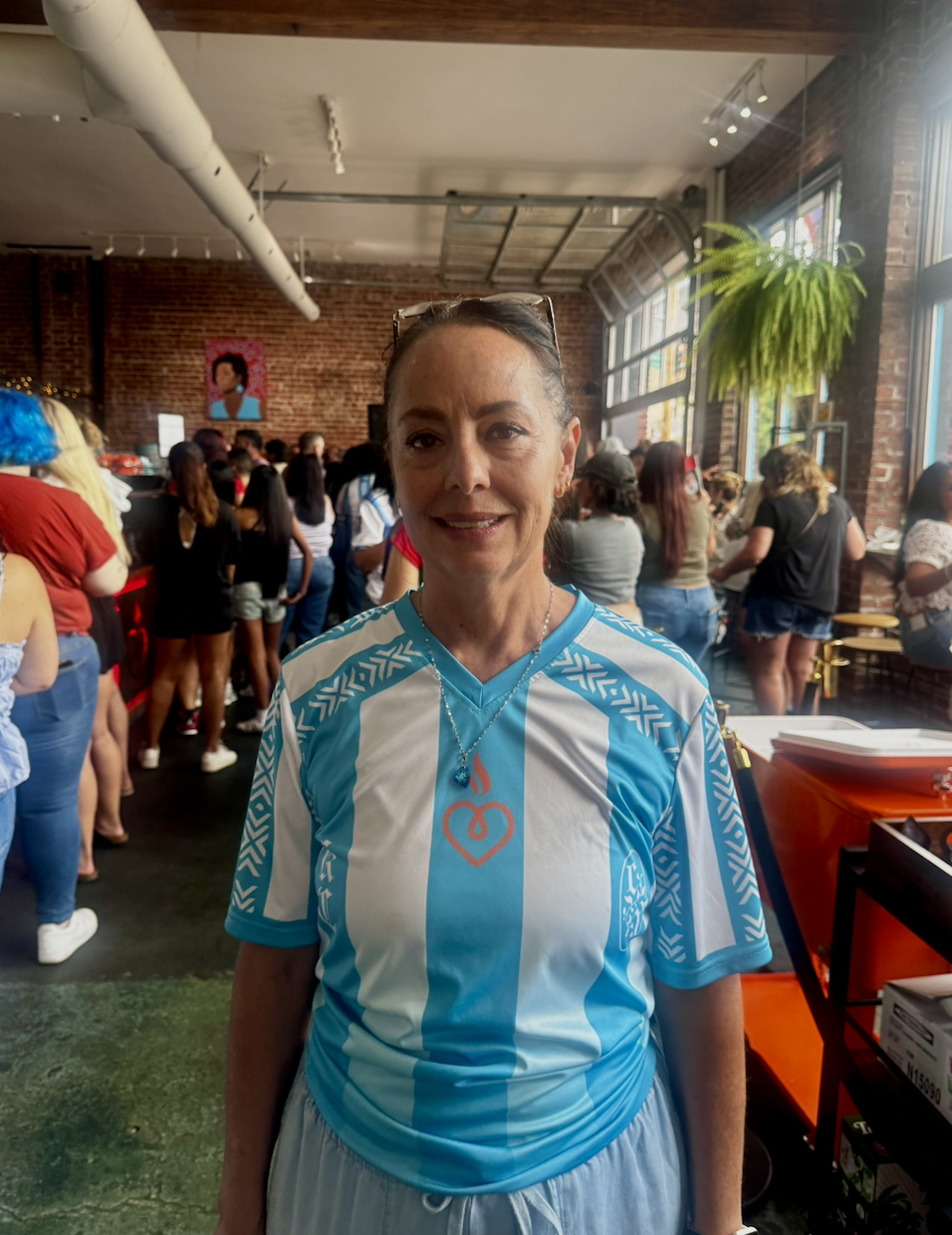
Across town, Café Corazón, a seven-time winner of Kansas City’s best small business award, scaled for cultural specificity instead of volume.
Argentinian owner Miel Castagna-Herrera spent a year planning how to meet a World Cup crowd. Sitting in a hotel-dense stretch of the Crossroads district near a cluster of Argentine-owned businesses, the café leaned into its existing yerba mate menu—a bitter, caffeinated South American tea—after Argentine journalists filmed segments there the week before Argentina’s opener. Those segments aired on Argentine television and drew visitors who recognized the café. “I saw you,” fans said before ordering.
Advertisement
“We’ve always had Americans trying [yerba mate] for the first time,” Castagna-Herrera told Fortune, “but I think now that everyone sees Messi with his mate gourd, people who are not Argentinians are trying it more often.”
Sales at the Crossroads location rose 15% to 20% during the tournament, but were even higher at the café’s other two locations—complicated, she said, by a schedule spread across multiple cities that caused crowds to surge for a few days around a match, then disappear. “It’s been a strange organization of how they’re doing this World Cup,” she said.
Still, it’s been gratifying to see both Americans and foreigners try not only yerba mate, but even drinks Cafe Corazon made specifically for the teams that played in Kansas City. “It’s a mishmash, but then we made like a Tunisian coffee that they drink there, which is really fun.”
From falling ‘off a cliff financially’ to ‘paying bills’ in Philadelphia
At Midnight & The Wicked, a cocktail lounge in Philadelphia, the World Cup collided with a separate policy change: Pennsylvania’s decision to let the city extend bar hours from 2 a.m. to 4 a.m. for the tournament.
Owner Artem Ustayev said Philadelphia summers are normally the slowest stretch of his business, as clientele decamps for the Jersey Shore. “We fall off a cliff financially speaking,” he told Fortune, recalling weeks last summer where the lounge did $30,000 in sales total—for that whole week.
Advertisement
Brazil’s group-stage match against Haiti upended that. Ustayev said the venue pulled in roughly $80,000 in sales that night alone, and close to $110,000 after taxes and tips. That would average some of his best weeks. “I would do a full week on that, and I did that in one night,” he said, calling it the busiest night in the bar’s history.
The lounge ran out of Corona a few times over the tournament, though Ustayev had stocked up on high-end liquor and champagne in advance. And, he added, extending hours to 4 a.m. didn’t translate into rowdier late nights, contrary to what state regulators had worried about. “That was not rooted in reality,” Ustayev said. Fans paced themselves rather than rushing to drink before an early close, he said, and staff saw no drop in tips despite the international crowd—something many worried about given how predominant tipping culture is in the U.S. “If anything, they’ve only seen an increase in their paychecks.”
And so has he. “I’m paying bills. Put it like that.”
Fans in Vancouver line up to get souvenirs ‘they’ll never lose’
On Vancouver’s Granville Street, closed to traffic and packed with fans throughout the tournament, Adrenaline Tattoos found a different kind of demand: fans who wanted something permanent to take home.
“Tattoos are just like the new souvenir,” said Mike Bilinsky, the shop’s operations manager. “Whenever people go somewhere, they want to permanently remember that trip, and that demographic of soccer fans is already tattooed to begin with.”
Advertisement
What began as a social media push—the parlor initially offered free tats to any Canadian national soccer team member—quickly became a new tourist attraction. While trademark restrictions kept requests away from FIFA’s own branding, fans chose things like flags, maple leafs, and soccer balls, plus a particularly popular design: a tattoo styled after a passport stamp.
At least half of the shop’s World Cup-related clientele were international visitors, said Bilinsky, who compared the atmosphere on the street to Vancouver’s 2010 Winter Olympics. “Energy on the street,” he said. “Everyone’s just in a really good mood.”
“It’s something they’ll never lose,” Bilinsky said of the tattoos.
Smoke from the Canadian wildfires that engulfed the Northeast United States in a haze hardly let up in Greater Boston.
But Saturday’s rain may have cleared the skies just in time for the World Cup final in New Jersey on Sunday.
The Massachusetts Department of Environmental Protection issued an air quality alert that the fine particles from smoke across the entire state averaged at a level “Unhealthy for Sensitive Groups,” which includes people “with lung or heart disease, older adults, and children.”
Fine particulates that are 2.5 micrometers or less in diameter (PM2.5) were tracked at a level of 130, which the agency rates as in the middle of the 101-150 “Unhealthy for Sensitive Groups,” at multiple locations in the city and in nearby municipalities.
Advertisement
The U.S. Air Quality Index also recorded a 130 rating for much of the region but the city itself was rated at 166 near South Station, with nearby locations including Quincy, Chelsea, and Lynn hovering around 160 PM2.5. This concentration falls under the “Unhealthy” category.
Similar warnings were issued throughout much of the country Saturday.
At MetLife Stadium, where the World Cup final is scheduled to take place, the sky was the same thick, soupy gray it has been for days, even after a drenching thunderstorm prompted warnings of flash flooding and forced the Spanish national team to suspend its last outdoor training session ahead of the clash with Argentina.
Saturday’s storm front will largely move the smoke out of the Northeast before the final between Spain and Argentina, said Tyler Roys, a senior meteorologist at AccuWeather.
“There could be some lingering smoke that would make things hazy, but very faint,” Roys said. “In terms of the thickest smoke, the smoke that has really been eye-popping and leads to poor air quality, that is not expected across New York City or much of the Northeast.”
Advertisement
The air quality index shows an improvement from unhealthy air for sensitive groups on Saturday to “moderate” air quality Sunday in East Rutherford, which means little to no health risk for the general public.