Politics
‘Let’s brew it in the United States’: Teamsters target Modelo and Corona in push for Mexican beer tariffs


NEWYou can now listen to Fox News articles!
One of the nation’s largest labor unions wants President Donald Trump to make one of America’s favorite imports a lot more American.
The International Brotherhood of Teamsters are urging the administration to impose significant tariffs on Mexican beer, arguing more of it should be brewed by U.S. workers instead of across the border.
The request comes as the Office of the U.S. Trade Representative continues to assess whether certain countries’ policies have fueled unfair manufacturing advantages.
The Teamsters argue Mexico has fueled its brewing industry through government-backed investment incentives, lower labor costs and export-focused policies that have expanded production and exports, helping imported beer capture a growing share of the U.S. market.
AMERICA’S FAVORITE BEERS — AND THE JOBS TIED TO THEM — ARE AT THE CENTER OF A BREWING TRADE FIGHT
The brewer of Modelo claimed the No. 1 spot in June 2023, when Modelo Especial surpassed Bud Light on dollar sales, and it continues to rank among the country’s best-selling beers (Aaron M. Sprecher/Getty Images)
The tariff push could have implications for some of America’s best-known imported beer brands, including Modelo, Corona, Pacifico and Tecate, much of which is brewed in Mexico before being shipped to retailers across the U.S.
“We can brew Modelo beer. It’s the same recipe. Let’s brew it in the United States,” Sean O’Brien, general president of the International Brotherhood of Teamsters, told Fox News Digital. “We are very good at producing goods and services in this country,” he added.
In its filing, the union said Mexican beer production has increased 85% since 2014, with about 80% of the country’s beer exports shipped to the United States. Meanwhile, capacity utilization at major U.S. breweries fell from 82% in 2013 to 65% in 2023, a trend the Teamsters say threatens thousands of well-paying union jobs.
TRUMP BET TARIFFS WOULD BRING BACK AMERICAN FACTORY JOBS. NEW REPORT SAYS IT DIDN’T WORK
Economists say the beer industry could see job cuts as tariffs increase costs for brewers and importers. (Artur Widak/NurPhoto/Getty Images)
The union argues tariffs would help shift more beer production back to the U.S., supporting American breweries along with the farmers who grow barley and hops, aluminum manufacturers that produce cans and the truckers who move beer across the country.
“I’m pro-America, pro-American worker, pro American jobs. So if there’s an opportunity to tariff Mexican beer in this situation, which is gonna provide opportunity for our current members, which we have tens of thousands in the brewery and distribution industry, then I’m all for tariffs and all for keeping American jobs in America,” O’Brien added.
THINK YOUR STATE IS EXPENSIVE? NEW DATA REVEALS WHERE AMERICANS FACE THE HIGHEST COST OF LIVING
The Teamsters say the threat to U.S. brewery jobs is growing as major brewers continue investing billions of dollars in Mexico.
According to the filing, breweries have announced plans to add another 19 million to 23 million hectoliters of production capacity over the next five years, an expansion the union attributes to export-focused tax incentives, lower labor costs and industrial policies aimed at boosting manufacturing for foreign markets.
The filing also cites Mexico’s 2023 tax incentives for export-oriented manufacturers and its broader “Plan México” industrial strategy, arguing those policies have encouraged additional investment while suppressing wages and making it more difficult for U.S. producers to compete.
CLICK HERE TO DOWNLOAD THE FOX NEWS APP
The Teamsters have publicly backed tariffs as high as 75% on Mexican beer imports, calling them one potential remedy to what they describe as an uneven playing field. In a separate submission to USTR, the union said continued pressure from imported beer could force more U.S. brewery slowdowns or closures, jeopardizing good-paying brewery jobs that have supported American families for generations.
The Teamsters’ filing is one of several submitted as USTR weighs potential trade actions under its ongoing Section 301 investigation.
USTR did not immediately respond to Fox News Digital’s request for comment.



Politics
Platner ally Troy Jackson locks down delegates as top rivals for Democratic Senate nomination drop out

NEWYou can now listen to Fox News articles!
Former Maine Senate President Troy Jackson appears to have locked up enough delegates to win the abbreviated race to replace now ex-candidate Graham Platner as the Democratic Senate nominee in the high-stakes showdown to face off with longtime Republican Sen. Susan Collins.
Delegates aligned with Jackson won the vast majority of the 500 slots that were up for grabs on Saturday and Sunday as Maine’s 16 counties held two days of delegate selection for next weekend’s nominating convention. And Jackson’s top two rivals for the nomination, Maine Secretary of State Shenna Bellows and Nirav Shah, a former top public health official, dropped out of the race on Sunday.
“In November, Mainers will defeat Susan Collins, and we will take back our Senate seat from the billionaires and corporations who think they own it,” Jackson said in a social media post Sunday evening.
While the delegates on Jackson’s slate are not required to support him at next weekend convention, he is in an extremely strong position to secure the nomination and face off in the midterm elections against Collins in what’s expected to be a combative and expensive ballot box battle that’s among a dozen nationwide which will determine if the Democrats can win back the Senate majority. The GOP currently holds the chamber 53-47.
DEMOCRACY ’26: STAY UP TO DATE WITH THE FOX NEWS ELECTION HUB
Former Maine Senate President Troy Jackson is running for the Democratic U.S. Senate nomination in the race to replace former nominee Graham Platner. (Sophie Park / Bloomberg via Getty Images)
A fifth-generation logger and a one-time conservative Republican who became a Democrat over two decades ago, Jackson came in third place last month in Maine’s Democratic gubernatorial primary.
On Saturday, in the race to replace Platner, Jackson-aligned delegates won more than 90% of the slots, including all 149 in Cumberland County, Maine’s most populous county and home to the state’s largest city, Portland.
“Yesterday was an unbelievable huge step, but our work is not finished — not even close,” Jackson said Sunday morning. And the winning streak of Jackson-aligned delegates continued throughout the day.
Over 470 of the 500 delegates elected this weekend were on Jackson’s slate. The delegates chosen will join another 101 coming automatically from the Democratic State Committee. All 601 will officially vote for the Senate nominee at next Saturday’s convention in Bangor, Maine.
Bellows, who unsuccessfully ran for the Democratic gubernatorial nomination, exited the Senate sprint on Sunday morning.
“Donald Trump’s attacks on our democracy are only accelerating, and the best way that I can serve our state and country at this moment is by focusing exclusively on my role as Secretary of State,” Bellows said in a statement that didn’t mention Jackson.
SIGN UP TO GET THE POLITICS NEWSLETTER
From left, U.S. Senate hopefuls Shenna Bellows, Troy Jackson, Dr. Nirav Shah, and Jordan Wood prepare for their televised debate at the WCSH-6 studio Thursday, July 16, 2026, in Portland, Maine. ( )
Shah, a former director the Maine Center for Disease Control and Prevention from 2019 to 2023 who later served as principal deputy director of the federal CDC during then-President Joe Biden’s administration, and who came in second in last month’s Democratic gubernatorial primary, dropped out Sunday evening and backed Jackson.
“To Maine Democrats: Susan Collins will not be defeated without a united Democratic Party. And we cannot unite without treating one another with respect,” Shah wrote in a statement. “No matter whom you supported in this race, I urge us all to remember that in the weeks ahead.”
Jackson, in a social media post, thanked Shah and urged, “Now it’s time for all of us to come together, build the broadest possible coalition, and defeat Susan Collins. Let’s get to work.”
Jordan Wood, a former congressional staffer for then-Rep. Katie Porter of California who unsuccessfully ran for the Senate as well as the Democratic nomination in the state’s 2nd Congressional District this cycle, also dropped out on Sunday. Another Senate candidate, Maine Beer Company co-founder Dan Kleban, announced a campaign suspension on Sunday as well..
MAINE DEMOCRATS RALLY BEHIND PLATNER’S PLATFORM IN SPRINT TO REPLACE HIM
ORONO, MAINE – MAY 24: Sen. Bernie Sanders (I-VT) stands with Troy Jackson (L), who is running for Governor of Maine, and Democratic U.S. Senate candidate Graham Platner during a “Fighting Oligarchy” tour stop at the Collins Center for the Arts on the University of Maine campus on May 24, 2026 in Orono, Maine. Platner is the presumptive Democratic nominee and will face incumbent Sen. Susan Collins (R-ME) for Maine’s U.S. Senate seat in the general election. (Joe Raedle / Getty Images)
Along with Platner, Jackson had the support of progressive champion Sen. Bernie Sanders of Vermont as he ran for governor, and he is currently backed by ‘Our Revolution,’ the group born in 2016 out of Sanders’ first presidential campaign.
Jackson, similar to Platner, is running on a progressive and populist platform aimed at working-class voters. He backs raising taxes on billionaires, the universal healthcare system known as “Medicare-for-all,” abolishing U.S. Immigration and Customs Enforcement, and he opposes military aid to Israel at a time that Democrats are increasingly divided on support for America’s longtime Middle East ally.
Platner, a combat veteran and oyster farmer who was backed by Sanders soon after he launched his bid last August, saw his campaign quickly catch fire. Two-term Democratic Gov. Janet Mills, who was heavily recruited by longtime Democratic Senate leader Sen. Chuck Schumer to run for the Senate, suspended her campaign this spring after trailing Platner in fundraising and in the polls.
THE TWELVE RACES THAT WILL DETERMINE THE SENATE MAJORITY
Republican Sen. Susan Collins of Maine tours a food bank in Harrison, Maine, on May 5, 2026. The food bank was able to expand thanks to federal funding that the senator helped obtain. (Paul Steinhauser/Fox News)
But even as Platner steamrolled the Democratic establishment and crushed the competition last month to capture the nomination, he had already been forced on defense in the wake of a slew of scandals.
Platner dropped out earlier this month, amid calls from top Democrats in Maine and across the country to immediately exit the race following an explosive report containing an allegation of rape from a woman he previously dated. Platner denied the report but stepped aside.
While Jackson was among those who quickly called on Platner to end his bid in the wake of the rape allegation, he had previously campaigned alongside Platner and made the case that he was the best candidate to continue the fight for the progressive and populist agenda.
Democratic U.S. Senate candidate Graham Platner and Troy Jackson stand together during a “Fighting Oligarchy” tour stop at the Collins Center for the Arts on the University of Maine campus in Orono, Maine, on May 24, 2026. (Joe Raedle/Getty Images)
“This movement has always been bigger than one person. It’s about taking on a system rigged against working people, fighting for ‘Medicare-for-all,’ strong unions, higher wages, reproductive freedom, and an economy where billionaires and corporations finally pay their fair share,” Jackson said last week during a Our Revolution virtual town hall, as he pointed to Platner supporters.
CLICK HERE TO DOWNLOAD THE FOX NEWS APP
At last week’s first debate among the replacement candidates, Jackson pointed to Platner and said, “That’s the thing that I think Graham did the best: talked about fighting against the health care industry and the prescription drug industry to make sure that people in this state and this country have affordable, quality health care.”
Politics
Commentary: Voodoo, exorcism and a killer at age 7. Meet Colorado’s Republican nominee for governor
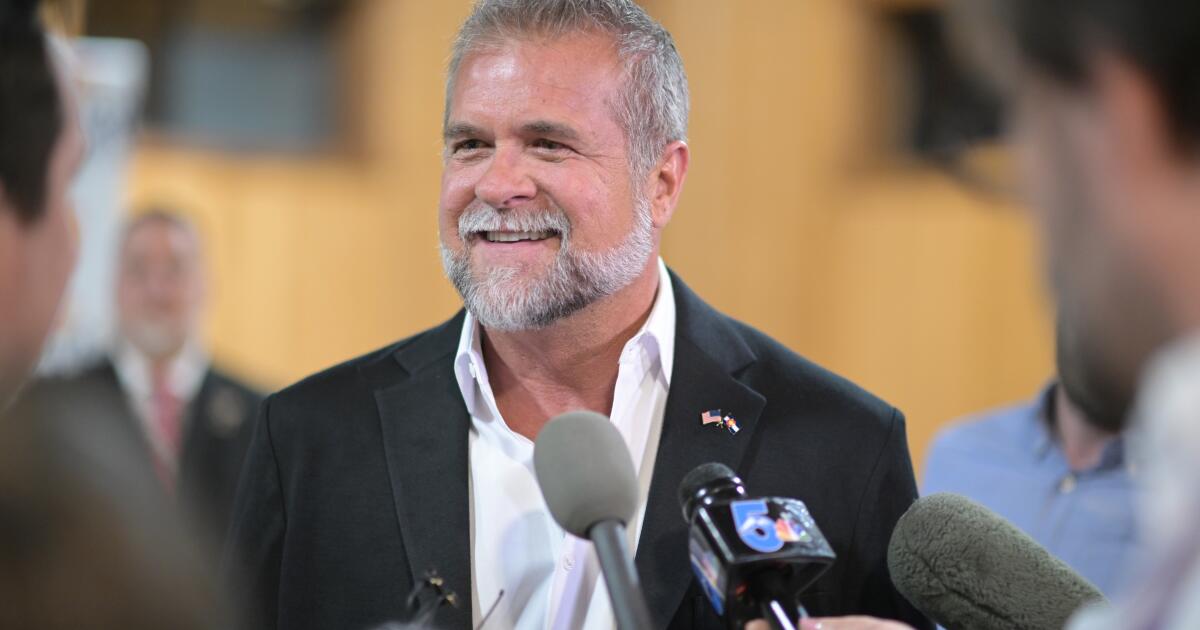
When Victor Marx was 3 years old, he was forced into a voodoo ritual involving a beheaded cat. At age 7, he killed a man.
Or so Marx says.
But he was not just a precocious child.
As an adult running a “high-risk” Christian ministry, Marx says he rescued 45,000 women and children from captivity and abuse. As a civilian, he supposedly called in a U.S. military airstrike that killed 70 ISIS fighters. He’s exorcised demons — and can do so over the telephone, he says, if need be.
True or, most likely, false, those woolly claims and epic tales of derring-do aren’t the weirdest thing about Marx.
The weirdest thing is that Marx is the Republican nominee for governor of Colorado, an actual part of these United States.
A political newcomer, Marx eked out his victory in a three-way race by less than 2,500 votes out of more than 520,000 cast. (It took almost nine days to declare a winner, but surely you knew that already, given the national outcry over how long it took Colorado to count its ballots. Oh, wait. Never mind.)
Although slender, Marx’s victory delivered a strong statement: about the grave condition of mainstream Republicanism; about the increasing embrace of oddity and extremism by a deeply disaffected slice of the American electorate; about the unsettled and unsettling nature of today’s politics.
“It’s almost cult-like,” Dick Wadhams, a former Colorado GOP chairman, said of Marx’s support. “You talk to some of these people, and there is no doubt in their mind he will be governor, because God has decided that he’s going to be governor.”
There’s fat chance of that. (Please don’t smite me.)
Colorado has elected only one Republican governor in the last 55 years, and that was back in 2002. It’s been 10 years since a Republican won any statewide office. The Democratic nominee, Atty. Gen. Phil Weiser, is as close to a November shoo-in — after stomping U.S. Sen. Michael Bennet in the primary — as it gets.
But Marx, 61, a former Marine and expert in martial arts, is nothing if not swaggering. His role model is, of course, the political disrupter and fabulist-in-chief currently occupying the White House.
Like President Trump, Marx relies heavily on personal charisma, a strong social media presence and the purposeful shunning of campaign norms which, to the politically alienated, speaks to his independence from the establishment and offers a welcome break from the same old, same old.
He casts himself as a problem-solver and negotiator par excellence. He skimps on policy and skipped most of the preprimary debates; at the one he did attend, Marx brought his dog, a Dutch shepherd, onstage. In lieu of a closing statement, Marx prayed.
When asked, he hasn’t backed off his fantastical claims. But Marx hasn’t done a very good job substantiating them.
As a young boy growing up in Louisiana, he says, his abusive stepfather — the one who supposedly involved him in a satanic feline decapitation — drove him to rural Mississippi, where Marx shot and killed a man. Police told Colorado Public Radio they had no record of any unsolved homicides from that time.
“How many people have you killed?” Kyle Clark, an anchorman on Denver’s 9News, asked the candidate in a persistent and revealing sit-down interview.
“I don’t think that’s important,” Marx replied. “It’s actually kind of — it’s an odd question to me.”
Actually, it’s not.
(Conceding the Republican race, state Sen. Barbara Kirkmeyer — the runner-up — conspicuously declined to endorse Marx, urging voters to “choose the path that is best for Colorado” in November. “For the record,” she added. “I still haven’t killed anyone.”)
In many ways, Marx is a mainstream conservative Republican. He founded All Things Possible Ministries, a Christian nonprofit that tends to refugees and other victims of trauma. His focus on law and order, tax relief, small government and deregulation are all standard GOP fare.
But his florid tales of youthful homicide, telephonic exorcisms, personally intercepting human smugglers on the U.S.-Mexico border — well, not so much.
Most voters will probably have a hard time getting past those autobiographical extravagances, which could spell trouble — depressed GOP turnout, guilt by association — for other Colorado Republicans, including freshman Rep. Gabe Evans, who’s fighting to hang onto a closely fought congressional seat in the north-central part of the state.
It’s a loss Republicans can ill afford as they desperately seek to preserve their bare House majority.
Despite its preference for Democratic governors, Colorado was, until not that long ago, a competitive two-party state. It was a presidential battleground as recently as 2012. Republicans held a majority in the state Senate as recently as 2018.
But the MAGA-fication of the state GOP has hastened Colorado’s evolution from political battleground to a solidly blue bastion.
“The Colorado Republican Party right now is impotent and irrelevant,” said Wadhams, who fought unsuccessfully against its takeover by Trump-worshiping zealots. “The ironic twist to this story is that polling has shown over the past several months that voters are getting restless about what they see as the decline of Colorado in terms of education, energy, roads and transportation.”
Just last week, the annual Colorado Health Foundation issued its annual Pulse Poll, a dour report card on the state of the state that found three-quarters of respondents were concerned they may not be able to live there in the future.
But don’t expect Democrats to lose their sovereignty anytime soon.
That’s what happens when a party and its voters stop seriously competing and instead indulge their passions and fever dreams. You get candidates, and political caricatures, like Victor Marx.
God help us.

California has some of the nation’s toughest gun laws, but state lawmakers are concerned that a new technology is allowing criminals to obtain firearms by building them from scratch. By using 3-D printers, they warn, lawbreakers are able to make key components of untraceable “ghost guns” with the press of a button.
Ghost guns, which authorities say make it more difficult to investigate shootings because they lack serial numbers, have been a growing problem for law enforcement nationwide. According to federal data, the number of privately made firearms recovered in crimes surged from more than 1,600 in 2017 to nearly 27,500 in 2023. California leads the nation in recoveries over that period.
In response, legislators are seeking to mandate that all 3-D printers sold in the state come equipped with software that prohibits users from making triggers and other gun parts. A bill passed the Assembly in May and is advancing through the Senate.
But the proposal has drawn opposition from a diverse coalition, which includes civil liberties groups, tech companies and 3-D printing enthusiasts as well as Hollywood effects studios, who argue that “firearm blocking software” will also prohibit legitimate designs and expose makers to government or corporate surveillance.
-
Share via
Inside a San Fernando workshop, Samuel McBride makes movie monsters come to life for the camera. One of his latest creations, an animatronic hand, clutches when he pulls a trigger that he built using a 3-D printer.
McBride says the technology has transformed the work at Legacy Effects, where he is a lab manager, but he’s worried it will soon be off-limits because of a proposed change in California law.
McBride fears the law would interfere with the making of devices like the one that activates his lifelike hand.
“If I just took apart this trigger and put it on a printer, how is anyone, computer or human, going to tell me how I intend to use it?” he asked.
Backers of the proposed law say it has the potential to help save lives.
“As gun violence continues to devastate our communities, we cannot allow 3-D printing technology to become a new pipeline for untraceable weapons,” said Assemblymember Rebecca Bauer-Kahan, the bill’s author.
Critics of the proposed California law note that 3-D printed guns represent a small subset of ghost guns recovered by law enforcement at crime scenes. According to the federal Bureau of Alcohol, Tobacco, Firearms and Explosives, most “privately made firearms” recovered by police are assembled from mail-order kits or unfinished parts rather than printed at home.

Jorge Perez of Monster City Studios holds a sculpture made with a large, industrial 3-D printer.
(Ronaldo Bolaños / Los Angeles Times)
“This fight is not over whether ghost guns are dangerous,” said David Tobin, an independent creator leading the coalition. “It is over whether the state can or should require a consumer tool to surveil a person’s designs before they are allowed to make something.”
Everytown for Gun Safety, a national nonprofit that advocates for gun control and has pushed for the passage of California’s bill, pointed to rising 3-D printed firearm recoveries across 20 major cities and warned that homemade plastic parts can help people bypass background checks or turn handguns into automatic weapons.
Krystal LoPilato, who advocates for policy at Everytown, said the group has successfully guided a similar bill through the New York state Legislature.

A handgun frame made using a 3-D printer is held for display at the office of the federal Bureau of Alcohol, Tobacco, Firearms and Explosives.
(Alex Brandon / Associated Press)
LoPilato said the policy aims to be proactive, rather than allowing more violence to take place before regulating the problem. Opponents counter that California already bars unlawful firearm manufacturing with 3-D printers, and that ghost gun recoveries have declined since the state adopted a series of new laws and enforcement efforts.
A June 1 letter to lawmakers, signed by a group of 3-D printing companies, stagecraft and prop-making studios and industry stakeholders, argued that AB 2047 raises 1st Amendment concerns and would harm businesses. The letter was signed by a wide variety of companies and individuals, including Prusa Research, a prominent 3-D printer manufacturer.
“To an algorithm, a gun barrel and a piece of pipe are the same grooved cylinder,” Jakub Kmošek, head of public affairs at Prusa, said in a statement to The Times. “This bill will only make it harder to build, repair, experiment, and innovate in California.”
Alan Scott, Legacy Effects’ co-founder, said 3-D printing has become central to the company’s survival in an industry where budgets are tighter and deadlines are shorter.
“Everything’s just got to be done faster these days. You don’t get to reduce the quality. We couldn’t stay in business if we weren’t 3-D printing,” Scott said.
To solve this problem, Bauer-Kahan put an entertainment industry exception in the bill, exempting “printers manufactured for and sold exclusively to entertainment industry stagecraft and propmaking studios” from the software requirement.
McBride, Legacy’s 3-D lab manager, said those printers do not really exist.
Legacy uses the same general-purpose machines available to other businesses willing to invest in the equipment, and no printers are marketed exclusively for Hollywood, he said.

2

1. A 3-D printed sculpture concept at Monster City, a special effects studio in Santa Clarita. (Ronaldo Bolaños / Los Angeles Times) 2. 3-D printing advocate David Tobin showcases a robotics kit at Monster City. (Ronaldo Bolaños / Los Angeles Times)
Legacy also worries about privacy. Major studios require strict secrecy before a movie or show is released. To accommodate this, the company shares design files through encrypted servers and protected internal systems.
“We’ve invested hundreds of thousands of dollars to bring all that technology here under the umbrella of our NDAs and our IP protection,” McBride said.
Bauer-Kahan noted at a Senate hearing that she is working to address concerns raised by 3-D printing users and industries that rely on the technology.
Paul Powers, chief executive of Physna, a company whose technology could be used to block gun parts on 3-D printers, said the strongest criticisms of AB 2047 “misunderstand how the software works.”
“Something that vaguely looks like a gun part is not considered to be a match,” he said.
Powers also responded to surveillance concerns by clarifying that his company’s software only blocks the printer from making prohibited parts — it doesn’t flag them to authorities or log users’ intellectual property.
“There’s no communication with anyone; it doesn’t go anywhere,” he said.
But Marleen Vogelaar, chief executive of Thangs3D, a platform for independent creators to share and sell 3-D printable designs, said that answer does not resolve her broader concerns about how AB 2047 would work in practice.
“These databases will always lag behind innovation and can be easily circumvented and generate false positives that block legal designs and wrongly flag everyday makers,” she said at a Senate hearing this month. “The bill also creates serious privacy and security risks by giving third parties access to analyze designer’s files. That threatens intellectual property and adds digital surveillance in a state that values data privacy.”
If the bill passes, the state’s Department of Justice would publish a roster of compliant printers. Printers not on the list would be banned from sale or transfer in California beginning in December 2029.
Aubrey Rodriguez, a legislative advocate with American Civil Liberties Union California Action, an advocacy organization formed by the ACLU’s three affiliates in the state, said the bill would ask ordinary users, schools and businesses to accept a new layer of control based on software they still do not trust.
Rodriguez said the proposal risks creating “a permanent back door into the privacy of our own homes, ripe for exploitation.”
“Once this new infrastructure exists, it is a simple software update away from tracking political dissent or preventing 3-D printing designs deemed inappropriate,” Rodriguez said.
-

 Florida6 minutes ago
California wealth charts a quieter path to Florida as Gulf Coast enters multibillion-dollar boom
-

 Georgia12 minutes ago
Logan Little League eliminated by Georgia in Southeast Region tournament
-
Hawaii18 minutes ago
US military identifies 2 soldiers killed in Iranian attack on Jordan as from Texas and Hawaii
-
 Idaho24 minutes ago
A queer Methodist minister didn’t feel safe at an Idaho hospital; her conference won’t return to Boise next year
-

 Illinois30 minutes ago
Illinois Unemployment Remains Relatively Unchanged
-

 Indiana36 minutes ago
Smokey to storms today, some strong storms possible Tuesday | July 20, 2026
-

 Iowa42 minutes ago
First quadruple organ transplant lets Iowa mom go home
-

 Kentucky54 minutes ago
Kentucky Basketball top-5 recruit RJ Evans


