Northeast
Autumn in New England: 6 states pack big color, major history, in small area

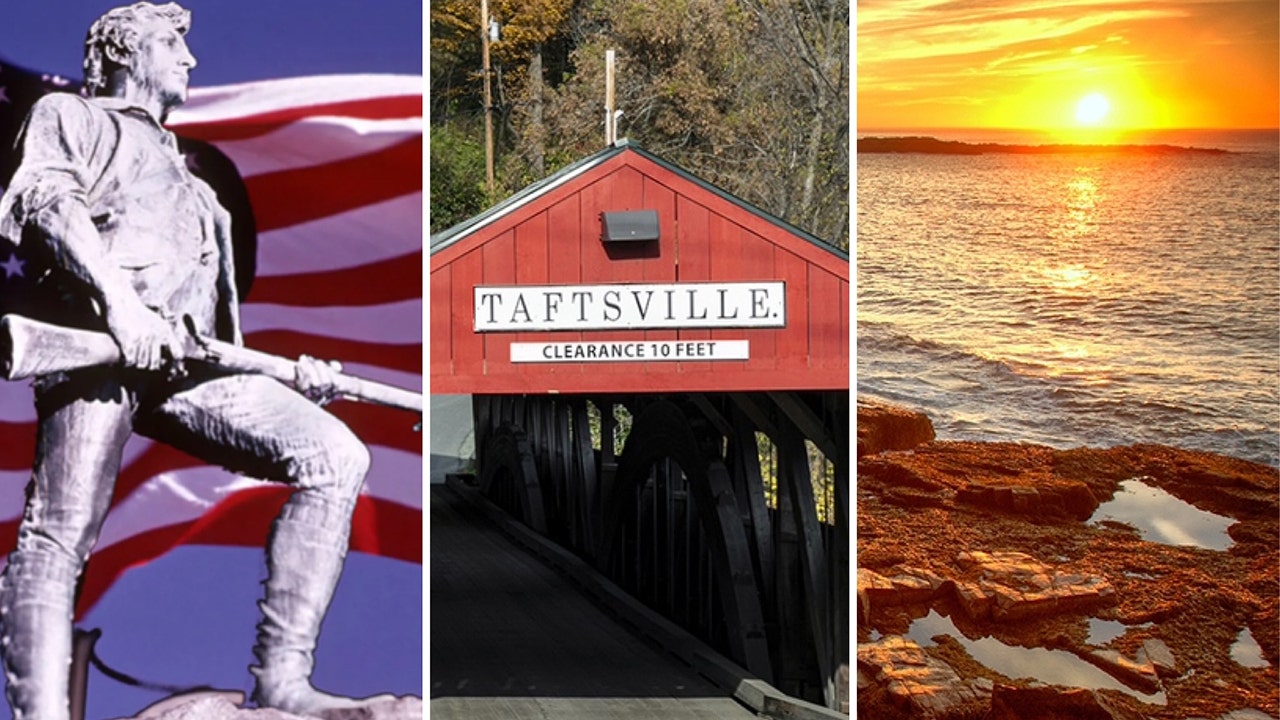
New England packs a lot of U.S.A. in a little corner of America.
Its six states combined would rank only 18th among the 50 states.
Visitors driving north up Interstate 95 can leave New York – not New England – and drive clear across Connecticut and Rhode Island, north through Massachusetts, zip through coastal New Hampshire and arrive in southern Maine in just five hours.
That’s five states, 10% of all of them, in a single afternoon, missing only the sixth New England state — beautiful, rural Vermont.
KANSAS CITY HOME TO AMERICA’S BEST BARBECUE, CHEFS CLAIM ‘OUR VARIETY MAKES US UNIQUE’
There’s plenty to see along the way. Among the options are plenty of coastlines, the sites that gave birth to the United States and spectacular autumn foliage.
Here is one must-see site in these six New England states.
Connecticut – Mystic Seaport
Mystic Connecticut USA. The small railroad station at Mystic is shown with a decorated hay cart. (Education Images/Universal Images Group via Getty Images)
America’s largest maritime museum brings the nation’s sailing heritage to life today with its historic New England oceanfront village, exhibits, period arts and crafts, and vessels such as the Charles W. Morgan, the world’s last remaining wooden whale ship.
The area is still essential to the nation’s maritime heritage today.
The U.S. Navy submarine fleet is headquartered a few miles west in Groton, where visitors can explore the USS Nautilus and Submarine Force Museum.
Maine – Acadia National Park
Sunrise over Acadia National Park, Mount Desert Island, Maine. (Dukas/Universal Images Group via Getty Images)
The majestic park offers the most spectacular example of New England’s famously rugged rocky coast.
The Atlantic Ocean gives way to a granite shoreline, then sprawling pinewood forests and stunning terrain highlighted by Cadillac Mountain, the highest peak on the eastern seaboard.
FALL LEAF-PEEPING NEW ENGLAND TRAVEL HAS AMERICANS EYEING 6 STATES AND DATES
Visitors also experience Maine’s unique downeast culture — complete with its own curious accent.
It offers a postcard landscape of lobster boats anchored in snug coves, quaint coastal villages of artists and boat builders, with havens for rock climbers, snowmobilers and ice fishermen.
Massachusetts – Minute Man National Historical Park
The Minuteman Statue in Lexington, Mass. is meant to depict Captain John Parker, who led the outnumbered Lexington militia against the British regulars on April 19, 1775. The ensuing skirmish, the “shot heard ’round the world,” ignited the American Revolution. (Kerry J. Byrne/Fox News Digital)
This serpentine park meandering through woodlands and town squares west of Boston tells the heroic tale of April 19, 1775, when 80 armed American civilians stood their ground on Lexington Common as 700 British troops, agents of the most powerful king in the world, pressed down upon them.
The Redcoats were looking to capture local munitions and rebel leaders Sam Adams and John Hancock. “Throw down ye arms,” a British officer commanded.
The outnumbered Americans did not surrender their arms. The “shot heard ‘round the world” rang out — and the American Revolution had begun.
MEET THE AMERICAN WHO LED 77 MINUTEMEN AGAINST 700 REDCOATS AT BATTLE OF LEXINGTON: CAPTAIN JOHN PARKER
The Lexington minutemen were quickly overrun, eight of them killed; but they had bought time as the call to arms spread across the countryside. The growing American force at Concord a few miles west greeted the British and turned them back.
Soon, thousands of colonists chased the Redcoats all the way back to Boston, decimating their ranks along the way. “What a Glorious Morning for America,” the street signs of Lexington still read today.
New Hampshire – Mount Washington
Mount Washington in New Hampshire in autumn. (Dukas/Universal Images Group via Getty Images)
The centerpiece of the Presidential Range of the White Mountains is nothing less than the tallest peak in the northeast (6,288 feet). More famously, Mount Washington habitually witnesses the globe’s most severe weather — due to its elevation and its location at the convergence of several major storm patterns.
Mount Washington’s brutal wind and cold is proclaimed locally as a testament to the hearty nature of “Live Free or Die” state residents. The summit held the record for highest wind speed ever recorded (231 mph) for several decades and reached a record low temperate of -50 degrees Fahrenheit in January 1885.
The Mount Washington Observatory recorded a wind chill of -103 degrees as recently as 2004.
The mountain today is a popular attraction for tourists, who ascend the top via hiking trail, precarious auto road or popular cog railway.
Rhode Island – Newport Mansions
The Breakers, built in 1895 as a summer estate by the Vanderbilt family, one of the famous mansions in Newport, Rhode Island. (Tim Graham/Getty Images)
The wealth of the Gilded Age springs to life in Newport, where the nation’s titans of 19th-century industry built ostentatious summer homes on the cliffs where scenic Narragansett Bay meets the Atlantic Ocean.
The Breakers, owned by railroad tycoon Cornelius Vanderbilt II, is probably the most spectacular, built of limestone in the ornate style of an Italian palazzo. Newport’s legacy as a playground of wealthy lives on today around its charming and busy New England downtown waterfront.
The city is home to the International Tennis Hall of Fame and hosted the America’s Cup, the world’s premier sailing race, for decades.
Vermont – Lake Champlain
Taftsville covered bridge at Taftsville in Vermont. (John Greim/Loop Images/Universal Images Group via Getty Images)
The “Sixth Great Lake” sits on the border of New York and is best explored from the quintessential New England college town of Burlington.
It has loomed large in both Native and European American history.
Lake Champlain divided the Mohawks to the west and Abenaki to the east, while British and continental forces fought for control of the 107 mile-long lake throughout the American Revolution.
MInuteman statute, Lexington, Massachusetts’ covered bridge, Taftsville, Vermont; sunrise over Acadia National Park, Maine. (H. Armstrong Roberts/ClassicStock/Getty Images; John Greim/Loop Images/Universal Images Group via Getty Images; Dukas/Universal Images Group via Getty Images)
Lake Champlain today is a perfect place to enjoy the pristine wilderness and especially the autumn foliage of northern New England — or to search for Champy.
For more Lifestyle articles, visit www.foxnews.com/lifestyle
The mysterious Loch Ness monster-like creature was first known to the Abenaki, allegedly witnessed by French explorer Samuel de Champlain himself, and reported by dozens of other witnesses in the centuries since.
Read the full article from Here

Boston, MA
‘More than just a cyclist’: Hundreds mourn Boston transit planner killed while biking – The Boston Globe

“She’s more than just a cyclist and an advocate,” Rose Frank, 36, who became friends with Gag in seventh grade, said. “Those were parts of her identity, but she’s such an amazing person in so many other ways, and we want to celebrate all of those ways.”
Gag, who grew up in Roslindale just minutes from the park, was a joyful and energetic child, said Mark Smith, 66, a neighbor who spoke at the event.
“She was the sweetest little girl with a big wide smile,” Smith said. “Whenever you were in her presence, you felt somehow special.”
Smith said Gag’s passion for giving back to her community likely came from her parents, Steve Gag and Laura Gang, longtime Roslindale residents who contributed greatly to developing the neighborhood. Steve Gag helped bring a farmers market to Adams Park, while Laura Gang was involved in the public library.
Gag’s loved ones said she grew up to become a generous person who cared deeply about her family and friends.
“Louisa showed up for people,” Molly Goodkind, 36, a childhood friend of Gag’s said during Sunday’s event. “We’ll never understand how she had time to be everyone’s go-to person.”
Gag, she said, would eagerly volunteer to cat-sit, even though she didn’t like cats. Another friend said she kept a spreadsheet of the birthdays of all the babies she knew.
“She was the person outside of my biological family who, if I needed something, she would be there in an instant,” Goodkind, who has known Gag since they were 2-years-old, said.
Gag’s friends said she was curious and remained open-minded, even though she held firm beliefs.
“Who do you know that was a vegetarian except for when it inconvenienced others? And of course, except for hot dogs, because according to Louisa, you can’t not have a hot dog at a barbecue,” Gag’s friend Danielle Shaked said, drawing laughs from the crowd, including Laura Gang, who dabbed at her eyes with a crumpled tissue.
Gag also found time for many hobbies, and was always trying new ones, her friends said. Beyond loving outdoor activities such as biking and hiking, she was passionate about sustainability and shopped secondhand or sewed her own clothes. She dabbled in photography, painting, and cooking.

Urban planning was one of Gag’s enduring passions, Goodkind said.
“In college, she created her own major,” she said. “I don’t remember exactly what she called it, but it was something like city and people.”
Gag attended college at the University of Rochester and later earned a master’s degree in urban and environmental planning and policy from Tufts University, according to her LinkedIn.
Before joining the city in 2022, Gag worked for LivableStreets Alliance, a Boston-based nonprofit that advocates for increased safety, equity, and affordability. She also interned for Mayor Michelle Wu when Wu was a city councilor.
Wu attended Sunday’s event, but did not speak. Like many other attendees, she held a yellow sunflower, one of Gag’s favorites, as she tearfully listened to the tributes.
While Gag didn’t like being the center of attention, her friends said she would have been grateful for Sunday’s event.
“She would be completely honored to know that she has impacted so many people,” Frank said, her gaze drifting over the people gathered in the park.
Under a small tent nearby, attendees crowded around a folding table, filling out remembrance cards. Dozens of bikes leaned against the park’s fences while more lay scattered in the grass.
Allyson Chiu can be reached at allyson.chiu@globe.com. Follow her on X @_allysonchiu.
Pittsburg, PA
Pittsburgh Pirates Select Incoming Tennessee Baseball Transfer Outfielder In MLB Draft | Rocky Top Insider

The Pittsburgh Pirates selected Tennessee baseball transfer commit Andrew Duncan with the 558th pick (19th round) in the 2026 MLB Draft on Sunday afternoon. A Wright State outfielder, Duncan committed to Tennessee out of the transfer portal last month.
Duncan is coming off a breakout junior season at Wright State where he slashed .367/.436/.577 with six home runs, 11 doubles, eight triples and 36 RBIs. As the eight triples indicate, speed is a key part of Duncan’s game with the outfielder stealing 19 bases on just 22 attempts.
The Dunedin, Florida native spent his freshman season at Florida State where he played in just 13 games before transferring to Wright State for his sophomore season. Duncan transferred to Tallahassee State College for his sophomore season before moving back up to the division one level at Wright State last season.
More From RTI: Elite Tennessee Baseball Catcher Signee Withdraws From MLB Draft, Will Play for Vols
Duncan played centerfield for the Raiders last season and will likely slide into that same spot at Tennessee next season if he does not sign with Pittsburgh. Outfield was a major point of emphasis for the Vols this offseason after losing Reese Chapman to graduation, Garrett Wright to the MLB Draft and both Jay Abernathy and Nate Eisfelder to the transfer portal.
Losing Duncan would be a real blow because of Tennessee’s need in centerfield for next season. A number of other Vols including Levi Clark, Blake Grimmer and Mercer transfer Braydon Kersey are capable of playing in the outfield but likely could not play centerfield at a high level defensively.
Duncan is one of 11 transfers to commit to Tennessee this offseason along with Air Force infielder Wyatt Hanoian, Cal Baptist shortstop Chris Ramirez, Baylor infielder Travis Sanders, FIU infielder Mario Trivella, Clemson right-handed pitcher Hayden Simmerson, Louisville right-handed pitcher Parker Detmers, South Carolina left-handed pitcher Jake McCoy, Northwestern State left-handed pitcher Brody Trosclair, UC Irvine left-handed pitcher Ricky Ojeda and Mercer two-way Braydon Kersey.

ROCKY HILL, Conn. (WFSB) – People like Dena Pizzoferrato are changing what they put in their grocery carts after hearing about a cyclosporiasis outbreak.
“I’m kind of a little nervous so I’m looking to see what I buy right now,” Pizzoferrato said. “Today I didn’t buy any lettuce. I said I’m OK for now.”
Doctors say the illness is spread through parasites that make their way onto fresh produce. There have been 23 reported cases in Connecticut since May, but the CDC says the number is likely higher. Across the country, more than 840 cases and 86 hospitalizations have been reported in 31 states.
Symptoms include diarrhea and nausea that can last days to weeks. Doctors have not identified a source for the outbreak.
Dr. Ulysses Wu, chief epidemiologist at Hartford HealthCare, said a range of produce could be contaminated.
“Typical things you would think are vegetables or fruits. In the past, it’s been raspberries, basil, cilantro. You may find it in lettuces, bagged salads. So it’s a variety of things that can be contaminated, but they have not found it at this time,” said Wu.
Wu said residents should take precautions with their produce. “Take precautions with your fruit and your produce. We give the same advice when people go overseas that you should always peel something. You should always boil something,” he said.
Doctors also recommend washing produce thoroughly if boiling is not an option, and washing hands regularly.
Copyright 2026 WFSB. All rights reserved.
-

 Detroit, MI11 minutes ago
Around 400 pairs of shoes intended for charity giveaway stolen from Detroit nonprofit, organization says
-

 San Francisco, CA23 minutes ago
How to watch San Francisco Giants vs. Colorado Rockies
-

 Dallas, TX29 minutes ago
3 unanswered questions before training camp: Dallas Cowboys edition
-

 Miami, FL35 minutes ago
“Love & Hip Hop: Atlanta” star Tommie Lee among 6 arrested during World Cup match in Miami, sheriff says
-

 Boston, MA41 minutes ago
‘More than just a cyclist’: Hundreds mourn Boston transit planner killed while biking – The Boston Globe
-

 Denver, CO47 minutes ago
Nuggets sign former Denver West basketball player Alpha Diallo out of EuroLeague
-

 Seattle, WA53 minutes ago
Portland aims to top Seattle’s 405 e-bikes with 2-mile Guinness record ride and party
-

 San Diego, CA59 minutes ago
Top-ranked Jannik Sinner beats Alexander Zverev to win Wimbledon again

