Northeast
AI raises the stakes for national security. Here’s how to get it right

NEWYou can now listen to Fox News articles!
Regulating advanced AI isn’t a game of checkers. It’s a game of chess.
Every move matters. You have to think several steps ahead. And if you focus only on the next play — or worse, react after the fact — you risk losing the long game.
Today, the United States finds itself at a turning point on AI, where real policy choices are being made. You can see it in the actions underway in both the states and Washington.
In recent months, leaders in both New York and California have passed landmark AI safety legislation. California’s SB 53 took effect on January 1, while New York’s RAISE Act was signed into law by Democrat Gov. Kathy Hochul in December and will take effect in 2027.
MIKE DAVIS: CONGRESS MUST STOP BIG TECH’S AI AMNESTY SCAM BEFORE IT’S TOO LATE
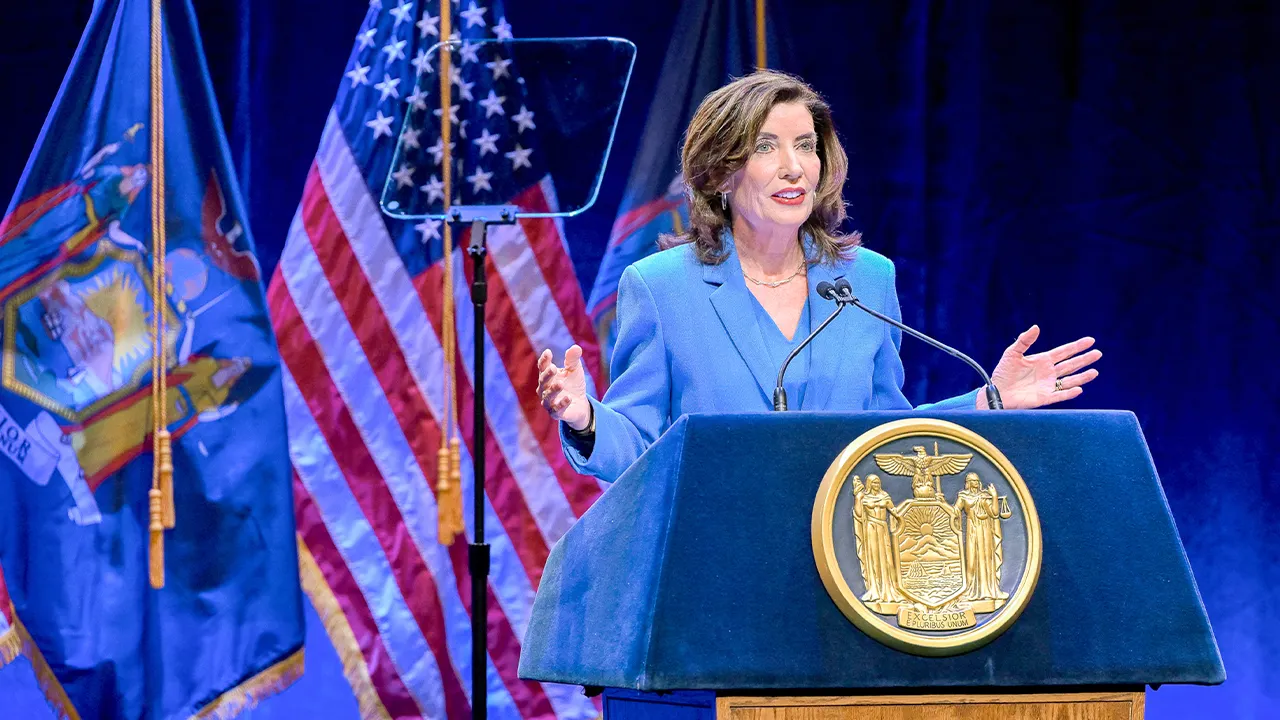
New York Gov. Kathy Hochul delivers her State of the State address at Hart Theatre at The Egg in Albany, New York, Jan. 13, 2026. (Heather Ainsworth/Bloomberg via Getty Images)
Both states are moving toward approaches that align state and federal law — recognizing that a fragmented, state-by-state patchwork isn’t sustainable. Given their size and economic impact, these moves create a clear path forward for federal action while positioning New York and California to lead the nation into the AI era.
There’s a word for this kind of alignment between state and federal action: harmonization. The federal government sets one clear national standard for the most powerful AI systems — the issues that affect national security and the country as a whole. States continue to focus on the issues closest to people’s daily lives: consumer protection, civil rights and how AI is used in schools, workplaces and public services. Each level of government plays to its strengths.
Think of it as one rulebook with two clear roles and one urgent mission: ensuring the United States maintains its competitive advantage in a technology central to national security and global economic leadership. Russian President Vladimir Putin has said bluntly that whoever leads in AI will lead the world. The United States can’t afford to drift — or to divide itself — at this critical moment.
STATE-LEVEL AI RULES SURVIVE — FOR NOW — AS SENATE SINKS MORATORIUM DESPITE WHITE HOUSE PRESSURE
That’s because AI leadership is increasingly an issue of national security — and national security requires prevention, not punishment after the fact.
When states act alone, they are often forced into a liability-only approach — holding companies accountable after harm has already occurred. Preventing the most serious risks requires access to the technical expertise and classified systems that only the federal government possesses.
That is why our North Star must remain clear: deploying frontier models safely and in a way that best positions the United States to maintain its innovation lead.
TRUMP ADMINISTRATION EYES SWEEPING FEDERAL POWER OVER AI, DRAFT ORDER SHOWS
That prevention-first approach already exists in practice. The Center for AI Standards and Innovation — created by the Biden administration and updated by the Trump administration — gives the federal government the ability to test and evaluate advanced AI systems before they are widely deployed. That kind of centralized testing is essential for managing risks that no single state or company can address on its own.
Without harmonization, AI companies would face a confusing patchwork of conflicting state requirements that slows innovation without improving public safety. With it, companies get clarity and consistency, the public gets stronger protections and states are given clear room to act where they add the most value.
Today, the United States finds itself at a turning point on AI, where real policy choices are being made. You can see it in the actions underway in both the states and Washington.
At the same time, states play a vital role, and the recent moves in New York and California show what that balance looks like in practice. By moving away from fragmented approaches and toward alignment, the two largest innovation economies in the country are helping create a de facto national standard that exists alongside, and not instead of, state action.
WHITE HOUSE OFFICIAL PRESSES ALLIES TO FREE AI FROM INNOVATION-KILLING REGULATIONS
This is what harmonization looks like in practice: Washington focuses on the highest-stakes safety issues, while states address kitchen-table ones. It is a third way forward — avoiding both unregulated acceleration and fragmented overreach.
Think about how we handle car safety. We don’t wait for accidents to happen and then rely solely on lawsuits to make cars safer. The federal government sets clear national safety standards. It requires rigorous testing. And it makes seatbelts, airbags, and braking systems mandatory — with strict rules for how well they must perform — before cars ever hit the road. Liability still matters, but prevention comes first, because the stakes are too high to get it wrong.
That balance isn’t new. It’s how the United States has governed aviation, food and drug safety, financial markets and telecommunications. In each case, the federal government set clear national standards for systems that power the entire country, while states continued to play a critical role closer to home. The result wasn’t less innovation or less growth. It was regulatory clarity, economic growth, and American leadership.
CHINA RACES AHEAD ON AI —TRUMP WARNS AMERICA CAN’T REGULATE ITSELF INTO DEFEAT
I saw this dynamic firsthand in 1996, when I was working in the White House just as the internet was beginning to reshape the economy.
Washington faced a choice that feels familiar today: apply old rules to a new technology, or agree on a new national framework built for what was coming next. Democrats and Republicans chose the latter.
CLICK HERE FOR MORE FOX NEWS OPINION
The result was the Telecommunications Act of 1996. It wasn’t perfect, but it got the big things right. It created clear national standards, gave innovators room to build and helped position the United States to lead the internet era that followed.
Think of it as one rulebook with two clear roles and one urgent mission: ensuring the United States maintains its competitive advantage in a technology central to national security and global economic leadership.
The lesson is straightforward. When America sets smart, national standards for emerging technologies, we don’t fall behind — we lead.
CLICK HERE TO DOWNLOAD THE FOX NEWS APP
The chessboard is set. If the United States focuses on prevention, harmonizes state and federal efforts, and keeps its eyes on that North Star, we can once again lead a defining technological era.
That’s how you win the long game: by playing chess, not checkers.
Read the full article from Here



Boston, MA
From across Boston they flock to play for Latin Academy boys’ tennis, a co-op of 29 schools – The Boston Globe

“I’ve done a lot of different things in my life, but there’s no question in my mind that the youth development aspect of what I’ve done with kids and tennis in Boston is the most important work I’ve ever done,” said Crane, who has dedicated the last 30 years of his life to youth tennis.
Once upon a time, Crane served as a sports journalist for the New York Post, the defender general of Vermont, and the executive director of the Massachusetts State Ethics Commission.
He has been the head boys’ tennis coach at Latin Academy since 2009, and last season led the Dragons to their first Division 3 semifinal appearance in program history.
This season, the Dragons are trying to repeat that success, and are doing so with players from five Boston high schools (Latin Academy, O’Bryant, Josiah Quincy Upper, East Boston, and New Mission).
Sophomore Mayfre Moreta, a New Mission student, has never crossed paths in the school hallways with his doubles partner, Gio Waterman, who attends Latin Academy, but the pair still managed to rally from a set down to clinch the deciding No. 2 doubles point in last year’s D3 quarterfinals.
“I think [that win] speaks to our identity as a program,” said Waterman. “It’s so nice to play with all these new guys from other city schools. We share that bond of representing the city of Boston.”
Along with the unique co-op structure, Crane runs a no-cut program that carries roughly 35 kids ranging from seventh to 12th grade every year who vary from beginners to experienced tournament players.
“We don’t cut because we want to teach kids from all over the city how to play the game,” said Crane. “We want to give them a sport that they’ll play for the rest of their lives.”
Mateus Washington, a Latin Academy senior, is in his sixth, and final, year with the program. Although Washington has dueled the state’s top players at No. 1 singles this season, he is just as proud that he gets to lead his teammates every day.

Matthew J Lee/Globe staff
“It’s really cool to see how the seventh-graders of this generation look so much like I did in seventh grade,” said Washington, who has posted a 3-3 record this year. “It’s super eye-opening and enriching to be a part of their development.”
Crane recognizes that the team’s makeup is unique and oftentimes difficult to manage.
“Logistically, it’s difficult. The kids are coming from all over the city, and they can’t all show up at the same time because their schools get out at different times,” said Crane.
But above all, Crane is thankful he can give his kids — many of whom come from low-income situations — the chance to play tennis, as well as offer them summer jobs at Sportsmen’s, Franklin Park Tennis Association, and other tennis facilities around the city.
“What motivates me the most is getting to know these kids, building relationships with them, and figuring out how I can be of help to them. I want to help them grow, help them succeed on and off the court, and help them get ready for the rest of their lives.”

▪ Emily Cilley has yet to lose a match as the head coach of the Swampscott girls.
In Cilley’s first year with the program, the Big Blue (4-0) have put last season’s second-round loss to Dover-Sherborn in the rearview mirror.
Key to their success have been sophomore stars Nikki Carr and Ginger Gregoire. Carr has been dominant at first singles, posting a 4-0 record without dropping a set, and Gregoire has been a great option at second singles, logging a 3-1 record and securing the deciding 3-6, 6-1, 6-1 victory in the season opener against Bishop Fenwick.
“They are both very disciplined players who understand the balance between being cautious and being patient,” said Cilley. “Their technical skills are on point, and they aren’t intimidated by the person across from them.”
The Big Blue’s strong start has catapulted them to the top of the Northeastern Conference. They’ll look to continue their unbeaten streak against St. Mary’s next Saturday.
▪ The girls of Central Catholic are off to their best start in program history.
The Raiders boast a 6-0 record after taking down Lowell 5-0 on Saturday morning. The win was their fifth sweep of the season, with the only non-sweep coming in a 4-1 victory over Notre Dame (Tyngsborough).
Morgan Bateman has looked unstoppable at second singles, as she is yet to drop a set, and Ella Asmar has been just as impressive at third singles, posting an undefeated record.
Although Haley Wolters was responsible for the only loss by a Raiders player this season, she has logged impressive victories at first singles, such as a 6-2, 6-3 win against Chelmsford and a 6-1, 6-1 triumph over Lowell.
The Raiders have a chance to extend their winning streak to nine with matches against North Andover, Lowell, and Haverhill on the horizon, before they clash with undefeated Andover on April 30.
Webb Constable can be reached at webb.constable@globe.com. Follow him on X @webbconstable.

It’s only fitting that one of the most eventful offseasons in Pittsburgh Steelers history will be capped by an equally unpredictable NFL draft. Owning 12 picks, including five in the top 100 for the first time since 1999, GM Omar Khan has a chance to radically change the franchise’s trajectory in front of a home crowd in Pittsburgh.
Last time they held five picks in the top 100, the Steelers found a couple very good long-term starters like OLB Joey Porter Sr. and DE Aaron Smith. But they also struck out on WR Troy Edwards, DB Scott Shields, and OT Kris Farris.
At a pivotal, transitional phase in franchise history, the Steelers can’t afford to find just two good starters. That may be a challenge in a draft lacking top-end talent that falls off a cliff in the later rounds. If they are out of range of coveted players, they can’t be timid in the trade market.
I posed the question on this week’s episode of The Depot Dive: Over or under 2.5 trades for the Steelers? I wanted to take the over, but it’s hard to make that work without a trade down. I settled on two.
All that said, here’s my best attempt at predicting what the Steelers will do in the 2026 NFL Draft.
Round One (12th Overall) – Spencer Fano/OL/Utah – 6054, 311 pounds
Trade: Steelers send Patrick Queen + Pick No. 21 + Pick No. 121 + Pick No. 224. Cowboys send Pick No. 12 + 2027 sixth-round pick.
If they want Vega Ioane or Fano, I think it will require a move up. But I don’t think the Steelers will want to sacrifice a lot of picks to accomplish that. Queen is an easy target with the Cowboys having reported interest in trading for him during free agency.
Using our Dave Bryan’s trade idea as a loose template, I like the Steelers to jump up in the first round to solidify the trenches once again. This is the best move for the current—which we know the Steelers place a heavy emphasis on—and the future as they lock in a potentially elite offensive line for the next decade.
It’s a bonus that Fano can play guard now — and potentially tackle later if Broderick Jones or Dylan Cook don’t work out. Fano is Dane Brugler’s top OL in the class. If he makes it to 12, I like the value a lot.
Others Considered: OG Vega Ioane, WR Makai Lemon, TE Kenyon Sadiq
Spencer Fano Scouting Report
Round Two (53rd Overall) – Jacob Rodriguez/ILB/Texas Tech – 6013, 231 pounds
Trading Queen creates a need that outweighs others (like wide receiver). Maybe Rodriguez doesn’t fall this far, but he should be the Steelers’ top target if he does.
As a former quarterback, Rodriguez has a unique football IQ that could be a force multiplier for the entire Steelers defense–something Patrick Queen never really turned into. I witnessed it firsthand at the Senior Bowl. He got everybody aligned correctly pre-snap in an environment where all had to learn a new defense in just a few days.
He’s also the most decorated defensive playmaker coming out of college in decades, even more than Payton Wilson’s impressive list of accolades from a couple years ago. This would be a home-run pick.
Others Considered: WR Denzel Boston, ILB CJ Allen, S Treydan Stukes
Jacob Rodriguez Scouting Report
Round Two (59th Overall) – Germie Bernard/WR/Alabama – 6012, 206 pounds
Trade: Steelers send No. 76 + No. 99. Texans send No. 59.
Another move up to make sure the Steelers get a receiver they like at the end of the second round. Bernard was a pre-draft visitor and has the size and athletic profile that Mike McCarthy likes at the position. He does everything well, and played a healthy mix of slot and outside receiver to fit in the rotation with DK Metcalf and Michael Pittman Jr.
Others Considered: WR Zachariah Branch, WR Chris Bell, ILB Jake Golday
Germie Bernard Scouting Report
Round Three (85th Overall) – Kamari Ramsey/S/USC – 6002, 202 pounds
Not every selection will be a pre-draft visitor, and Ramsey fits the description of the type of defensive back the Steelers have looked at. He has played a strong mix of safety and nickel and is capable of being a chess piece in Patrick Graham’s defense. Given the Steelers’ crowded secondary, he could focus on backing up Jalen Ramsey at free safety in the beginning.
Others Considered: S Jalen Kilgore, OG Keylan Rutledge, QB Drew Allar
Kamari Ramsey Scouting Report
Round Four (135th Overall) – Carson Beck/QB/Miami (FL) – 6046, 233 pounds
The Steelers have spent too much time scouting quarterbacks not to take one. And Beck has several traits they are looking for, including his track record as a winner and his size at nearly 6-5. Their view of Mike McCarthy as a QB whisperer suggests they will give him as many projects as possible until one sticks.
Others Considered: CB Tacario Davis, QB Garrett Nussmeier, WR Ja’Kobi Lane
Carson Beck Scouting Report
Round Five (161st Overall) – Ephesians Prysock/CB/Washington – 6033, 196 pounds
Prysock has all the traits to turn into an impact starter, and the Steelers have gravitated toward th long, rangy athletes at cornerback. He wouldn’t need to see the field right away with a crowded stable of defensive backs, but he has plenty of long-term upside.
Others Considered: WR/KR Kendrick Law, WR Josh Cameron, S Michael Taaffe
Ephesians Prysock Scouting Report
Round Six (216th Overall) – Kaden Wetjen/WR-KR/Iowa – 5090, 193 pounds
Calvin Austin III and Kenneth Gainwell both departed in the offseason, which means the Steelers need a kick and punt returner. Wetjen is the top return specialist in the draft with six total return touchdowns in college.
Others Considered: OT Aamil Wagner, CB Thaddeus Dixon, WR Caleb Douglas
Kaden Wetjen Scouting Report
Round Seven (230th Overall) – Josh Cuevas/TE/Alabama – 6033, 245 pounds
Cuevas is versatile enough to be a rotational backup tight end, and to play H-back or fullback in certain personnel packages. He’s a committed and aggressive blocker and has enough receiving skills to be a dependable option on passing downs, either running routes or blocking.
Others Considered: DL David Gusta, RB Jaydn Ott, TE Matthew Hibner
Josh Cuevas Scouting Report
Round Seven (237th Overall) – Brett Thorson/P/Georgia – 6012, 237 pounds
The Steelers brought back Cameron Johnston, but they didn’t even keep him over Corliss Waitman after last year’s training camp competition. Johnston is 34 years old and has dealt with injuries in each of the last two seasons. Thorson has a relationship with Johnston as a fellow Aussie, so it could be a decent pairing for another training camp competition this year.
Others Considered: WR CJ Daniels, QB Sawyer Robertson, TE John Michael Gyllenborg
Brett Thorson Scouting Report

-
 News14 minutes ago
Real estate investors are buying up long-term care facilities. Residents can suffer
-

 Detroit, MI2 hours ago
Former Piston shows Detroit what they’re missing as he dominates next to LeBron
-

 San Francisco, CA2 hours ago
Eastbound I-80 closure in San Francisco snarls traffic, slows business
-

 Videos2 hours ago
Can Keir Starmer survive the latest Mandelson revelations? | BBC News
-

 Dallas, TX3 hours ago
Petar Musa’s Brace Not Enough as FC Dallas Draws LA Galaxy 2-2
-

 Miami, FL3 hours ago
MLS: Messi double helps Inter Miami slay Rapids in front of huge crowd
-

 Boston, MA3 hours ago
From across Boston they flock to play for Latin Academy boys’ tennis, a co-op of 29 schools – The Boston Globe
-

 Denver, CO3 hours ago
Dale Kistler Obituary | The Denver Post