Northeast
AI raises the stakes for national security. Here’s how to get it right

NEWYou can now listen to Fox News articles!
Regulating advanced AI isn’t a game of checkers. It’s a game of chess.
Every move matters. You have to think several steps ahead. And if you focus only on the next play — or worse, react after the fact — you risk losing the long game.
Today, the United States finds itself at a turning point on AI, where real policy choices are being made. You can see it in the actions underway in both the states and Washington.
In recent months, leaders in both New York and California have passed landmark AI safety legislation. California’s SB 53 took effect on January 1, while New York’s RAISE Act was signed into law by Democrat Gov. Kathy Hochul in December and will take effect in 2027.
MIKE DAVIS: CONGRESS MUST STOP BIG TECH’S AI AMNESTY SCAM BEFORE IT’S TOO LATE
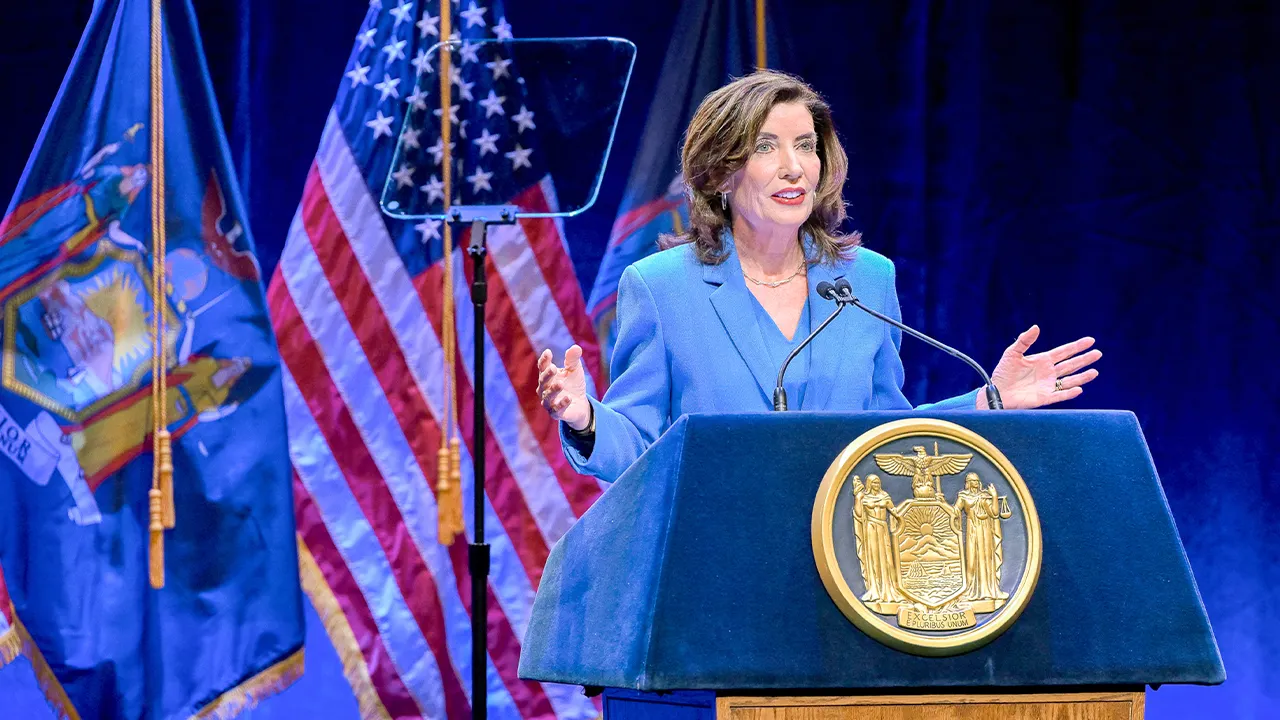
New York Gov. Kathy Hochul delivers her State of the State address at Hart Theatre at The Egg in Albany, New York, Jan. 13, 2026. (Heather Ainsworth/Bloomberg via Getty Images)
Both states are moving toward approaches that align state and federal law — recognizing that a fragmented, state-by-state patchwork isn’t sustainable. Given their size and economic impact, these moves create a clear path forward for federal action while positioning New York and California to lead the nation into the AI era.
There’s a word for this kind of alignment between state and federal action: harmonization. The federal government sets one clear national standard for the most powerful AI systems — the issues that affect national security and the country as a whole. States continue to focus on the issues closest to people’s daily lives: consumer protection, civil rights and how AI is used in schools, workplaces and public services. Each level of government plays to its strengths.
Think of it as one rulebook with two clear roles and one urgent mission: ensuring the United States maintains its competitive advantage in a technology central to national security and global economic leadership. Russian President Vladimir Putin has said bluntly that whoever leads in AI will lead the world. The United States can’t afford to drift — or to divide itself — at this critical moment.
STATE-LEVEL AI RULES SURVIVE — FOR NOW — AS SENATE SINKS MORATORIUM DESPITE WHITE HOUSE PRESSURE
That’s because AI leadership is increasingly an issue of national security — and national security requires prevention, not punishment after the fact.
When states act alone, they are often forced into a liability-only approach — holding companies accountable after harm has already occurred. Preventing the most serious risks requires access to the technical expertise and classified systems that only the federal government possesses.
That is why our North Star must remain clear: deploying frontier models safely and in a way that best positions the United States to maintain its innovation lead.
TRUMP ADMINISTRATION EYES SWEEPING FEDERAL POWER OVER AI, DRAFT ORDER SHOWS
That prevention-first approach already exists in practice. The Center for AI Standards and Innovation — created by the Biden administration and updated by the Trump administration — gives the federal government the ability to test and evaluate advanced AI systems before they are widely deployed. That kind of centralized testing is essential for managing risks that no single state or company can address on its own.
Without harmonization, AI companies would face a confusing patchwork of conflicting state requirements that slows innovation without improving public safety. With it, companies get clarity and consistency, the public gets stronger protections and states are given clear room to act where they add the most value.
Today, the United States finds itself at a turning point on AI, where real policy choices are being made. You can see it in the actions underway in both the states and Washington.
At the same time, states play a vital role, and the recent moves in New York and California show what that balance looks like in practice. By moving away from fragmented approaches and toward alignment, the two largest innovation economies in the country are helping create a de facto national standard that exists alongside, and not instead of, state action.
WHITE HOUSE OFFICIAL PRESSES ALLIES TO FREE AI FROM INNOVATION-KILLING REGULATIONS
This is what harmonization looks like in practice: Washington focuses on the highest-stakes safety issues, while states address kitchen-table ones. It is a third way forward — avoiding both unregulated acceleration and fragmented overreach.
Think about how we handle car safety. We don’t wait for accidents to happen and then rely solely on lawsuits to make cars safer. The federal government sets clear national safety standards. It requires rigorous testing. And it makes seatbelts, airbags, and braking systems mandatory — with strict rules for how well they must perform — before cars ever hit the road. Liability still matters, but prevention comes first, because the stakes are too high to get it wrong.
That balance isn’t new. It’s how the United States has governed aviation, food and drug safety, financial markets and telecommunications. In each case, the federal government set clear national standards for systems that power the entire country, while states continued to play a critical role closer to home. The result wasn’t less innovation or less growth. It was regulatory clarity, economic growth, and American leadership.
CHINA RACES AHEAD ON AI —TRUMP WARNS AMERICA CAN’T REGULATE ITSELF INTO DEFEAT
I saw this dynamic firsthand in 1996, when I was working in the White House just as the internet was beginning to reshape the economy.
Washington faced a choice that feels familiar today: apply old rules to a new technology, or agree on a new national framework built for what was coming next. Democrats and Republicans chose the latter.
CLICK HERE FOR MORE FOX NEWS OPINION
The result was the Telecommunications Act of 1996. It wasn’t perfect, but it got the big things right. It created clear national standards, gave innovators room to build and helped position the United States to lead the internet era that followed.
Think of it as one rulebook with two clear roles and one urgent mission: ensuring the United States maintains its competitive advantage in a technology central to national security and global economic leadership.
The lesson is straightforward. When America sets smart, national standards for emerging technologies, we don’t fall behind — we lead.
CLICK HERE TO DOWNLOAD THE FOX NEWS APP
The chessboard is set. If the United States focuses on prevention, harmonizes state and federal efforts, and keeps its eyes on that North Star, we can once again lead a defining technological era.
That’s how you win the long game: by playing chess, not checkers.
Read the full article from Here



The boat dock at the entrance of Penn’s Cave.
HUNTER SMITH / THE EXPRESS

HUNTER SMITH / THE EXPRESS
The colored light room in Penn’s Cave.
BELLEFONTE — After four generations of family stewardship, the owners of Penn’s Cave and Wildlife Park are asking the state to take over one of Centre County’s most iconic attractions in an effort to preserve it from future development.
Following remarks from CEO Russ Schleiden and his daughter, Jeanine Watson, the Centre County Commissioners on Tuesday endorsed the plan to make the natural wonder Pennsylvania’s 126th state park.
“This has been a very difficult decision for us,” said Schleiden. “But we feel that it’s a very important part of, not only Centre County, but the Commonwealth of Pennsylvania, and that it should be preserved in perpetuity.”
The Schleiden family has spent decades as custodians of America’s only all-water, limestone cavern, working to expand and conserve Penn’s Cave, which contains the headwaters of Penn’s Creek. To ensure the 1,400 acres of land and its waters are around for generations to come, the family is petitioning the Pennsylvania Department of Conservation and Natural Resources (DCNR) to designate the Penn’s Cave estate a state park and take over its stewardship.
The proposed transfer includes the cavern, Cave House, surrounding land and waterways, five homes and several barns. Watson said the family has been working toward the proposal for three years.
“I know the state, DCNR, has wonderful plans and visions for enhancing it and taking it to that next level beyond what we could do,” she said.
Penn’s Creek, which starts in the cavern, flows 34 miles to Selinsgrove where it joins the Susquehanna River Basin before emptying into the Chesapeake. The state has made significant investments in protecting those waters, and the proposed transition would expand that work.
“The tributaries also support the native brook trout,” said Schleiden, naming specifically Little Poe and Big Poe creeks, which are known for their fishing.
Penn’s Cave, he said, has always been supportive of “wildlife for everyone.”
With the commissioners’ help, Penn’s Cave and Wildlife Park has invested $2 million into the local wetlands, protecting local fauna while improving the area’s accessibility. Schleiden said transferring ownership to the state would ensure that mission remains central to the property.
“We strongly desire this to go to the state to protect and continue to conserve, and have it available to the public,” Watson said.
The property also carries historical significance. Penn’s Cave and Hotel was listed on the National Register of Historic Places in April 1978 for its local importance.
The Cave House, or hotel, was built in 1885 by the Long family, who first commercialized the cavern. At the time, visitors traversed the cave by boat using lanterns. That changed in 1927, when the Campbell family, who emigrated from Scotland to the land, electrified the cave.
“It probably had electricity before more than most of the local residents,” Schleiden said.
State Rep. Kerry Benninghoff, who helped coordinate with the state on the proposed transition, also joined the commissioners for the discussion.
Benninghoff said the move would require the endorsement of the governor and both chambers of the General Assembly. The governor is aware of the plan and visited the site last year, and Benninghoff said he has drafted legislation outlining the mechanics of the transition.
“I can’t think of a better time in our country and our county’s history, at the semiquincentennial, to make this a reality,” he said. “If you want to look at Americana in its best, the park I think exemplifies that.”
“In the long run, I think this is a tremendous investment for the commonwealth,” Benninghoff said, noting the transition would not be easy but the commissioners’ endorsement could help move the project forward during this budget cycle.
The proposal also carries potential economic benefits for the region.
Penn’s Cave and Wildlife Park already attracts visitors from all 50 states and several countries. During its peak season, the park employs dozens of local community members. The attraction is a multigenerational employer in Gregg Township, providing jobs for members of the Schleiden family and their employees, many of whom are young adults and teens.
Transferring ownership to DCNR and becoming Pennsylvania’s 126th state park could increase tourism and economic engagement in the area, the owners said. State parks in rural communities often bring tourism dollars and expand employment opportunities as operations grow.
Benninghoff said he could envision additional public amenities, including a campground, while emphasizing the property would remain accessible.
“This is not going to be an exclusive property that no one can access,” she said. “It’s actually one we want more people to enjoy.”
The commissioners each praised the work Schleiden and Watson have done and expressed support for the state park designation, citing the conservation, education, historical, tourism and recreational benefits of the proposal.
“Penn’s Cave is a premier tourist attraction in Centre County,” said Commissioner Mark Higgins, who noted it is one of only a few caves accessible by boat worldwide. “With the trout in the water and the wild animals surrounding it in the wildlife park, it’s a really, really fun half-day attraction to visit.”
“It’s just irreplaceable,” he said.
Commissioner Amber Concepcion called the property “an outstanding area of natural beauty” and added that it provides an opportunity for education and recreation.
“It’s a great place for kids to learn and for adults and people of all ages to spend a summer afternoon,” she said. “It would make a fantastic state park.”
Dershem called the opportunity “once in a lifetime” and said it would be a “crying shame” if the property were developed instead.
“This is an amazing opportunity for the Commonwealth of Pennsylvania to invest in a property that is literally irreplaceable, iconic to our region and unique. I don’t know that you’ll find anything quite like it,” Dershem said. “It’s an amazing place.”
Penn’s Cave, he added, “represents who we are in Centre County” and is “natural splendor at its best.”
Benninghoff said their support will emphasize the urgency of completing the transition to state legislators.
“This endorsement by the county, visitors bureau and other people helps to emphasize that we’d really like to get this done, and time is of the essence,” he said. “People have been knocking on their door, wanting to purchase this land and break it all apart, and a lot of it would go into development.”

(WJAR) — Thirty-two years ago was the commissioning of a Navy submarine named after the Ocean State.
Maria Stephanos was on board the USS Rhode Island on July 9, 1994.
Rhode Island was the Navy’s 15th Trident class ballistic submarine.
It was commissioned in Newport and was the first to be christened in its namesake state.
Powerball, Mega Millions jackpots: What to know in case you win
Here’s what to know in case you win the Powerball or Mega Millions jackpot.
Just the FAQs, USA TODAY
The Vermont Lottery offers several draw games for those willing to make a bet to win big.
Those who want to play can enter the MegaBucks and Lucky for Life games as well as the national Powerball and Mega Millions games. Vermont also partners with New Hampshire and Maine for the Tri-State Lottery, which includes the Mega Bucks, Gimme 5 as well as the Pick 3 and Pick 4.
Drawings are held at regular days and times, check the end of this story to see the schedule.
Here’s a look at July 8, 2026, results for each game:
Winning Powerball numbers from July 8 drawing
12-29-37-43-55, Powerball: 18, Power Play: 4
Check Powerball payouts and previous drawings here.
Winning Gimme 5 numbers from July 8 drawing
01-05-23-36-38
Check Gimme 5 payouts and previous drawings here.
Winning Pick 3 numbers from July 8 drawing
Day: 0-1-3
Evening: 2-4-0
Check Pick 3 payouts and previous drawings here.
Winning Pick 4 numbers from July 8 drawing
Day: 3-9-5-9
Evening: 9-2-0-9
Check Pick 4 payouts and previous drawings here.
Winning Megabucks Plus numbers from July 8 drawing
12-15-23-27-40, Megaball: 03
Check Megabucks Plus payouts and previous drawings here.
Winning Millionaire for Life numbers from July 8 drawing
16-18-43-48-50, Bonus: 01
Check Millionaire for Life payouts and previous drawings here.
Feeling lucky? Explore the latest lottery news & results
Are you a winner? Here’s how to claim your lottery prize
For Vermont Lottery prizes up to $499, winners can claim their prize at any authorized Vermont Lottery retailer or at the Vermont Lottery Headquarters by presenting the signed winning ticket for validation. Prizes between $500 and $5,000 can be claimed at any M&T Bank location in Vermont during the Vermont Lottery Office’s business hours, which are 8a.m.-4p.m. Monday through Friday, except state holidays.
For prizes over $5,000, claims must be made in person at the Vermont Lottery headquarters. In addition to signing your ticket, you will need to bring a government-issued photo ID, and a completed claim form.
All prize claims must be submitted within one year of the drawing date. For more information on prize claims or to download a Vermont Lottery Claim Form, visit the Vermont Lottery’s FAQ page or contact their customer service line at (802) 479-5686.
Vermont Lottery Headquarters
1311 US Route 302, Suite 100
Barre, VT
05641
When are the Vermont Lottery drawings held?
- Powerball: 10:59 p.m. Monday, Wednesday, and Saturday.
- Mega Millions: 11 p.m. Tuesday and Friday.
- Gimme 5: 6:55 p.m. Monday through Friday.
- Lucky for Life: 10:38 p.m. daily.
- Pick 3 Day: 1:10 p.m. daily.
- Pick 4 Day: 1:10 p.m. daily.
- Pick 3 Evening: 6:55 p.m. daily.
- Pick 4 Evening: 6:55 p.m. daily.
- Megabucks: 7:59 p.m. Monday, Wednesday and Saturday.
- Millionaire for Life: 11:15 p.m. daily
What is Vermont Lottery Second Chance?
Vermont’s 2nd Chance lottery lets players enter eligible non-winning instant scratch tickets into a drawing to win cash and/or other prizes. Players must register through the state’s official Lottery website or app. The drawings are held quarterly or are part of an additional promotion, and are done at Pollard Banknote Limited in Winnipeg, MB, Canada.
This results page was generated automatically using information from TinBu and a template written and reviewed by a Vermont editor. You can send feedback using this form.
-

 North Dakota3 minutes ago
Today in History, 1975: Earthquake rattles portions of Minnesota and the Dakotas, including Fargo-Moorhead
-

 Ohio10 minutes ago
Is another team ready to take over the top of the Big Ten from Indiana and Ohio State?
-

 Oklahoma13 minutes ago
Kip Lewis reveals why he returned to Oklahoma for senior season
-

 Oregon18 minutes ago
Pierce County Sheriff: Homicide ‘suspect was shot and killed by police in Seaside, Oregon’
-

 Pennsylvania25 minutes ago
‘Natural splendor at its best’: Penn’s Cave may become Pa.’s next state park
-

 Rhode Island28 minutes ago
Throwback: USS Rhode Island commissioned in Newport
-

 South-Carolina33 minutes ago
Watch out for SC’s 5 most common ticks and take steps to avoid bites
-
South Dakota40 minutes ago
SD Lottery Powerball, Lotto America winning numbers for July 8, 2026

