Northeast
ACLU sues Pennsylvania county over rejected mail-in ballots

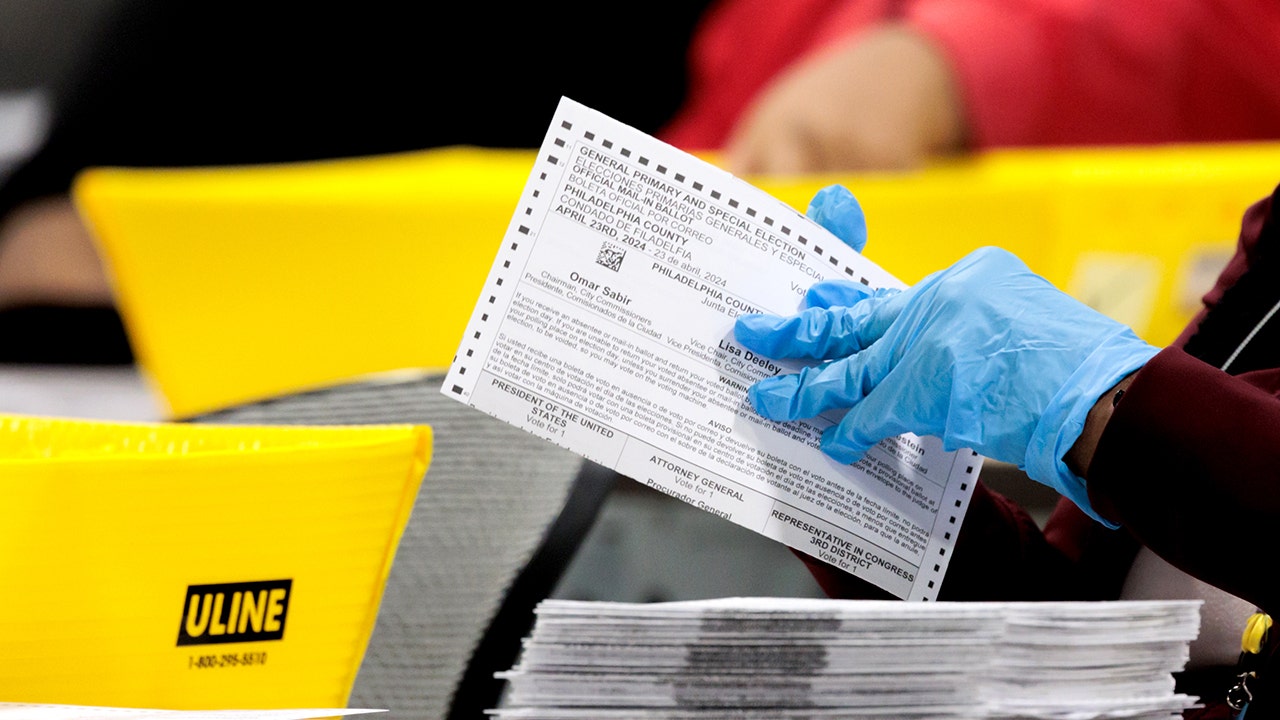
The American Civil Liberties Union says it has filed a lawsuit against Washington County in Pennsylvania, alleging that 259 eligible voters have been “disenfranchised” after not being informed of errors that disqualified their presidential primary mail-in ballots.
The lawsuit, filed on behalf of seven voters, the Washington Branch NAACP and the Center for Coalfield Justice – an environmental group – comes following the Washington County Board of Elections’ “decision before the 2024 primary election to conceal from voters errors they had made on their mail ballot return envelopes that meant their votes would not be counted,” according to the ACLU.
“Because the voters were not informed of the errors, they had no opportunity to correct them by either requesting a new mail ballot or by voting a provisional ballot at their polling place,” the ACLU said in a statement.
A spokesperson for Washington County did not immediately respond to a request for comment Monday from Fox News Digital.
ARIZONA ELECTION WORKER SEEN STEALING FROM SENATE SECURITY DESK A DAY BEFORE ELECTION CENTER THEFT, OFFICIALS SAY
An election worker flattens ballots during the Pennsylvania primary election at the City of Philadelphia’s Election Warehouse in 2024. (Hannah Beier/Bloomberg via Getty Images)
The lawsuit, filed in Washington County’s Court of Common Pleas, says the case is “about fundamentally unfair and egregious conduct by the Washington County Board of Elections that rises to the level of a procedural due process violation of the Pennsylvania Constitution.”
“In April 2024, the Washington County Board of Elections voted 2-1 to adopt a mail-in voting policy that deliberately concealed information about which voters had made disqualifying errors on their mail-in ballot envelopes,” it says. “The Board’s decision was a complete reversal of its prior policy of notifying voters of ballot envelope mistakes – such as missing signatures or incomplete dates – and providing them with an opportunity to correct those errors.”
“Instead, in the weeks leading up to the April 2024 election, the Board determined which mail-in ballots would not be counted, and then implemented a systematic process to keep that information from voters and the public, in many cases affirmatively misleading voters into thinking that their mail-in ballots would be counted,” the lawsuit continues.
CALIFORNIA CITY KEEPS CONTROVERSIAL LANGUAGE ON BALLOT MEASURE FOR NON-CITIZENS TO VOTE
The logo of the American Civil Liberties Union (Karen Bleier/AFP via Getty Images)
It alleges that the Board “deliberately entered information into Pennsylvania’s Statewide Uniform Registry of Electors (“SURE”) system that made it appear as if the Board had accepted the defective mail ballots, when in fact the Board had already set them aside and was planning to not count them” and then “instructed its election office staff not to provide any information to voters who inquired about the status of their mail-in ballot, including whether they had made errors that would prevent their vote from being counted.”
The ACLU is alleging 259 voters in Washington County have been “disenfranchised” because of the way their primary ballots were handled. President Biden and former President Trump are seen debating last week in Georgia. (Kyle Mazza/Anadolu via Getty Images)
The ACLU says the plaintiffs involved in the lawsuit are seeking a court order for the county to stop “conceal[ing] information about voters’ errors on their mail-in ballot return packets,” and enter the appropriate data in future elections into the state’s system “that will allow voters to be automatically notified about disqualifying mistakes related to their mail-in ballot prior to Election Day.”
Read the full article from Here


The Boston Red Sox will return to action on Friday to kick off the second half of the 2026 Major League Baseball season with a doubleheader against the Tampa Bay Rays.
The last few weeks have been incredible for Boston and have really gotten the organization right back into the thick of the playoff race. Beforehand, the Red Sox looked like one of the worst teams in baseball. Now, Boston is 46-48 and has won 14 of its last 16 games. It’s why you play the games. The MLB season is long and full of ups and downs. Sure, the first few months of the season were full of many down moments for the Red Sox, but they flipped a switch, got hot, and now are right back in the mix.
Now, there are just over two weeks to go until the 2026 trade deadline and Boston should be looking to add. But who should the Red Sox be targeting? Here are four intriguing options for Craig Breslow and the Red Sox’s front office to target.
Gleyber Torres — Detroit Tigers
The former longtime New York Yankee is a member of the Detroit Tigers and was slashing .280/.395/.395 with a .790 OPS, four homers and 18 RBIs before the All-Star break. Torres is on the Injured List, but has already begun a rehab assignment. Torres has the type of right-handed pop Boston’s lineup needs. Plus, he’s just 29 years old.
Luis Arráez — San Francisco Giants
Luis Arráez isn’t a right-handed bat and doesn’t have much power, but this is a guy with three batting titles under his belt and has a shot at another one. He’s batting .330 right now and would go a long way for Boston by getting on base towards the top of the lineup.
James Wood — Washington Nationals
This would be a pipe dream type of move. Wood is under team control for four more seasons and is just 23 years old, and yet he’s already a two-time All-Star. He blasted 31 homers last year and already has 28 this season in 97 games played. If the Red Sox could get a bat like his, they’d be all set. But it would cost quite a bit to pry him from Washington.
Isaac Paredes — Houston Astros
There are few players who were connected to Boston more this past offseason than Isaac Paredes. The Astros don’t look like a team that is going to sell, but Paredes is still worth a call. Houston traded Lance McCullers Jr. to the Milwaukee Brewers on Wednesday in a salary dump.
 Add us as a preferred source on Google
Follow

Two people were arrested earlier this week following a drug bust in Downtown Pittsburgh, police said.
Pittsburgh Police said Wednesday that Kyree Hairston-Mitchell, 24, and Mya Bryant, 23, were each arrested Monday following a drug bust at a residence along Stanwix Street along with the search of two vehicles.
Police said that detectives from the bureau’s Violence Prevention Unit arrested both individuals after executing warrants and searching the home and the vehicles where they discovered a large amount of drugs, cash, and a gun.
According to police, detectives recovered $12,000 in cash, heroin, marijuana, cocaine, prescription drugs, and a handgun.
Hairston-Mitchell and Bryant are each facing numerous drug-related felony charges, according to court records.
Court documents show that Hairston-Mitchell is being held in the Allegheny County Jail after being unable to post $25,000 bail. Bryant was arraigned and released on nonmonetary bond, court records show.
Both individuals are set to face a preliminary hearing later this month.
Police said that a passenger in one of the vehicles involved in the arrests was taken into custody on a warrant out of Ohio.

See the moment a husky shields child from bear
A husky jumped into action to protect a child as a bear charged at them through the yard in Connecticut.
If you’re looking for the best barbecue restaurant in the state, you may have to drive to the state’s capital.
Business Insider identified the most beloved barbecue spot in each state, including Connecticut.
“Our list includes barbecue destinations with historical or regional significance and devoted national or local followings,” Business Insider said. “Many of the spots or their pitmasters have won major accolades, and some have appeared on mainstream TV shows.”
Business Insider’s choice for the most iconic place for barbecue in Connecticut is a specific location of a chain restaurant that has multiple stores in the Constitution State.
Here’s what Business Insider had to say about Bear’s Smokehouse Barbecue, and why it might be worth the extra trip to Hartford, Connecticut.
Bear’s Smokehouse — Hartford, Connecticut
Business Insider said the Hartford location is the most iconic Bear’s Smokehouse in Connecticut. However, Bear’s has locations in Windsor, New Haven, South Windsor, and Storrs (although that one is in a University of Connecticut Student Union).
“Local outlet Hartford Courant named Bear’s Smokehouse the best ribs and best food truck in the state,” Business Insider said. “USA Today also named it one of the best restaurants in the country in 2026 (albeit, one of the North Carolina locations).”
Chain restaurant or not, this location’s menu appears to have all the goods that make a barbecue restaurant great: beef brisket, burnt ends, pulled pork, and turkey breast, all done up in a Kansas-City style of barbecue that would make Ted Lasso proud.
They also offer some innovative takes on hearty dishes like poutine with Bear Style Poutine, which comes with fries, spicy cheese curds, brisket gravy, and your choice of meat.
You can find Bear’s Smokehouse at 25 Front St, Hartford, Connecticut.
They open at 11 a.m. on weekdays and weekends but their closing hours vary depending on the day.
Rin Velasco is a trending reporter. She can be reached at rvelasco@usatodayco.com.
-

 World6 minutes ago
Fake Hezbollah video threatening attack on France possibly Russia-tied
-

 News36 minutes ago
Trump’s ‘American Flag Blue’ in the Lincoln Memorial pool is already gray — and the Olympic canoer ‘vandal’ is fighting his arrest | Fortune
-

 Los Angeles, Ca2 hours ago
Water main break floods West Hollywood streets, traps cars
-

 Detroit, MI3 hours ago
Detroit’s air quality early Thursday ranked as hazardous, worst in the world
-

 San Francisco, CA3 hours ago
‘It was a scene from the Titanic’: Fishermen recall rescuing passengers from sinking boat in SF Bay
-

 Dallas, TX3 hours ago
Big picture takeaways from the Dallas Mavericks first week at Summer League
-

 Miami, FL3 hours ago
“We’re going to be champions”. Argentina fans in Miami Beach celebrate team’s win against England
-

 Boston, MA3 hours ago
4 Red Sox Trade Targets to Solidify Boston’s Push for a Playoff Spot

