News
World reacts as US top court limits Trump’s tariff powers


President Donald Trump has imposed a new 10 percent worldwide tariff after the United States Supreme Court struck down his previous trade measures, triggering immediate concern and responses from governments and markets.
On Friday, Trump announced the decision on his social media platform, Truth Social, saying he has signed an executive order to impose the global tariff, which will take effect “almost immediately”.
list of 3 itemsend of listRecommended Stories
The US top court’s ruling and Trump’s new tariffs have left countries grappling with the legal and economic fallout, raising questions about ongoing agreements, tariff reductions, and the legality of past duties.
Governments are now evaluating how the new levy will affect key industries, investment plans, and trade negotiations, while analysts warn that uncertainty could persist until legal and trade frameworks are clarified.
South Korea
In South Korea, one of the US’s closest allies, the presidential office, Blue House, has released a statement, saying the government will review the trade deal and make decisions in the national interest, casting a question mark over the agreement signed in November last year, which lowered tariffs from 25 to 15 percent in exchange for $350bn in cash and investments from South Korea in the US.
“For major South Korean companies in chemicals, pharmaceuticals, and semiconductors, the Supreme Court ruling has been positive: Even if Trump introduces the new 10 percent tariffs under Section 122, they would still pay a lower rate,” said Jack Barton, an Al Jazeera correspondent in Seoul.
“However, exporters of automobiles, more than half of which go to the US, remain subject to the 25 percent tariff, and steel exports are still hit with 50 percent duties under Section 232, which was not affected by the ruling.”
The South Korean government is expected to move cautiously. Exports account for 85 percent of South Korea’s gross domestic product, with the US as the second-largest market.
“Officials have indicated that rapid changes could jeopardise major agreements, including a recent multibillion-dollar shipbuilding deal with the US and other investments,” said Barton.
“While no definitive policy statement has been made yet, the Blue House has said that the trade deal will be under careful review and changes are likely.”
India
India has faced some of the highest US tariffs under Trump’s previous use of emergency trade powers. The president first imposed a 25 percent levy on Indian imports and later added another 25 percent on the country’s purchases of Russian oil, bringing the total to 50 percent.
Earlier this month, the US and India reached a framework trade deal. Trump said Prime Minister Narendra Modi agreed to stop buying Russian oil and that US tariffs would be lowered to 18 percent for India’s top exports to the US, including clothing, pharmaceuticals, precious stones, and textiles. Meanwhile, India said it will eliminate or reduce tariffs on all US industrial goods and a range of agricultural products.
According to political economist MK Venu, founding editor of Indian publication, The Wire, “Critics have argued New Delhi should have waited for the US Supreme Court decision before finalising the interim trade deal and even trade analysts previously connected with the government have maintained it would have been wiser to wait for the court verdict.”
Venu added that Trump was eager to finalise the trade deal, which includes a commitment to buy $500bn worth of new imports in defence, energy, and artificial intelligence (AI) from the US over the next five years.
While India, he said, welcomed the reduction of tariffs to 18 percent and the removal of penal duties on Russian imports, uncertainty remains over negotiations, as the Supreme Court ruling affects the legal basis of past tariffs.
“The Indian trade delegation is likely to wait for the final outcome of the Supreme Court verdict before proceeding with further negotiations, and countries around the world are expected to follow the court’s ruling rather than rush into trade agreements under legislation deemed unconstitutional,” he said.
China
China has reacted in a muted way to the Supreme Court ruling, with much of the country still on the Lunar New Year break.
Al Jazeera’s Rob McBride, reporting from Beijing, said, “The Chinese embassy in Washington has issued a blanket statement, noting that trade wars benefit nobody, and that the decision is likely to be broadly welcomed in China, which has long been a primary target of Trump’s tariff policies.”
Since last April, he said, China has faced multiple layers of tariffs, including 10 percent on chemicals used in fentanyl production exported to the US and 100 percent on electric vehicles.
Analysts have estimated that the overall tariff level, about 36 percent, could now fall to about 21 percent, providing some relief to an economy already under strain from the COVID-19 pandemic, a prolonged property market crisis, and declining exports.
Shipments from China to the US have reportedly fallen by roughly a fifth over the past year.
“Beijing has sought to offset losses in the US market by strengthening trade ties with Southeast Asian nations and pursuing agreements with the European Union,” McBride said.
“The Supreme Court ruling may also create a more favourable atmosphere ahead of a planned state visit by Trump in early April, when he is expected to meet President Xi Jinping, potentially opening space for a reset in relations between the world’s two largest economies.”
Canada
Canada has welcomed the US Supreme Court’s decision but has pointed out that there are still some challenges ahead.
Regional leaders across the country, including those of British Columbia and Ontario, have signalled that the ruling is a positive step, according to Al Jazeera’s Ian Wood, reporting from Toronto.
However, Minister for Canada-US trade Dominic LeBlanc has said that significant work remains, as Section 232 tariffs on steel, aluminium, softwood lumber, and automobiles have remained in place.
Meanwhile, Ontario’s Premier Doug Ford has added that while optimism has grown, tension has persisted over what Donald Trump will do next, Wood said.
Mexico
Mexico’s president, Claudia Sheinbaum, said her government would be carefully reviewing the Supreme Court’s decision to assess its scope and the extent to which Mexico might be affected.
“The reality is that despite all we’ve heard over the last year about tariffs or the threat of tariffs, Mexico has actually ended up in quite a privileged, even competitive position, especially when compared to other countries,” said Al Jazeera’s Julia Gliano, reporting from Mexico City.
“We have to remember Mexico is the US’s largest trading partner, and the two countries, along with Canada, share a vast trading agreement that shields most products from the so-called reciprocal tariffs that President Trump announced.
“There were also punitive tariffs related to fentanyl and illegal immigration along the US border, which Mexico had managed to suspend while negotiations continued on those matters. Now the tariffs that Mexico has been subjected to on steel, aluminium, and car parts are not affected by today’s decision.”
So, the government here in Mexico, she said, is now standing by to see what the Trump administration comes up with next as it reels from today’s decision by the Supreme Court.
Limits of Trump’s tariff powers
A senior legal scholar told Al Jazeera that the US Supreme Court ruling marks a key moment in the legal battle over Trump’s tariffs, focusing on constitutional limits rather than economics.
Frank Bowman, professor emeritus at the University of Missouri School of Law, told Al Jazeera that the court has for the first time confronted what he called Trump’s broader challenge to the rule of law.
“This is a ruling that is important in several respects. The first, more broadly, is that this is the first time in the last year that the Supreme Court has stepped in and attempted to do something about Donald Trump’s generalised attack on the rule of law in the United States.
“And make no mistake, although tariffs certainly are about economics, what Trump has done over the last year is essentially to defy the law. And the Supreme Court happily decided that they had had enough and that they would say no. So, they’re not ruling on economic policy. They made a decision that the president simply exceeded his constitutional authority.”



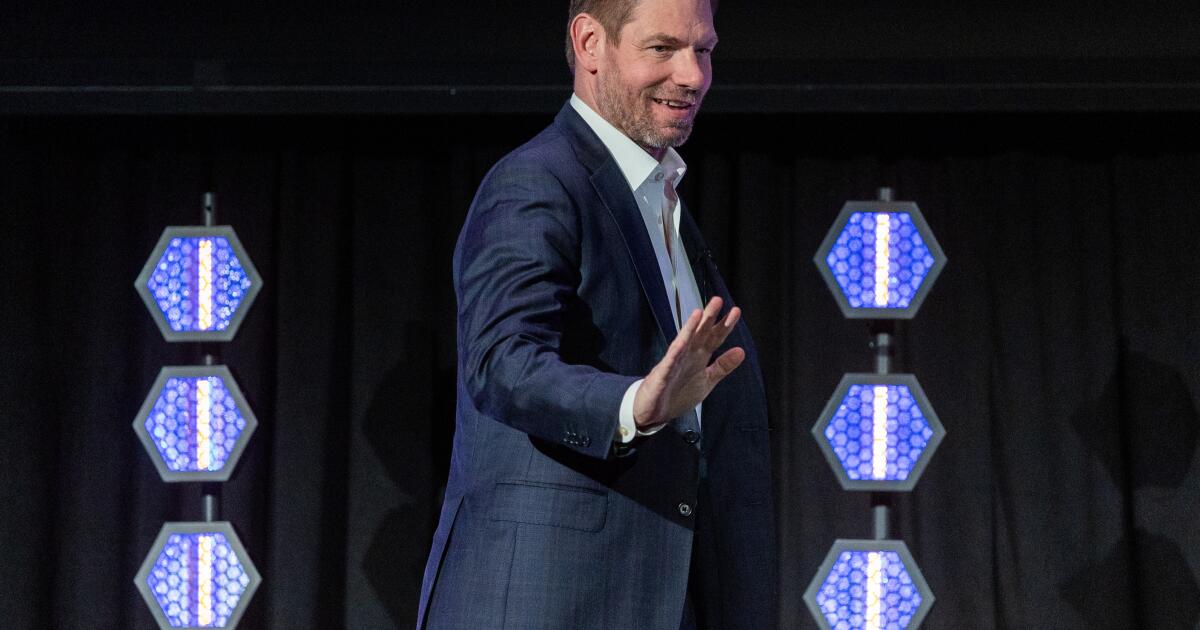
The Manhattan District Attorney’s Office in New York has launched an investigation into a sexual assault allegation against Rep. Eric Swalwell, D-Calif., NBC News confirmed Saturday.
Multiple women in the last two days have come forward alleging that Swalwell sexually assaulted or harassed them while serving in Congress, including one who alleged he assaulted her in New York. Swalwell has denied the allegations.
A spokesperson for the district attorney’s office urged “survivors and anyone with knowledge of these allegations to contact our Special Victims Division at 212-335-9373. Our specially trained prosecutors, investigators, and counselors are well-equipped to help you in a trauma-informed, survivor-centered manner.”
On Friday, the San Francisco Chronicle reported that one woman said she had sexual encounters with the congressman when he was her boss and alleged that he twice sexually assaulted her when she was too intoxicated to consent. One of those incidents, the woman alleged, took place in New York in 2024.
And later Friday, CNN reported on sexual misconduct allegations against Swalwell from three additional women, including one who said he kissed her without her consent in public and two others who said the congressman sent them unsolicited photos or videos of his penis.
NBC News has not independently corroborated their stories.
CNN was the first to report of the Manhattan District Attorney’s Office investigation.
Representatives for Swalwell’s office and campaign did not immediately respond to requests for comment.
Swalwell on Friday denied the allegations in a video posted to X, telling viewers: “These allegations of sexual assault are flat false. They’re absolutely false. They did not happen. They have never happened, and I will fight them with everything that I have.”
The CNN and San Francisco Chronicle stories were reported just weeks before California voters are set to begin voting in the state’s primary for governor, where Swalwell has been a leading candidate in a crowded field of Democrats, including former Rep. Katie Porter, businessman Tom Steyer and former U.S. Health Secretary Xavier Becerra.
On Friday and Saturday, multiple high-profile figures and groups rescinded their previous endorsements of Swalwell, including the California Federation of Labor Unions and the California chapter of the Service Employees International Union.
Democratic leaders in the House, including House Minority Leader Hakeem Jeffries, D-N.Y., Democratic Whip Katherine Clark, D-Mass., and Democratic Caucus Chair Pete Aguilar, D-Calif., on Friday called the allegations against Swalwell “disturbing” and urged him to “immediately end his campaign to be California’s next Governor.”
On Saturday, two Republican congresswomen vowed to seek punishment against against Swalwell in the wake of the sexual assault allegations.
Rep. Lauren Boebert, R-Colo., said in a post on X that she plans to force a floor vote this week on a resolution to censure Swalwell, which would require a simple majority to succeed.
And Rep. Anna Paulina Luna, R-Fla., said in a post on X that she plans to introduce a resolution to expel Swalwell from Congress. That resolution would have a higher threshold for passage, with two-thirds of the chamber needing to vote in favor.
This is a developing story. Please check back for updates.

Adam Edelman contributed.

After a nearly 10-day journey that took the Artemis II astronauts around the moon, in front of an eclipse and farther away from Earth than any humans before them, the crew of four have made a dramatic return home.
The Artemis II astronauts share a group hug aboard the Orion capsule.
hide caption
toggle caption
NASA astronauts Reid Wiseman, Victor Glover and Christina Koch and Canadian Space Agency astronaut Jeremy Hansen were ensconced in the Orion space capsule when they dropped into the Pacific Ocean off the coast of San Diego at 8:07 p.m. Friday. The USS John P. Murtha is stationed near the splashdown zone to help recover the crew.

To get back to Earth, the space capsule had to withstand predicted temperatures of about 5,000 degrees Fahrenheit and slow down from nearly 25,000 miles per hour — or more than 30 times the speed of sound — to a gentle 19 mph or so before splashdown.
The roughly 13-minute journey from the top of the atmosphere to the surface is like “riding a fireball through the atmosphere,” NASA astronaut and Artemis II crew member Victor Glover said before the maneuver.
But, he said, it’s also a necessary one.

“We have to get back,” Glover said. “There’s so much data that you’ve seen already, but all the good stuff is coming back with us.”
The crew of four, who looped around the far side of the moon on Monday April 6, took photos and made observations as they passed over the lunar surface. The crew is set to bring that data and more back to the team on the ground.
Nell Greenfieldboyce and Central Florida Public Media’s Brendan Byrne contributed to this report.

President Trump has submitted plans plans to paint the Eisenhower Executive Office Building white to a group that advises on architecture in Washington, D.C.
The French Second Empire-style, slate-gray building houses office space for members of the president’s team, including the National Security Council.
The building sits across a driveway from the West Wing and was completed in 1888. The plans submitted by the president say that the Eisenhower Executive Office Building is an eyesore that has long been criticized and has fallen into disrepair since its completion. The plans say “the color, design, and massing of the existing structure does not align visually with the surrounding architecture and lacks any symbolic cohesion with the White House.” The plan points to examples of cracks and poor exterior maintenance and argues, “The benefit to painting the stone is that it is repeatable.”
“The inability to bring the stone facade back to a baseline color has plagued the maintenance of the [Executive Office Building] in the past, and and will continue to plague it if not addressed,” the plan says.
The plans included renderings of what the building would look like if it’s painted white.
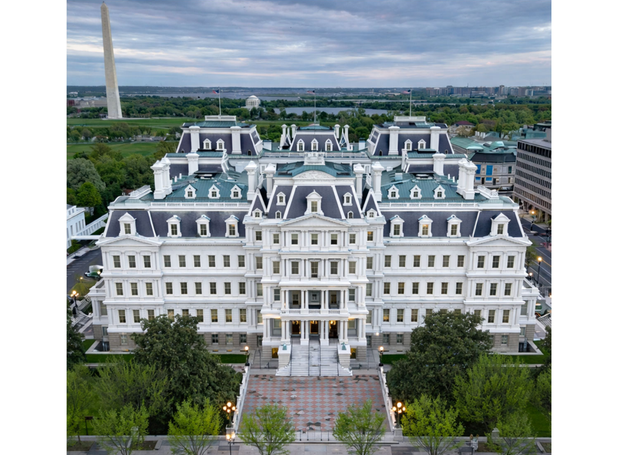
The Executive Office of the President submitted a design proposal to the Commission of Fine Arts, a panel of Trump appointees who advise on public architecture and design in the nation’s capital.
The CFA will hear a presentation on the plan on April 16.
Pressure grows for Swalwell to exit governor’s race, criminal inquiry launched

Artemis II astronauts safely splash down off San Diego coast after historic moon mission

Letters to Sports: Celebrating UCLA’s inspiring national title win

Pope Leo urges world leaders to reject war and negotiate peace

Manhattan DA’s office to investigate Swalwell sexual assault allegation

Florida High School Football Rankings: Top 25 teams – Oct. 21

How old is Bo Nix? What to know about Oregon quarterback ahead of 2024 NFL Draft

Cleary's 21 help Le Moyne down Central Connecticut State 69-64 in OT

99th annual Pony Swim held in Virginia

Indiana Members Credit Union announced as new anchor tenant at Bottleworks District
Pope Leo urges world leaders to reject war and negotiate peace
Manhattan DA’s office to investigate Swalwell sexual assault allegation

NASA’s Artemis II mission in 20 minutes

Trump adversary running for Senate borrows his filibuster playbook

Russian propaganda unit targets Hungary’s elections
-

 Atlanta, GA7 days ago
1 teenage girl killed, another injured in shooting at Piedmont Park, police say
-

 Movie Reviews1 week ago
Vaazha 2 first half review: Hashir anchors a lively, chaos-filled teen tale
-

 Georgia4 days ago
Georgia House Special Runoff Election 2026 Live Results
-

 Pennsylvania5 days ago
Parents charged after toddler injured by wolf at Pennsylvania zoo
-

 Arkansas1 day ago
Arkansas TV meteorologist Melinda Mayo retires after nearly four decades on air
-
 Milwaukee, WI5 days ago
Potawatomi Casino Hotel evacuated after fire breaks out in rooftop HVAC system
-
 Entertainment1 week ago
Inside Ye’s first comeback show at SoFi Stadium
-

 Indianapolis, IN1 week ago
Fighting Illini begin Final Four preparations in Indianapolis