
News
Wildfires prompt evacuations in Carolinas


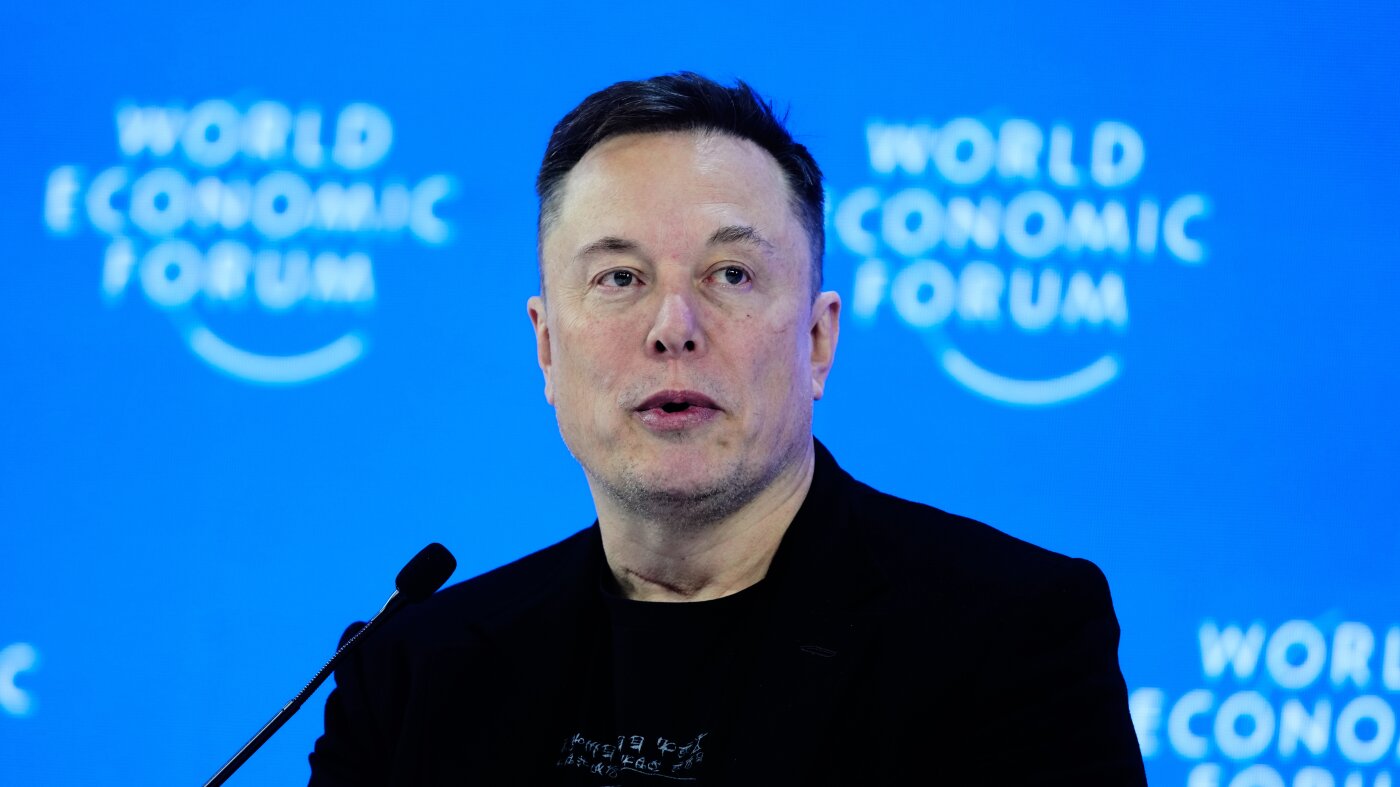
Elon Musk attends the annual meeting of the World Economic Forum in Davos, Switzerland, on Jan. 22.
Markus Schreiber/AP
hide caption
toggle caption
Markus Schreiber/AP
SAN FRANCISCO — A jury has found Elon Musk liable for misleading investors by deliberately driving down Twitter’s stock price in the tumultuous months leading up to his 2022 acquisition of the social media company for $44 billion. But it absolved him of some fraud allegations, finding that he did not “scheme” to mislead investors.

The civil trial in San Francisco centered on a class-action lawsuit filed just before Musk took control of Twitter, which he later renamed X. Jurors were asked to decide if two tweets and comments Musk made on a podcast in May 2022 amounted to him intentionally defrauding Twitter shareholders, who sold their shares based on Musk’s statements.

The nine-person jury returned the verdict after nearly four days of deliberation, nearly three weeks after the trial began on March 2. They said that while Musk was liable for misleading investors with two tweets — including one said the Twitter deal was “temporarily on hold,” he did not do so with a statement he made on a podcast and that he did not intentionally “scheme” to defraud investors.
The jury awarded shareholders between about $3 and $8 per stock per day as damages, which the plaintiffs’ lawyers said amounts to about $2.1 billion. Musk’s fortune is currently estimated at about $814 billion, much of it tied up in Tesla shares.
“It’s an important victory, not just for investors of Twitter, but for the public markets,” said Joseph Cotchett, an attorney for the plaintiffs. “I think the jury’s verdict sends a strong message that just because you’re a rich and powerful person, you still have to obey the law, and no man is above the law.”
Musk’s lawyers said they had no comment as they walked out of the courtroom.
Much of the trial focused on Musk’s claims about the number of bots on Twitter. Musk testified that Twitter had a much higher number of fake and spam accounts than the 5% it disclosed in regulatory filings. He used what he called Twitter’s misrepresentation of the number of fake accounts on its service as a reason to retreat from the purchase.
After Musk tried to back out, Twitter went to court in Delaware to force him to honor his original deal. Just before that case was scheduled to go to trial, Musk reversed course again and agreed to pay what he had originally promised.
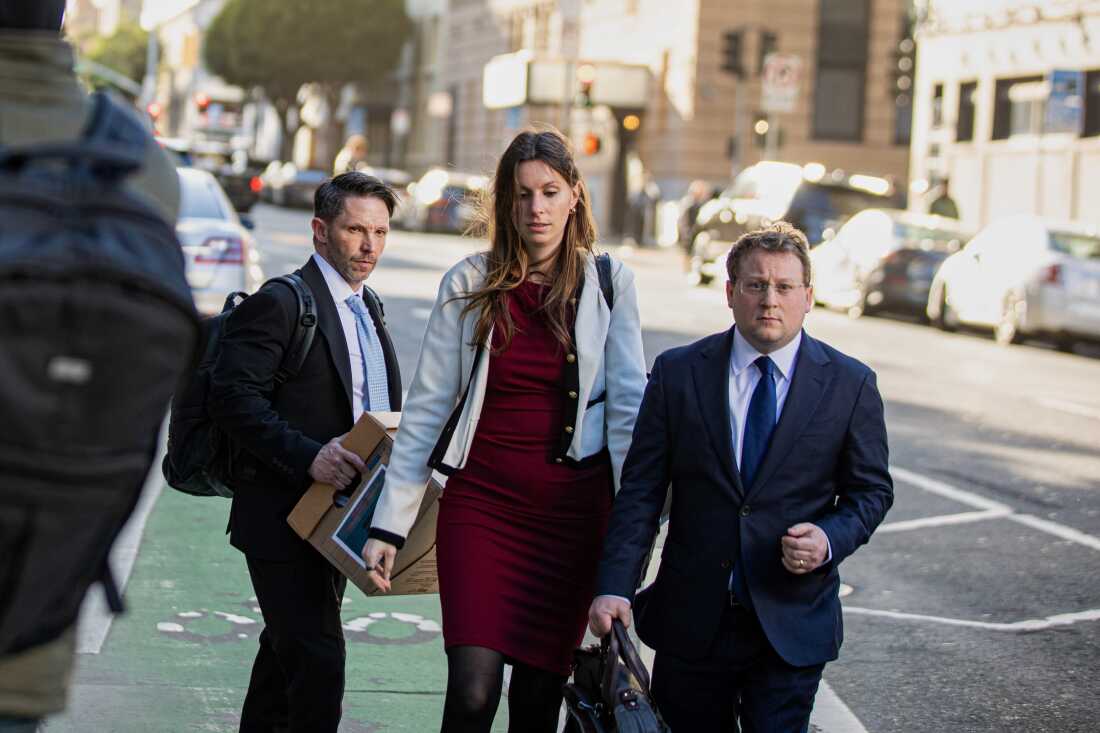
Members of Elon Musk’s legal team, including attorney Michael Lifrak (left), exit the Phillip Burton Federal Building in San Francisco on March 4.
Dan Hernandez/San Francisco Chronicle/AP
hide caption
toggle caption
Dan Hernandez/San Francisco Chronicle/AP
The central question of the case was whether Musk sent out tweets — including one on May 13, 2022, that said the Twitter deal was “temporarily on hold” while he sought information on the number of fake accounts on the service — as a deliberate scheme to tank Twitter’s shares. The jury found that while Musk did mislead investors with two tweets, he did not do so with a statement he made on a podcast because it was an opinion. The jurors also absolved him of scheming to drive down the stock.
The nearly three-week trial in San Francisco federal court for the Northern District of California saw testimony from former Twitter executives including CEO Parag Agrawal and CFO Ned Segal, as well as Musk, who was on the stand for more than a day.
In his testimony, Musk maintained that Twitter’s leadership lied about the amount of bots on the platform and withheld information from him about how the number of fake accounts was calculated. He repeatedly described the information that Twitter’s board provided with an abbreviation for a bull’s scatology. “I did make it clear that I thought it was BS,” Musk said of Twitter’s calculations asserting that only about 5% of its accounts were bots.
Musk also asserted that his decision to follow through on the deal at the original sales price provided a huge windfall for most Twitter shareholders.
But Twitter’s shares fell below $33, or about 40% below Musk’s original purchase price, while the deal was hanging in limbo. That downturn cost shareholders who sold their stock during the uncertainty caused by what the lawsuit alleges was Musk’s deceitful behavior.
“I can’t control whether people sell their stock, but everyone who held the stock fared extremely well,” Musk said.
The plaintiffs argued that, as Tesla’s stock price declined and buying Twitter became too expensive for Musk, he tweeted statements that drove down the stock price in the hopes he could renegotiate the deal for a lower price or get out of it altogether.
Musk’s tweets, the plaintiffs’ lawyer argued, were not some “innocent mistake” or a “stupid tweet” off the top of his head, but carefully calculated to drive down’s Twitter’s stock price.
In closing arguments, Mark Molumphy, a lawyer for the plaintiffs, asked jurors to hold Musk accountable and compensate thousands of investors who lost money because of tweets Musk sent, including one from May 13, 2022, that said the deal was “on hold.”
“He knew what he was doing,” Molumphy said.
Musk’s lawyers motioned for a mistrial several times during the contentious trial, contending that the billionaire Tesla CEO can’t get a fair trial in San Francisco because of animosity toward him from the public.
This isn’t the first time that Musk has been dragged into court to defend himself against allegations of duping investors with his social media posts. Three years ago, Musk spent about eight hours testifying in a San Francisco federal trial about his plans to buy Tesla — the electric automaker that he still runs as a publicly traded company — for $420 per share in a proposed 2018 deal that never materialized. A nine-member jury absolved Musk of wrongdoing in that case.

Singer-songwriter Lee Greenwood discusses the momentum behind America 250 celebrations on ‘Mornings with Maria.’
The U.S. Mint is moving forward with a gold commemorative coin featuring President Donald Trump after a federal arts commission approved a design Thursday, with Treasury officials citing a legal authority that allows the inclusion of a sitting president despite longstanding restrictions.
FOX Business confirmed with a source familiar with the Commission of Fine Arts that the design shown is the mock-up approved by the panel, clearing a key step toward production of the coin.
The move is notable because federal law traditionally bars living individuals from appearing on U.S. currency, but Treasury officials say a separate statutory authority allows the minting of gold coins that can feature the sitting president, setting up a potential break from long-standing precedent.
“As we approach our 250th birthday, we are thrilled to prepare coins that represent the enduring spirit of our country and democracy, and there is no profile more emblematic for the front of such coins than that of our serving President, Donald J. Trump,” U.S. Treasurer Brandon Beach said in a statement provided to FOX Business.
TRUMP WAIVES JONES ACT FOR 60 DAYS IN BID TO FREE UP THE FLOW OF OIL TO US PORTS
A semiquincentennial commemorative gold coin design featuring U.S. President Donald Trump, in this undated handout image. The black and white sketch shows what one side of the coin is expected to look like. (U.S. Mint/Handout via REUTERS / Reuters)
Beach added that the proposed commemorative gold coin would be separate from circulating currency and fall under the Treasury secretary’s discretion.
“The Secretary has sole discretion on final design selection,” the statement said, noting the process followed review opportunities presented to advisory bodies.
The move would mark a rare instance of a sitting U.S. president appearing on a government-issued coin.
Treasury officials pointed to a provision under federal law, 31 U.S.C. § 5112, that allows the secretary to authorize bullion and proof gold coins with specifications, designs and inscriptions determined at their discretion.
FED’S POWELL SAYS IT’S ‘TOO SOON TO KNOW’ IRAN WAR’S IMPACT ON ECONOMY
People view the portrait of U.S. President Donald Trump, taken by official White House photographer Daniel Torok which is the basis of a proposed U.S. Mint semiquincentennial commemorative gold coin design, on display at the Smithsonian National Port (REUTERS/Jonathan Ernst / Reuters)
The authority allows coins to be issued “in accordance with such designs… and inscriptions as the Secretary… may prescribe from time to time,” according to the statute cited by Treasury officials.
The Treasury statement also noted that the Citizens Coinage Advisory Committee (CCAC) declined to review the proposed designs, while the Commission of Fine Arts (CFA) “has taken every opportunity to review thus far.”
Officials said the Mint fulfilled its statutory obligation to seek CCAC input despite the panel opting not to weigh in on the designs.
The approved design features Trump in a suit and tie with a stern expression, leaning forward with his hands resting on a desk in a forceful pose, according to materials presented to the commission.
BESSENT RULES OUT GOVERNMENT INTERVENTION IN OIL FUTURES MARKET DURING IRAN WAR
President Donald Trump speaks during a press conference at Trump National Doral in Miami, Florida, on March 9, 2026. (Saul Loeb/AFP via Getty Images / Getty Images)
The coin includes “LIBERTY” along the top and the dates “1776–2026,” marking the nation’s semiquincentennial.
The reverse side is expected to depict a bald eagle in flight alongside traditional inscriptions including “UNITED STATES OF AMERICA” and “E PLURIBUS UNUM.”
The Associated Press first reported that the Commission of Fine Arts approved the design without objection during its March meeting on Thursday.
The effort represents a departure from traditional practice, as U.S. currency has historically avoided depicting living individuals, though commemorative and bullion coins operate under different rules.
Officials said the coin will be part of a limited production run, with final details on size and denomination still under consideration.
GET FOX BUSINESS ON THE GO BY CLICKING HERE
The coin is tied to the nation’s 250th anniversary celebrations in 2026, with Treasury officials framing the effort as part of a broader initiative to mark the milestone.
The White House did not immediately respond to FOX Business’ request for comment.
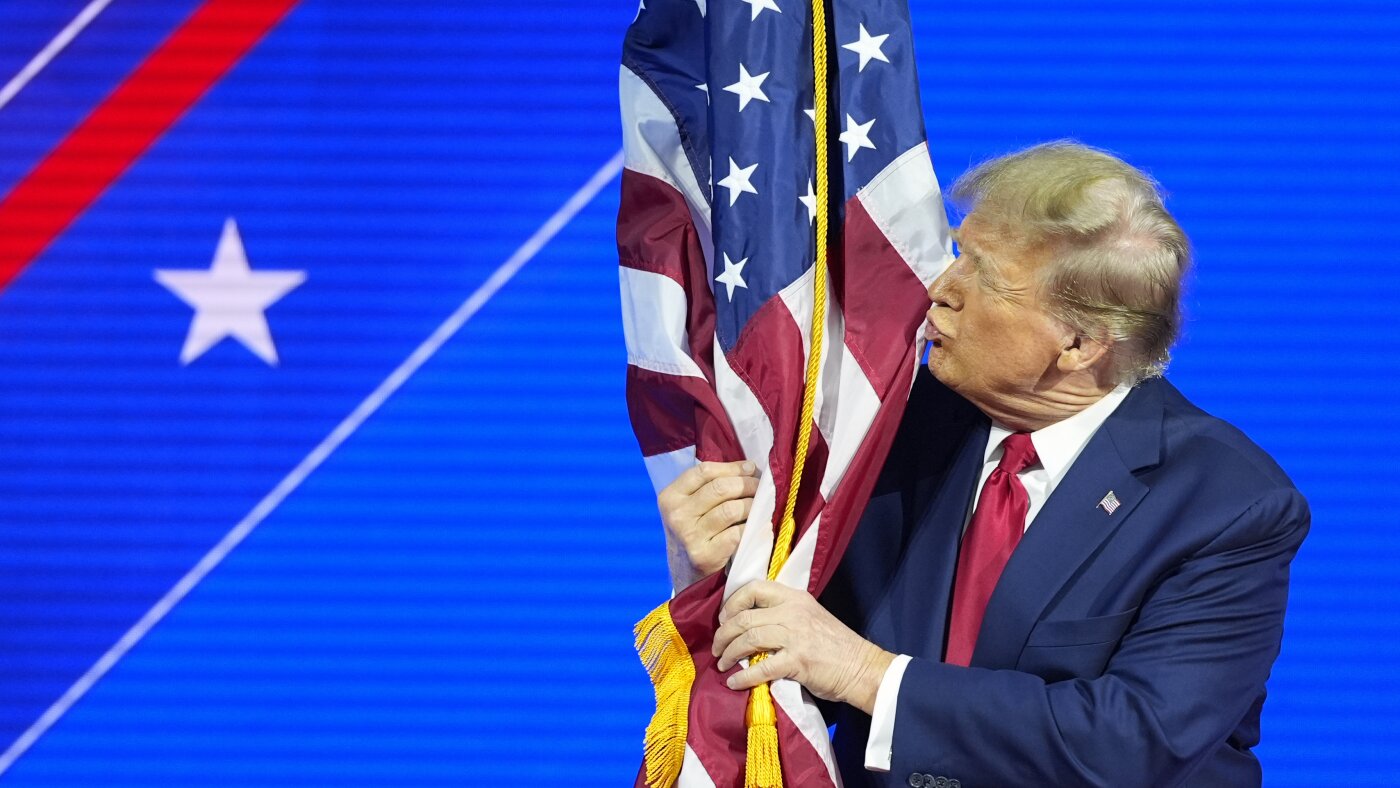
Before he was elected to a second term, former President Donald Trump hugged and kissed the U.S. flag as he spoke at the Conservative Political Action Conference at National Harbor, in Oxon Hill, Md., in 2024.
Alex Brandon/AP
hide caption
toggle caption
Alex Brandon/AP
Three major reports out this month say President Trump has done serious damage to American democracy at remarkable speed since his return to the White House.
An annual report from V-Dem, an institute at Sweden’s University of Gothenburg, concluded democracy had deteriorated so much in the U.S. that it lowered the country’s democracy ranking from 20th to 51st out of 179 countries.
The U.S. landed between Slovakia and Greece.

Meanwhile, Bright Line Watch, which surveys more than 500 U.S. scholars, concluded that the U.S. system now falls nearly midway between liberal democracy and dictatorship. The newest survey comes out next week. Bright Line Watch’s co-directors spoke to NPR exclusively ahead of publication.
Yet another report out Thursday from Freedom House, a Washington, D.C.-based democracy think-tank, said that among free countries, the U.S. joined Bulgaria and Italy in registering the largest declines in political rights and civil liberties last year.
“The developments in the United States are moving towards dictatorship, what the founders wanted to avoid,” said Staffan Lindberg, the V-Dem Institute’s founding director, who spent seven years in the U.S. “It’s the most rapid decline ever in the history of the United States and one of the most rapid in the world.”
V-Dem stands for Varieties of Democracy. More than 4,000 scholars contributed data to the report, which is the largest of its kind.
White House spokeswoman Olivia Wales dismissed V-Dem’s analysis as “a ridiculous claim made by an irrelevant, blatantly biased organization.”
She called Trump a champion for freedom and democracy and the most transparent and accessible president ever.
“His return to the White House saved the legacy media from going out of business,” Wales said.

Trump has rejected criticism that he tries to rule as an autocrat.
“A lot of people are saying maybe we like a dictator,” Trump said to reporters in the Oval Office last August. “I don’t like a dictator. I’m not a dictator.”
Lindberg said V-Dem downgraded America’s rating based on the Trump administration concentrating executive power, overstepping laws, circumventing the Republican-led Congress as well as attacks on the news media and freedom of speech. Lindberg, a political scientist, is struck by the speed with which Trump has acted.
“Under the Trump administration, democracy has been rolled back as much during just one year as it took Modi in India and Erdogan in Turkey 10 years to accomplish, and Orban in Hungary four years,” said Lindberg, referring to Indian Prime Minister Narendra Modi, Turkish President Recep Tayyip Erdogan and Hungarian Prime Minister Viktor Orbán.
All three of those leaders came to power through democratic elections, but scholars say they have since undermined checks and balances on executive power to try to ensure they remain in office.
Trump is a big fan of Orbán’s and has praised him as a “strongman” and a “tough person.” Orbán faces election next month — the first real challenge to his rule in a decade and a half.

President Trump is a big fan of Hungarian Prime Minister Viktor Orbán, pictured at the White House on Nov. 7, 2025. Political scientists view Orbán as an autocratic leader who has chipped away at this country’s system of checks and balances.
Roberto Schmidt/Getty Images
hide caption
toggle caption
Roberto Schmidt/Getty Images
Scholars are alarmed by Trump’s blitz on the U.S. system of governance, but John Carey, a co-director of Bright Line Watch, says the United States’ democracy rating might have slid even further in recent months if not for the courts pushing back.
Carey says autocrats try to co-opt or pressure government institutions that serve as referees but notes that didn’t work last month as the Supreme Court ruled against the president on tariffs.
“One of the things that the tariff decision suggested [is] he has not fully captured that set of referees,” said Carey, a professor of political science at Dartmouth, “and that’s the most important set.”
Brendan Nyhan, a fellow Dartmouth professor and Bright Line co-director, adds that just because Trump has undermined democracy, doesn’t mean the effects are permanent.
“There’s just no question that what we’re seeing is the authoritarian playbook,” said Nyhan, “but there’s no guarantee that Trump will be able to operate this way after the midterms, let alone a successor after 2028.”
Yana Gorokhovskaia, director for strategy and design for Freedom House, says some of Trump’s policies abroad also are undermining the country’s democratic standing overseas.
For instance, the State Department often used to call out election fraud in other countries, but under Trump, it has said it will only comment on foreign elections when the U.S. has a clear and compelling interest.
“What we’re losing is democratic solidarity globally,” Gorokhovskaia said. “We’re no longer emphasizing … a distinction between democracies and autocracies in the world.”
That doesn’t mean the U.S. doesn’t take sides in foreign elections. Just last month, Secretary of State Marco Rubio publicly endorsed Orbán, Hungary’s autocratic leader, for a fifth term.
Jury finds Elon Musk misled investors during Twitter purchase

Farmington, Farmington Hills push for revitalization of Grand River

Elderly driver sentenced to probation in West Portal crash that killed family of 4

Dallas Police tweak off-duty job rule after saying man impersonated police

Fire tears through longtime Miami Gardens home of retired teacher

Florida High School Football Rankings: Top 25 teams – Oct. 21

How old is Bo Nix? What to know about Oregon quarterback ahead of 2024 NFL Draft

Cleary's 21 help Le Moyne down Central Connecticut State 69-64 in OT

99th annual Pony Swim held in Virginia

Indiana Members Credit Union announced as new anchor tenant at Bottleworks District
Jury finds Elon Musk misled investors during Twitter purchase

Pritzker pushes prosecutions of Trump officials as part of Dem ‘Project 2029’ agenda

Iran’s Khamenei says enemy ‘defeated’ in written Nowruz message

Gold Trump coin moves forward after Treasury invokes rare authority

Meet the longtime biz partner of Ilhan Omar’s husband as questions swirl over her skyrocketing net worth
-

 Detroit, MI2 days ago
Drummer Brian Pastoria, longtime Detroit music advocate, dies at 68
-

 Oklahoma6 days ago
Family rallies around Oklahoma father after head-on crash
-

 Nebraska1 week ago
Wildfire forces immediate evacuation order for Farnam residents
-

 Georgia5 days ago
How ICE plans for a detention warehouse pushed a Georgia town to fight back | CNN Politics
-

 Massachusetts1 week ago
Massachusetts community colleges to launch apprenticeship degree programs – The Boston Globe
-

 Alaska6 days ago
Police looking for man considered ‘armed and dangerous’
-

 Colorado1 week ago
‘It’s Not a Penalty’: Bednar Rips Officials For MacKinnon Ejection | Colorado Hockey Now
-
 Southwest1 week ago
Talarico reportedly knew Colbert interview wouldn’t air on TV before he left to film it