Connect with us

News

Why the next president's judicial appointments will impact climate action

Published

on

Why the next president's judicial appointments will impact climate action

Environmental activists rally in front of the U.S. Supreme Court in 2022 after it ruled against the Obama administration’s plan to cut climate-warming emissions at the nation’s power plants. The Supreme Court has since further limited the power of federal agencies like the Environmental Protection Agency.

Drew Angerer/Getty Images


hide caption

toggle caption

Advertisement

Drew Angerer/Getty Images

Nerdy question for all of you policy wonks out there: What did the Obama administration’s landmark climate regulation on the nation’s power plants — the Clean Power Plan — and the Trump administration’s more lenient replacement of it — the Affordable Clean Energy Rule — have in common?

Both were seen as major industry-changing regulations. Both were lauded by some and reviled by others.

And neither went into effect.

Advertisement

“Basically any environmental rule of any magnitude is challenged in the courts,” said Lisa Heinzerling, a law professor at Georgetown University and a senior adviser to former President Barack Obama’s Environmental Protection Agency (EPA). “The courts have the final word.”

As President Biden and former President Donald Trump vie for a second term amid what’s sure to be one of the hottest years in recorded history, NPR’s Climate Desk has looked at both candidates’ records on climate change and what to expect if either is elected. Trump is promising to “drill, baby, drill,” and weaken regulations on oil and gas development. Biden is promising to create more jobs with an energy transition away from climate-warming fossil fuels.

But given the litigious nature of environmental law and the U.S. Supreme Court’s recent decisions, particularly one limiting the power of federal agencies, legal experts say one of the election’s most consequential aspects for the climate would be the judicial appointments either candidate makes.

The president has the power to nominate federal judges for lifelong terms. Not only to the Supreme Court, but also to federal appellate and district courts, which see tens of thousands of cases each year. Pending Senate approval, those appointments shape the country’s judiciary and the government’s ability to implement laws for decades.

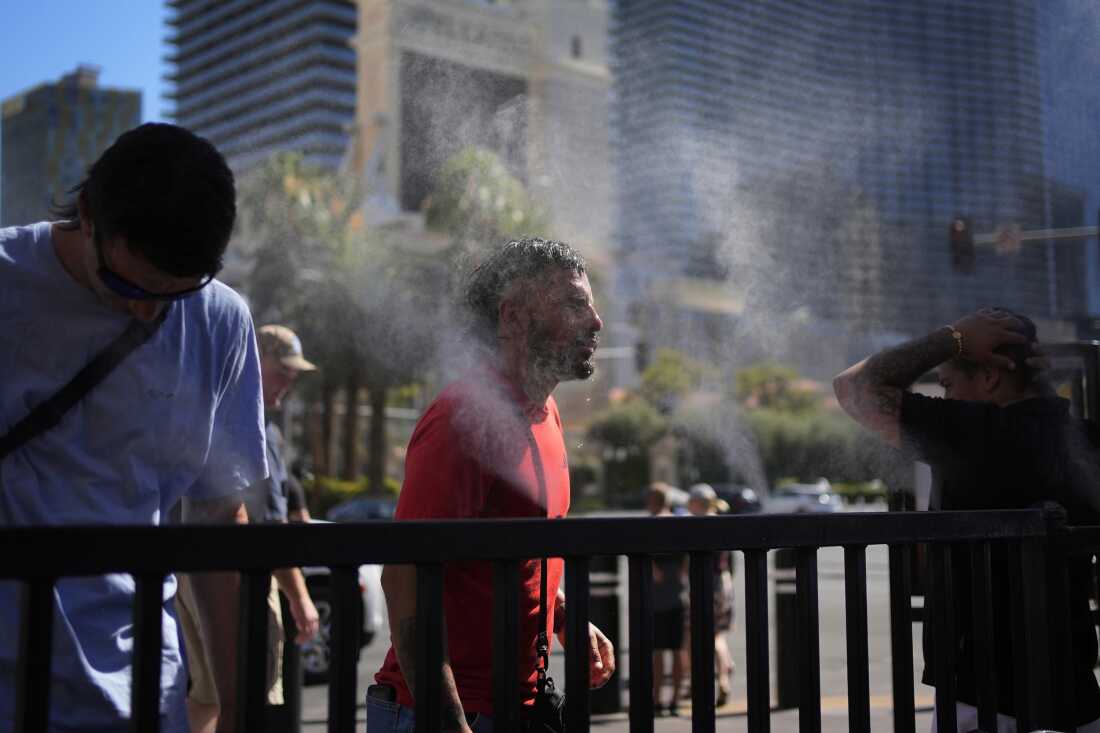
People cool off in misters along the Las Vegas Strip, Sunday, July 7, 2024, in Las Vegas. Used to shrugging off the heat, Las Vegas residents are now eyeing the thermometer as the desert city is on track Wednesday to set a record for the most consecutive days over 115 degrees (46.1 C) amid a lingering hot spell that's expected to continue scorching much of the U.S. into the weekend.

People cool off in misters along the Las Vegas Strip during a deadly, record-breaking heatwave. Heatwaves are growing in intensity, frequency and duration as climate change intensifies.

John Locher/AP

Advertisement


hide caption

toggle caption

John Locher/AP

Advertisement

“Almost all cases involving some type of environmental action ultimately go to a court of appeals,” said Jeff Holmstead, an attorney with the law firm Bracewell LLC, who worked on air issues at the EPA under former President George W. Bush.

Biden has appointed 201 judges, including one justice to the Supreme Court. Trump appointed 234, including three Supreme Court justices, giving conservatives a 6-3 majority on the nation’s highest court.

Since then, the Supreme Court has ruled against agencies’ ability to cut climate-warming emissions, to protect the nation’s wetlands and ephemeral streams and to limit air pollution for states downwind of power plants and factories.

“I think it is clearer than ever that folks who believe fervently that we should protect public health from environmental harms really can’t make progress if they have a hostile judiciary waiting,” said Cara Horowitz, executive director of the Emmett Institute on Climate Change and the Environment at the UCLA School of Law. “The work becomes a lot harder when you have a Supreme Court sitting at the end of every litigation road that’s hostile to the administrative state and environmental regulations.”

Recent SCOTUS decision could greatly affect climate regulation

For the last 40 years, the American judicial system has operated with the understanding that if a law is ambiguous, the courts should defer to the expertise of the federal agency implementing it, as long as that implementation is reasonable.

Advertisement

In other words, if a law like the Clean Air Act isn’t crystal clear, the courts would defer to experts and scientists at federal agencies, like the EPA, to fill in the gaps when writing regulation and implementing laws.

In its recent term, the Supreme Court’s conservative majority threw out what’s known as the Chevron deference in a ruling on two related cases. Writing for the majority, Chief Justice John Roberts argued that “courts must exercise their independent judgment in deciding whether an agency has acted within its statutory authority.”

Legal experts say the decision could affect the government’s ability to regulate food, medicine, telecommunication and worker safety, among others. But the implications for environmental regulations are particularly stark. That’s because the Clean Air Act, the Clean Water Act and the Endangered Species Act were purposely written vaguely to accommodate for future problems.

“Many of these laws were passed in the 1970s when we were gaining an understanding of various environmental issues, and when Congress wrote these laws, they imparted on agencies a very capacious authority to account for the best available science,” said Erik Schlenker-Goodrich, executive director of the Western Environmental Law Center. “And the best available science emerges over time.”

The Endangered Species Act, which protects imperiled plants and animals like the Key Deer, is more than 50 years old. Federal agencies are tasked with using old environmental statutes to deal with modern problems, fueling much of the environmental litigation seen in federal courts.

The Endangered Species Act, which protects imperiled plants and animals like the Key Deer, is more than 50 years old. Federal agencies are tasked with using old environmental statutes to deal with modern problems, fueling much of the environmental litigation seen in federal courts.

Ryan Kellman/NPR

Advertisement


hide caption

toggle caption

Ryan Kellman/NPR

Advertisement

Scientists’ understanding of emerging environmental problems like climate change, PFAS and plastic pollution is constantly evolving. Government agencies are tasked with protecting people from those problems using existing laws.

“So when Supreme Court justices are saying we’re going to freeze things as we knew them back in the 1970s, what they’re essentially saying is agencies can’t account for the science, agencies can’t adapt to the science and agencies cannot protect the public’s interest,” Schlenker-Goodrich said.

Proponents of the Supreme Court’s decision argue the Chevron deference gave federal agencies too much power.

“The fact that a statute was silent on an issue doesn’t mean that Congress intended to let the agency sort of read it however it wants,” Holmstead said.

Agency attorneys “are acting like anybody else’s attorneys,” said Damien Schiff, a senior attorney focused on environmental law at the Pacific Legal Foundation, a conservative public interest law group. “They’re just simply advocates articulating a view, but it’s not necessarily privileged in terms of its accuracy or propriety just because it’s being articulated by a government agency.”

Advertisement

Schiff, whose law firm filed an amicus brief calling for the end of Chevron, said the change is part of a broader shift in the court’s approach to law that could help groups on the left and those on the right, making it easier “for private parties to try to vindicate their rights against government entities.”

JJ Apodaca, executive director of the Amphibian and Reptile Conservancy, said the shift means instead of relying on federal scientists, “with Ph.D.s and master degrees,” decisions will now be made by judges who, “have political affiliations and in many cases, haven’t taken a science or biology class since high school.”

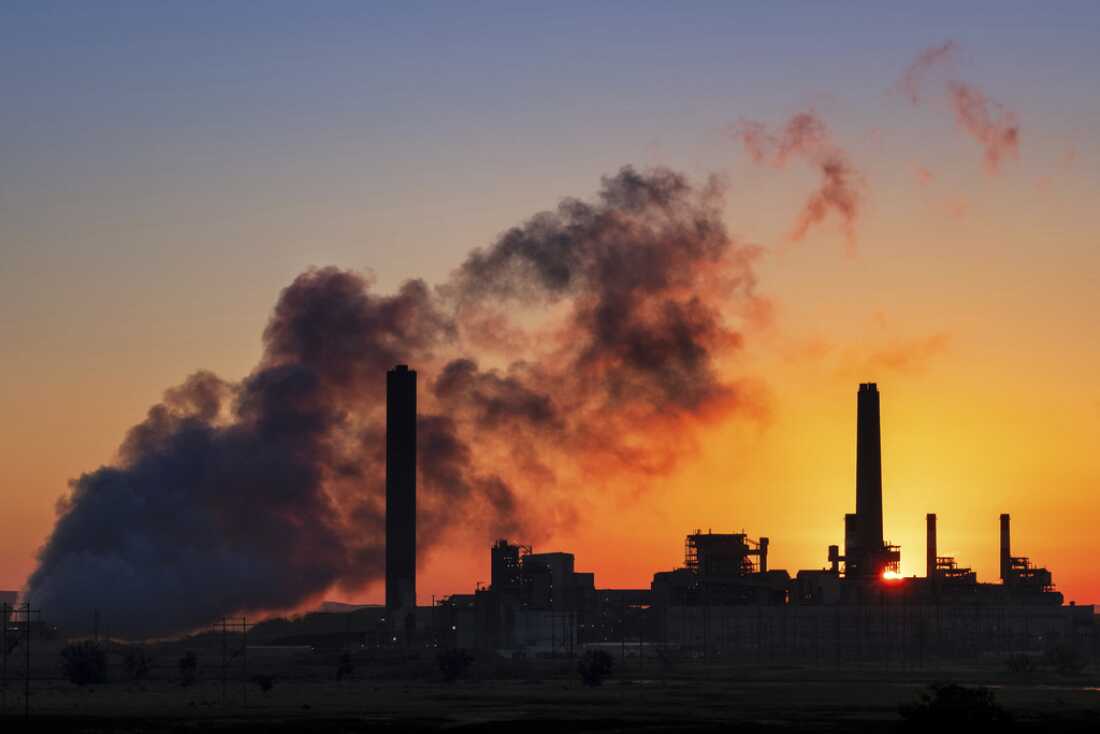
A coal-fired power plant is silhouetted against the morning sun.

The Obama and Biden administration’s have tried using the Clean Air Act to limit climate-warming emissions from the nation’s power plants, but their efforts have been held up or blocked in courts.

J. David Ake/AP


hide caption

Advertisement

toggle caption

J. David Ake/AP

The politics of the judiciary

An impartial judiciary has been a cornerstone of American democracy since its inception.

Trump’s term led to the most conservative Supreme Court in more than 90 years, but it also allowed Republican leadership to place more than 230 other judges in federal district and appellate courts — which issue “the bulk of the federal legal decisions in this country,” Heinzerling said.

Advertisement

Earlier this year, a federal appeals court ended a long-running lawsuit by young plaintiffs in Oregon who argued the U.S. government’s contribution to climate change violated their constitutional rights. In 2022, a U.S. district court restored endangered species protections to gray wolves in 44 states.

Those lower courts often get the benefit of the doubt, Heinzerling said. “Which means they can have a huge influence on what the regulatory landscape looks like.”

In his first campaign, Trump vowed to appoint judges in the mold of the late conservative Justice Antonin Scalia. Three-quarters of his appointees were men and roughly 84% were white, according to the Pew Research Center. An analysis by The Washington Post in May found that Biden has placed more non-white federal judges than any president in history. Nearly two-thirds are women.

“When he talks about rights and liberties, [Biden] knows that in the end those rights and liberties are decided by federal judges, so the makeup of the federal judiciary is connected to everything else we do,” former White House chief of staff Ron Klain told NPR last year.

Biden has had less say on the makeup of the Supreme Court, filling only one opening during his first term — Justice Ketanji Brown Jackson — and legal experts say it’s unlikely he’d be able to shift it in a second term. The court’s two oldest justices, Clarence Thomas and Samuel Alito, are both conservative and unlikely to retire if Biden is reelected. If Trump wins in November, critics fear he could replace both with younger justices, locking in the court’s conservative majority for decades to come.

Advertisement

Regardless of who wins, legal experts say, the Supreme Court’s recent decisions will make it harder for the federal government to tackle environmental problems like climate change, barring new legislation from Congress.

“[Chevron] makes it harder for agencies to use old laws to address new problems,” said Sam Sankar, senior vice president for programs at the environmental firm Earthjustice. “But that doesn’t mean that we can’t address the threats of climate, and we will. Problems are getting bad enough that Congress, even the right wing, is going to start needing to react to these things in federal lawmaking.”

“The question is,” he added, “how much do we lose and how much does it cost us to try to address the problems we’ve got?”

News

Trump administration sends letter wiping out addiction, mental health grants

Published

on

Trump administration sends letter wiping out addiction, mental health grants

A demonstrator holds a sign during International Overdose Awareness Day on Aug. 28, 2024 in New York City.

Erik McGregor/LightRocket via Getty Images


hide caption

toggle caption

Advertisement

Erik McGregor/LightRocket via Getty Images

The Trump administration sent shockwaves through the U.S. mental health and drug addiction system late Tuesday, sending hundreds of termination letters, effective immediately, for federal grants supporting health services.

Three sources said they believe total cuts to nonprofit groups, many providing street-level care to people experiencing addiction, homelessness and mental illness, could reach roughly $2 billion. NPR wasn’t able to independently confirm the scale of the grant cancellation. The U.S. Substance Abuse and Mental Health Services Administration (SAMSHA) didn’t respond to a request for clarification.

“We are definitely looking at severe loss of front-line capacity,” said Andrew Kessler, head of Slingshot Solutions, a consultancy firm that works with mental health and addiction groups nationwide. “[Programs] may have to shut their doors tomorrow.”

Advertisement

Kessler said he has reviewed numerous grant termination letters from “Salt Lake City to El Paso to Detroit, all over the country.”

Ryan Hampton, the founder of Mobilize Recovery, a national advocacy nonprofit for people in and seeking recovery, told NPR his group lost roughly $500,000 “overnight.”

“Waking up to nearly $2 billion in grant cancellations means front-line providers are forced to cease overdose prevention, naloxone distribution, and peer recovery services immediately, leaving our communities defenseless against a raging crisis,” Hampton said. “This cruelty will be measured in lives lost, as recovery centers shutter and the safety net we built is slashed overnight. We are witnessing the dismantling of our recovery infrastructure in real-time, and the administration will have blood on its hands for every preventable death that follows.”

Copies of the letter sent to two different organizations and reviewed by NPR signal that SAMHSA officials no longer believe the defunded programs align with the Trump administration’s priorities.

The letter points to efforts to reshape the national health system in part by restructuring SAMHSA’s grant program, which “includes terminating some of its … awards.”

Advertisement

According to the letter, grants are terminated as of Jan.13, adding that “costs resulting from financial obligations incurred after termination are not allowable.”

The National Association of County Behavioral Health and Developmental Disability Directors sent a letter to members saying it believes “over 2,000 grants [nationwide] with a total of more than $2 billion” are affected. The group said it’s still working to understand the “full scope” of the cuts.

This move comes on top of deep Medicaid cuts, passed last year by the Republican-controlled Congress, which affect numerous mental health and addiction care providers.

Kessler told NPR he’s hearing alarm from care providers nationwide that the safety net for people experiencing an addiction or mental health crisis could unravel.

“In the short term, there’s going to be severe damage. We’re going to have to scramble,” he said.

Advertisement

Regina LaBelle, a Georgetown University professor who served as acting head of the Office of National Drug Control Policy during the Biden administration, said the SAMHSA grants pay for lifesaving services.

“From first responders to drug courts, continued federal funding quite literally save lives,” LaBelle said. “The overdose epidemic has been declared a public health emergency and overdose deaths are decreasing. This is no time to pull critical funding.”

Requests for comment from SAMHSA and the Department of Health and Human Services were not immediately returned.

This is a developing story.

Advertisement
Continue Reading

News

Video: Clashes With Federal Agents in Minneapolis Escalate

Published

on

Video: Clashes With Federal Agents in Minneapolis Escalate

new video loaded: Clashes With Federal Agents in Minneapolis Escalate

transcript

transcript

Clashes With Federal Agents in Minneapolis Escalate

Fear and frustration among residents in Minneapolis have mounted as ICE and Border Patrol agents have deployed aggressive tactics and conducted arrests after the killing of Renee Good by an immigration officer last week.

“Open it. Last warning.” “Do you have an ID on you, ma’am?” “I don’t need an ID to walk around in — In my city. This is my city.” “OK. Do you have some ID then, please?” “I don’t need it.” “If not, we’re going to put you in the vehicle and we’re going to ID you.” “I am a U.S. citizen.” “All right. Can we see an ID, please?” “I am a U.S. citizen.”

Advertisement
Fear and frustration among residents in Minneapolis have mounted as ICE and Border Patrol agents have deployed aggressive tactics and conducted arrests after the killing of Renee Good by an immigration officer last week.

By Jamie Leventhal and Jiawei Wang

January 13, 2026

Continue Reading

News

Lindsey Halligan argues she should still be U.S. attorney, accuses judge of abuse of power

Published

on

Lindsey Halligan argues she should still be U.S. attorney, accuses judge of abuse of power

Top Justice Department officials defended Lindsey Halligan’s attempts to remain in her position as a U.S. attorney in court filings Tuesday, responding to a federal judge who demanded to know why she was continuing to do so after another judge had found that her appointment was invalid.

The filing, signed by Halligan, Attorney General Pam Bondi and Deputy Attorney General Todd Blanche, accused a Trump-appointed judge of “gross abuse of power,” and attempting to “coerce the Executive Branch into conformity.”

Last week, U.S. District Judge David Novak, who sits on the federal bench in Richmond, ordered Halligan to provide the basis for her repeated use of the title of U.S. attorney and explain why it “does not constitute a false or misleading statement.” 

Novak gave Halligan seven days to respond to his order and brief on why he “should not strike Ms. Halligan’s identification as United States attorney” after she listed herself on an indictment returned in the Eastern District of Virginia in December as a “United States attorney and special attorney.”

U.S. District Judge Cameron Currie had ruled in November that Halligan’s appointment as interim U.S. attorney was invalid and violated the Constitution’s Appointments Clause, and she dismissed the cases Halligan had brought against former FBI Director James Comey and New York Attorney General Letitia James. 

Advertisement

The statute invoked by the Trump administration to appoint Halligan allows an interim U.S. attorney to serve for 120 days. After that, the interim U.S. attorney may be extended by the U.S. district court judges for the region. 

Currie found that the 120-day clock began when Halligan’s predecessor, Erik Siebert was initially appointed in January 2025. Currie concluded that when that timeframe expired, Bondi’s authority to appoint an interim U.S. attorney expired along with it. 

The judge ruled that Halligan had been serving unlawfully since Sept. 22 and concluded that “all actions flowing from Ms. Halligan’s defective appointment” had to be set aside. That included the Comey and James indictments.

In their response, Bondi, Blanche and Halligan called Novak’s move an “inquisition,” “insult,” and a “cudgel” against the executive branch. The Justice Department argued that Currie’s ruling in November applied only to the Comey and James cases and did not bar Halligan from calling herself U.S. attorney in other cases that she oversees. 

“Adding insult to error, [Novak’s order] posits that the United States’ continued assertion of its legal position that Ms. Halligan properly serves as the United States Attorney amounts to a factual misrepresentation that could trigger attorney discipline. The Court’s thinly veiled threat to use attorney discipline to cudgel the Executive Branch into conforming its legal position in all criminal prosecutions to the views of a single district judge is a gross abuse of power and an affront to the separation of powers,” the Justice Department wrote.

Advertisement

In his earlier order, Novak said that Currie’s decision “remains binding precedent in this district and is not subject to being ignored.”

The Justice Department called Currie’s ruling “erroneous”: and said that Halligan is entitled to maintain her position “notwithstanding a single district judge’s contrary view.”

On Monday, the second-highest ranking federal prosecutor in the Eastern District of Virginia, Robert McBride, was fired after he refused to help lead the Justice Department’s prosecution of Comey, a source familiar with the matter told CBS News. McBride is a former longtime federal prosecutor in Kentucky’s Eastern District and had only been on the job as first assistant U.S. attorney for a few months after joining the office in the fall. 

Halligan is a former insurance lawyer who was a member of President Trump’s legal team, and joined Mr. Trump’s White House staff after he won a second term in 2024. In September, Halligan was selected to serve as interim U.S. attorney for the Eastern District of Virginia after her predecessor abruptly left the post amid concerns he would be forced out for failing to prosecute James.

Just days after she was appointed, Halligan sought and secured a two-count indictment against Comey alleging he lied to Congress during testimony in September 2020. James, the New York attorney general, was indicted on bank fraud charges in early October. Both pleaded not guilty and pursued several arguments to have their respective indictments dismissed, including the validity of Halligan’s appointment, and claims of vindictive prosecution.

Advertisement

Continue Reading
Advertisement

Trending