Connect with us

News

Why fintech upstarts have failed to unseat UK banks

Published

on

Why fintech upstarts have failed to unseat UK banks

In a 2018 letter to new staff members, digital bank Monzo outlined a lofty series of ambitions. The company said it aimed “to do for personal finance what Facebook has done for keeping up with your friends, or Google for finding information”.

The company, barely three years old at the time, also set a “long-term goal” of reaching a billion customers worldwide. Alongside a new cohort of challengers that also included Starling and Revolut, it was on a mission to usurp “legacy” banks, particularly the Big Four of HSBC, Barclays, Lloyds and NatWest that dominate the UK market.

A decade after these fintechs burst on to the scene, they have arguably succeeded in their mission of setting new standards for digital banking; features such as foreign currency transactions and bill-splitting, along with reliable, smartphone-friendly technology, are loved by younger customers.

“They have been amazing at challenging some of the norms in the industry,” says Tom Merry, a partner at consultancy Accenture.

But they are now being tested in a downturn. The plentiful venture capital that financed their heady growth — globally, the sector attracted $102bn in investment in 2021 — is drying up. Yet they are still burning through cash to acquire new customers while higher interest rates are driving increased competition for consumer deposits.

Advertisement

You are seeing a snapshot of an interactive graphic. This is most likely due to being offline or JavaScript being disabled in your browser.

Traditional high-street banks have raised their game by upgrading their own digital banking services, with the result that about 60 per cent of adults living in Britain now use a mobile banking app, up from 33 per cent in 2015, according to trade body UK Finance

Critics say consumers are using neobanks as a convenient payment management service, rather than as a replacement for traditional current accounts.

Investors in fintechs are increasingly scrutinising the neobanks’ differing business models and assets, looking for proof they can be durably profitable and attract sufficient deposits to fund lending.

Their managers are working out alternative ways to generate revenue, including monetising data and licensing technology to others.

Advertisement

“Are neobanks an evolution or are they a revolution? They feel like an evolution,” says Tom Mendoza, fintech partner at EQT venture.

“Many of them are good companies but they will not fundamentally disrupt the fabric of retail banking.”


Launched within a year of each other between 2014 and 2015, the UK’s three leading digital challengers all benefited from ready access to venture capital funding.

The companies quickly reached “unicorn” status — defined as a private valuation of above $1bn — and valuations ballooned higher still during the mania for tech stocks. Revolut became the UK’s top fintech in 2021 after a funding round led by Japanese investment group SoftBank implied a $33bn valuation, though two of its investors last year reduced the carrying values of their stakes.

All have enjoyed a decade of rapid growth in customer numbers but pursued increasingly differentiated strategies.

Advertisement

Revolut is Europe’s largest neobank with 40mn customers worldwide. It has opted for rapid expansion across multiple markets and attracted users with a broad suite of services including multi-currency current accounts, cheap foreign exchange and cryptocurrency trading.

The fintech is based in London, where its offices are emblazoned with neon signs exhorting staff to “get shit done”, but licensed as a bank in Lithuania. Its application for a licence in the UK, its single biggest market, has been stalled for more than three years; the departure of several senior executives and a warning from auditors that it may have “materially misstated” its revenues on its 2021 accounts have not helped.

Anne Boden, chief executive of Starling
Anne Boden, chief executive of Starling. Its focus on banking for small businesses has helped it to reach an almost 10 per cent share of that market © Geoff Caddick/AFP/Getty Images

Starling and Monzo secured UK banking licences in 2016 and 2017, respectively. But the two banks, which split from the same company following a row between founders Anne Boden and Tom Blomfield, have also pursued divergent paths.

Monzo has focused on retail customers, while Starling has also expanded into banking for small businesses and built up a 9 per cent share of that market. 

Starling is also the only one of the three that is currently profitable, posting a £195mn pre-tax profit in the year to March 2023. Monzo and Revolut say they expect to do so in their next set of accounts.

Profitability has moved to the top of the agenda for the sector as higher interest rates and an investment slowdown in the last two years forced companies to drop their “growth at all costs” mindset.

Advertisement

Global fintech investment has dropped by nearly 50 per cent in 2023 compared with the previous year, according to trade body Innovate Finance.

Neobanks have undeniably achieved one of their mission statements: making digital banking easy. Their designed-for-mobile interfaces attracted a new generation of customers while clever graphics, clear copywriting and intuitive budgeting tools helped foster transparency around personal finance.

Features such as the ability to split bills, temporarily freeze bank cards, move money and get payment notifications in real time within an app have become staples of modern-day banking.

You are seeing a snapshot of an interactive graphic. This is most likely due to being offline or JavaScript being disabled in your browser.

Unlike traditional banks, whose IT often comprised multiple layers of mostly server-based systems, further complicated by mergers and acquisitions, fintechs have relied on newer, cloud-based applications.

They were also run like start-ups. Managers encouraged staff to move quickly to build and test new products. Lucas Johnston, a former software engineer at Starling and Monzo who now works in the FT’s consulting arm, recalls the nascent industry embracing “the Silicon Valley mantra of constantly talking to customers and iterating on [their] products”.

Advertisement

“That, combined with a relatively young team typically from a tech background working with a modern tech stack, meant that they found the core features that consumers wanted,” he says. 

Within a few years of existence, the new banks had forced some of the nation’s largest and oldest financial institutions to pour millions of pounds into the development of their own apps in order to compete with their younger peers. The big banks not only borrowed some of the fintechs’ flagship features, they also poached staff from their ranks.

“The progress that has been made by the incumbent high street banks would not have happened absent the intervention that these neobanks have made,” says Merry.

But the ability to quickly open accounts and make transfers has also proved a boon for criminals. Britons lost £1.2bn to financial fraud last year, according to trade body UK Finance, with experts pointing to the country’s digitised banking industry as a factor.

The start-ups struggled to scale up their anti-financial crime capacities at the same speed they were attracting new users, while a wave of new sanctions imposed after Russia’s 2021 invasion of Ukraine increased the amount of due diligence banks had to conduct on new customers.

Advertisement

The Financial Conduct Authority in 2022 warned that a spike in “suspicious activity reports” to the National Crime Agency had raised “concerns about the adequacy of [neobanks’] checks when taking on new customers”. The year before, the watchdog launched an investigation into Monzo over potential breaches of financial crime regulations. 

“There cannot be a trade-off between quick and easy account opening and robust financial crime control,” FCA executive director Sarah Pritchard said at the time. 

Tom Blomfield co-founded Monzo in 2015
Tom Blomfield co-founded Monzo in 2015. Higher interest rates and a recent investment slowdown has forced fintechs to drop their ‘growth at all costs’ mindsets © Charlie Bibby/Financial Times

A separate report from the UK’s Payment Systems Regulator said that Monzo and Starling had some of the highest fraud rates in 2022, with only 6 per cent of those who reported fraud to Monzo fully reimbursed by the bank — compared to 44 per cent for Starling, 70 per cent for NatWest and 91 per cent for Nationwide.

Revolut’s compliance has also raised concerns. A flaw in its payment system in the US allowed criminals to steal more than $20mn of company funds over several months in 2022, the FT has previously reported.

The FCA has also investigated Revolut over allegations it allowed money to be released from accounts flagged by the National Crime Agency as suspicious.


The push for profitability will require the challengers to tweak their business models away from simply acquiring more customers.

Advertisement

“The neobanks recognise they will not survive at scale and be sustainably profitable without a two-sided balance sheet [with loans and deposits] that’s deep, but they are not there yet,” said Accenture’s Merry.

Conventional banks have traditionally offered current accounts at little or no profit to attract customers and provide deposits that can then be recycled into mortgages and personal loans.

The differential between the interest paid on those deposits and that charged on loans — the so-called net interest margin — underpins their profits. Customers are also upsold other products, such as credit cards, insurance and investment services.

£1.2bnAmount Britons lost to financial fraud last year, according to trade body UK Finance

By contrast, and despite attempts to push into new areas including buy-to-let mortgages for Starling and passive investing for Monzo, fintechs still derive most of their revenue from transaction fees and interest on cash deposited with central banks.

Advertisement

“Outside of the current account, there hasn’t really been any other game-changing propositions [from neobanks],” says Julian Sawyer, who co-founded Starling but left the bank in 2019 and now works in crypto.

Many of their customers still rely on a traditional bank account to receive salary payments, then use the convenient functionality of a neobank to manage payments.

Jayne Opperman, chief executive of consumer relationships at Lloyds Banking Group, says that while many Lloyds customers hold multiple bank accounts, they still want “a trusted bank” and tend to rely on the legacy institutions for big life transactions such as buying a home.

Investors are closely watching the fintechs’ shares of “primary bank accounts” — typically those that receive salary payments. An FCA review in 2022 estimated that UK neobanks had a market share of about 8 per cent of personal current accounts.

But the same review found that relative to big banks, a smaller proportion of those were primary accounts. “This results in lower balances, lower volumes of transactions, and lower overdraft usage [leading] to lower funding benefits and less scope to generate fee income.”

Advertisement

Fintechs downplay the importance of primacy. Revolut’s head of growth, Antoine Le Nel, says that while “we may not have too many people bringing their salaries . . . we have a lot of people who move all their money to Revolut the day after”.

Its customers move about £2,000 to their Revolut account every month, Le Nel says. The company estimates that more than a third of its customers use Revolut as their primary bank account for day-to-day payments.

Revolut chief executive Nikolay Storonsky
Revolut chief executive Nikolay Storonsky. The digital bank is thinking of diversifying its revenue sources by moving into areas such as advertising © Charlie Bibby/FT

Monzo chief executive TS Anil told the FT in March that while it does not publish the percentage of salaries paid into its current accounts, “the quality of engagement” of its users was “off the charts” relative to the UK market.

Monzo and Starling rank ahead of other banks when it comes to how likely customers would be to recommend them to friends and families, according to an industry-wide survey conducted by Ipsos.

“Whether you look at weekly transactions, bank retention, customer love, net promoter score, it’s no accident that the largest share of our user growth comes from word of mouth and organic channels,” said Anil.

Even if digital banks can convince customers to trust them with a larger portion of their money, they will have to contend with wider structural changes in the UK banking market.

Advertisement

Analysts say that customers who would once have relied on a single institution for many of their financial needs — a frequent quip used to be that Britons were more likely to change their spouse than their bank — are increasingly using a potpourri of services from various providers.

One person may use Starling or Monzo to buy groceries while holding a mortgage with NatWest, sending cross-border payments via listed fintech Wise and trading crypto on Revolut.

60%Percentage of adults living in Britain that now use a mobile banking app, up from 33 per cent in 2015

Neobanks are also rushing to explore new sources of revenue beyond the traditional business of banking. Starling is betting that franchising its technological knowhow will boost its valuation, Monzo is expanding into the US, while Revolut is diversifying into areas such as advertising.

In addition to the reinvigoration of high-street banks, fintechs are also facing competition from digital challenger Chase UK, which has attracted more than 2mn customers since its launch in 2021 by offering market-leading interest rates, cashback promotions and a slick app.

Advertisement

Backed by US banking giant JPMorgan Chase, it is expected to launch a credit card this year and expand into Europe. Chief executive Kuba Fast says Chase UK was in “a unique position”, able to offer a fintech-like experience “with the reassurance of an established and trusted bank”.

Merry considers it unlikely that a large bank would acquire a fintech, even though their valuations have moderated. A purchaser would have to put in heavy investment, and the operational risks of adapting tech platforms designed for a smaller pool of customers and business lines to a wider product range and many more clients would be significant, he says.

Alex Barkley, head of strategic partnerships at HSBC Ventures, agrees most big banks would not want to write “a cheque that large”. Listing a fintech on the stock market would also be difficult, given that most still lose money and that the share price performance of challenger banks such as Metro has been poor.

Sir Ron Kalifa, who authored a government-commissioned review into the competitiveness of fintech in the UK, says collaboration between big banks and fintechs would benefit the industry as this would allow the latter to combine their tech and agility with the scale, customer bases and regulatory expertise of traditional banks.

But others argue that the main beneficiaries of the investment that has poured into fintechs have been consumers. “It’s silly to suggest that neobanks have materially challenged the hegemony of traditional institutions,” says Barkley.

Advertisement

“Arguably, their only lasting impact is pushing big banks to improve their own digital platforms.”

News

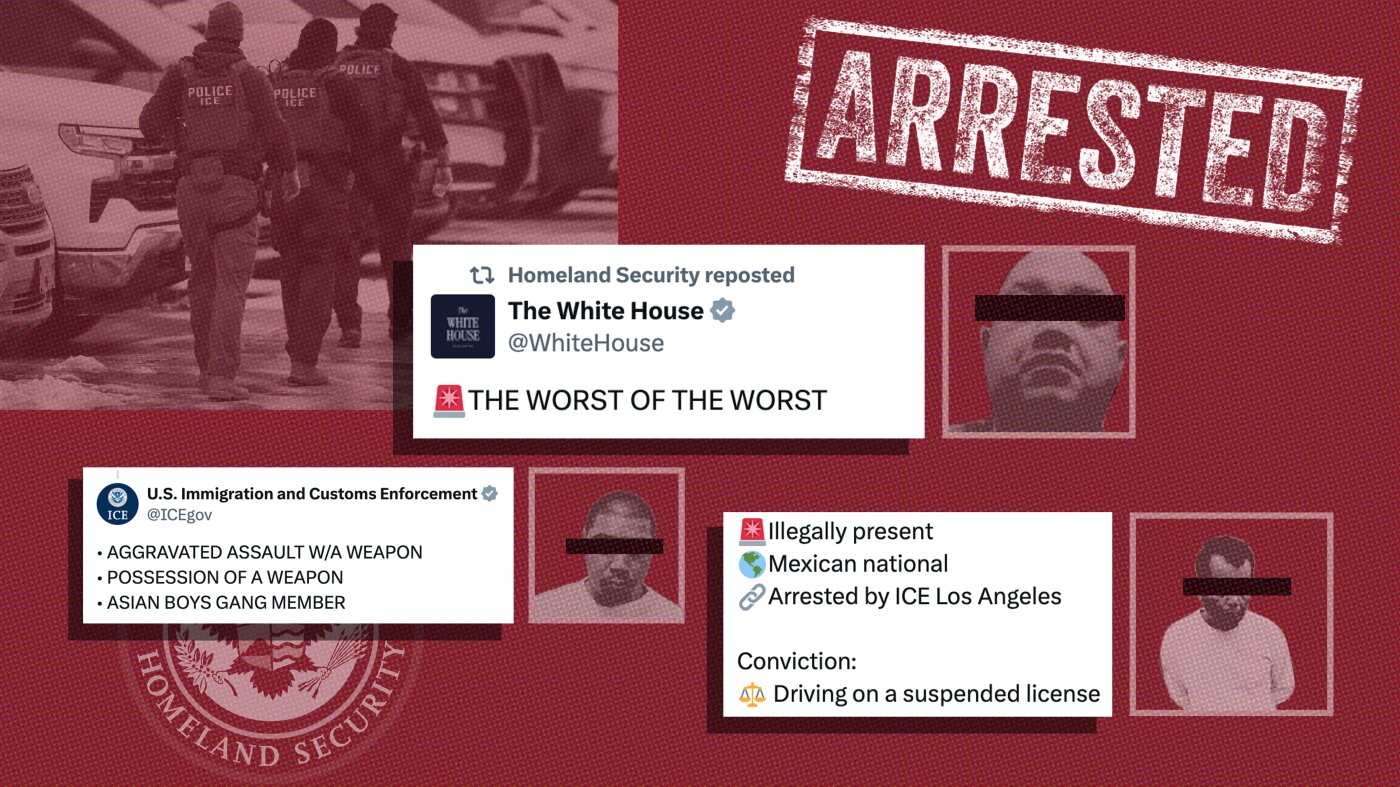
How the federal government is painting immigrants as criminals on social media

Published

on

How the federal government is painting immigrants as criminals on social media

Getty Images, Dept. of Homeland Security and The White House via X/Collage by Emily Bogle/NPR

Two days after At Chandee, who goes by Ricky, was arrested by U.S. Immigration and Customs Enforcement, the White House’s X account posted about him, calling the 52-year-old the “WORST OF WORST” and a “CRIMINAL ILLEGAL ALIEN.”

Except that the photo the White House posted was of a different person. The post also incorrectly claimed Chandee had multiple felony convictions — he has one, for second-degree assault in 1993 when he was 18 years old. He shot two people in the legs and served three years in prison.

Advertisement
At "Ricky" Chandee with his wife, Tina Huynh-Chandee.

At “Ricky” Chandee with his wife, Tina Huynh-Chandee.

Via the Chandee family


hide caption

toggle caption

Via the Chandee family

Advertisement

Chandee, who came to the U.S. as a child refugee, was ordered to be deported back to his home country, Laos. But Laos had not been accepting all of the people the U.S. wanted it to, so the federal government determined that it was likely infeasible to deport him, his lawyer Linus Chan told NPR. Chandee therefore was granted permission to stay in the U.S. and work so long as he checked in with immigration authorities periodically. He has not missed a check-in in over 30 years and has not had another criminal incident.

People who know Chandee do not see him as “worst of the worst.”

After Chandee completed his prison sentence, he finished school and became an engineering technician. He worked for the City of Minneapolis for 26 years, became a father, and his son grew up to join the military.

In his free time, Chandee enjoys hiking and foraging for mushrooms, Minnesota Public Radio reported.

Advertisement

“We are proud to work alongside At ‘Ricky’ Chandee,” said Tim Sexton, Director of Public Works for the City of Minneapolis in a statement. “I don’t understand why he would be a target for removal now, why he was brutally detained and swiftly flown to Texas, or how his removal benefits our city or country.” Chandee is petitioning for his release in federal court.

Chandee’s case is not unique 

Social media accounts from the White House, the Department of Homeland Security and other immigration agencies have spent much of the past year posting about people detained in the administration’s immigration crackdown, typically portraying them as hardened, violent criminals. That’s even as over 70% of the people detained don’t have criminal records according to ICE data.

NPR’s research of cases in Minnesota shows that while many of the people who have been highlighted on social media do have recent, serious criminal records, about a quarter are like Chandee, with decades-old convictions, minor offenses or only pending criminal proceedings. Scholars of immigration, media and criminal law say such a media campaign is unprecedented and paints a distorted picture of immigrants and crime.

A year into President Trump’s second term, the X accounts of DHS and ICE have posted about more than 2,000 people who were targets of mass deportation efforts. Starting late last March, DHS and ICE began posting on X on a near daily basis, often highlighting apprehensions of multiple people a day, an NPR review of government social media posts show.

Advertisement

Among the 2,000 people highlighted by the agencies, NPR identified 130 who were arrested by federal agents in Minnesota and tried to verify the government’s statements about their criminal histories.

In most of the social media posts, the government did not provide the state where the conviction occurred or the person’s age. Public court records do not tend to include photos so definitive identification can be a challenge.

NPR derived its findings from cases where it was able to locate a name and matching criminal history in the Minnesota court and detention system, in nationwide criminal history databases, sex offender databases, and in some cases, federal courts and other state courts.

In 19 of the 130 cases, roughly 1-in-7, public records show the most recent convictions were at least 20 years ago.

Seventeen of the 19 cases with old convictions did include violent crimes like homicide and first-degree sexual assault. ICE provided some of those names to Fox News as key examples of the agency’s accomplishments. “It’s the most disturbing list I’ve ever seen,” said Fox News reporter Bill Melugin on X, highlighting the criminal convictions of each person on the list.

Advertisement

For seven people, their only criminal history involved driving under the influence or disorderly conduct.

ICE agents approach a house before detaining two people in Minneapolis on Jan. 13.

ICE agents approach a house before detaining two people in Minneapolis on Jan. 13.

Stephen Maturen/Getty Images


hide caption

toggle caption

Advertisement

Stephen Maturen/Getty Images

Six of the 130 Minnesota cases highlighted by the administration involved people with no criminal convictions. The government’s social media posts for those six instead rely upon the charges and arrests as evidence of their criminality, even though arrests don’t always lead to charges and charges can be dismissed.

In yet another case, the government highlighted a criminal charge even while noting it had been dismissed. (The person did have other existing convictions.)

For 37 of the 130 people, NPR was unable to confirm matching criminal history after consulting the databases and news coverage. Some of the names turned up no criminal history at all. The government said these people committed crimes ranging from homicide and assault to drug trafficking, and cited one by name to Fox News. NPR tried to reach out to all 37 people and their families for comment but did not receive a response from any.

Advertisement

In a statement to NPR, DHS’s chief spokesperson Lauren Bis did not dispute NPR’s findings or provide documentation where NPR wasn’t able to confirm matching criminal history.

“The fact that NPR is defending murderers and pedophiles is gross,” Bis wrote. “We hear far too much about criminals and not enough about their victims.” before listing four of the people with old convictions of homicide and sexual assault, underlining the date of deportation order for three of them.

Images designed to trigger emotion

The stream of social media posts with photos of mostly nonwhite people are meant to draw an emotional response, says Leo Chavez, an emeritus professor of anthropology at the University of California, Irvine. They “have been used repeatedly over and over to get people to buy into, really drastic, drastic and draconian actions and policies,” he said.

Chavez, whose most recent book is The Latino Threat: How Alarmist Rhetoric Misrepresents Immigrants, Citizens, and the Nation, recalls how political campaigns in past decades presented images of Latinos — often men — without context. “Just by showing their image, showing brown people, particularly brown men, it’s supposed to be scary.”

The fact that the government’s social media posts come with statements about criminal history as well as photos reinforces that emotional response, Chavez said. DHS has previously acknowledged inaccuracies on their website. But even if the department issues corrections, Chavez said, “the goal was actually achieved, which was to reinforce the criminality and the visualization.”

Advertisement

CNN’s analysis of DHS’s “Arrested: Worst of the Worst” website showed that for hundreds out of about 25,000 people posted on the website, the crimes listed were not violent felonies. Instead, DHS listed people with records that included traffic offenses, marijuana possession or illegal reentry. DHS said the website had a “glitch” that it will fix but also that the people in question “have [committed] additional crimes.”

“I’ve never seen anything like this when it comes to immigration enforcement in the modern era,” said Juliet Stumpf, a professor at Lewis & Clark Law School who studies the intersection of immigration and criminal law. She said the drumbeat of social media posts focused on specific individuals was like “FBI’s most wanted posters” or “like reality TV shows.”

Then-DHS Assistant Secretary for Public Affairs Tricia McLaughlin, flanked by deputy director of U.S. Immigration and Customs Enforcement Madison Sheahan, left, and Acting director of U.S. Immigration and Customs Enforcement Todd Lyons, speaks during a news conference at ICE Headquarters, in Washington, D.C., on May 21, 2025.

Then-DHS Assistant Secretary for Public Affairs Tricia McLaughlin, flanked by deputy director of U.S. Immigration and Customs Enforcement Madison Sheahan (left), and Acting director of U.S. Immigration and Customs Enforcement Todd Lyons, speaks during a news conference at ICE Headquarters, in Washington, D.C., on May 21, 2025.

Jose Luis Magana/AP


hide caption

Advertisement

toggle caption

Jose Luis Magana/AP

Stumpf drew a parallel with an incident from the 1950s when the U.S. government deported two permanent residents suspected of being communists. “The government was kind of proclaiming and celebrating their deportation because getting rid of these communists was making the country safer,” said Stumpf, “Maybe that’s comparable to something like [this].”

An analysis by the Deportation Data Project shows a dramatic increase in arrests of noncitizens without criminal records during President Trump’s current term compared to President Biden’s term.

Advertisement

“If you look at research, immigrants actually tend to commit fewer crimes than even U.S. citizens do. And that’s true of immigrants who have lawful status here and immigrants who don’t,” said Stumpf. “If we have a number of social media posts that are painting immigrants as the worst of the worst…it’s actually really putting out a distorted version of reality about who immigrants actually are.”

Some claims are disputed by other authorities

In some posts, DHS and ICE have also used photos of people and statements about their criminal histories to burnish the federal government’s accomplishments, defend their agents and criticize states like Minnesota. State and local authorities have in turn pushed back, and some of the federal government’s claims about the people it has detained have been met with setbacks in the courts.

DHS accused Minnesota’s Cottonwood County of not honoring detainers, written requests by ICE to hold prisoners in custody for a period of time so ICE can pick them up. In one post, the agency identified a person who was charged with child sexual abuse, writing “This is who sanctuary city politicians and anti-ICE agitators are defending.”

The Cottonwood County sheriff’s office said DHS’s post “misrepresented the truth” in their own post on Facebook. According to their account, the county did honor the detainer but ICE said it was unable to pick up the person before the order expired and the county had to release the suspect.

The Minnesota Department of Corrections wrote in a blog post that dozens of people DHS listed on its “Worst of the Worst” website were not arrested as DHS described, but were transferred to ICE by the state because they were already in state custody. The Corrections Department has since launched a page dedicated to “correct the Department of Homeland Security’s (DHS) repeated false claims.”

Advertisement

The “Worst of the Worst” website has some overlap with the department’s social media posts, but it contains a much larger number of people — over 30,000 nationally. It included a Colombian soccer star who was extradited to the U.S., tried in Texas, convicted of drug trafficking and served time in federal prison. The website incorrectly describes him as being arrested in Wisconsin. The soccer player, Jhon Viáfara Mina, recently finished his sentence early and returned to Colombia, according to Spanish newspaper El Diario Vasco.

In some instances, DHS and ICE wrote about incidents where they ran into conflict when carrying out arrests. In those posts, they named the arrestees and posted their photos. But in one case where the incident went to court, the government’s account of the events shifted. After a federal agent shot Julio C. Sosa-Celis in Minneapolis in January, DHS claimed he was lodging a “violent attack on law enforcement.” Assault charges against Sosa-Celis fell apart in court as new evidence surfaced, and the officers involved were put on leave.

Despite the fact that the charges were dropped, DHS’s post profiling Sosa-Celis remains online.

Continue Reading

News

Bill Clinton to testify before House committee investigating Epstein links

Published

on

Bill Clinton to testify before House committee investigating Epstein links

Former president Bill Clinton is scheduled to give deposition Friday to a congressional committee investigating his links to Jeffrey Epstein, one day after Hillary Clinton testified before the committee and called the proceedings “partisan political theatre” and “an insult to the American people”.

During remarks before the House oversight committee, Hillary Clinton, the former secretary of state, insisted on Thursday that she had never met Epstein.

The former Democratic president, however, flew on Epstein’s private jet several times in the early 2000s but said he never visited his island.

Clinton, who engaged in an extramarital affair while president and has been accused of sexual misconduct by three women, also appears in a photo from the recently released files, in a hot tub with Epstein and a woman whose identity is redacted.

Clinton has denied the sexual misconduct claims and was not charged with any crimes. He also has not been accused of any wrongdoing connected to Epstein.

Advertisement

Epstein visited the White House at least 17 times during the early years of Clinton’s presidency, according to White House visitor records cited in news reports. Clinton said he cut ties with him around 2005, before the disgraced financier, who died from suicide in 2019, pleaded guilty to solicitation of a minor in Florida.

The House committee subpoenaed the Clintons in August. They initially refused to testify but agreed after Republicans threatened to hold them in contempt.

The Clintons asked for their depositions to be held publicly, with the former president stating that to do so behind closed doors would amount to a “kangaroo court”.

“Let’s stop the games + do this the right way: in a public hearing,” Clinton said on X earlier this month.

The committee’s chair, James Comer, did not grant their request, and the proceedings will be conducted behind closed doors with video to be released later.

Advertisement

On Thursday, Hillary Clinton’s proceedings were briefly halted after representative Lauren Boebert leaked an image of Clinton testifying.

During the full day deposition, Clinton said she had no information about Epstein and did not recall ever meeting him.

Before the deposition, Comer said it would be a long interview and that one with Bill Clinton would be “even longer”.

Continue Reading

News

Read Judge Schiltz’s Order

Published

on

Read Judge Schiltz’s Order

CASE 0:26-cv-00107-PJS-DLM

Doc. 12-1 Filed 02/26/26

Page 5 of 17

and to file a status update by 11:00 am on January 20. ECF No. 5. Respondents never provided a bond hearing and did not release Petitioner until January 21, ECF Nos. 10, 12, after failing to file an update, ECF No. 9. Further, Respondents released Petitioner subject to conditions despite the Court’s release order not providing for conditions. ECF Nos. 5, 12–13.

Abdi W. v. Trump, et al., Case No. 26-CV-00208 (KMM/SGE)

On January 21, 2026, the Court ordered Respondents, within 3 days, to either (a) complete Petitioner’s inspection and examination and file a notice confirming completion, or (b) release Petitioner immediately in Minnesota and confirm the date, time, and location of release. ECF No. 7. No notice was ever filed. The Court emailed counsel on January 27, 2026, at 10:39 am. No response was provided.

Adriana M.Y.M. v. David Easterwood, et al., Case No. 26-CV-213 (JWB/JFD)

On January 24, 2026, the Court ordered immediate release in Minnesota and ordered Respondents to confirm the time, date, and location of release, or anticipated release, within 48 hours. ECF No. 12. Respondent was not released until January 30, and Respondents never disclosed the time of release, instead describing it as “early this morning.” ECF No. 16.

Estefany J.S. v. Bondi, Case No. 26-CV-216 (JWB/SGE)

On January 13, 2026, at 10:59 am, the Court ordered Respondents to file a letter by 4:00 pm confirming Petitioner’s current location. ECF No. 8. After receiving no response, the Court ordered Respondents, at 5:11 pm, to immediately confirm Petitioner’s location and, by noon on January 14, file a memorandum explaining their failure to comply with the initial order. ECF No. 9. Respondents did not file the memorandum, requiring the Court to issue another order. ECF No. 12. On January 15, the Court ordered immediate release in Minnesota and required Respondents to confirm the time, date, and location of release within 48 hours. ECF No. 18. On January 20, having received no confirmation, the Court ordered Respondents to comply immediately. ECF No. 21. Respondents informed the Court that Petitioner was released in Minnesota on January 17, but did not specify the time. ECF No. 22.

5

Continue Reading

Trending