News
Were the Kennedy Files a Bust? Not So Fast, Historians Say.


In June 1973, a C.I.A. employee wrote a memo at the request of William E. Colby, the agency’s director, listing various ways the C.I.A. had, to put it delicately, “exceeded” its charter over the years.
The seven pages matter-of-factly described break-ins at the French Consulate in Washington, planned paramilitary attacks on Chinese nuclear facilities and injections of a “contaminating agent” in Cuban sugar bound for the Soviet Union. The memo ended with an offhand aside about John A. McCone, the agency’s former director.
“Finally, and this will reflect my Middle Western Protestant upbringing, McCone’s dealings with the Vatican, including Pope John XXIII and Pope Paul VI, would and could raise eyebrows in certain quarters,” the author wrote.
It was just one paragraph in the roughly 77,000 pages the National Archives posted online this week as part of the latest — and supposedly final — release of its vast collection of documents related to the assassination of President John F. Kennedy.
But for some of the scholars who immediately started combing through the documents, the brief passage, seen unredacted for the first time, raised eyebrows for sure.
“This opens a door on a whole history of collaboration between the Vatican and the C.I.A., which, boy, would be explosive if we could get documents about it,” said Peter Kornbluh, a senior analyst at the National Security Archive, an independent research center at George Washington University.
“Which of course,” he added, “we will now try to do.”
The document drop may have been a disappointment for those hoping for juicy revelations about the Kennedy assassination. But for scholars steeped in the history of intelligence agencies and the secret side of American foreign policy, there have been revelations aplenty.
They include information about C.I.A. involvement in various attempted coups, election interference in countries around the world and connections that ran to the top of some foreign governments. To see the documents all drop suddenly, without redactions, was remarkable to scholars.
“I didn’t think I’d live to see it,” Mr. Kornbluh said.
That the release included so much material with no obvious connection to the assassination reflected the broad intentions of the President John F. Kennedy Assassination Records Collection Act, a 1992 law passed after the Oliver Stone film “JFK” prompted a resurgence of conspiracy theorizing.
The law ordered that all government records related to the assassination and various investigations be gathered in one place and released within 25 years, with some exceptions for grand jury secrecy, tax privacy and concern for “identifiable harm” to national security.
And the law defined “assassination-related record” broadly, taking in a swath of documents related to the inner workings and covert operations of the C.I.A. and F.B.I., including many gathered by the Senate’s Church Committee, established in 1975 to investigate abuses by the intelligence agencies.
Before this week, 99 percent of the roughly six million pages in the collection had already been made public. Only several thousand documents remained redacted, and as few as 50 withheld in full, according to past statements from the archives.
Tulsi Gabbard, the director of national intelligence, said this week that only a few documents, which remained under a court seal because of grand jury rules, were still secret. The federal government is working to get those documents unsealed.
The release of the newly unredacted material had long been opposed by the C.I.A. because it would give up the names of its sources. But equally important to the agency was the desire to protect its mid-20th-century tradecraft: how well it had penetrated the Egyptian government’s communications, or the depth of its contacts in France.
Unredacted passages in the new documents revealed how the C.I.A. wiretapped phones in Mexico City in 1962. While that may be interesting in a Cold War spy movie kind of way, it has no bearing on whether American spy agencies can listen to a phone call made on an encrypted app on a modern cellphone.
But for historians, the agency’s closely guarded “sources and methods” are important to filling out the full historical picture. And some of the new material is startling, they said.
Fredrik Logevall, a Harvard historian who is working on a multivolume biography of Kennedy, said that it was remarkable to see a full version of an unredacted 1961 memo by Arthur Schlesinger Jr., an aide to Kennedy, written shortly after the Bay of Pigs fiasco, warning of the growing power of the C.I.A. and calling for it to be reorganized.
Newly visible passages revealed, among other things, that nearly half of the political officers in American embassies around the world were working for the C.I.A. “That’s astonishing,” Dr. Logevall said.
He also cited a now-unredacted 41-page memo of minutes from meetings between 1962 and 1963 of the President’s Foreign Intelligence Advisory Board, which included many suggestive new details, including some related to surveillance of China’s efforts to develop a nuclear bomb.
There was also an unredacted 1967 report by the C.I.A.’s inspector general on the 1961 assassination of the Dominican dictator Rafael Trujillo that now shows the names of all the C.I.A. agents involved in the plot.
“Without the 1992 law, all of this probably would have been under lock and key forever,” Dr. Logevall said.
The revelation of sources’ identities causes the C.I.A. deep angst, on principle and because it undermines efforts to recruit sources today.
“These relationships are secret for a reason,” said Nicholas Dujmovic, a retired C.I.A. historian. “If people don’t want others to know that they were cooperating with the C.I.A., for whatever reason, we have a moral obligation to keep these relationships secret, because that was the going in agreement.”
Arturo Jimenez-Bacardi, a historian at the University of South Florida and researcher for the National Security Archive, said the documents also revealed efforts to interfere in elections in Finland, Peru and Somalia that had been rumored but undocumented, or entirely unknown. There was also new information, he said, about C.I.A. involvement in failed and successful coups in various countries, including Brazil, Haiti and what is now Guyana.
A 1964 C.I.A. inspector general report on the workings of the agency’s station in Mexico City was particularly significant, he said, because it contained one of the most detailed accounts available of how the agency organized its ground operations.
A heavily redacted version was released in 2022. But newly visible passages revealed that Adolfo López Mateos, the president of Mexico, had approved a joint surveillance operation against Soviets in Mexico.
The memo also described a “highly successful project” aimed at “rural and peasant targets,” led by a Catholic priest who had created an extensive network of youth groups, credit unions, agricultural co-ops and study centers — presumably, Dr. Jimenez-Bacardi said, to make sure people “don’t go on the Soviet path.”
The White House said on Thursday that all remaining classified documents in the collection are now open for research at the National Archives, with additional pages still set to be digitized and posted online “in the coming days.”
Dr. Jimenez-Bacardi said he was eager to see the Church Committee interviews and depositions of former directors of the C.I.A., but had not yet found them.
Parts were included in previous releases. “But there are still secrets in those depositions,” he said.



new video loaded: Passengers Wait in Long Security Lines at LaGuardia After Deadly Crash

By Cynthia Silva
March 24, 2026

An Air Canada jet collided with a fire truck at LaGuardia Airport in Queens on Sunday night, killing two people and injuring dozens. The fire truck was responding to an unrelated incident when the crash happened.
Audio from air traffic control, flight data and imagery of the aftermath provide clues as to how the collision unfolded.
Before the crash
After multiple attempts at takeoff and reporting an issue with an odor, a United Airlines plane on the east side of the airport requested assistance. A Port Authority Aircraft Rescue and Firefighting truck responded and began traveling across the airport toward the United plane.
At the same time, around 11:36 p.m. an Air Canada Express Flight 8646 approached Runway 4 at about 150 miles per hour, according to flight data.
Fire truck cleared to cross runway
About 30 seconds before the collision, which was around 11:37 p.m., the fire truck requested permission from air traffic control to cross Runway 4 at crossing “D.” An air traffic controller promptly granted access, responding “Truck 1 and company, cross 4 at delta.”
Ten seconds after granting permission and about 10 seconds before the collision, the same controller is heard saying, “Stop, stop, stop, stop, Truck 1, stop, stop, stop.”
Flight data shows that the Air Canada plane touched down on the runway about 15 seconds before the collision with the fire truck.
About 10 seconds before the crash, the controller said, “Stop, Truck 1, stop!”
In the six seconds between when the controller told Truck 1 to stop the first time and the second time, the United flight covered approximately 1,000 feet, traveling about 200 feet per second, or 130 miles per hour, according to analysis of the flight data.
Moment of crash
Surveillance footage reviewed by The New York Times shows the Air Canada flight traveling down the runway and approaching the intersection where the fire truck had requested permission to cross. As the fire truck made a left turn onto Runway 4, the plane collided into the back half of the truck around 11:37 p.m.
Before the crash, one passenger, Rebecca Liquori, 35, said that there was turbulence as the flight prepared to land and that a flight attendant gave a warning about what to do in case of a possible emergency landing.
Using the length of the plane as a reference scale, The Times estimated the speed of the plane in the video footage to be about 110 miles per hour right before impact.
After the crash, the plane traveled about an additional 600 feet down the runway before coming to a stop off to the side of the runway. The fire truck was knocked onto its side and also slid down the runway before coming to a halt on a grassy median.
The diagram below shows what a Bombardier CRJ-900 jet looks like compared with a typical airport fire truck.
Aftermath
Images and video of the aftermath show that a large portion of the front of the airplane, including most of its cockpit, was torn off or crushed by the impact. Both the pilots died in the collision. A flight attendant, Solange Tremblay, was ejected from the plane while still strapped into her seat, sustaining a fractured leg.

A statue of the explorer Christopher Columbus stands on White House grounds at the Eisenhower Executive Office Building (EEOB) in Washington, D.C., on March 23, 2026.
Jim Watson/AFP/Getty Images
hide caption
toggle caption
Jim Watson/AFP/Getty Images
The Trump administration placed a statue of Christopher Columbus on White House grounds over the weekend, doubling down on its efforts to commemorate the 15th-century explorer.
“As we celebrate our Nation’s 250th anniversary of independence, the White House is proud to honor Christopher Columbus’s legendary life and legacy with a well-deserved statue on the White House grounds,” Davis Ingle, a White House spokesperson, said in a statement. “In this White House, Christopher Columbus is a hero, and President Trump will ensure he’s honored as such for generations to come.”
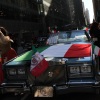
The statue is a replica of the one that used to sit in Baltimore’s Little Italy, according to John Pica, a Maryland lobbyist and president of the Italian American Organizations United. In 2020, after the killing of George Floyd by a white police officer and a reckoning on racial justice issues in the U.S., protesters pulled the statue down and hurled it into the city’s Inner Harbor.
The marble statue depicted Columbus facing east towards the sun, and was dedicated by former Baltimore Mayor William Donald Schaefer and President Ronald Reagan in October 1984.
Soon after, Pica, who also has served as a Maryland state senator, said his group hired divers to fish pieces of the statue out of the harbor. They raised money through grants and private contributions to hire a Maryland sculptor to rebuild it, Pica said.
The replica had been finished for a few years and sat in storage until Pica got a call last week that the White House wanted the statue. The statue was installed around 2 a.m. Sunday morning, he said, and it is on loan to the White House until the end of Trump’s term.
“It’s a place where it can peacefully shine and be protected,” he added.
“It’s a source of pride for Italian Americans,” Pica said. “Christopher Columbus, notwithstanding the controversy around him, is a symbol of pride and adventure for Italian Americans.”
Pica said he understands the hesitancy around Columbus’ legacy. In a way, he said, Italian Americans are “stuck” with Columbus.
“We don’t raise a glass of wine to Christopher Columbus on Columbus Day,” Pica said. “We celebrate our heritage. We don’t have Columbus celebrations. We have Italian American celebrations and Italian heritage celebrations. It’s just Columbus happens to be the symbol.”
The statue is not the administration’s first attempt to shine a favorable light on the controversial figure.
Last year, the Trump administration issued a proclamation commemorating Columbus Day, and took a jab at people who have criticized the explorer.
“Outrageously, in recent years, Christopher Columbus has been a prime target of a vicious and merciless campaign to erase our history, slander our heroes, and attack our heritage,” the proclamation read. “Before our very eyes, left-wing radicals toppled his statues, vandalized his monuments, tarnished his character, and sought to exile him from our public spaces.”
Indigenous Peoples’ Day, which is not an official federal holiday but is celebrated by cities and states across the country, previously had been recognized by the Biden administration.
Members of the public offer mixed reactions to the statue
On Monday morning, groups of schoolchildren, tourists and locals passed by the White House and offered differing opinions of the statue.
The statue wasn’t visible to the public because of construction and fences walling off the area. But when Ivone Sagastume, a first-generation Guatemalan American, heard about the new statue, she was brought to tears. To her, she said, the statue is another way the Trump administration is dividing the country.
“We as a nation have fought for unity and for respect of other cultures,” Sagastume, 35, said. “That symbol is just going to destroy that even more, it’s just destroying what this country was built on.”
Gerald Horne, a professor of history and African American studies at the University of Houston, said that reaction to the statue makes sense.
“Statues are political statements and those who have objected to the statue of Christopher Columbus are objecting to his role in helping to ignite genocide against the Indigenous population, of being an enslaver himself,” Horne said.
Middle school history teacher Scott Silk, 57, looked out at the White House with a group of students from San Diego behind him.
“For so many people in the United States, Christopher Columbus is a symbol of racism and the oppression of native peoples,” he said.
He said if he and his students could see the statue, he would ask them to reflect on what it means.

But others, like Martha Castillo, a tourist from San Diego, Calif., said it’s important to remember American history.
“I think it’s a good idea to have it here,” Castillo, 55, said. “This is a historic place and I think it should be here in the White House.”
Peter Diaz, 47, traveled from Miami, Fla. to explore the city’s capital. Diaz said the country has “bigger problems” than a statue.
“How many statues do we have in every city? In every state?” he said. “Are those really the issues that we care about? Don’t you think we have to think about our kids?”

‘Hannah Montana’ fans question Starbucks drink. ‘She hates raspberry’.

More than 300 attend Concordia Nebraska church work student luncheon

Jeff Choate evaluates spring camp following Nevada’s first padded scrimmage

Democrats gain ground in NH, new St. Anselm poll shows

N.J. Gov. Mikie Sherrill orders NJ Transit to improve rider experience

Florida High School Football Rankings: Top 25 teams – Oct. 21

How old is Bo Nix? What to know about Oregon quarterback ahead of 2024 NFL Draft

Cleary's 21 help Le Moyne down Central Connecticut State 69-64 in OT

99th annual Pony Swim held in Virginia

Indiana Members Credit Union announced as new anchor tenant at Bottleworks District

Video: Passengers Wait in Long Security Lines at LaGuardia After Deadly Crash

King Charles to address Congress in historic first state visit to Washington

Iran names successor to security chief killed in US-Israeli attack

See How the LaGuardia Plane Crash Unfolded

Mullin confirmed as DHS chief as lawmakers near solution on shutdown standoff
-

 Detroit, MI6 days ago
Drummer Brian Pastoria, longtime Detroit music advocate, dies at 68
-

 Georgia1 week ago
How ICE plans for a detention warehouse pushed a Georgia town to fight back | CNN Politics
-

 Movie Reviews6 days ago
‘Youth’ Twitter review: Ken Karunaas impresses audiences; Suraj Venjaramoodu adds charm; music wins praise | – The Times of India
-

 Alaska1 week ago
Police looking for man considered ‘armed and dangerous’
-

 Education1 week ago
Video: Turning Point USA Clubs Expand to High Schools Across America
-
 Science1 week ago
Long COVID leaves thousands of L.A. county residents sick, broke and ignored
-

 Sports3 days ago
IOC addresses execution of 19-year-old Iranian wrestler Saleh Mohammadi
-
 Science1 week ago
Industrial chemicals have reached the middle of the oceans, new study shows