Connect with us

News

We asked, you answered. Here are your most memorable moments with Mom for Mother's Day

Published

on

We asked, you answered. Here are your most memorable moments with Mom for Mother's Day

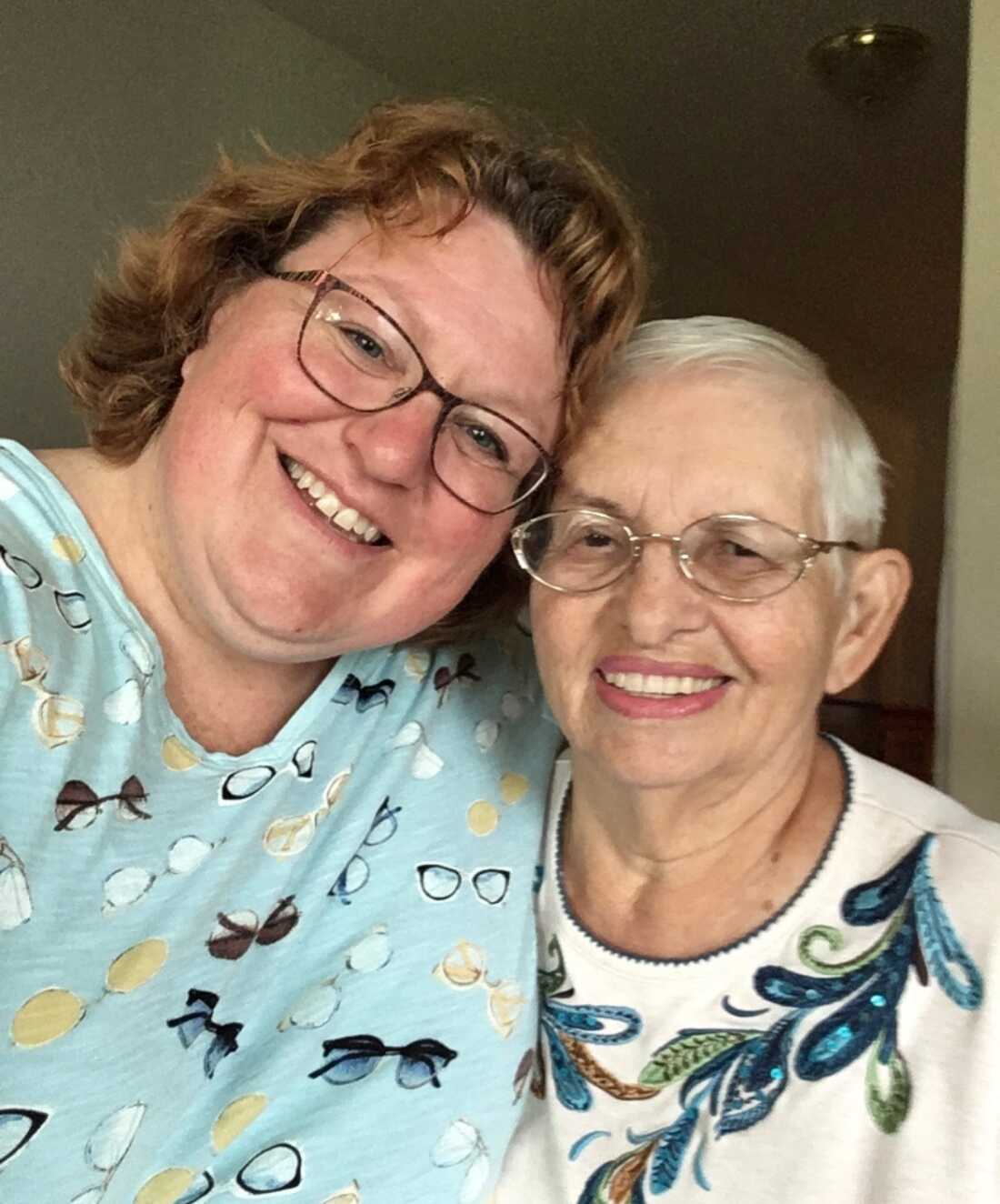
Connie Walton (left); Carmelia “Dinks” Hinkson; and Denille Andrus, with her son Joe Tanner, are among the mothers who are honored and remembered on Mother’s Day.

Julie Walton-Davidson, Lora Hinkson and via Joe Tanner


hide caption

toggle caption

Advertisement

Julie Walton-Davidson, Lora Hinkson and via Joe Tanner

When Brianna McIndoe was growing up in Tampa, Fla., her mother, Lisa McIndoe, maintained a beautiful flower garden in front of their home that attracted neighbors who would stop by to admire it.

“To this day, I am impressed by her ability to grow something beautiful where there was nothing before,” recalls Brianna, now 34. “I remember sitting outside with her planting seeds in the early spring, and she would teach me about the different varieties.”

Among those seeds were various types of the cockscomb flower, a uniquely shaped, fuzzy plant that comes in many colors and was a favorite of both Brianna and her mother. The irony of it also being known as the “brain flower” held little significance for them at the time.

Advertisement

This past April, on a warm spring day while her children, ages 7 and 5, were on break from school, Brianna took them on a scenic 7 1/2-hour drive from their home in Augusta, Ga., to visit their grandmother Lisa in Lutz, a suburb of Tampa.

“When we arrived at the nursing home, my mom didn’t recognize me,” Brianna says.

After a couple of hours, Brianna and the kids left to visit other relatives and friends before heading back home. As they started their journey homeward, Brianna felt a strong urge to visit her mom again.

This time, they stayed for a few more hours. The kids worked on a puzzle, while Brianna attempted to engage her mother in conversation, even though it was mostly unsuccessful.

“Right before we were getting ready to leave, my daughter mentioned the puzzle, and I turned to my mom and asked, ‘Was I like this when I was younger?’ ” Brianna recalls. “For a brief moment, I saw a glimpse of my mom again. She laughed and said, ‘You were just like that as a kid. She is just like you.’ In that moment, I knew she remembered, and it brought me so much joy.”

Advertisement

Brianna’s story is among nearly 500 shared with NPR after we invited readers to submit their favorite memories of their moms, whether their mothers are still present for them to hug or live on in their hearts. Brianna’s experience is also one of many that highlight the struggles of mothers dealing with dementia. Brianna says her mother, 63, is in a nursing home, receiving full-time care due to early-onset dementia.

“My mom is both alive and gone,” Brianna says.

Amid this struggle, Brianna has contemplated the legacies that many think of when considering their mothers.

“Something she always tells me is to leave things better than you found them. I’m trying to do that with my kids, making sure they have a better life than I had.”

Brianna’s sentiments were reflected in numerous submissions from across the United States and beyond — as far away as Africa, the Caribbean, Europe and Asia. They came from people in their 20s to their 70s, representing many races, genders, ethnicities and religious beliefs.

Advertisement

NPR received a flood of nostalgic stories — memories of moms from childhood, along with adult reflections that often showed that no matter how old we become, moms still surprise us.

There were humorous tales of moms’ antics that left us laughing, valuable pieces of moms’ advice that we might just adopt, and stories that tugged at our hearts, especially those poignant stories about mothers who have passed away.

Many favorite memories of Mom stem from her advice

Michael Sweet's mother, Donna Sweet, holds her 18-month-old great-granddaughter, Margot Higgins, during a family event celebrating her wedding anniversary.

Michael Sweet’s mother, Donna Sweet, holds her 18-month-old great-granddaughter, Margot Higgins, during a family event celebrating her wedding anniversary.

Michael Sweet


hide caption

Advertisement

toggle caption

Michael Sweet

Unsurprisingly, stories about life lessons taught by moms are among the favorite memories people cherish. Even if you could barely walk when she dropped those gems, you may now be watching your own children carry on that legacy today.

Take Michael Sweet, 62, a father of four, for example. He recalls that of everything his mother, Donna Sweet, 83, instilled in him, the most vivid and life-changing moment occurred when he was just 4 years old.

Advertisement

At that time, Michael’s family lived in a small working-class town in Pennsylvania. It was a segregated neighborhood, but Michael remembers attending a preschool filled with “kids of all races and abilities.” The year was 1967, a tumultuous time in American history. Each evening with his parents, he would tune in to the CBS Evening News, getting “a rundown of the horrors” unfolding across the nation.

“Walter Cronkite had been showing news footage of a lot of people who happened to have darker skin color than mine marching down streets wearing Sunday-best clothing: men, women and, most impactful for me, kids,” Michael recalls.

“Then the film showed the same people being beaten by policemen. Firemen were knocking women and kids to the ground, and they were getting pinned against buildings by high-pressure firehoses. Worst, as far as I was concerned, was big German shepherds were being sent to bite all these people.”

The dog attacks were particularly incomprehensible to him, as his favorite TV show featured Lassie, a heroic collie. This shocking contrast upended his understanding of the world; to him, police and firefighters were figures who protected people, not ones who caused harm. Confused, he finally asked his mother why these people were being hurt.

“Was it because Black people are bad? That was the only logical answer I could come up with,” Michael says.

Advertisement

This question shook his mother, and she devised a plan to help him understand.

He remembers her saying, “Some people just won’t accept others if their shells are different colors.” His mother helped him understand that the protests he saw on TV were about people demonstrating against the mistreatment of Black individuals because of the color of their skin, and that such behavior was wrong.

Michael doesn’t recall many discussions about civil rights, but that conversation with his mother was “all I ever needed to set my moral compass.”

“From that moment, I knew I was going to protect anyone who was being treated mean[ly] even if it meant stopping the police.”

Later in life, Michael became a police officer in Ohio.

Advertisement

“I wasn’t able to help those kids back in 1967, but for 29 years, that was my number one job — protecting anyone in harm’s way.”

“Mary Had a Little Lamb”

NEED TO CONFIRM Bobbi Jo Dziuk and her mother Eva Erbele??

Bobbi Jo Dziuk (left) with her mother, Eva Erbele.

Bobbi Jo Dziuk


hide caption

toggle caption

Advertisement

Bobbi Jo Dziuk

In the late 1940s, Bobbi Jo Dziuk’s dad was a bachelor farmer living in North Dakota. One of his brothers met a lovely woman from New York and got married. It turned out she had a lovely single cousin as well. Thus began the courtship between Bobbi’s parents, which initially took place through letters. They married in January 1956, and Bobbi’s mom, Eva Erbele, moved to bitterly cold North Dakota. This transition was particularly challenging for a woman who had grown up in tropical Puerto Rico before moving to the Bronx. But the newlywed couple believed their love would keep them warm.

Over the next 60 years, they were rarely apart. One year, Bobbi’s dad needed surgery and had to be hospitalized overnight. Since the hospital was a few hours away from home, Bobbi and her mom decided to stay at a hotel.

“As we shared a bed that night, she asked if I would lay my head right next to hers on the pillow, with our foreheads touching and holding hands, ’cause ‘that’s how we fall asleep every night,’ ” Bobbi recounts. “I teased my mom if I should sing her lullabies too. Her quiet reply, ‘I would love that!’ So forehead to forehead, holding hands, in the dark, I sang my mom lullabies until she fell asleep.”

Advertisement

Bobbi, 56, remembers she sang nursery rhymes like “Mary Had a Little Lamb.”

Her father made a full recovery but died three years later — during the winter. The following nine years were difficult for her mom, as she had rarely been apart from her husband.

Bobbi and her siblings did their best to bring her comfort, even as dementia and Parkinson’s disease started to take a toll. Eventually, they moved her into a senior care facility, which helped her to adjust to being alone.

Before her mother became ill, Bobbi was able to create many cherished memories with her, including moments with Bobbi’s now 22-year-old son. However, she says none stands out to her like that night at the hotel.

“This memory has become more precious since she passed away [March 20] at the age of 92,” Bobbi says.

Advertisement

Mom’s cooking is the best

Lora Hinkson still cherishes her mother, Carmelia "Dinks" Hinkson's, sweet bread.

Lora Hinkson still cherishes the sweet bread that her mother, Carmelia “Dinks” Hinkson (pictured), made.

Lora Hinkson


hide caption

toggle caption

Lora Hinkson

Advertisement

For many people, Mom’s food is the best, and countless memories are created around the cuisine that shaped their childhood and has even been passed on as tradition. For example, Lora Hinkson from Barbados cherishes her mom’s sweet bread, a Caribbean delicacy filled with coconut. Although her mother, Carmelia “Dinks” Hinkson, has been gone since 2016, Lora, now an accountant in her 40s, can still vividly recall the delicious aroma of that bread wafting through the house and even into the streets whenever she thinks of her mom.

“The scent was special, yes. The scent, slightly sweet and spicy from the coconut. Added to that, also the warmth of the oven,” Lora recounts. “On cold rainy days, when the house could be cold and miserable, the warmth of the oven just made the house feel cozy. Welcoming. Like home.”

New York attorney Subhan Ali fondly remembers the enticing curry flavors that filled his family’s home while he was growing up in India and in their new community after they moved to the U.S. His mother, Syeda Ali, insisted on making several dishes for him to freeze whenever they visited each other, ensuring he would always have a taste of home and her delicious cooking.

Despite his efforts to dissuade her, she wouldn’t hear of it.

Advertisement
Subhan Ali's mother, Syeda Ali, receiving flowers on her birthday in 2017.

Subhan Ali’s mother, Syeda Ali, receiving flowers on her birthday in 2017.

Subhan Ali


hide caption

toggle caption

Subhan Ali

Advertisement

On what would become my last trip to see her, her health had declined, and she had to be admitted to the hospital,” he recalls. “The doctor called to inform me that she had stage 4 lung cancer. At 88, this meant she didn’t have much time left. After the call, I walked back to her room, and before I could say a word, she said rather longingly, ‘If I were back home, I could have cooked something for you.’ In that moment, it hit me that she would never cook for me again.”

His mother died on July Fourth in 2018.

“Long after her passing, I warmed up some frozen food she had prepared and ate it,” he says. “My mother would have been in her seventh heaven that her children were still enjoying her cooking, even after she had died!”

Let me tell you about legacy

An equally impactful memory was shared by Suzette Takacs, a 71-year-old retired teacher from Campbell, Calif., of her mom, Phyllis Rosnes, who is now 95. Suzette says it has guided her throughout her life, despite it occurring when she was just 11 years old.

Advertisement

At the time, they lived in Southern California. It was just a typical summer day, and they were at a grocery store, where a large table displayed fresh green grapes. Both mother and daughter loved grapes, and Suzette gazed at her mom with anticipation, longing for the juicy treats. But her mother just stood staring at the grapes, appearing in deep thought.

“Mom looked down at me then and said, ‘I would love to buy some of these grapes, but I’ve been hearing that the people who pick them are not being treated very well. That’s not right, so we’re not going to buy any,’ ” Suzette recounted.

This was in 1965 during a time when Cesar Chavez and the farm workers union were instrumental in organizing the Delano Grape Strike and boycott, which lasted until 1970 and advocated for farmworker rights.

Suzette reflects that in that moment, her mom took a stance that taught her to always consider the plight of others and to help them, even in small ways.

“I love my sweet mom, but I love her all the more for teaching me this valuable and life-altering lesson. I’m still so proud of her! Helping others in need has always brought us the greatest joy.”

Advertisement

Suzette’s own daughter, Erin, continues this legacy by working as a teacher for children with disabilities.

Dorothy Taffner and her son David Taffner bonded over their love of crossword puzzles.

via David Taffner


hide caption

toggle caption

Advertisement

via David Taffner

Similarly, David Taffner, a 56-year-old manager in pharmaceuticals from Michigan, reflects on his own learning experience from his mother, Dorothy Taffner, who loved crossword puzzles and would solve them with his dad. It wasn’t until well into his adult life that he finally bought a New York Times crossword puzzle book. When his parents visited and noticed his unfinished puzzles, his mom offered him a simple piece of advice: “If you think you know the answer, write it in — it’s probably correct.”

For years, David ignored this advice. However, recently, after 20 years of second-guessing and five years after his mom passed away, he started following her suggestion. “And damn, she was right! I’ve got the right answer more often than not,” he says.

“Now, my daily habit of working a crossword puzzle brings me more joy because I know Mom would be nodding her head at all the things I’ve learned,” David says.

Advertisement

Do what I do

Julie Walton-Davidson's mother, Connie Walton, 83

Julie Walton-Davidson’s mother, Connie Walton, 83, always emphasizes seeing beyond superficial appearances, which inspired Julie to instill that in her own daughters.

Julie Walton-Davidson


hide caption

toggle caption

Julie Walton-Davidson

Advertisement

Some lessons are learned not from what is said directly to a child, but from what they overhear when adults are unaware that they’re listening. This was the experience shared by high school teacher Julie Walton-Davidson. Now in her 40s, Julie recalls a grocery store visit from her childhood with her mother, Connie Walton, who is now 83 years old.

A neighbor stopped to chat. I had turned the aisle when I heard the neighbor referring to me, saying, ‘… she is stunning.’ My mom responded by saying, ‘You should see her heart.’ She didn’t know I had overheard her, but that day she raised the bar and set it,” Julie remembers. “Her words have been a constant reminder throughout my life of what’s most important.”

Now, Julie is raising her two daughters, ages 20 and 23, with similar ideals, teaching them to always recognize their value beyond superficial appearances and to be good and kind individuals.

Honoring Mom after she’s gone

Elisabeth Simons with her husband

Elisabeth Simons stands with her husband, Harold Simons, at their wedding.

via Bob Simons

Advertisement


hide caption

toggle caption

via Bob Simons

Advertisement

Not every memory of a mother is reminiscent of a Hallmark greeting card or a heartwarming holiday movie. Not all mothers are portrayed as the ideal parental figures their children wish for. But losing a mother is undoubtedly one of the most heartbreaking experiences.

Many people have shared the moment their mom passed away. While the pain of losing a loved one is unfathomable, some find remarkable ways to honor their memory.

“My mom passed away on my birthday in 2019, at the age of 89,” recounts Bob Simons, a dad of three who lives in Atlanta. “I am truly honored that she passed on the same day that she gave birth to me 58 years earlier.”

Now 64, Bob cherishes that last visit he had with his mom, Elisabeth Simons, a Holocaust survivor from Vienna. She escaped to the U.S. with her mom and sister. She spent much of her adult life in Boston as a doctor and medical school professor while raising Bob and his sister.

“On the evening before she died … I was blessed to be able to spend an hour and a half with her, just listening to her reminisce about her life,” Bob shares. “She started our conversation saying, ‘It’s been a good life …’ to which I responded, ‘Mom, it’s been a great life!’ “

Advertisement


Elisabeth Simons (left) with her children Bob and Lee Simons in 2015.

Bob Simons


hide caption

toggle caption

Advertisement

Bob Simons

After her passing, many of her students wrote tributes, and Bob’s brother-in-law compiled them into a book. On Bob’s birthday each year — the anniversary of his mother’s death — the family reads these tributes in her memory. Bob also keeps her memory alive with the opening line he used in her eulogy:

“I still talk with Mom every day, the only difference is that now I can get a word or two in every once in a while.”

Joe Tanner has a similar memory of his mother.

Advertisement

Sure, he loved her laugh, watching her dance around the kitchen while singing country music, and of course her comforting hugs, especially as they sat on the couch in their cozy Utah home, where she would ask him about his day. But nothing compares to the day she showed up at his place after receiving an important message.

“My mom has always been very loving, but was also very religious. I knew she would be kind, but I also knew that it would be something that would make her have to face some decisions that were tough,” Joe recounts. “I knew that she was going to worry about me. I was too nervous to have to see her face or worry about the heartbreak, so I came out to her in an email.”

Denille Andrus hugs her son Joe Tanner in Bear Lake, Utah.

Denille Andrus hugs her son Joe Tanner in Bear Lake, Utah.

via Joe Tanner


hide caption

Advertisement

toggle caption

via Joe Tanner

The timing was incredible, he recalls. The day before he sent the email, his mom’s computer had been hacked, so she took it for repairs.

“The day she got her computer back, she saw my email and drove two hours unannounced to come and see me,” he says. She initially made small talk, he says, then “just grabbed me and gave me the biggest hug she could give and started crying. She needed me to know what happened and that nothing could have changed the love that she had for me.”

Advertisement

He was 32 at the time.

“Then we sat and cried together and made sure that we each knew how much we loved and appreciated one another.”

Joe’s mom, Denille Andrus, died six years ago of cancer. She was 61.

“She wanted to show love and support to me, as well as give a nod to my religious siblings and wanted to have rainbows at her funeral. She asked my sisters to paint rainbows on her fingernails.”

Mom’s high jinks and love are unmatched

Janean Schmidt from Spokane, Wash., shares a riveting memory of her mom, Janet Joregsen, now in her 70s.

Advertisement

In the mid-1980s, while they were living in Los Angeles, the musical Cats was all the rage. Although Janean’s mom was not a fan of the genre, Janean was obsessed with it. For her 16th birthday, she insisted on going to see Cats and, surprisingly, her mom reluctantly agreed. They decided to make a whole day of it, including dinner near the theater.

Janean reminisces about how back then during intermission, attendees could walk onstage and get close to the oversized set pieces and even collect autographs from characters.

“We all walk onto the stage, and my mom turns around to face the audience, and belts out just the title word to the show’s biggest hit: ‘Meeeeeemmm-rrryyyyy… There, now I can say I’ve sung ‘Memory’ on the stage of Cats,” Janean hilariously recalls.

“I occasionally remind her of that moment, I loved it so much.”

In contrast to Janean’s mother, Angel Limb’s mom, Cora Mae, had a strong affinity for musical arts, especially the tunes of World War II, during which she came of age. Cora loved swing and Big Band music, which she called “war tunes,” and she frequently sang these to Angel. By age 4, Angel knew the lyrics to dozens of her mom’s favorite tunes, believing no other genre existed.

Advertisement

“On my first day of kindergarten, l knew none of the songs my teacher Miss Leonard sang with the class,” Angel, a Virginia resident, recalls. “She asked why l did not sing. I told her that l had never heard ‘The Itsy-Bitsy Spider’ or ‘Old MacDonald Had a Farm.’ “

Perplexed, Miss Leonard asked what songs she did know.

“l belted out a few bars of the Andrews Sisters’ 1941 hit ‘Boogie Woogie Bugle Boy,’ and added a few of their dance moves as well. I can still see the look on Miss Leonard’s face that clearly said, ‘What an oddball!’

“My first kindergarten report card described me as ‘… bright, confident, and offbeat.’ Unusual upbringing? Yes, please, and thanks, Mom!”

For Patricia Avila from San Benito, Texas, a similarly memorable moment occurred a decade ago when she took her mom, Aurora Avila, on a trip to Hawaii. Patricia was looking forward to her mother climbing to the top of the 750-foot Diamond Head, but her then-72-year-old mom felt daunted by the challenging ascent and opted to stay at the base. Patricia climbed with friends, and moments after reaching the summit, something unexpected happened.

Advertisement

“A friend tapped me on the shoulder and pointed to my mom,” Patricia recalls. “I remember feeling surprised to see her on the top of Diamond Head and proud of her accomplishment. It was the highlight of the trip!”

My mom’s the undefeated comedian

Overall, the responses to our callout show that even though some may not have the most joyful experiences with their mom, the memories that are most cherished are those precious moments that make a child feel most comforted, safe, cared for and valued. Scarcely would a child feel love without the undeniable support of their mom and presence of laughter.

English professor Makayla Steiner, 39, dares you to prove this notion wrong with her reflection on running for student council in ninth grade. She was quiet and shy, and neither she nor her mom, Camille Callister, a high school teacher, was sure she would be elected.

Makayla Steiner poses with campaign posters for student council that her mom, Camille Callister, helped her make.

via Makayla Steiner


hide caption

Advertisement

toggle caption

via Makayla Steiner

However, her mom diligently helped her make campaign posters and treats. When the winners were announced, Makayla was shocked to see her name on the list. She gathered posters and walked home, excited to tell her mom. As she entered the front door, her mother looked at her in anticipation.

Advertisement

“I smiled, shrugged, and said, ‘I won!’ ” Makayla recalls.

Her mom screamed with joy, hugged her, and they danced around. Then, Camille pulled a cake out of the oven.

Makayla Steiner (left) with her mom Camille Callister.

Makayla Steiner (left) with her mom, Camille Callister.

Camille Callister


hide caption

Advertisement

toggle caption

Camille Callister

“It was colorfully decorated and she had piped ‘The thrill of victory!’ on top,” Makayla remembers.

Makayla was pleased, but she wondered aloud what her mother would have done if she had lost.

Advertisement

Her mom grinned sheepishly, then went back to the oven and pulled out a smaller cake.

“She had decorated it with blue foot-shaped candies and had piped ‘Da Agony of Da-Feet!’ on it. I laughed, and in the 20-plus years since then, I have remembered fondly that lesson: that win or lose, my mom was going to be there for and with me, and in good humor. She’s the best!”

Happy Mother’s Day to all moms — whether alive or living on in our hearts!

News

U.S. launches strikes in Syria targeting Islamic State fighters after American deaths

Published

on

U.S. launches strikes in Syria targeting Islamic State fighters after American deaths

President Donald Trump and Defense Secretary Pete Hegseth salute as carry teams move the transfer cases with the remains of Iowa National Guard soldiers Sgt. William Nathaniel Howard, 29, of Marshalltown, Iowa, and Sgt. Edgar Brian Torres-Tovar, 25, of Des Moines, Iowa, and civilian interpreter Ayad Mansoor Sakat, who were killed in an attack in Syria, during a casualty return, Wednesday, Dec. 17, 2025 at Dover Air Force Base, Del.

Julia Demaree Nikhinson/AP


hide caption

toggle caption

Advertisement

Julia Demaree Nikhinson/AP

WASHINGTON — The Trump administration launched military strikes Friday in Syria to “eliminate” Islamic State group fighters and weapons sites in retaliation for an ambush attack that killed two U.S. troops and an American civilian interpreter almost a week ago.

A U.S. official described it as “a large-scale” strike that hit 70 targets in areas across central Syria that had IS infrastructure and weapons. Another U.S. official, who also spoke on condition of anonymity to discuss sensitive operations, said more strikes should be expected.

“This is not the beginning of a war — it is a declaration of vengeance. The United States of America, under President Trump’s leadership, will never hesitate and never relent to defend our people,” Defense Secretary Pete Hegseth said on social media.

Advertisement

The new military operation in Syria comes even as the Trump administration has said it’s looking to focus closer to home in the Western Hemisphere, building up an armada in the Caribbean Sea as it targets alleged drug-smuggling boats and vowing to keep seizing sanctioned oil tankers as part of a pressure campaign on Venezuela’s leader. The U.S. has shifted significant resources away from the Middle East to further those goals: Its most advanced aircraft carrier arrived in South American waters last month from the Mediterranean Sea.

Trump vowed retaliation

President Donald Trump pledged “very serious retaliation” after the shooting in the Syrian desert, for which he blamed IS. Those killed were among hundreds of U.S. troops deployed in eastern Syria as part of a coalition fighting the militant group.

During a speech in North Carolina on Friday evening, the president hailed the operation as a “massive strike” that took out the “ISIS thugs in Syria who were trying to regroup.”

Earlier, in his social media post, he reiterated his backing for Syrian President Ahmad al-Sharaa, who Trump said was “fully in support” of the U.S. effort.

Trump also offered an all-caps threat, warning IS against attacking American personnel again.

Advertisement

“All terrorists who are evil enough to attack Americans are hereby warned — YOU WILL BE HIT HARDER THAN YOU HAVE EVER BEEN HIT BEFORE IF YOU, IN ANY WAY, ATTACK OR THREATEN THE U.S.A.,” the president added.

The attack was conducted using F-15 Eagle jets, A-10 Thunderbolt ground attack aircraft and AH-64 Apache helicopters, the U.S. officials said. F-16 fighter jets from Jordan and HIMARS rocket artillery also were used, one official added.

U.S. Central Command, which oversees the region, said in a social media post that American jets, helicopters and artillery employed more than 100 precision munitions on Syrian targets.

How Syria has responded

The attack was a major test for the warming ties between the United States and Syria since the ouster of autocratic leader Bashar Assad a year ago. Trump has stressed that Syria was fighting alongside U.S. troops and said al-Sharaa was “extremely angry and disturbed by this attack,” which came as the U.S. military is expanding its cooperation with Syrian security forces.

Syria’s foreign ministry in a statement on X following the launch of U.S. strikes said that last week’s attack “underscores the urgent necessity of strengthening international cooperation to combat terrorism in all its forms” and that Syria is committed “to fighting ISIS and ensuring that it has no safe havens on Syrian territory and will continue to intensify military operations against it wherever it poses a threat.”

Advertisement

Syrian state television reported that the U.S. strikes hit targets in rural areas of Deir ez-Zor and Raqqa provinces and in the Jabal al-Amour area near the historic city of Palmyra. It said they targeted “weapons storage sites and headquarters used by ISIS as launching points for its operations in the region.”

IS has not said it carried out the attack on the U.S. service members, but the group has claimed responsibility for two attacks on Syrian security forces since, one of which killed four Syrian soldiers in Idlib province. The group in its statements described al-Sharaa’s government and army as “apostates.” While al-Sharaa once led a group affiliated with al-Qaida, he has had a long-running enmity with IS.

The Americans who were killed

Trump this week met privately with the families of the slain Americans at Dover Air Force Base in Delaware before he joined top military officials and other dignitaries on the tarmac for the dignified transfer, a solemn and largely silent ritual honoring U.S. service members killed in action.

The guardsmen killed in Syria last Saturday were Sgt. Edgar Brian Torres-Tovar, 25, of Des Moines, and Sgt. William Nathaniel Howard, 29, of Marshalltown. Ayad Mansoor Sakat, of Macomb, Michigan, a U.S. civilian working as an interpreter, also was killed.

The shooting near Palmyra also wounded three other U.S. troops as well as members of Syria’s security forces, and the gunman was killed. The assailant had joined Syria’s internal security forces as a base security guard two months ago and recently was reassigned because of suspicions that he might be affiliated with IS, Interior Ministry spokesperson Nour al-Din al-Baba has said.

Advertisement

The man stormed a meeting between U.S. and Syrian security officials who were having lunch together and opened fire after clashing with Syrian guards.

Continue Reading

News

Trump’s push to end transgender care for young people opposed by pediatricians

Published

on

Trump’s push to end transgender care for young people opposed by pediatricians

A display at the Gender Health Program of Children’s Minnesota hospital. Under a proposed rule announced Thursday, a hospital will lose all its Medicaid and Medicare funding if it continues to provide gender-affirming care for trans people under age 18.

Selena Simmons-Duffin/NPR


hide caption

toggle caption

Advertisement

Selena Simmons-Duffin/NPR

Dr. Kade Goepferd watched the Trump administration’s moves on Thursday to ban gender-affirming care for transgender youth with “a mix of sadness and frustration.”

Goepferd, who is the founder of Children’s Minnesota Gender Health Program, says that for the medical community, nothing has changed about the evidence supporting gender-affirming care that could justify the government’s actions.

“There’s a massive propaganda and disinformation campaign that is selectively targeting this small population of already vulnerable kids and their families,” Goepferd says.

Advertisement

“Men are men”

Federal health officials said many times at Thursday’s announcement that their actions were driven by science and evidence, not politics or ideology. They frequently praised a report published by the Department of Health and Human Services in November. It concluded that clinicians who provide medical care to help youth transition have failed their patients and emphasized the benefits of psychotherapy as an alternative.

At times, health officials cast doubt on the idea that a person could be transgender at all.

“Men are men. Men can never become women. Women are women. Women can never become men,” said Acting CDC Director Jim O’Neill. He added that “the blurring of the lines between sexes” represented a “hatred for nature as God designed it.”

Health Secretary Robert F. Kennedy Jr. said doctors and medical groups had “peddled the lie” that these treatments could be good for children, and that those youth were “conditioned to believe that sex can be changed.”

Doctor groups disagree

The American Academy of Pediatrics, the medical group that represents 67,000 pediatricians across the country, pushed back forcefully on those characterizations.

Advertisement

“These policies and proposals misconstrue the current medical consensus and fail to reflect the realities of pediatric care and the needs of children and families,” said AAP President Dr. Susan J. Kressly in a statement. “These rules help no one, do nothing to address health care costs, and unfairly stigmatize a population of young people.”

AAP’s official position on this medical care is that it is safe and effective for the young people who need it. That view is shared by the American Medical Association, the Endocrine Society, among other medical organizations.

In a statement Thursday, the American Psychological Association wrote: “APA is deeply concerned about recent federal actions that not only challenge the scientific understanding of gender identity but also potentially jeopardize the human rights, psychological health, and well-being of transgender and nonbinary individuals.”

The most significant proposal released by HHS would withhold all Medicare and Medicaid funding from hospitals — a big portion of their budgets — if they provided gender-affirming care to those under age 18.

The Children’s Hospital Association said that rule — if finalized — would set a dangerous precedent. “Today’s proposed conditions make it possible for all kinds of specialized health care treatments to be withheld based on government-mandated rules,” wrote CEO Matthew Cook. “Millions of families could lose access to the care they need.”

Advertisement

After a 60-day comment period, the rules could be finalized and then take effect.

Attorneys general in New York and California have said they will fight these rules and protect the rights of trans people to get care in their states. The ACLU has vowed to sue, and more legal challenges are expected.

“I don’t want to be lost”

According to a CDC survey, about 3% of teenagers aged 13-17 identify as transgender, approximately 700,000 people. A poll from health research organization KFF found that less than a third of transgender people took medication related to their identity and 16% had had surgery.

For young people, medical options most commonly include puberty blockers and hormones. Surgery is very rare for minors. “This is health care that evolves over time, is individualized, tailored to a patient’s needs, often after years of relationship with a trusted health care team,” says Goepferd.

NPR spoke to a transgender 15-year old in California this week about the moves Trump administration officials were making to restrict care. “They think what I’m feeling is a phase and that my family should just wait it out and that it’s better I’m unhappy and never receive care,” he says. NPR agreed not to name him because of fears for his safety.

Advertisement

He says it can be difficult for those who are not transgender to understand that experience, but that, as far as he can tell, these health officials “are not interested in understanding trans people.”

He describes the long and deliberate process he made with his parents and doctors before he began taking testosterone. “The decision to not start gender-affirming care is often just as permanent as a decision to start it,” he says. “Not starting [hormone therapy], for some people, it feels like ruining our body, because there are certain changes we can never have.”

Now, after six months on testosterone, he feels like he’s on the right path, and is worried about the prospect of losing access to his medication if HHS’s efforts to shut down care nationally succeed. “It feels like someone’s throwing me into the bush just off the path I’m on, and that’s kind of terrifying,” he says. “I don’t want to be lost. I want to keep going where I’m going.”

“Deep moral distress”

More than half of states already ban gender-affirming care for young people after a frenzy of laws passed since 2021 in Republican-led states. This week, Republicans in the House led efforts to pass two federal bills that would restrict access to care, including one that could put doctors who provide the care in prison for up to ten years. It’s unclear if the bills will be voted on in the Senate.

Although nothing has officially changed in states where the care is still legal, these efforts to enact national restrictions have doctors and health systems in those states bracing for the possibility that their clinics will have to close down.

Advertisement
Dr. Kade Goepferd is standing in an exam room at Children's Minnesota hospital.

Dr. Kade Goepferd takes care of transgender and gender diverse young people at Children’s Minnesota hospital.
hide caption

toggle caption

“There’s a deep moral distress when you know that there is care that you can provide to young people that will measurably improve their health and the quality of their life, and you’re being restricted from doing that,” Goepferd of Children’s Minnesota says. “And there’s a moral distress in feeling like — as a hospital or a health care system — you have to restrict care that you’re providing to one population to remain financially viable to provide health care for other kids.”

Continue Reading

News

Takeaways from an eventful 2025 election cycle

Published

on

Takeaways from an eventful 2025 election cycle

Is there such a thing as an “off year” for U.S. elections? The elections in 2025 were not nearly as all-encompassing as last year’s presidential race, nor as chaotic as what is expected from next year’s midterms. But hundreds of elections were held in dozens of states, including local contests, mayoral races, special congressional elections and two highly anticipated governor’s races.

Many of the elections were seen as early tests of how lasting President Trump’s 2024 gains might be and as a preview of what might happen in 2026.

Advertisement

Here are five takeaways from the 2025 election cycle.

In Elections Seen as Referendums on Trump, Democrats Won Big

Advertisement

Democrats did well in nearly all of this year’s elections, continuing a pattern that has played out across off-year elections for the last two decades: The party that wins the White House routinely loses ground in the next round of elections.

Advertisement

Virginia and New Jersey have historically swung away from the president’s party in governor’s races

The change in the final margin from the presidential election to the next election for governor

Sources: Virginia Department of Elections, N.J. Division of Elections, Dave Leip’s Atlas of U.S. Elections. The New York Times

Advertisement

Elections in these years are often viewed as referendums on the president’s performance. And Mr. Trump’s approval ratings, after months of holding steady, took a dip in November.

A notable shift came in New Jersey, where the majority-Hispanic townships that swung toward Mr. Trump in 2024 swung back to Democrats in the 2025 governor’s race. That contributed significantly to the victory of Representative Mikie Sherrill, the Democratic candidate, over Jack Ciattarelli, the Trump-backed Republican.

Advertisement

New Jersey’s majority-Hispanic towns snapped back left in 2025

Each line is a township whose width is sized to the number of votes cast in 2025

Advertisement

Note: Includes townships where more than 500 votes were cast in 2025. Sources: N.J. county clerks, N.J. Division of Elections, U.S. Census Bureau. The New York Times

The leftward swing was viewed by many political commentators as a reaction to Mr. Trump. If that is the case, it remains to be seen how much of it will carry over into 2026.

Advertisement

Progressive and Moderate Democrats Are Both Claiming Victories

Democratic strategists continue to debate whether the party should embrace progressive candidates or more moderate ones. And in 2025, the election results had both sides feeling emboldened.

Advertisement

In New York City, Zohran Mamdani, a democratic socialist who struggled to garner support from the Democratic Party, defeated former Gov. Andrew Cuomo by nine points. A similar story played out in Jersey City, where James Solomon, a progressive, crushed former Gov. James McGreevey of New Jersey in a mayoral runoff. Progressives also prevailed in cities like Detroit and Seattle.

Centrist Democrats, meanwhile, came away with arguably the two biggest wins of the year against Trump-endorsed Republicans. Abigail Spanberger and Ms. Sherrill, both Democrats, outperformed their polling estimates and decisively won the high-profile governor’s races in Virginia and New Jersey.

The debate will continue among Democrats as several 2026 primaries have prominent progressive and moderate candidates going head to head.

Advertisement

In Texas, Representative Jasmine Crockett, a progressive, entered the primary race for a U.S. Senate seat against the more moderate James Talarico. A similar situation has developed in Maine, where Graham Platner has pitched himself as a more progressive alternative to Janet Mills in the party’s attempt to unseat Senator Susan Collins, a Republican. Other progressives, like Julie Gonzales in Colorado and Brad Lander in New York, are challenging incumbent Democrats in primary races.

A Record 14 Women Will Serve as Governors in 2026

Advertisement

Virginians elected Ms. Spanberger as their first female governor. In New Jersey, Ms. Sherrill became the second woman to secure the position. Both women significantly outperformed Vice President Kamala Harris’s margins from the 2024 presidential race, improving on her results by almost 10 points.

Female candidates also did well down the ballot. Eileen Higgins will be the first female mayor in Miami after defeating Emilio González, who had the support of Mr. Trump. And, in Seattle, Katie Wilson defeated the incumbent mayor, Bruce Harrell.

Advertisement

States that will have female governors in 2026

Advertisement

Source: Center for American Women and Politics at Rutgers University. The New York Times

Come 2026, a record 14 women — 10 Democrats and four Republicans — will serve as governors, with six of them expected to run for re-election next year. (More than a dozen states have yet to elect a female governor.)

In New York, it is likely that both candidates will be women: Representative Elise Stefanik, a Republican, began a campaign last month against the incumbent, Kathy Hochul.

Advertisement

Special Elections Are Still Very Special (for Democrats)

Despite not flipping any House seats, Democrats outperformed Ms. Harris’s 2024 results in every House special election this cycle. Their wins, however, offer limited insight into what might happen in 2026.

Advertisement

Special elections, which happen outside of regular election cycles to fill vacated seats, draw fewer voters than those in midterm or presidential years. Special election voters tend to be older and highly engaged politically, and they are more likely to be college educated. That has given Democrats a distinct advantage in recent years, and 2025 was no exception.

Advertisement

Democrats did well in the 2025 special elections

Democratic candidates in this year’s special congressional elections outperformed Kamala Harris’s 2024 margins.

Sources: Special election results are from The Associated Press, and 2024 presidential margins by congressional district are estimates from The New York Times. The New York Times

Advertisement

Democratic strength in special elections extended to lower-profile races held this year. In Virginia, Democrats secured 64 out of 100 seats in the House of Delegates. In Georgia, Democrats won two seats on the Georgia Public Service Commission, the first time the party won a non-federal statewide office since 2006. Pennsylvania Democrats swept the major Bucks County contests, electing a Democratic district attorney for the first time. And, in Mississippi, Democrats broke the Republican supermajority in the State Senate.

Odd-Numbered Years Are Still Very Odd (for Election Polls)

Advertisement

Polling in off-year election cycles is challenging because it’s hard to know who will turn out to vote. This year, the polls significantly overestimated the Republicans in the Virginia and New Jersey governor’s races, which both had particularly high turnout for an off year. In 2021, polls had the opposite problem, as they overestimated Democrats.

Advertisement

Polls missed in opposite directions in 2021 and 2025

Each dot is a poll from the relevant governor’s election, positioned according to its polling error in the election.

Notes: Chart includes polls fielded in October or November of the election cycle. Polling error refers to the difference between the actual result margin and the poll margin. Sources: Polls from 2025 were collected by The New York Times, and polls from 2021 were collected by the Roper Center for Public Opinion Research and 538. The New York Times

Advertisement

Polling misses don’t necessarily carry over from cycle to cycle: Despite the leftward bias of the polls in 2021, they performed very well in 2022. After each election, pollsters look at the result and evaluate their performance, and then note where they went wrong. Analysis from groups like the American Association for Public Opinion Research frequently indicates that errors come from an incorrect sense of who shows up to vote. Pollsters then try to adjust for this error in the next election cycle.

The errors of 2025 may prove largely irrelevant, however, as the midterm elections will feature a larger, very different pool of voters with a new set of races, and a new host of lessons for pollsters to learn.

Advertisement

Off years are weird, and the polling errors they produce often are as well.

Continue Reading
Advertisement

Trending