

Connect with us

News

Vintage Trump remarks after convictions renew dilemma for news media and voters alike

Published

on

Vintage Trump remarks after convictions renew dilemma for news media and voters alike

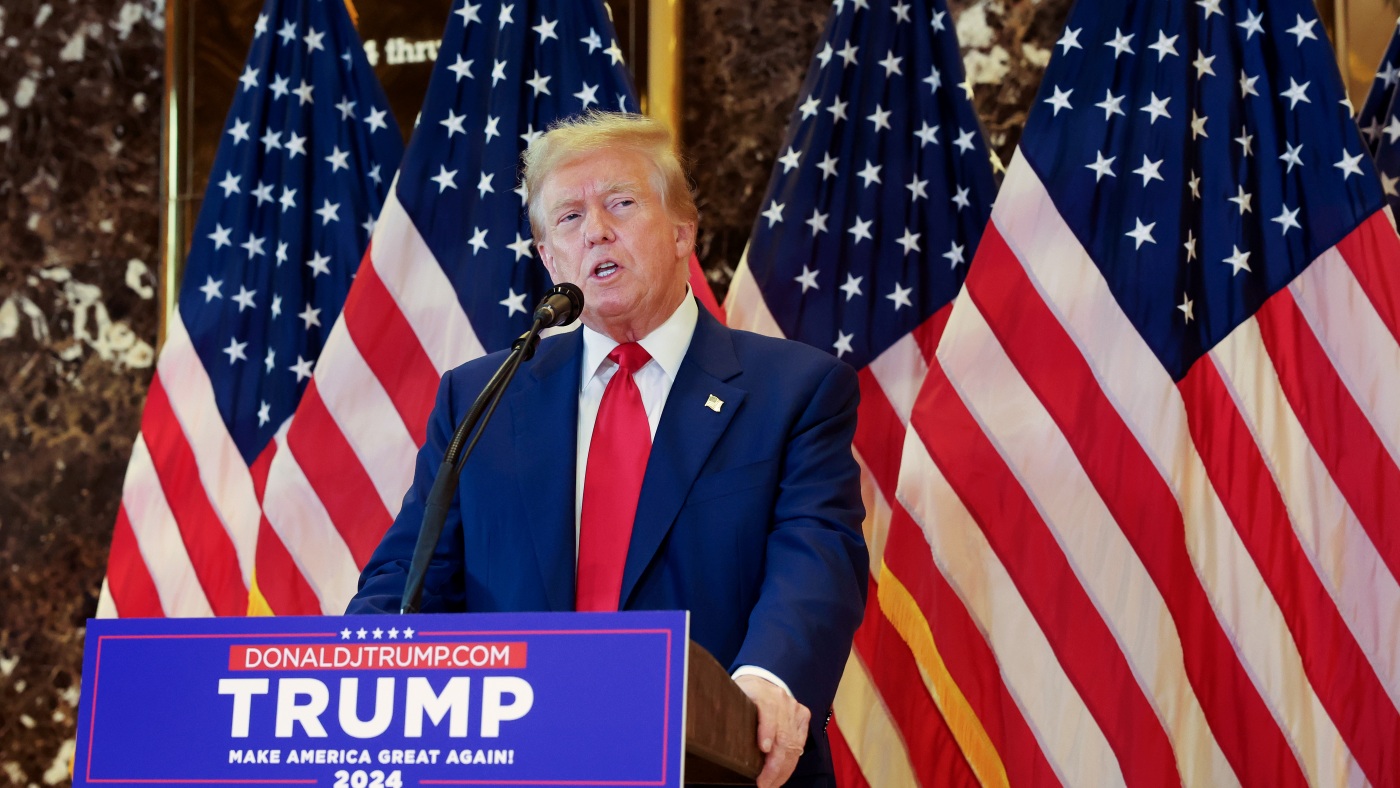
Donald Trump at Trump Tower on Friday responds to his 34-count conviction in the “hush money” trial.

Spencer Platt/Getty Images


hide caption

toggle caption

Advertisement

Spencer Platt/Getty Images

Former President Donald Trump stood in the lobby of Trump Tower in Midtown Manhattan Friday morning looking somehow ill at ease in his own building.

He wore his signature suit, shirt and tie and stood alone at a lectern with five American flags and a cold stone wall behind him. Gone was the usual human backdrop of flag-waving supporters seen at MAGA rallies. He stood alone, without script or teleprompter, armed only with two sheets of paper and a look of barely controlled rage.

It was billed as a press conference to respond to the jury verdict that had convicted him on 34 charges the day before. But it was more a speech than a press conference. A contingent of reporters with cameras stood a few yards away, but Trump spoke without interruption and took no questions.

Advertisement

Not far off, a small crowd of supporters including some family members applauded and cheered at intervals. Trump never quite settled on which group he was addressing, connecting only sporadically with the live TV broadcast camera. Some of the TV news channels eventually cut away while he rambled on for a total of 33 minutes.

It was the same location Trump spoke from nine years ago this month when he descended “the golden escalator” to the same lobby and announced his first campaign for the Republican nomination for president. The scene that day featured Melania and Ivanka Trump, both all in white, and a forest of cameras held aloft beneath Trump’s elevated stage. Everything about those theatrics described a different time in a different world.

Trump would recall that occasion on Friday when he almost immediately started attacking immigrants, as he had in 2015.

But first, he had to deal with the moment — and the reason he was here.

“This is a case where if they can do this to me, they can do this to anyone,” Trump said, referring to the prosecutors and Manhattan district attorney, Alvin Bragg. “These are bad people. These are in many cases, I believe, sick people.”

Advertisement

It was an echo of Trump’s frequent claim to his rally crowds that they and not him are the targets of all his legal woes and political adversaries.

But Trump reserved most of his vitriol for Judge Juan Merchan, who would not move the trial out of New York and denied most of the motions filed by Trump’s attorneys.

“We just went through one of many experiences where we had a conflicted judge, highly conflicted. There’s never been a more conflicted judge,” Trump said.

Trump has long tried to make an issue of Merchan’s total of $35 in contributions to Democrats in 2020 and the Democratic ties of the judge’s daughter. At Merchan’s request, both issues had been reviewed by the New York Advisory Committee on Judicial Ethics and his refusal to recuse was upheld on appeal.

But Trump was back at it on Friday, and the accusations of bias were just getting started.

Advertisement

“As far as the trial itself, it was very unfair,” said Trump. “We weren’t allowed to use our election expert under any circumstances.”

Merchan actually did allow that expert to testify with the stipulation that the prosecution could also bring in its own expert. At that point, Trump’s team decided not to call the witness.

“You saw what happened to some of the witnesses that were on our side, they were literally crucified by this man,” Trump said, again referring to the judge.

“He looks like an angel but he’s really a devil,” Trump said of Merchan. “He looks so nice and soft.”

Hearing Roy Cohn in Trump’s words

Former U.S. President Donald Trump speaks at a news conference at Trump Tower following the verdict in his hush-money trial at Trump Tower on May 31, 2024 in New York City. A New York jury found Trump guilty Thursday of all 34 charges of covering up a $130,000 hush money payment to adult film star Stormy Daniels to keep her story of their alleged affair from being published during the 2016 presidential election. Trump is the first former U.S. president to be convicted of crimes.

Former President Donald Trump speaks at a news conference at Trump Tower on Friday following the verdict in his hush-money trial in New York City.

Spencer Platt/Getty Images

Advertisement


hide caption

toggle caption

Spencer Platt/Getty Images

Advertisement

Trump’s weeks of vituperating Merchan recall the maxim he had received half a century ago from a lawyer named Roy Cohn, who was known for saying: “Don’t tell me what the law says, tell me who the judge is.”

Cohn had a career matched by few in the legal profession. The son of a judge, he graduated from both Columbia and Columbia Law School at the age of 20 and went to work for the Justice Department. He helped to convict Julius and Ethel Rosenberg of helping the Soviets steal nuclear secrets. FBI Director J. Edgar Hoover then recommended Cohn to Sen. Joseph McCarthy of Wisconsin, who hired him to help with his hunt for communists in the government.

Cohn went on to spend 30 years representing many of the biggest names in New York, including athletes, entertainers, a cardinal and organized crime bosses. In the 1970s he represented Trump’s family real estate business when it faced federal charges for racial discrimination.

Trump himself continued to rely on Cohn for years thereafter. Even after reaching the White House in 2017, he complained that none of his many lawyers fought for him like “my Roy Cohn.”

Trump’s well-worn playbook of false statements

Trump did not let his most recent court reversal take up all his on-camera time on Friday. With live TV coverage rolling, at least for a while, he veered off his latest court reversal to attack the man he wants to replace in the White House in November.

Advertisement

Calling Election Day Nov. 5 “the most important day in American history,” Trump blamed Biden for all his legal travails. He said the trial in New York had been orchestrated “in Washington” to protect the incumbent administration, which he called “a fascist state.”

Trump has made these accusations before, offering no form of evidence, as he again did not on Friday. But he used the allegation of Biden involvement to pivot to attacking Biden on immigration.

It was a kind of reprise of what might be called Trump’s greatest hit. In his speech in this same venue in 2015, he had stunned the political world with his language about immigrants at the U.S. border with Mexico: “They’re not sending their best … they’re bringing drugs, they’re rapists.”

Trump on Friday broadened his assault to include a number of other specific countries and nationalities sending “millions” who were “pouring in” unchallenged across “open borders.” He mentioned Congo in Africa and China in particular.

He said the prisons of Venezuela had been “emptied out” and that countries were sending people from their mental institutions.

Advertisement

He offered no evidence or sources for any of these statements.

And while some of his assertions took the form of casual, unproven superlatives such as “record numbers of terrorists” entering the country, some were downright false statements starkly at odds with the facts.

Early in his Friday remarks, when he criticized the Manhattan district attorney, he had said crime was “rampant” in the city and painted it in apocalyptic terms. Crime statistics in New York City are actually much lower today than in the 1990s, a decade in which Trump ally Rudy Giuliani was elected to his two terms as mayor. Shootings and homicides are down in particular in the past two years.

But this species of misstatement or disinformation has been part of the Trump arsenal for some time. He often raises rhetorical questions and makes sweeping statements that seem to have sprung from an alternative reality.

His talent for selling his own version of reality posed a challenge to the news media as far back as his years as the star of a TV “reality show” called The Apprentice. Trump was in the middle of his 14 seasons with the show when he began publicly questioning whether President Barack Obama had been born in the U.S.

Advertisement

It was just this kind of falsehood — picked up and promoted by countless commenters on cable TV, websites and social media — that made Trump a political force before he was an actual candidate. And when, in the fall campaign of 2016, he informed the world that he had himself laid to rest the “birther” issue (which he blamed on Hillary Clinton’s 2008 campaign), it forced many in the mainstream media to reexamine their longstanding aversion to the word “lie.”

By the end of Trump’s term in office, the news media had come to routinely label many of his claims as false — especially his denial of his defeat in the 2020 election. Some had also taken to labeling as lies the Trump statements they believed he had to know were false.

But Friday at Trump Tower was another reminder that as the November election gets closer and the political season comes to predominate, Trump can be expected to test and exceed the boundaries of fact and fiction one again.

Are we better prepared to deal with it this time?

Advertisement

News

Wheelchair curler Steve Emt’s path from drunk driver to three-time Paralympian

Published

on

Wheelchair curler Steve Emt’s path from drunk driver to three-time Paralympian

American Steve Emt competes in Sunday’s mixed doubles match against Italy, which the U.S. won.

Maja Hitij/Getty Images


hide caption

toggle caption

Advertisement

Maja Hitij/Getty Images

Anyone watching the Winter Paralympics has probably taken note of Steve Emt, who — along with Laura Dwyer — is representing Team USA in the Games’ first-ever mixed doubles event.

Their performance is one thing: The pair notched three dramatic, back-to-back wins in the round-robin tournament to reach the semifinals, marking the first time the U.S. has qualified for a medal round in wheelchair curling since the 2010 Paralympics.

After losing to Korea in the semifinals, Emt and Dwyer will face Latvia in the bronze medal match on Tuesday, in the hopes of winning the U.S. its first Paralympic medal in wheelchair curling.

Advertisement

But it’s their teamwork and attitude on ice that really set them apart. Emt, in particular, has charmed the internet, with his booming baritone delivering a steady stream of encouragement to his doubles partner and demands to the granite stones they’re sliding (“curl!” “sit!”).

“I have three older siblings. I was always on the basketball court getting beat up by them, so I had to assert myself on the court, around the kitchen table, everything,” he said when asked about his deep voice this week.

Steve Emt and Laura Dwyer celebrate during a match this week.

Steve Emt and Laura Dwyer have made sure to celebrate their wins, of which there have been many throughout this wheelchair curling mixed doubles round-robin tournament.

Maja Hitij/Getty Images


hide caption

Advertisement

toggle caption

Maja Hitij/Getty Images

While Emt, 56, is competing in a new event, he’s no stranger to the sport: The 10-time national champion and three-time Paralympian is the most decorated Paralympic curler in U.S. history.

But he didn’t know what curling was until he got recruited off the street just over a decade ago.

Advertisement

Emt, who is 6 feet, 5 inches tall, was enjoying a day in Cape Cod, Mass., in 2013 when a stranger with slicked-back hair approached and asked if he was local. Emt replied that he lived in Connecticut and suspiciously asked why.

“He said, ‘Well, I train with the Paralympic rowing team here in the Cape. I saw you pushing up the hill back there. With your build, I could make you an Olympian in a year,’” Emt recalled, referring to his wheelchair. “And I heard ‘Olympics,’ I’m like: Let’s go. What the hell is curling?”

After their conversation, Emt drove home and did some research, confirming that curling was not related to weightlifting, as he originally suspected.

“I went back two weeks later and I threw my first stone, and it just bit me,” he said.

Before long, Emt was making the two-and-a-half-hour drive to Massachusetts to spend the weekend training with that stranger-turned-coach, Tony Colacchio. He made the U.S. wheelchair curling team in 2014 and competed at his first world championship in 2015. Emt made his Paralympic debut in Pyeongchang in 2018, five years after that fateful encounter.

Advertisement

Emt, speaking to reporters in October, said the sport of curling has changed him as a person, mellowing him out. But the existence of the sport as a competitive outlet for athletes with disabilities changed his life.

Emt had been an all-star high school athlete, an Army West Point cadet and a UConn basketball walk-on before a drunk driving incident paralyzed him from the waist down at 25 years old.

“I’m a jock … I need to compete, and I didn’t have anything going on in my life,” Emt said. “Seventeen years after my crash, I had a hole, and then [Colacchio] came along and stalked me into the sport.”

By that point, Emt had spent years working as a middle school math teacher, a high school basketball coach and a motivational speaker. The latter has been his full-time job for almost a decade, taking him to over 100 schools across the country each year. He tells those teenagers about the chance Colacchio took on him, encouraging them to “be a Tony.”

“Go sit with that kid at lunch that’s sitting alone … smile [at] somebody in a hallway, get your heads out of your phones, get your heads out of the sand,” he continued. “We’re all going through something … and a simple ‘hello’ or ‘good morning,’ it could change their day. It could change somebody’s life.”

Advertisement

Why Emt now shares his story 

This is the third Paralympics for Emt, who is already eyeing Salt Lake City 20

This is the third Paralympics for Emt, who is already eyeing Salt Lake City 2034.

Mattia Ozbot/Getty Images


hide caption

toggle caption

Mattia Ozbot/Getty Images

Advertisement

Emt wasn’t always so willing to open up. For the first half a year after his 1995 crash, he told everyone a deer had run in front of his car rather than admit he had gotten behind the wheel drunk.

“I was lying to myself, I was lying to everybody around me,” he said. “I didn’t want kids to look at me in my hometown, in the state, and everyone around the country, as a drunk driver. I wanted them to look at me as a stud athlete and a great person.”

Emt had been a “stud athlete”: His talents in high school basketball, soccer and baseball made him a star in his hometown of Hebron, Conn., and earned him a spot on the basketball team at West Point.

But he dropped out two years later, after his father’s sudden death from a heart attack. He went home to Connecticut and eventually enrolled at UConn, where he walked on to its storied basketball team, joining future NBA greats like Donyell Marshall. Emt says, with a chuckle, that he had 38.7 seconds of playing time in his two years.

Advertisement

Emt was wearing his Big East championship jacket the night of his 1995 accident, which he says left him for dead on the side of the highway. When he woke up from a coma a few days later, he learned he would never walk again.

And he didn’t want to tell people why, until a newspaper reporter approached him six months later wanting to tell his story — and encouraged him to be honest. He said the opportunity to “come clean” helped him accept what he’d done and forgive himself.

“That’s my label: Yeah I’m a curler, yeah I’m a speaker, yeah I’m a drunk driver,” he said. “I’m in a wheelchair because of a drunk driving crash, and I want you to know it and I want you to learn from me.”

Emt first got into motivational speaking about eight months after his accident, and has been doing it ever since. He calls it his therapy.

He says that and curling — which is about shaking hands with competitors instead of smack-talking them — has helped him slow down and appreciate the little things. Relocating to Wisconsin and the chiller pace of Midwest life has also helped. And he says he cherishes the platform that curling has given him.

Advertisement

“I want people to know: ‘Hey, when you’re ready to talk, I’m here for you.’ This is what I do, from my speaking to my curling, whatever it is, there are so many opportunities to be successful again,” he said. “When you wake up and you’re told you’re never going to walk again, it’s like, what do I do now? … And I just want people to know that there are so many avenues out there, so many things to do.”

Emt, the oldest Paralympian on Team USA, originally aimed to make it to three Games. But he’s now eyeing even more, as he’d like to compete on home turf in Salt Lake City in 2034 (two Games away).

“I’m going to be like 90 years old competing at the Paralympics,” he laughed.

Continue Reading

News

Map: 2.3-Magnitude Earthquake Reported North of New York City

Published

on

Map: 2.3-Magnitude Earthquake Reported North of New York City

Note: Map shows the area with a shake intensity of 3 or greater, which U.S.G.S. defines as “weak,” though the earthquake may be felt outside the areas shown.  All times on the map are Eastern. The New York Times

A minor, 2.3-magnitude earthquake struck about 12 miles north of New York City on Tuesday, according to the United States Geological Survey.

The temblor happened at 10:17 a.m. Eastern in Sleepy Hollow, N.Y., data from the agency shows.

The Westchester County emergency services department said in a statement that it had not received any reports of damage.

As seismologists review available data, they may revise the earthquake’s reported magnitude. Additional information collected about the earthquake may also prompt U.S.G.S. scientists to update the shake-severity map.

Advertisement

Source: United States Geological Survey | Notes: Shaking categories are based on the Modified Mercalli Intensity scale. When aftershock data is available, the corresponding maps and charts include earthquakes within 100 miles and seven days of the initial quake. All times above are Eastern. Shake data is as of Tuesday, March 10 at 10:30 a.m. Eastern. Aftershocks data is as of Tuesday, March 10 at 2:18 p.m. Eastern.

Continue Reading

News

Ed Martin, outspoken Justice Department lawyer, is formally accused of ethical violations | CNN Politics

Published

on

Ed Martin, outspoken Justice Department lawyer, is formally accused of ethical violations | CNN Politics

Ed Martin, an outspoken Trump administration official, is facing attorney discipline proceedings in Washington, DC, for a letter he sent to Georgetown Law about its diversity programs, the district’s professional conduct investigator announced on Tuesday.

Martin is formally accused of violating his ethical codes as an attorney for telling Georgetown Law’s dean last year that his Justice Department office wouldn’t hire students because of the school’s diversity, inclusion and equity initiatives programs, according to the filing from Hamilton Fox, the disciplinary counsel for DC who acts as a quasi-prosecutor on attorney discipline matters.

Unlike unsolicited complaints, Fox’s formal disciplinary complaint kicks off professional conduct proceedings for Martin in which he will need to respond and could be sanctioned or ultimately lose his law license.

Fox’s announcement on Tuesday marks the first major bar discipline proceeding against a high-profile administration official or attorney supporting President Donald Trump during Trump’s second term. Several Trump lawyers faced disciplinary proceedings after the efforts to overturn Joe Biden’s victory in the 2020 presidential election, including Rudy Giuliani, who lost his law license.

“Acting in his official capacity and speaking on behalf of the government, he used coercion to punish or suppress a disfavored viewpoint, the teaching and promotion of ‘DEI,’” Fox wrote in the complaint. “He demanded that Georgetown Law relinquish its free speech and religious rights in order to continue to obtain a benefit, employment opportunities for its students.”

Advertisement

Martin was removed from the top prosecutor job in DC after senators made clear he would not be confirmed to the role, but has remained at the Justice Department in several roles, including as pardon attorney.

“Mr. Martin knew or should have known that, as a government official, his conduct violated the First and Fifth Amendments to the Constitution of the United States,” Fox wrote.

Martin is being represented by a Justice Department attorney, a source told CNN.

A spokesperson for DOJ attacked Fox’s complaint. “The DC bar’s attempt to target and punish those serving President Trump while refusing to investigate or act against actual ethical violations that were committed by Biden and Obama administration attorneys is a clear indication of this partisan organization’s agenda,” DOJ said.

Martin had sent the letter to Georgetown Law while serving temporarily as US attorney for DC, a prominent Justice Department position, and told the school his federal prosecutors’ office wouldn’t hire Georgetown’s law school students. It came at a time when the Trump administration was beginning to crack down on universities for their DEI efforts.

Advertisement

In his letter, Martin claimed a whistleblower told him that the school was teaching and promoting DEI.

Martin also violated attorney ethics rules by contacting judges of the DC court directly, Fox alleged, rather than going through official channels, once he was informed he was under investigation for his professional conduct. The DC Court of Appeals ultimately signs off on attorney discipline findings.

Early last year, Fox’s office had formally asked Martin to respond to a complaint it received by a retired judge regarding the Georgetown letter.

Martin instead wrote to the judges on the DC court complaining about Fox.

“In that letter, he stated that he would not be responding to Disciplinary Counsel’s inquiry, complained about Disciplinary Counsel’s ‘uneven behavior,’ and requested a ‘face-to-face meeting with all of you to discuss this matter and find a way forward,’” Fox wrote.

Advertisement

“He copied the White House Counsel ‘for informational purposes because of the importance of getting this issue addressed,’” Fox said.

The top judge in the DC courts told Martin the court wouldn’t meet with him about the disciplinary matter and that he would need to follow procedure.

With Fox’s complaint, there will now be several steps ahead of bar discipline authorities looking at Martin’s action, and Fox didn’t specify how Martin should be reprimanded or punished if the discipline boards and the court ultimately determine he violated his ethical codes.

Spokespeople for the Justice Department didn’t immediately respond to requests for comment on Tuesday morning.

In recent days, Attorney General Pam Bondi announced her office would have a more powerful role in reviewing attorney discipline complaints against Justice Department attorneys, potentially setting up an approach that could keep the department at odds with the bar on behalf of DOJ attorneys facing their own individual disciplinary proceedings.

Advertisement

CNN’s Paula Reid contributed to this report.

Continue Reading

Trending
