News
Trump’s Vision for D.C. ‘Garden of Heroes’ Statues Grows in Size and Cost


President Trump’s vision for his National Garden of American Heroes is growing larger and most likely more expensive than his initial estimates, with the latest plans calling for reflecting pools, dining facilities and an amphitheater alongside 250 life-size statues of notable Americans.
The plans have expanded to the point that they could require significant redevelopment of West Potomac Park, an area of mostly sports fields near the National Mall, according to documents obtained by The New York Times. The statues alone could cost more than the $40 million approved for the project by Congress, according to the Trump administration’s estimate.
Based on the latest renderings, the Garden of Heroes could rank among the more expensive and time-consuming projects Mr. Trump has undertaken as he works to remake the nation’s capital in his own style.
Construction has yet to begin, raising questions about whether Mr. Trump will run out of time — and money — to deliver on his ambitions before the end of his second term. If Mr. Trump were to solicit donor funds, as he has done with his ballroom project, it could renew ethical concerns about attempts to court favor with the White House.
The latest drawings depict a “Heroes Walk,” connecting themed areas dedicated to categories of American figures, including politicians, soldiers, scientists, activists, artists and athletes. The set of honorees is eclectic: George Washington, Ronald Reagan and Amelia Earhart are on a list circulated by the administration, along with Elvis Presley, Kobe Bryant, Alfred Hitchcock, Dr. Seuss and others.
Accompanying the statues would be formal gardens, reflecting pools and plazas arranged in a style reminiscent of classical European planning traditions, according to renderings reviewed by The Times. The Trump administration has yet to settle on a final plan or submit it to any oversight board.
One of the most prominent features in the plans would be a large amphitheater carved into the landscape at the water’s edge, suggesting the space is intended to function both as a performance venue and as a ceremonial gathering place.
The plans also include cafes and open recreational spaces.
“President Trump’s National Garden of American Heroes will be built to reflect the awesome splendor of our country’s timeless exceptionalism,” said Davis Ingle, a White House spokesman. “President Trump continues to beautify and honor our nation’s capital during America’s historic semiquincentennial celebration.”
Proposed in his first term, Mr. Trump initially hoped to have the project completed by July 4 of this year, the 250th anniversary of American independence. But administration officials are now hoping to have a few dozen statues ready to unveil in time, with the remainder of the project to be completed by the end of Mr. Trump’s term.
Sanitizing History
Mr. Trump first proposed a Garden of Heroes during his first term, at a time of widespread protesting over the murder of George Floyd in police custody. Protesters had toppled statues of Confederate generals and leaders, and in some instances vandalized monuments to national icons like George Washington and Abraham Lincoln.
Mr. Trump denounced those actions as attempts to “erase our values” and he signed an executive order authorizing the monument garden. The election of Joseph R. Biden Jr. as president interrupted those plans, but since Mr. Trump took office for a second time, he has taken the project up again in earnest.
Paul M. Farber, the director of Monument Lab, a nonprofit public art, history and design studio based in Philadelphia, noted that the description of the historical figures being honored portrays a sanitized version of American history.
Mr. Trump’s executive order detailed most of the figures to be featured with statues, and a White House task force overseeing festivities for the country’s 250th anniversary also published a list, with biographies of those selected.
The description of Martin Luther King Jr., for instance, praises the civil rights leader for having a “can-do” spirit, but makes no direct mention of the racism that he fought.
“To not name the injustice that made people ‘significant Americans’ is a sanitizing of the history,” Mr. Farber said. “Whether it’s Ida B. Wells-Barnett or Frederick Douglass, when you look at the fine print, you understand the Faustian bargain here, which is representation at the cost of real history.”
Under the “journalists” category, there are two honorees: Edward R. Murrow of CBS, and Alex Trebek, who hosted the game show “Jeopardy!”
The National Endowment for the Humanities has solicited “preliminary concepts” for individual statues from artists who must be American citizens. Mr. Trump has directed that subjects be depicted in a “realistic” manner, with no modernist or abstract designs allowed.
Artists who are selected will receive awards of up to $200,000 per statue, which must be made of marble, granite, bronze, copper or brass. (That price is a relative bargain. Outdoor public sculptures can cost roughly $1 million each to produce in cities like New York.)
Still — even if the statues cost $200,000 each, for a total of $50 million — there is not enough money appropriated by Congress to pay for them. And then there is the matter of the redevelopment of the land, the reflecting pools and all the rest in the latest plan.
Hurdles Ahead
Since the start of his second term, Mr. Trump has embarked on what he has characterized as an effort to beautify the nation’s capital. He has run into hurdles.
The president is in the midst of a legal battle over whether he can unilaterally build a $400 million ballroom at the White House with donor funds, after he abruptly demolished the historic East Wing. He is also in court fighting to close the John F. Kennedy Center for the Performing Arts, which he has renamed the Trump-Kennedy Center, for a major renovation. He has proposed building a 250-foot triumphal arch near Washington’s border with Arlington, Va. Next to his proposed garden is a golf course that Mr. Trump wants to make into a luxury destination.
His plans for the Garden of Heroes have yet to go before any review panel.
Should Mr. Trump leave office without finishing his signature projects, the next administration would be faced with choices about whether to finish them or abandon them.
It’s an issue other countries have faced as well, said Ken Lum, a sculptor, professor and Chair of Fine Arts at the University of Pennsylvania Stuart Weitzman School of Design.
“I don’t think it’s like the Sagrada Familia in Barcelona, where it was this great project of Gaudi and people said, ‘No, we must finish this,’” Mr. Lum said. “I think there’s going to be a lot of debate in terms of, ‘We don’t need to finish this. Maybe we should even take it down.’”
Mr. Trump has tapped several people closely associated with the National Civic Art Society, a nonprofit that endorses traditional styles of architecture, to oversee the Garden of Heroes, according to three people close to the project.
The garden would most likely need to overcome some legal hurdles, including the possible need for exemption under the Commemorative Works Act, which restricts what can be built around some federal lands in Washington. The site’s proximity to the Potomac also could introduce concerns about ecological disruption.
Mr. Trump appears to have left himself room to make five last-minute nominations; there are only 245 people on a list the administration distributed. The White House did not reply to questions about whom he would choose to fill extra slots.
In an interview with The New York Times in January, Mr. Trump described his plans for the Garden of Heroes as “beautiful.”
“That’s going to be most likely right on the Potomac River,” he said, adding: “It’s going to be a beautiful complex. You’re going to have the hall of — you know, it’s — we’ll call it a hall. We call it a lot of things, but the memorials or statues are going to — it’s going to be beautiful.”



News
Newsom’s office responds to SCOTUS ruling on women’s sports as California faces ongoing trans athlete wave

Linda McMahon slams Democrats for dismissing women’s sports concerns
Education Secretary Linda McMahon discusses the Supreme Court’s ruling upholding transgender sports bans, emphasizing the need to protect women’s sports. McMahon highlights the impact on female athletes, addressing concerns about fairness, lost opportunities, and safety in locker rooms. She criticizes Democrats for their dismissal of these issues, reaffirming the Trump administration’s commitment to defending women’s rights under Title IX.
California Gov. Gavin Newsom’s office has responded after the U.S. Supreme Court made a historic ruling on trans athletes in women’s sports on Tuesday.
The court ruled 6-3 to uphold state laws that protect women’s sports from biological male trans athletes. California is one of 23 states in the country that don’t have laws to protect women’s sports, and since 2014, has had a law in place to protect the rights of males to compete against females.
A spokesperson for Newsom’s office said the Supreme Court ruling will not impact California’s current setup.
SUPREME COURT MAKES RULING ON TRANS ATHLETES IN WOMEN’S SPORTS
California Gov. Gavin Newsom speaks during a press conference in Hayward, California, on March 2, where he criticized President Donald Trump’s decision to strike Iran. (Tayfun Coskun/Anadolu via Getty Images)
“The Supreme Court’s decision does not affect California’s laws. The state remains committed to ensuring every Californian, including the LGBTQ community, is met with dignity and respect,” the spokesperson told Fox News Digital.
A source within Newsom’s office provided Fox News Digital a bulleted list titled “As a Governor, Governor Newsom has the strongest record in the country on protecting and expanding transgender rights.”
The list included several bragging points, including “making it easier to update gender markers on official documents,” and “appointed multiple trans judges.”
The list concludes by pointing out, “California is one of 22 states that have laws requiring transgender students to participate in sports consistent with their gender identity. California passed this law in 2013 (AB 1266) and it was signed into law by Governor Jerry Brown.”
Newsom’s state was ravaged by a trans athlete national media crisis in May, for the second year in a row and third time in total in one year, as prominent trans athlete AB Hernandez competed in girls’ sports.
Hernandez won two track and field state titles for the second straight year. Ahead of the first round of the state tournament in early May, “Save Girls Sports” protesters led by former NCAA women’s soccer player Sophia Lorey scheduled a press conference near the competition grounds.
AB HERNANDEZ ADVANCES IN CALIFORNIA STATE CHAMPIONSHIP AS SAVE GIRLS’ SPORTS ACTIVISTS RALLY NEARBY
A source within Newsom’s office previously addressed the press conference in the days leading up to the event in a statement provided to Fox News Digital, prompting controversy and criticism from locals.
“The Governor has said discussions on this issue should be guided by fairness, dignity, and respect. He rejects the right wing’s cynical attempt to weaponize this debate as an excuse to vilify individual kids. The Governor’s position is simple: stand with all kids and stand up to bullies,” the statement read.
The governor faced mass backlash from activists across the country for his office’s statement. The controversy only exploded the very next week when it was revealed the California Interscholastic Federation (CIF) re-implemented a pilot program that bumped every girl who finished behind the trans athlete up by one spot on the podium. The change resulted in now-infamous imagery of Hernandez sharing podium spots with the female second-place finishers.
President Donald Trump’s Department of Justice is engaged in Title IX lawsuits against education agencies in California for its policies that allow trans athletes in girls’ high school sports. The lawsuit was officially launched in July after Hernandez won two state finals in triple jump and high jump, and won second place in long jump, at last year’s championships.
Newsom previously declared that he believed males competing in girls’ sports is “deeply unfair” during an episode of his podcast with the late Charlie Kirk in March 2025.
Then in July 2025, Newsom spoke about the issue in an interview on the “Shawn Ryan Show” saying he has been “amazingly frustrated by it” and that he regularly encounters parents who are angry about the state’s policies at his children’s soccer games.
“Every parent coming up says, ‘It’s so unfair.’ Like ‘Whoa,’ like everywhere I went, progressively-minded people, not bigots, that are champions of trans policy like I am, but didn’t like the sports. They were like ‘come on man, you got to figure this out,’” Newsom said.
Newsom added that his allies in the LGBTQ caucus were “furious” with him after he made his initial comments in March while speaking to Kirk, and even recalled an alleged conversation with President Donald Trump about it.
CLICK HERE TO DOWNLOAD THE FOX NEWS APP
“Trump is having the time of his life, and I assure you he is because we’ve had conversations on this topic,” Newsom said.
“And now he’s suing and threatening us, and they’re just, and you know, I’m the poster child,” Newsom added. “But I do think we have to address that issue.”

Why are there so many Greeks in Tarpon Springs, Fla.? Because in the early 1900s, Greek sponge divers came from the Dodecanese islands and revolutionized the sponge industry on Florida’s gulf coast.
What explains the pockets of Portuguese and Cape Verdeans in New Bedford, Mass.? In the 1800s, winds pushed whaling boats east to the Azores and Cape Verde, where experienced whalers joined the crews.
There’s the Basque population in Boise, Idaho, whose ancestors traded a mountainous region between France and Spain for the American West in the hopes of finding gold but later turned to sheep herding. There are the families of Yemeni immigrants hired by Ford Motor Company to build cars in Detroit, and the Vietnamese refugees who were resettled near New Orleans and Houston, where they could carry on shrimping.
These stories are everywhere on this map of American ancestry, which shows how people described their backgrounds to the Census Bureau. There are nearly 200 unique identities represented; blend them — as 340 million Americans do — and we arrive at a jumbled, overlapping, story-filled infinity.
Much of what we see is a history of immigration. Over 250 years, the country has absorbed more than 100 million people. We can trace the pressures that pushed and pulled them here — and the policies that welcomed certain groups while keeping others out — through the patterns in where their descendants live today.
Now, a larger share of the country was born abroad than ever before, and the Trump administration’s sweeping immigration bans echo exclusionist policies enacted in response to similar demographic conditions a century ago.
Those policies defined Americans for generations. Recent efforts to limit immigration will likewise affect how future Americans understand their heritage and themselves.
How we got here
In the late 1700s, the area that would become the present-day United States was already diverse. At least 1.5 million Native people, and possibly many more, were living across the territory. They were joined by about three million Europeans and enslaved Africans living in both the English colonies and the French and Spanish territories.
From colonial times, immigration was an important contributor to population growth. It accelerated as the new country’s territory expanded west and immigrants arrived to settle it. From 1820 to 1860, more than five million people came, through a mostly open door.
With the advent of the steamship, the cost of passage plummeted, and companies offered special immigrant fares that were often coupled with rail tickets to the interior of the country. Once a community of immigrants was established somewhere, it tended to grow.
After 1840, immigration from Western Europe began to rise quickly as political instability in Germany and the famine in Ireland drove people to leave. Asian immigrants, drawn by the discovery of gold in California in 1848, were recruited to work on farms and railroads.
Later in the 19th century, pogroms across Eastern Europe and the aftermath of Italian reunification drove a surge of migration to the United States. From 1880 to 1920, 24 million immigrants arrived. They went almost everywhere except the South, where the land-owning elite already had cheap labor from the formerly enslaved and poor tenant farmers.
Cities swelled. In 1910, according to the Ellis Island National Museum of Immigration, three-quarters of the residents of Boston, Chicago, Cleveland, Detroit and New York City were immigrants or children of immigrants.
1850
2 million total immigrants
The 1850 census did not include data on the birthplace of enslaved people.
1910
14 million total immigrants
1970
9 million total immigrants
2024
50 million total immigrants
Many rural areas in the Midwest had a similar share of immigrants in 1910, but newcomers to the cities tended to be from novel sources like Russia or Italy. That meant there were more languages, more cuisines and more workers. It also meant there were more crowds, more slums and more people behaving in unfamiliar ways — fodder to drive views that the new immigrants were unassimilable and that policies were needed to keep them out.
The first federal law to severely limit immigration had come much earlier, in 1882, when practically all Chinese people were barred from entering the country. More restrictions followed, and eventually animosity toward new immigrants led to the passage of laws in the 1920s creating a quota system tied to nationality.
Western Europeans were given generous quotas and Southern and Eastern Europeans much smaller ones. For the rest of the Eastern Hemisphere, the quotas were set to almost nothing. Ships raced through the night to reach New York Harbor, all trying to be first to dock at Ellis Island.
There weren’t quotas for countries in the Americas and the Caribbean, but there were other restrictions. Mexicans faced mass deportation campaigns in the 1930s and 1950s, even as millions were recruited as temporary workers to fill agricultural jobs across the Southwest.
Over the next 40 years, these rules drove the foreign-born population in the United States to its lowest levels. Children of immigrants replaced immigrants, blending into American society while retaining their own cultural traditions.
Then, alongside the civil rights movement of the 1960s, activists and lawmakers who saw the national quota system as racist pushed to replace it with one based on employment and family ties.
Another decades-long wave of immigration followed, this time from different parts of the world.
Chart data is unavailable.
Share of immigrants in the United States by region of birth
The new rules allowed people to sponsor their family members and relatives, and they gave preference to workers with advanced degrees and specialized skills. The family visas, in particular, led to an unforeseen boom in immigration.
An expanded refugee program also brought more immigrants, many from Southeast Asia who were displaced by Cold War conflicts.
For the first time, immigrants from the Western Hemisphere faced limits on their numbers. Similar to the European workers who arrived earlier in the century, many chose to settle in the United States permanently instead of risking returning to their home countries between periods of working in the United States. Millions who couldn’t get visas turned to entering illegally.
The most recent immigration wave, during the Biden administration, was different still: The number of visas for immigrants remained steady, while migrants from Central America arrived at the southwest border in large numbers to seek asylum. Desperate conditions in Cuba, Haiti and Venezuela, as well as wars in Afghanistan, Ukraine and elsewhere led hundreds of thousands of people to flee to the United States — many of them drawn to established communities of immigrants from their countries.
Where we are today
The lines of American ancestry today are not neatly drawn, and groups overlap and spill into one another. Some people don’t answer the census questions about their origins at all. For others, it’s complicated. Descendents of enslaved people, for example, may identify themselves as African American because they are unable to trace their roots to a specific place.
Many areas have truly mixed populations, with people of several different ancestries nearly equally represented.
Take this area just southwest of Houston, for example:
Nigerian, Jordanian, Mexican, Vietnamese, African American, Salvadoran, Iraqi, German, English, Irish and Chinese people are all among the top groups in these neighborhoods.
Every city has its own distinct pattern, visualized in the the patchwork of gold, green and blue in Los Angeles, the stark reds, blues and yellows of Chicago, a purple Minneapolis, a green Honolulu:
Who comes next?
If the patterns in these maps reflect the immigration policies of at least a century ago, we can expect them to shift and change again as a result of contemporary decisions about who makes up the American mosaic.
No comprehensive immigration legislation has passed Congress since the 1980s. After a surge of immigration during the Biden administration, in which an estimated eight million people entered the country over three years, demographic experts now estimate that the United States could reach net-zero or negative immigration sometime soon. That is in part because of the Trump administration’s aggressive actions to speed deportations of people who are in the country illegally and to limit pathways to legal immigration.
At the same time, the factors that pull immigrants to the United States remain strong. And, unlike 100 years ago, the country now faces a declining population and work force. The tension between the need for new workers and resurgent nativist politics will influence who comes, who settles and who is counted among the ancestors of future generations.
About the data
The ancestry maps in this article and the related interactive map draw from seven tables of race, ethnicity and ancestry data that the Census Bureau published as part of the American Community Survey estimates for 2019-2024.
The census ancestry and origin data are estimates based on a sample of the population and include margins of error that can be large for small population groups. We used the estimates published by the Census Bureau without adjustment.
In the survey, respondents are asked questions about their race and whether they are of Hispanic or Latino origin. Each of those questions allows respondents to list their national origins. An additional question asks about their ancestries. People can claim multiple ancestries or origins and appear in multiple categories.
Some groups appear in multiple tables. For example, people can select “white” as their race and list “German” as a specific origin. Separately, anyone can also choose “German” in response to the survey’s ancestry question. For such groups, we used the table with the higher value for the country as a whole. In a small number of cases, similar ancestries were grouped together.
Colors for each census tract are blended based on the adjusted number of people who reported being of each race and ancestry in the tract, for each group above a minimum threshold.
In charts of the immigrant population, counts come from Census Bureau research publications, the 2000 census and the American Community Survey. Those counts include only foreign-born residents and exclude any descendants born in the United States.

Former Federal Election Commission Chairman Trevor Potter testifies during a Senate Rules and Administration Committee hearing on artificial intelligence and the future of elections on Capitol Hill in Washington, D.C., Sept. 27, 2023.
Drew Angerer/Getty Images
hide caption
toggle caption
Drew Angerer/Getty Images
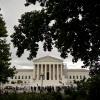
The Supreme Court struck down limits on how much political parties can spend in coordination with their candidates in a 6-3 decision split along ideological lines. The ruling is the latest in a series of Supreme Court decisions that have loosened campaign finance restrictions, overturning a 2001 precedent that upheld the spending limits.
Former Federal Election Commission Chairman Trevor Potter, who now serves as president of the Campaign Legal Center, joined NPR’s Morning Edition to break down the ruling. Speaking to NPR’s Michel Martin, Potter discussed why the court reversed its earlier precedent, how the ruling changes campaign finance rules and whether greater transparency could address concerns about corruption.
Listen to the full interview by clicking on the blue play button above. And read takeaways from the conversation below.
The post-Watergate limits were meant to prevent corruption
Potter said they were designed to stop donors from routing large contributions through national party committees to directly fund a favored candidate’s campaign. The restrictions were intended to prevent “an obvious way around” campaign contribution limits.
The court previously upheld the same limits
Asked why the Supreme Court upheld the law about 20 years ago, Potter said the justices concluded the restrictions were a constitutional way to prevent corruption. He said the court viewed them as an “anti-circumvention measure” to stop donors from using political parties to bypass contribution limits.
Potter rejects the majority’s rationale
Potter rejected the majority’s view that political parties have less political power than outside groups, saying earlier Supreme Court decisions allowing unlimited outside spending created that imbalance. He pointed to Justice Elena Kagan’s dissent in support of that argument.
Disclosure wouldn’t necessarily reveal private fundraising arrangements
Potter said disclosure alone would not address his concerns because it cannot reveal private agreements between candidates and donors. While campaign donations to political parties are public, he said voters would not see behind-the-scenes requests from candidates asking donors to contribute to party committees that later support their campaigns.
“We’re never going to see that,” Potter said. “I don’t think there’s a way to practically disclose those backroom deals.”
This interview was written for the web by Majd Al-Waheidi and edited by Treye Green.
-
Montana52 seconds ago
Montana weather: Thunderstorms likely, temps rising to 80s — July 2, 2026
-

 Nebraska8 minutes ago
Discounted tickets for Nebraska State Fair over 4th of July Weekend
-

 Nevada11 minutes ago
Additional mosquito pools test positive for West Nile virus in Clark County
-

 New Hampshire16 minutes ago
‘Rugged’ Yurt-Shaped Cabin Perched on 6 Lush Acres in New Hampshire Is Listed for Just $300K
-

 New Jersey23 minutes ago
Independence Day surprise: New Jersey’s costly new data broker law | IAPP
-

 New Mexico26 minutes ago
Here were New Mexico State’s best moments in the WAC
-

 North Carolina31 minutes ago
North Carolina Football Top 30 Players Countdown: No. 22
-

 North Dakota38 minutes ago
North Dakota offers wellness grants to rural hosptials


