Alaska
As war stalls, Putin concedes he never cut a deal with Trump in Alaska


For months, high-ranking Russian officials insisted that a path to ending the war in Ukraine – largely on Moscow’s maximalist terms – had been decided at a meeting between President Vladimir Putin and President Donald Trump last August in Anchorage. Only Ukraine’s intransigence stood as an obstacle.
But that narrative has unraveled – perhaps because the only way to get the United States to help broker a new deal is admitting there never was a previous one.
In recent days, three top Russian officials accused the White House of not honoring the Alaska agreement. Foreign Minister Sergei Lavrov even speculated that the summit was a U.S. “ploy to buy time to rearm the Kyiv regime.”
Secretary of State Marco Rubio, however, pushed back. “If there had been an agreement, we would have had an end of the war,” Rubio told reporters.
“Russia wants the entirety of Donetsk to be turned over to them, among some other things,” he said, explaining Russia’s demand for more Ukrainian territory.
After days of back-and-forth, Putin conceded the point, saying on Sunday that “there were indeed no agreements reached in Anchorage.”
“The spirit of Anchorage – although it wasn’t expressed in any formal documents, and no one put any signatures down – in Anchorage we discussed certain possibilities for ending the crisis in Ukraine,” Putin told a state television reporter Sunday. “And the compromises discussed were precisely the proposals the American side made to us.”
The contradictions started in Alaska immediately after the summit. Putin said an agreement that will “pave the path toward peace in Ukraine” was reached, while Trump said that while the meeting was “extremely productive … there’s no deal until there’s a deal.” Trump also told Fox News afterward that it was “up to Zelensky” now to get a deal done, referring to Ukrainian President Volodymyr Zelensky.

The Russian leader’s decision now effectively to bury the Alaska summit, which the Kremlin and its propagandists had mythologized as a turning point, comes as Russian forces are largely stalled on the battlefield in Ukraine – a sharp change from the previous four summers when they made gains.
Instead, the skies over Russia and the Ukrainian territory it occupies are increasingly crowded with advanced Ukrainian drones, signaling a new phase in which Russia is playing technological catch-up and regular Russian citizens are feeling the war intrude on their lives with gasoline shortages and disruptions to summer travel, including to occupied Crimea.
Russian political analysts have interpreted the indirect spat between Rubio and Lavrov over the alleged deal as a sign that Ukraine has convinced Trump it can keep fighting – and that it can pose a serious threat to Crimea, which Russia illegally annexed in 2014, rather than surrendering the Donbas region, as Russia has demanded.
Trump probably arrived in Anchorage believing that Ukraine’s defeat was inevitable and that the sooner it accepted terms, the better for everyone, Fyodor Lukyanov, a prominent foreign policy analyst who advises the Kremlin, wrote in an op-ed in a Russian publication.
“The goal of Kyiv and the collective Brussels was to convince Trump that the belief in Ukraine’s inevitable defeat was mistaken,” Lukyanov wrote. “Ten months after the Anchorage summit, they succeeded in persuading him.”
Since Alaska, no major breakthrough has materialized in Russia’s favor, Europe so far has managed to sustain its military and economic aid to Ukraine, and Trump has become distracted by Iran.
“Diplomacy in the midst of hostilities is shaped by their outcome,” Lukyanov wrote. “If the balance of power – or the perception thereof – shifts, the understandings reached at an earlier stage lose their validity.”
Ukraine’s push to impose a “logistical lockdown” on Crimea and Kyiv’s growing capability to strike deep inside Russia seem to be part of a 40-day blitz declared by Zelensky to “influence” Moscow to end the war.
Continuing that pressure, Ukraine overnight launched dozens of drones at the Moscow region and struck Russia’s Dubna satellite communications center north of the capital. Zelensky said Russia uses the Dubna site for reconnaissance and coordination of its military activities in Ukraine.
Andrei Vorobyov, governor of the Moscow region, confirmed the attack had occurred but said that an “administrative building was damaged by drone debris.”
Amid chaotic scenes in Crimea, the Russia-installed authorities imposed a state of emergency in response to strikes on highways and bridges. There have also been blackouts that have prompted many summer visitors to return home.
“He’s holding his own at least,” Trump said of Zelensky last week, speaking to reporters at the White House. “A lot of people dying on both sides, but I think he’s doing pretty well. You have to say he’s courageous, he’s got great equipment, he’s got great men, he’s got fighters.”
Ukraine seems to have scaled drone production to a level that can sustain strikes on Russian cities hundreds of miles from the border and that keeps the frontline kill zone stable. This means that ground action is drying up.
“The war has markedly changed this year,” said Ruslan Leviev, an analyst with the Conflict Intelligence Team, a group that uses open-source data to track the Russian military.
“It’s hard to say the battle initiative is on the Ukrainian side,” Leviev said, “but time is on Ukraine’s side – more problems keep arising for Russia, economically, politically and militarily, and it’s all adding up.”
Russian budget data indicates that its military recruited 71,216 men during the first quarter of 2026, compared with 89,601 over the same period last year, according to Janis Kluge, a Russia expert at the Berlin-based German Institute for International and Security Affairs.
Recruitment stabilized somewhat in the second quarter, returning to around 30,000 contracts per month. But local media reports suggest the overall stream of recruits has slowed compared with previous years as the pool of men drawn by the enormous pay packages that eclipse regional Russian salaries appears to be shrinking.
Rumors have circulated that Russia may declare a fresh mobilization after key parliamentary elections in the fall – the first since the war began – but politically that move could prove extremely costly for the Kremlin. The “partial mobilization” in 2022 drove tens of thousands of men to flee Russia. After four years of war, and mounting economic strain, the mood has soured considerably.
Leviev and other analysts said that they doubt Moscow would call for full mobilization, since this would require significant financial resources to set up new formations, and train and equip them, and that such a move fundamentally wouldn’t unfreeze the line of contact. “At this pace, the war on the ground looks to us as a dead end,” Leviev said.
This poses several challenges for Russia.
Russia still holds an advantage in manpower, conventional arms and ballistic missiles, which it continues to use against Ukrainian cities and infrastructure. But Ukraine’s relentless drone campaign, especially its use of medium-range drones, has chipped away at this advantage, complicating frontline logistics and driving up the costs for Moscow of supplying the front.
Russia’s flagship air defense systems were designed for high-altitude targets like jets and ballistic missiles, not slow, low-flying drones. Interceptor missiles also cost many times more than the drones they shoot down, draining stocks at a rate Western officials have said may be unsustainable.
In his remarks Sunday, Putin commented on the deteriorating situation in Crimea and the wider fuel shortage in Russia after weeks of silence.
Addressing Ukraine’s drone campaign, Putin said that Russia needed to “significantly ramp up production of air defense systems.” He also pledged to ensure the supply of fuel to Crimea by land and sea but did not say how this would be accomplished.
Putin also asserted that Kyiv had put forward what he called “new proposals” to curtail hostilities in four regions of eastern Ukraine – Kherson, Zaporizhzhia, Donetsk and Luhansk – and agree to mutually halt long-range strikes.
Putin, however, cast the offer as a distraction that would allow Ukraine to redeploy units from other regions to these four areas, relieving pressure along the nearly 800-mile frontline. He reiterated that Moscow aims to fight on.
“We have some certainty regarding the challenges facing Putin, but what we can expect from him in response to these challenges remains unclear,” said Vladimir Pastukhov, a Russian political scientist and honorary senior research fellow at University College London.
According to Pastukhov, Putin has several options to escalate the war, all fraught with risk. These include an attack on a NATO nation in the Baltics, the detonation of a tactical nuclear weapon in Ukraine or a mass mobilization of Russian soldiers. Moscow could also adopt a hybrid strategy, potentially striking European military facilities supporting Ukraine.
That would effectively be a limited, undeclared war on Europe, testing Trump’s loyalty to NATO allies.
Putin could also pressure its ally Belarus to allow Russian forces to attack Ukraine from its territory, opening a new northern front.
Putin on Sunday said Russia was expecting a resumption of U.S.-led peace talks and a visit to Moscow by U.S. envoys Steve Witkoff and Jared Kushner – once the “hot phase” of the Iran war is resolved.
Lukyanov, the analyst, said Russia believes that Trump’s position on the war in Ukraine will shift again – as it has many times. “But first,” he wrote, “the White House must be brought to the understanding that a military victory for Russia’s adversaries is impossible.”



Alaska
Man with same name as Alaska Sen. Dan Sullivan can appear on GOP primary ballot, state’s Supreme Court rules

The battle of the Dan Sullivans is on.
The Alaska Supreme Court ruled Monday that a man with the same name as Republican Sen. Dan Sullivan can challenge the sitting lawmaker in the state’s GOP Senate primary in August. The high court upheld a ruling from a lower court judge that cleared the way for Daniel J. Sullivan to appear on the primary ballot, reversing a decision by state officials earlier this month that he was ineligible because he was allegedly trying to confuse voters.
The state Supreme Court directed Alaska’s Division of Elections to decide how Daniel J. Sullivan should be listed on the ballot “within the confines of existing Alaska ballot design law.”
The conflict is taking place in one of the country’s most closely watched Senate elections. The sitting Sen. Sullivan is running for a third term, but former Democratic Rep. Mary Peltola is vying to challenge him, setting up what could be an unusually competitive race in a deep-red state that hasn’t elected a Democrat to the Senate in almost 20 years.
The senator has called his same-name competitor a “sham candidate” and accused him of trying to trick voters and help Democrats flip the seat. Daniel J. Sullivan — a retired teacher and former U.S. Forest Service employee from Petersburg, Alaska — has denied those allegations and insisted he is both qualified and genuinely interested in running for Senate.
About two weeks ago, the Alaska Division of Elections determined that the challenger Sullivan could not appear on the ballot, arguing his paperwork “was not filed in order to declare an actual good-faith candidacy, but was instead filed with a purpose to confuse or mislead.”
In a letter to the candidate, Director Carol Beecher pointed to the fact that Daniel J. Sullivan had initially requested to appear on the ballot as “Dan Sullivan,” the same name format as the senator. She also wrote that he hadn’t previously been affiliated with the state Republican Party, had a website design that “appears to be deliberate[ly]” similar to the senator’s campaign site and had worked with a political consultant with links to Democratic candidates.
Daniel J. Sullivan asked a state court to reverse the decision. On Friday, Judge Thomas Matthews ruled in his favor, finding the non-senator Sullivan met the requirements to run for U.S. Senate and the state didn’t have the authority to exclude him based on “good faith.”
“The court does not minimize the Division’s concern that voters should not be misled,” the judge wrote. But he added that “Alaska election law gives the Division tools to address that concern,” including regulating how candidates appear on the ballot.
With ballots set to be printed this week, the issue was appealed to the Alaska Supreme Court on an expedited basis, with both sides filing court papers over the weekend.
The state Division of Elections asked the high court to overturn Matthews’ ruling, arguing it would “leave Alaska constitutionally required to permit bad-faith ballot access.” The agency said it reached its conclusion about Daniel J. Sullivan after it received a complaint from the National Republican Senatorial Committee “credibly alleging” he was seeking to “cause voter confusion” and made a “bewildering” request to appear on the ballot with the senator’s middle initial.
If Daniel J. Sullivan is permitted to remain on the ballot, the state asked the Alaska Supreme Court to allow it to print his full name and list his party affiliation as “nonpartisan” to “ensure voters are not forced to guess between two nearly identical names.”
The Alaska Republican Party and several GOP-led states filed amicus briefs siding with Alaska.
Daniel J. Sullivan’s lawyers, meanwhile, argued the state “lacked any basis in Alaska law to exclude Mr. Sullivan from the ballot” and didn’t have the power to look into his “private motivations.” They wrote that state law doesn’t give officials the power to keep qualified candidates off the ballot due to potential confusion.
“[All] that Mr. Sullivan asks here is to be listed on the ballot, and the Division is obviously empowered to do so in a non-confusing manner,” his lawyers wrote.
Following oral arguments, the high court sided with Daniel J. Sullivan in a two-page order late Monday, and said it would issue a fuller opinion at a later date.
Jeffrey Robinson, an attorney for Daniel J. Sullivan, told CBS News his legal team is “grateful” for the Alaska Supreme Court’s decision to “affirm Judge Matthews’ well-reasoned, thorough order vacating the Division’s unlawful decision to exclude Mr. Sullivan as a candidate.”
“We expect that the Division will act in full compliance with existing Alaska ballot design law in its preparation of the ballots,” Robinson said in an email.
The senator’s campaign spokesperson, Nate Adams, said: “We’re disappointed in the court’s decision because as the sham candidate Dan J. Sullivan’s lawyers made clear in their legal arguments, the only reason he is running is to deceive voters and manipulate Alaska’s election system.”
“However, we are encouraged by the fact that the Director of the Division of Elections will be able to use her expertise to differentiate between the Petersburg fraud and the incumbent — Senator Dan Sullivan — to the benefit of Alaska voters,” Adams said.

The first Jesuit missionaries in Alaska sailed up the Yukon River in 1887. By the turn of the 20th century, the religious order of the Catholic Church had as many as 50 Jesuits in the state.
Now, only two remain. And by the end of June, there will be none.
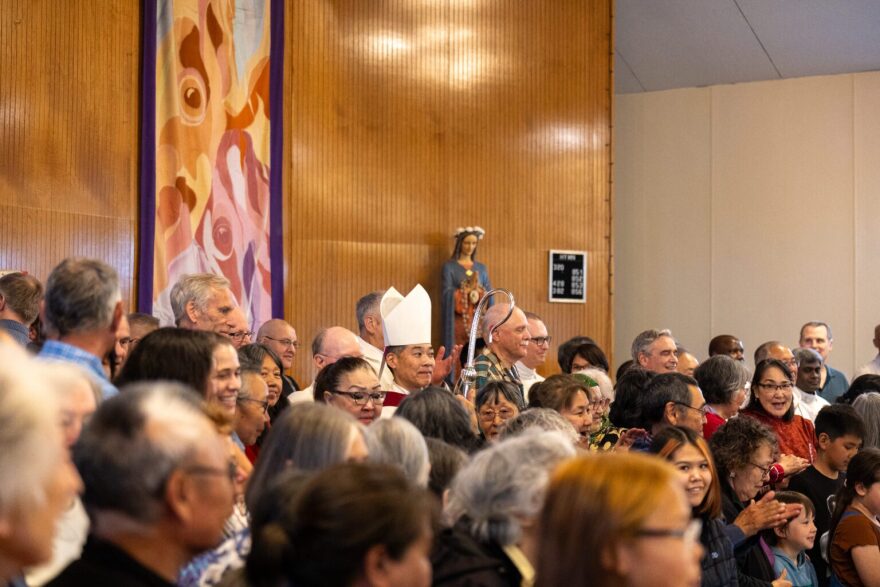
The Jesuits’ nearly 140 years in the state was honored at an event at Bethel’s Immaculate Conception Church on June 16. A procession of priests wearing long white gowns with red hems walked down the aisle to open the event. The Bishop of the Diocese of Fairbanks, Stephen Maekawa, thumped the ground with a shimmering silver staff known as a clozier as he approached the altar.
“My brothers and sisters, we gather together to celebrate this wonderful and blessed occasion to acknowledge the love of God and the work of God through the 139 year mission of the Society of Jesus of the Jesuit fathers,” Maekawa said to open the event.
A traditional Catholic mass followed, with readings in both English and Yup’ik. During the sermon, Maekawa acknowledged the vastness of the Fairbanks diocese, and the tremendous amount of work done by the Jesuits to establish it.
“All of the 46 churches of the Diocese of Fairbanks that we currently have were established by either the Jesuit fathers or by direction of a Jesuit bishop,” Maekawa said. “We have a long history of the Society of Jesus’ presence and ministry here in all of Alaska.”
The Jesuits are an order within the Catholic Church, akin to the Dominicans or Franciscans. They have a reputation for taking on some of the Catholic Church’s most remote assignments.
That missionary spirit brought the Jesuits to the Yukon River in 1887, where they built churches, schools, and ministries. Without their work, Catholicism may not have taken root in huge swaths of Alaska, particularly among Alaska Native communities.

But the Jesuits leave a complicated legacy. Their methods of converting Native people to the religion, particularly in the first half of the 20th century, created generational traumas still felt to this day.
Fr. Sean Carroll is the provincial of the Jesuits West Province, which oversees Alaska and nine other states.

“Thank you for all that you have taught us about who Jesus is and how to love and serve Him wholeheartedly,” Carroll said. “I also thank you for your patience with us. For there have been times when we have sinned and when we have hurt you.”
Missionaries, including the Jesuits, forcefully converted and assimilated Alaska Native people into Western culture and religion. Students at Jesuit-run boarding schools were forced to abandon their Native languages and physically punished when caught speaking languages other than English. Native dancing and drumming were also banned.
The Jesuits West Province maintains a list of 150 Jesuits with credible claims of sexual abuse against minors or vulnerable adults. A quarter of the accused Jesuits served in Alaska at some point in time.
“I ask for your forgiveness for all that we have done that was not rooted in Christ and love for Him, and for when we did not value your culture nor recognize the presence of God in you,” Carroll said.
Carroll gave the order to withdraw from the state last spring. A big issue was the recruitment of Jesuits willing to travel and serve in remote villages. He told the congregation that the Jesuits’ work would continue, just without a permanent presence.
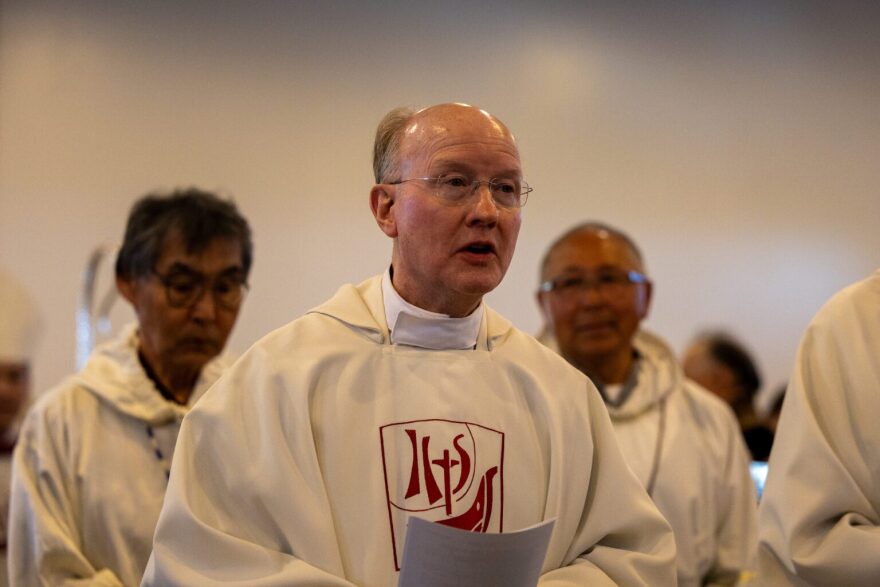
Fr. Rich Magner is one of the two remaining Jesuit priests in Alaska. His last day serving Chevak, Hooper Bay, and Scammon Bay is June 30.
“We all always knew coming in, or should have known, that we’re not going to be here forever. It’s going to be mission accomplished at some point,” Magner said. “And then we hand it off to the diocese that we’ve helped create, and so that’s a good feeling.”
Magner’s next stop is a Clinical Pastoral Education residency in Tacoma, Washington.
The other remaining priest, Fr. Tom Provinsal, first came to Alaska in 1968 to teach. A fond memory, he said, was meeting Elders that practiced traditional subsistence lifestyles.
“Some of the grandmothers, their fingers were just all bent with arthritis and stuff like that, you know, their whole lives they’ve been working out in the cold and the wet, doing food, sewing, all that kind of stuff,” Provinsal said. “I’d say I just feel very privileged to have come when I did come and to see that.”
Provinsal returned in 1975 as a priest and has served in the region ever since. After moving away, he plans to take a five month sabbatical. What happens next, he said, is in God’s hands.
Two lines formed in the aisle for communion at the end of the mass. After taking communion, Bethel’s Parish Administrator Susan Murphy gave a final thank you.
“It’s difficult to say goodbye to people who have been a part of our lives for so long,” Murphy said. “We know that you have done what was yours to do, and have taught us to do what is ours to do. We are grateful.”

Dominic Hunt, a Yup’ik deacon that flew in from Emmonak for the event, led the congregation through a final prayer.
“Bless them with your wisdom, that they may be a word of hope, a world in need. We ask this through Christ, our Lord. Amen,” Hunt said.
About 70 people posed for a photo on the altar – priests, deacons, parishioners, Elders and children — many of them smiling, some standing quietly.
The photo doesn’t tell the whole story. But it’s a moment when gratitude, grief, and memory all shared the same room.

JUNEAU, Alaska (KTUU) – The Supreme Court of Alaska will be taking up the case of the State of Alaska, Division of Elections v. Daniel J. Sullivan, Jr.
The oral arguments will be held Monday at 10 a.m. via Zoom, according to an order and opening notice.
The document also specifies that a decision is expected to be made before noon on Tuesday.
According to documents from the Division of Elections, the state must start printing ballots at noon on the same day.
This comes after an Anchorage Superior Court Judge ordered Dan J. Sullivan on to the ballot Friday.
See a spelling or grammar error? Report it to web@ktuu.com
Copyright 2026 KTUU. All rights reserved.
-

 Boston, MA2 minutes ago
Historian clears up one of the biggest myths about the Boston Tea Party
-
Denver, CO5 minutes ago
Nemanja Jokic, the older brother of\u00a0Denver …
-

 Seattle, WA10 minutes ago
3 Seahawks Rookies Who Must Step Up Right Away
-

 San Diego, CA17 minutes ago
Adobe Falls: The elusive waterfall that briefly returns after San Diego rains
-

 Milwaukee, WI20 minutes ago
Steve Czaban returns with new home in Milwaukee sports-talk radio
-

 Atlanta, GA25 minutes ago
Golestan brings a taste of Persian home cooking to Peachtree Corners – Atlanta Magazine
-

 Minneapolis, MN32 minutes ago
Minneapolis City Council abandons tax hike near George Floyd Square, revises development plan
-

 Indianapolis, IN35 minutes ago
Caitlin Clark not practicing Tuesday, to do individual workout

