News
Trump Guts Voice Of America News Agency, Musk Says “Nobody listens to them anymore.”


Voice of America staff were locked out of their offices on Saturday—unable to complete planned reporting—after President Donald Trump signed an executive order gutting the government-run news agency that the White House has referred to as “radical propaganda.”
VOA was founded in 1942 in part to counter Nazi propaganda.
The move impacts all full-time staffers at the VOA and the Office for Cuba Broadcasting, which runs Radio and Television Martíore, and is poised to have a devastating effect on practically all operations under the United States Agency for Global Media—the parent entity of VOA and the department targeted by Trump’s Friday evening order.
According to the agency, which is fully funded by federal dollars, broadcasters and their sister networks reach 420 million people in 63 languages and more than 100 countries each week, “often in some of the world’s most restrictive media environments.”
“I am deeply saddened that for the first time in 83 years, the storied Voice of America is being silenced,” VOA director Michael Abramowitz wrote in a LinkedIn post. He shared that his entire staff of 1,300 journalists, producers, and assistants had been put on administrative leave, including himself. “Even if the agency survives in some form, the actions being taken today by the Administration will severely damage Voice of America’s ability to foster a world that is safe and free and in doing so is failing to protect U.S. interests,” he said.
A statement released by the White House following the executive order details news coverage by VOA as justification for the defunding, including an article defining white privilege after the murder of George Floyd, a story about whether Russia perpetuated allegations against Hunter Biden to benefit Trump, and a segment on LGBT migrants.
“It’s a relic of the past,” Ric Grenell, Trump’s special envoy for special missions, wrote on X in February. “We don’t need government-paid media outlets.” Trump’s billionaire donor and Department of Government Efficiency advisor Elon Musk wrote on his social media platform: “Yes, shut them down … Nobody listens to them anymore.”
The order, entitled “Continuing the Reduction Of The Federal Bureaucracy,” called for multiple other departments to be “eliminated to the maximum extent consistent with applicable law,” including the Institute of Museum and Library Services, the United States Interagency Council on Homelessness, and the Minority Business Development Agency.
In December, Trump announced that Republican Kari Lake, a former news anchor who ran twice for office in Arizona on a MAGA platform and lost both times, was his pick to serve as director of Voice of America—though that didn’t happen. A couple of months later, Trump named her a senior adviser to the USAGM.
On Saturday morning, Lake took to X, shared a link to the executive order, and told employees to check their emails—where they would find news of being terminated.
X content
This content can also be viewed on the site it originates from.



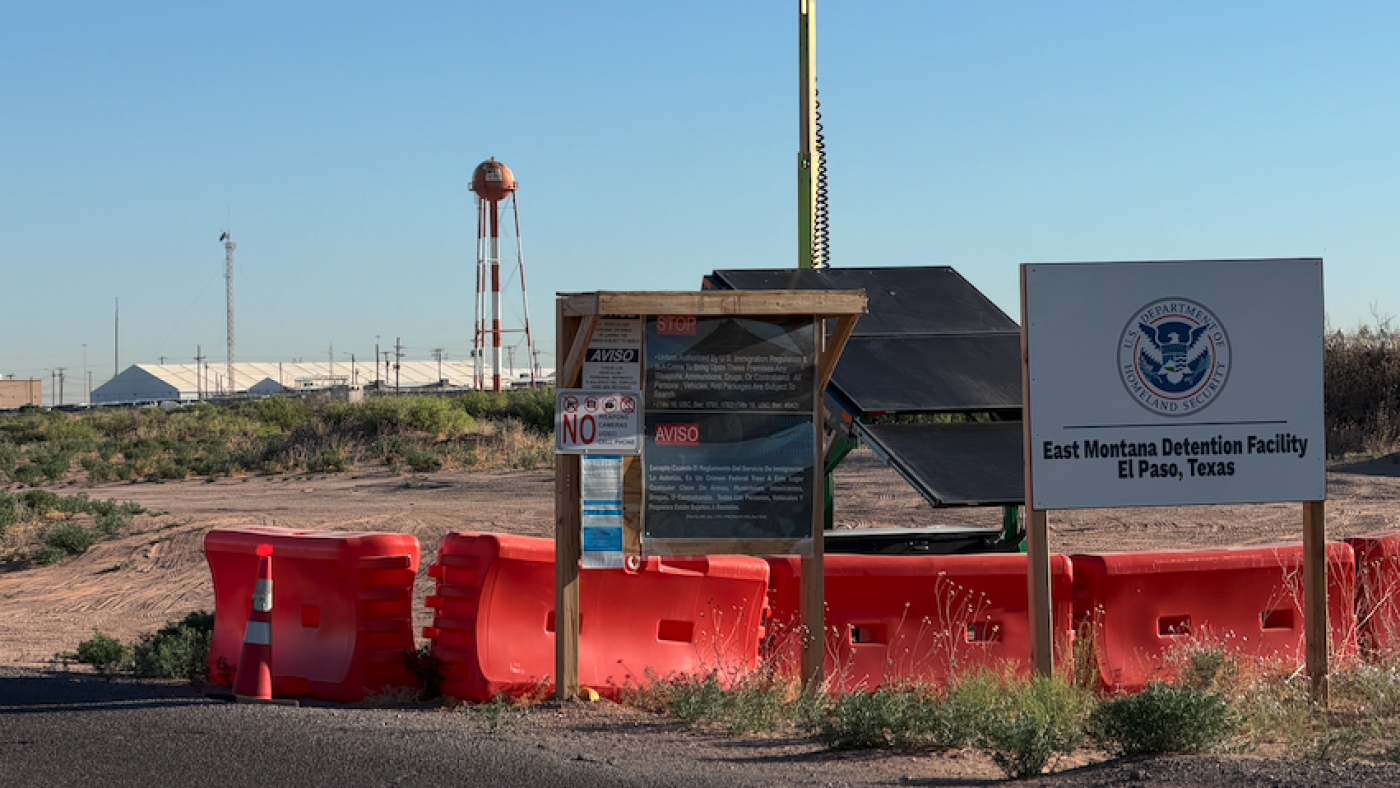
Entrance to Camp East Montana in El Paso, Texas.
Sergio Martínez-Beltrán/NPR
hide caption
toggle caption
Sergio Martínez-Beltrán/NPR
EL PASO, Texas — A long paved road, flanked by desert sand, leads to the big white tents usually housing some 3,000 immigrants with beds for up to 2,000 more.
The Immigration and Customs Enforcement, or ICE, detention center is located on the grounds of the U.S. Army’s Fort Bliss military base and is known as Camp East Montana.
Opened in August 2025, it’s currently the largest immigrant detention center in the U.S. and one of the facilities with the most detainee deaths. Out of 25 people who died in ICE detention since October, 3 were at Camp East Montana.
Concerns are rising among immigration advocates, lawmakers and former detainees about the company that initially ran the detention center, Acquisition Logistics, which had never run a center before securing a $1.3 billion federal contract. Advocates and multiple members of Congress are calling for the facility to be shut down.
“When they say in the news that this is the worst facility in the country, they damn right,” said Owen Ramsingh, a man from the Netherlands who was detained at Camp East Montana for more than four months before being deported in February.
He called the living conditions, food, bathrooms, and treatment by the facility’s staff “horrible.”
Ramsingh said he saw detainees battling mental health crises due to being detained for long periods in large cells that could house up to 72 men. He says they were served small portions of food, and suffered in cramped quarters with foul excrement odor emanating from the bathrooms in the cells.
ICE inspectors in February found 49 violations to detention standards at the facility, including inadequate medical care and failure from staff to “accurately document required checks to prevent significant self-harm and suicide.”
More than 45 people interviewed by the ACLU at Camp East Montana “reveal alarming conditions of confinement and repeated instances of coercion, physical force, and threats against immigrants facing third-country deportations, in violation of agency policies and standards, as well as statutory and constitutional protections,” the civil liberties group said in its December letter to ICE.
Multiple detainee deaths raise big concerns
In December, Francisco Gaspar-Andres, a Guatemalan man, died of kidney failure after being hospitalized for two weeks, DHS said.
A month later, Cuban national Geraldo Luna Campos died while in detention. Initially, DHS said he died after experiencing “medical distress.” The agency said he had become “disruptive while in line for medication” and was placed in segregation.
However, an autopsy conducted by the El Paso County Medical Examiner’s Office ruled his death a homicide. The report said he died from “asphyxia due to neck and torso compression.” No one has been charged in his death.
A third death happened on Jan. 14, according to DHS. Victor Manuel Diaz, a national of Nicaragua died by suicide, DHS said in a statement.
But Diaz’s family do not believe that to be true.
“When we talked to Victor after he had been detained by ICE in Minnesota and brought to Camp East Montana at Fort Bliss Army Base in El Paso, we were not worried because Victor would just be returned to Nicaragua to us. It was a very brief call,” the family said in a statement to NPR. “Little did we know it was the last time we would ever hear his voice.”

Attorney Randall Kallinen holds a photo of the burial of Victor Manuel Diaz, a Nicaraguan man who died while in detention at Camp East Montana.
Sergio Martínez-Beltrán/NPR
hide caption
toggle caption
Sergio Martínez-Beltrán/NPR
The family’s attorney, Randall Kallinen, told reporters last month Diaz’s autopsy was performed by the Army’s medical examiner.
“It was said that he died in a room by himself, in a clinic room. And we haven’t received word of why he was in the clinic,” Kallinen said. “Because they’re not saying he he tried to commit suicide somewhere else and then went to the clinic room — they’re saying he was in the clinic. That’s what their story is.”
In a statement to NPR, the Department of Homeland Security said “When there are signs of a detainee self-harming, staff abides by strict prevention and intervention protocol to ensure the detainee’s health and wellbeing is protected.”
The agency said ICE conducts mental health intake screenings for detainees within 12 hours of their arrival to any detention facility.
Lack of nutrition, mental health crises
45-year-old Owen Ramsingh has lived in the U.S. since 1986, when he came to Omaha, Nebraska with his mother when he was just five years old.
When he was a teenager, Ramsingh was convicted of possession of crack cocaine. He served 25 months in prison, part of that time in a state penitentiary.
After his release, Ramsingh said he “changed my life around.” He worked in construction for 15 years, had kids, later worked in security and even started his own power washing business.
Ramsingh had been a permanent resident all of these years, and he renewed his green card multiple times over the years. He says he often visited the Netherlands without any issues. But in March 2025, when he returned from Europe, he was detained at the Chicago O’Hare Airport by immigration agents. He said they told him he was being detained due to his nearly three decades old conviction.
Ramsingh was eventually transferred to Camp East Montana.
He said he saw at least one detainee collapse.
“We were beating on the windows,” he said, adding he yelled at the guards, “‘You guys are killing us!’ And they just laughed at us.”
Talking from his father’s home in the Netherlands, after being deported in mid-March, Ramsingh told NPR he also heard guards betting on which detainee was going to die by suicide.
“This is so screwed up that you’re trying to bet on our lives, you know, with these other officers thinking this s- – – is funny,” Ramsingh said. For him it was personal — he told NPR he talked three detainees out of killing themselves.
Acquisition Logistics LLC, the private company in charge of the detention center when Ramsingh was there, did not respond to NPR’s questions about this incident or its past management of the facility. DHS said in a statement that the agency inherited the contract from the Department of War.
The agency pointed out Ramsingh’s past conviction as the reason for his removal. “A green card is a privilege, not a right, and under our nation’s laws, our government has the authority to revoke a green card if our laws are broken and abused,” DHS said.
A woman who was detained at Camp East Montana told NPR she lost 35 pounds in her months-long detention there. The woman asked NPR for anonymity because she fears retaliation from immigration authorities.
“It was a horrible experience,” the woman said.
She told NPR the food was often inedible, and that the portions provided were very small. Detainees had to ration their food by hiding fruits and crackers under their shirts.
She said most of the women in her pod had stomach issues “because nobody wanted to eat.” People would eat a tortilla with water to feel full because they didn’t want to eat the food, which the woman said tasted bad.
The woman said she had trouble sleeping. She told NPR when she or others would get sick, the medical staff would most of the time tell them to drink water and offer acetaminophen.
An inexperienced company
Public complaints surfaced soon after Camp East Montana was opened in August 2025.
Several measles and tuberculosis outbreaks sparked multiple lockdowns.
Imelda Maynard, the legal director of the immigration legal clinic Estrella de El Paso, told NPR her team has repeatedly encountered roadblocks since the opening of the facility.
“We’ve always run into hiccups here and there, but with this camp in particular, there’s been issues from the get go on just trying to establish baseline communication with people there,” Maynard said.
Advocates have placed much of the blame on Acquisition Logistics, LLC, A Virginia-based small company that secured a $1.3 billion contract with the federal government to run Camp East Montana. However, the company had never operated a detention facility before.
“At that facility … it really does feel like one side doesn’t know what the other side is doing and everyone’s just kind of doing their own thing,” Maynard said. “It doesn’t seem like there’s coordinated efforts, and I really feel like that’s a management problem, and I think that’s on the contractor side of things.”
DHS replaced Acquisition Logistics’ contract last month. The company did not reply to NPR’s request for comment.
A new, $453 million contract was given to Amentum Services, a company that was working as a subcontractor for Acquisition Logistics. Amentum Services didn’t respond to NPR’s request for comment.
“ICE is always looking at ways to improve our detention facilities to ensure we are providing the best care to illegal aliens in our custody,” a DHS official said.
DHS said in a statement Amentum Services has been a partner of ICE in managing Camp East Montana. The contract, the agency said, “will allow Camp East Montana to continue abiding by the highest detention standards WITH the ability to provide MORE medical care on-site. This contract also allows more on-site staff and a PRECISE quality assurance surveillance plan.”
The agency said ICE will have “even more oversight of the contractors at this facility,” although it didn’t provide details of what that entails.
“Far from closing, Camp East Montana is upgrading,” DHS said.
But immigrant rights activists and members of Congress have called for the facility to shut down.
Congresswoman Veronica Escobar, D-Texas, called Acquisition Logistics LLC’s contract and the complaints from the detainees “very troubling.”
“These people are playing with the taxpayer dollars of hardworking Americans,” Escobar, who has visited Camp East Montana multiple times, said. “It’s unacceptable.”
She wants the Department of Justice to investigate the contract issued to Acquisition Logistics LLC.
“It’s not enough to just switch contractors,” Escobar said. “Acquisition Logistics needs to be investigated.”

The Justice Department has issued a legal opinion arguing that President Donald Trump does not have to turn over his presidential records to the National Archives at the end of his administration.
The Presidential Records Act of 1978 requires presidential documents be sent to the National Archives and Records Administration. In an opinion released Thursday, the Justice Department’s Office of Legal Counsel found the law “is unconstitutional for two independent but interlocking reasons.”
It exceeds Congress’ powers and it does so at the expense of the autonomy of the presidency, T. Elliot Gaiser wrote in the opinion, noting that Congress can’t order the papers of Supreme Court justices to be sent to the archives.
The president “need not further comply with its dictates.”
If the Trump administration chooses to follow the opinion from the office, which offers legal advice to the executive branch but does not set law, he could face outside legal challenges should he violate the Presidential Records Act in the future.
The determination is a signal that the president will not turn over his documents to the archives. Trump was accused violating the Presidential Records Act by refusing to turn over documents he kept after leaving office following his first term.
According to federal prosecutors, Trump willfully retained national defense documents at his private home in Mar-a-Lago, obstructed justice and concealed materials, including a classified military map reportedly shown to unauthorized individuals. The case was dismissed by Judge Aileen Cannon in 2024 before he won re-election.
A memo by the special prosecutor’s office later released found that the president kept a document that was previously accessible by only a few people at his home.
“Trump had in his possession some highly sensitive documents — the type of documents that only presidents and officials with the most sensitive authority have,” the memo said.
Trump has long argued he did nothing wrong. Shortly after he took office, he dismissed the head of the National Archives, following through on a vow to change the leadership atop the agency, which was involved in the criminal case against him.
The office of legal counsel serves as a quasi-judicial office within the executive branch. It was once involved in the George W. Bush- era memos authorizing the use of “enhanced interrogation techniques” like waterboarding against terrorism suspects.
Axios first reported details of the opinion. Gaiser, who previously clerked for Supreme Court Justice Samuel Alito, was part of Trump’s 2020 campaign team, and was named in testimony before the Jan. 6 committee in which former White House press secretary Kayleigh McEnany named him as someone she “really trusted on the matters of election integrity.”
McEnany said that Gaiser advised that the vice president had a “substantive” role to play in the election certification process, the type of view which gave Trump supporters hope that Mike Pence could overturn Trump’s 2020 election loss.
Responding to written questions during his nomination process, Gaiser declined to discuss his views in detail, and wrote that his “ethical duties as an attorney include a duty of confidentiality regarding the advice I provided to a former client.”
The Presidential Records Act, signed into law by President Jimmy Carter in 1978 following the Watergate scandal, requires official records of the president and vice president, created or received after January 1981, to be made public, and for the National Archives to manage a president’s records after the individual leaves office.
The act requires that the president “take all practical steps” to keep presidential records separate from personal records, and it allows the president — once the archivist weighs in — to dispose of records that no longer have “administrative, historical, informational, or evidentiary value.”
The act also states that presidential records are automatically transferred into the legal custody of the archivist as soon as the president leaves office.

Note: Map shows the area with a shake intensity of 4 or greater, which U.S.G.S. defines as “light,” though the earthquake may be felt outside the areas shown. The New York Times
A light, 4.6-magnitude earthquake struck in Northern California on Thursday, according to the United States Geological Survey.
The temblor happened at 1:41 a.m. Pacific time about 1 mile southeast of Boulder Creek, Calif., data from the agency shows.
U.S.G.S. data earlier reported that the magnitude was 5.1.
As seismologists review available data, they may revise the earthquake’s reported magnitude. Additional information collected about the earthquake may also prompt U.S.G.S. scientists to update the shake-severity map.
Source: United States Geological Survey | Notes: Shaking categories are based on the Modified Mercalli Intensity scale. When aftershock data is available, the corresponding maps and charts include earthquakes within 100 miles and seven days of the initial quake. All times above are Pacific time. Shake data is as of Thursday, April 2 at 5:41 a.m. Eastern. Aftershocks data is as of Thursday, April 2 at 6:11 a.m. Eastern.

Podcast: Hungary elects: what is at stake and who is likely to win?
ICE detention deaths are on a record pace. One Texas facility bears the brunt

Ex-Detroit Mayor Kwame Kilpatrick accuses prosecutors of

SF’s Human Rights Commission ex-leader pleads not guilty to 17 felony charges

FIFA World Cup: Dallas Arboretum pays tribute to Dutch team with flower displays

Florida High School Football Rankings: Top 25 teams – Oct. 21

How old is Bo Nix? What to know about Oregon quarterback ahead of 2024 NFL Draft

Cleary's 21 help Le Moyne down Central Connecticut State 69-64 in OT

99th annual Pony Swim held in Virginia

Indiana Members Credit Union announced as new anchor tenant at Bottleworks District
Podcast: Hungary elects: what is at stake and who is likely to win?
ICE detention deaths are on a record pace. One Texas facility bears the brunt

GOP rails against ‘s— sandwich’ deal as all eyes turn to House to end DHS shutdown

Planning commission approves Trump’s White House ballroom plans

Trump does not have to turn over presidential records, Justice Department says
-

 South-Carolina5 days ago
South Carolina vs TCU predictions for Elite Eight game in March Madness
-

 Culture1 week ago
Wil Wheaton Discusses ‘Stand By Me’ and Narrating ‘The Body’ Audiobook
-

 Miami, FL1 week ago
Jannik Sinner’s Girlfriend Laila Hasanovic Stuns in Ab-Revealing Post Amid Miami Open
-

 Culture1 week ago
What Happens When We Die? This Wallace Stevens Poem Has Thoughts.
-

 Minneapolis, MN1 week ago
Boy who shielded classmate during school shooting receives Medal of Honor
-

 Vermont5 days ago
Skier dies after fall at Sugarbush Resort
-

 Politics5 days ago
Trump’s Ballroom Design Has Barely Been Scrutinized
-

 Education1 week ago
Video: Transgender Athletes Barred From Women’s Olympic Events