News
The U.S. Is Trying to Deport Mahmoud Khalil, a Legal Resident. Here’s What to Know.


The Trump administration invoked an obscure statute over the weekend in moving to deport Mahmoud Khalil, a permanent legal resident of the United States who recently graduated from Columbia University, where he helped lead campus protests against high civilian casualties in Gaza during Israel’s campaign against Hamas.
Mr. Khalil was arrested by immigration officers on Saturday and then sent to a detention center in Louisiana. On Monday, a federal judge in New York, Jesse M. Furman, ordered the federal government not to deport Mr. Khalil while he reviewed a petition challenging the legality of the detention.
Here’s what to know about the administration’s attempt to deport Mr. Khalil.
Who is the Columbia graduate?
Mr. Khalil, 30, earned a master’s degree from Columbia’s School of International and Public Affairs in December. He has Palestinian heritage and is married to an American citizen who is eight months pregnant.
At Columbia last spring, Mr. Khali assumed a major role in student-led protests on campus against Israel’s war efforts in Gaza. He described his position as a negotiator and spokesman for Columbia University Apartheid Divest, a pro-Palestinian group.
What’s the legal basis for his arrest?
The Trump administration did not publicly lay out the legal authority for the arrest. But two people with knowledge of the matter, who spoke on the condition of anonymity to discuss sensitive internal deliberations, said Secretary of State Marco Rubio relied on a provision of the Immigration and Nationality Act of 1952 that gives him sweeping power to expel foreigners.
The provision says that any “alien whose presence or activities in the United States the Secretary of State has reasonable ground to believe would have potentially serious adverse foreign policy consequences for the United States is deportable.”
What is Mr. Khalil being accused of?
That is not very clear.
Mr. Rubio reposted a Homeland Security Department statement that accused Mr. Khalil of having “led activities aligned to Hamas.” But officials have not accused him of having any contact with the terrorist group, taking direction from it or providing material support to it.
Rather, the administration’s rationale is that the protests that Mr. Khalil played a key part in were antisemitic and created a hostile environment for Jewish students at Columbia, the people with knowledge of the matter said. Mr. Rubio’s argument, they said, is that the United States’ foreign policy includes combating antisemitism across the globe and that Mr. Khali’s residency in the nation undermines that policy objective.
Could this happen to more visa or green card holders?
President Trump said Mr. Khalil’s case was “the first arrest of many to come.”
But a lawful permanent resident, or green card holder, is protected by the Constitution, which includes First Amendment free-speech rights and Fifth Amendment due-process rights. The Trump administration’s efforts to deport Mr. Khalil under the I.N.A. provision are likely to face a constitutional challenge, several legal experts said.
What happens next?
There is little precedent for deporting a legal permanent resident based on the provision of the 1952 law that gives the State Secretary a broad power to do so on foreign-policy grounds.
A lawyer for Mr. Khalil, Amy Greer, said her client would “vigorously” challenge the Trump administration’s actions in court. On Monday, Judge Furman, of the Federal District Court in Manhattan, scheduled a hearing for two days later after barring the Trump administration from deporting Mr. Khalil “to preserve the court’s jurisdiction.”
What has President Trump said about pro-Palestinian protesters?
Since 2023, Mr. Trump has repeatedly vowed to revoke visas of international students who participate in pro-Palestinian protests and criticize Israel’s war efforts.
At a rally in Iowa on Oct. 16, 2023, Mr. Trump declared that “in the wake of the attacks on Israel, Americans have been disgusted to see the open support for terrorists among the legions of foreign nationals on college campuses. They’re teaching your children hate.”
He added: “Under the Trump administration, we will revoke the student visas of radical, anti-American and antisemitic foreigners at our colleges and universities, and we will send them straight back home.”
At a speech in Las Vegas on Oct. 28 of that year, Mr. Trump said that “we’ll terminate the visas of all of those Hamas sympathizers, and we’ll get them off our college campuses, out of our cities and get them the hell out of our country.” And at a Nov. 8, 2023, campaign stop in Florida, he said he would “quickly cancel the student visas of all Hamas sympathizers on college campuses, which have been infested with radicalism.”



Why are there so many Greeks in Tarpon Springs, Fla.? Because in the early 1900s, Greek sponge divers came from the Dodecanese islands and revolutionized the sponge industry on Florida’s gulf coast.
What explains the pockets of Portuguese and Cape Verdeans in New Bedford, Mass.? In the 1800s, winds pushed whaling boats east to the Azores and Cape Verde, where experienced whalers joined the crews.
There’s the Basque population in Boise, Idaho, whose ancestors traded a mountainous region between France and Spain for the American West in the hopes of finding gold but later turned to sheep herding. There are the families of Yemeni immigrants hired by Ford Motor Company to build cars in Detroit, and the Vietnamese refugees who were resettled near New Orleans and Houston, where they could carry on shrimping.
These stories are everywhere on this map of American ancestry, which shows how people described their backgrounds to the Census Bureau. There are nearly 200 unique identities represented; blend them — as 340 million Americans do — and we arrive at a jumbled, overlapping, story-filled infinity.
Much of what we see is a history of immigration. Over 250 years, the country has absorbed more than 100 million people. We can trace the pressures that pushed and pulled them here — and the policies that welcomed certain groups while keeping others out — through the patterns in where their descendants live today.
Now, a larger share of the country was born abroad than ever before, and the Trump administration’s sweeping immigration bans echo exclusionist policies enacted in response to similar demographic conditions a century ago.
Those policies defined Americans for generations. Recent efforts to limit immigration will likewise affect how future Americans understand their heritage and themselves.
How we got here
In the late 1700s, the area that would become the present-day United States was already diverse. At least 1.5 million Native people, and possibly many more, were living across the territory. They were joined by about three million Europeans and enslaved Africans living in both the English colonies and the French and Spanish territories.
From colonial times, immigration was an important contributor to population growth. It accelerated as the new country’s territory expanded west and immigrants arrived to settle it. From 1820 to 1860, more than five million people came, through a mostly open door.
With the advent of the steamship, the cost of passage plummeted, and companies offered special immigrant fares that were often coupled with rail tickets to the interior of the country. Once a community of immigrants was established somewhere, it tended to grow.
After 1840, immigration from Western Europe began to rise quickly as political instability in Germany and the famine in Ireland drove people to leave. Asian immigrants, drawn by the discovery of gold in California in 1848, were recruited to work on farms and railroads.
Later in the 19th century, pogroms across Eastern Europe and the aftermath of Italian reunification drove a surge of migration to the United States. From 1880 to 1920, 24 million immigrants arrived. They went almost everywhere except the South, where the land-owning elite already had cheap labor from the formerly enslaved and poor tenant farmers.
Cities swelled. In 1910, according to the Ellis Island National Museum of Immigration, three-quarters of the residents of Boston, Chicago, Cleveland, Detroit and New York City were immigrants or children of immigrants.
1850
2 million total immigrants
The 1850 census did not include data on the birthplace of enslaved people.
1910
14 million total immigrants
1970
9 million total immigrants
2024
50 million total immigrants
Many rural areas in the Midwest had a similar share of immigrants in 1910, but newcomers to the cities tended to be from novel sources like Russia or Italy. That meant there were more languages, more cuisines and more workers. It also meant there were more crowds, more slums and more people behaving in unfamiliar ways — fodder to drive views that the new immigrants were unassimilable and that policies were needed to keep them out.
The first federal law to severely limit immigration had come much earlier, in 1882, when practically all Chinese people were barred from entering the country. More restrictions followed, and eventually animosity toward new immigrants led to the passage of laws in the 1920s creating a quota system tied to nationality.
Western Europeans were given generous quotas and Southern and Eastern Europeans much smaller ones. For the rest of the Eastern Hemisphere, the quotas were set to almost nothing. Ships raced through the night to reach New York Harbor, all trying to be first to dock at Ellis Island.
There weren’t quotas for countries in the Americas and the Caribbean, but there were other restrictions. Mexicans faced mass deportation campaigns in the 1930s and 1950s, even as millions were recruited as temporary workers to fill agricultural jobs across the Southwest.
Over the next 40 years, these rules drove the foreign-born population in the United States to its lowest levels. Children of immigrants replaced immigrants, blending into American society while retaining their own cultural traditions.
Then, alongside the civil rights movement of the 1960s, activists and lawmakers who saw the national quota system as racist pushed to replace it with one based on employment and family ties.
Another decades-long wave of immigration followed, this time from different parts of the world.
Chart data is unavailable.
Share of immigrants in the United States by region of birth
The new rules allowed people to sponsor their family members and relatives, and they gave preference to workers with advanced degrees and specialized skills. The family visas, in particular, led to an unforeseen boom in immigration.
An expanded refugee program also brought more immigrants, many from Southeast Asia who were displaced by Cold War conflicts.
For the first time, immigrants from the Western Hemisphere faced limits on their numbers. Similar to the European workers who arrived earlier in the century, many chose to settle in the United States permanently instead of risking returning to their home countries between periods of working in the United States. Millions who couldn’t get visas turned to entering illegally.
The most recent immigration wave, during the Biden administration, was different still: The number of visas for immigrants remained steady, while migrants from Central America arrived at the southwest border in large numbers to seek asylum. Desperate conditions in Cuba, Haiti and Venezuela, as well as wars in Afghanistan, Ukraine and elsewhere led hundreds of thousands of people to flee to the United States — many of them drawn to established communities of immigrants from their countries.
Where we are today
The lines of American ancestry today are not neatly drawn, and groups overlap and spill into one another. Some people don’t answer the census questions about their origins at all. For others, it’s complicated. Descendents of enslaved people, for example, may identify themselves as African American because they are unable to trace their roots to a specific place.
Many areas have truly mixed populations, with people of several different ancestries nearly equally represented.
Take this area just southwest of Houston, for example:
Nigerian, Jordanian, Mexican, Vietnamese, African American, Salvadoran, Iraqi, German, English, Irish and Chinese people are all among the top groups in these neighborhoods.
Every city has its own distinct pattern, visualized in the the patchwork of gold, green and blue in Los Angeles, the stark reds, blues and yellows of Chicago, a purple Minneapolis, a green Honolulu:
Who comes next?
If the patterns in these maps reflect the immigration policies of at least a century ago, we can expect them to shift and change again as a result of contemporary decisions about who makes up the American mosaic.
No comprehensive immigration legislation has passed Congress since the 1980s. After a surge of immigration during the Biden administration, in which an estimated eight million people entered the country over three years, demographic experts now estimate that the United States could reach net-zero or negative immigration sometime soon. That is in part because of the Trump administration’s aggressive actions to speed deportations of people who are in the country illegally and to limit pathways to legal immigration.
At the same time, the factors that pull immigrants to the United States remain strong. And, unlike 100 years ago, the country now faces a declining population and work force. The tension between the need for new workers and resurgent nativist politics will influence who comes, who settles and who is counted among the ancestors of future generations.
About the data
The ancestry maps in this article and the related interactive map draw from seven tables of race, ethnicity and ancestry data that the Census Bureau published as part of the American Community Survey estimates for 2019-2024.
The census ancestry and origin data are estimates based on a sample of the population and include margins of error that can be large for small population groups. We used the estimates published by the Census Bureau without adjustment.
In the survey, respondents are asked questions about their race and whether they are of Hispanic or Latino origin. Each of those questions allows respondents to list their national origins. An additional question asks about their ancestries. People can claim multiple ancestries or origins and appear in multiple categories.
Some groups appear in multiple tables. For example, people can select “white” as their race and list “German” as a specific origin. Separately, anyone can also choose “German” in response to the survey’s ancestry question. For such groups, we used the table with the higher value for the country as a whole. In a small number of cases, similar ancestries were grouped together.
Colors for each census tract are blended based on the adjusted number of people who reported being of each race and ancestry in the tract, for each group above a minimum threshold.
In charts of the immigrant population, counts come from Census Bureau research publications, the 2000 census and the American Community Survey. Those counts include only foreign-born residents and exclude any descendants born in the United States.

Former Federal Election Commission Chairman Trevor Potter testifies during a Senate Rules and Administration Committee hearing on artificial intelligence and the future of elections on Capitol Hill in Washington, D.C., Sept. 27, 2023.
Drew Angerer/Getty Images
hide caption
toggle caption
Drew Angerer/Getty Images
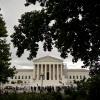
The Supreme Court struck down limits on how much political parties can spend in coordination with their candidates in a 6-3 decision split along ideological lines. The ruling is the latest in a series of Supreme Court decisions that have loosened campaign finance restrictions, overturning a 2001 precedent that upheld the spending limits.
Former Federal Election Commission Chairman Trevor Potter, who now serves as president of the Campaign Legal Center, joined NPR’s Morning Edition to break down the ruling. Speaking to NPR’s Michel Martin, Potter discussed why the court reversed its earlier precedent, how the ruling changes campaign finance rules and whether greater transparency could address concerns about corruption.
Listen to the full interview by clicking on the blue play button above. And read takeaways from the conversation below.
The post-Watergate limits were meant to prevent corruption
Potter said they were designed to stop donors from routing large contributions through national party committees to directly fund a favored candidate’s campaign. The restrictions were intended to prevent “an obvious way around” campaign contribution limits.
The court previously upheld the same limits
Asked why the Supreme Court upheld the law about 20 years ago, Potter said the justices concluded the restrictions were a constitutional way to prevent corruption. He said the court viewed them as an “anti-circumvention measure” to stop donors from using political parties to bypass contribution limits.
Potter rejects the majority’s rationale
Potter rejected the majority’s view that political parties have less political power than outside groups, saying earlier Supreme Court decisions allowing unlimited outside spending created that imbalance. He pointed to Justice Elena Kagan’s dissent in support of that argument.
Disclosure wouldn’t necessarily reveal private fundraising arrangements
Potter said disclosure alone would not address his concerns because it cannot reveal private agreements between candidates and donors. While campaign donations to political parties are public, he said voters would not see behind-the-scenes requests from candidates asking donors to contribute to party committees that later support their campaigns.
“We’re never going to see that,” Potter said. “I don’t think there’s a way to practically disclose those backroom deals.”
This interview was written for the web by Majd Al-Waheidi and edited by Treye Green.

A woman suffered several injuries but survived falling 1,500 feet down California’s Mount Shasta on Sunday, officials said.
The climber, 31, was attempting to ascend the mountain, which is technically a stratovolcano with the second-highest peak in the Cascades, according to the U.S. Forest Service. She was climbing in a group of three novices at an elevation of around 13,000 feet when she fell.
She suffered a suspected ankle fracture and “additional injuries consistent with the significant fall,” although she was found alert and “in good spirits,” the forest service said. Officials haven’t identified the climber.
Efforts to locate and rescue the woman got underway at around noon on Sunday and involved three climbing rangers from the forest service as well as members of the California Highway Patrol. An initial helicopter search was limited because of cloud cover on the mountain, the forest service said, prompting one ranger to ascend a portion of the mountain on foot to reach her. One member of the woman’s climbing party helped carry rescue equipment, as did a fourth climber who stopped to assist.
California Highway Patrol safely removed the woman from the mountain at around 5:30 p.m., and she was eventually taken to Mercy Medical Center Mount Shasta for medical care, according to the forest service.
The agency said the woman’s fall “serves as an important reminder that Mount Shasta is a high-altitude mountaineering environment, not a hike,” and “experienced climbers can encounter rapidly ranging weather, steep snow and ice, rockfall, and hazardous fall conditions.”
It also encouraged prospective climbers to “be honest about your experience and physical conditioning” before attempting to summit the mountain.
The woman and her climbing party were ascending Mount Shasta along a route called Avalanche Gulch, which “is steep and rigorous requiring crampons, a mountain axe, helmet, and basic snow travel skills,” according to the Mount Shasta Avalanche Center. It takes climbers up a 7,000-foot vertical ascent that features “steep snow and ice, rock fall, and weather extremes,” the center said.
-

 Oregon6 minutes ago
Former Oregon corrections officer receives lifetime hunting ban, fined over $114K
-

 Pennsylvania9 minutes ago
Pennsylvania State Police trooper killed in crash along Interstate 81
-

 Rhode Island14 minutes ago
‘Real Housewives of Rhode Island’ star Liz McGraw exits show after one season
-

 South-Carolina21 minutes ago
South Carolina Lottery Powerball, Pick 3 results for July 1, 2026
-

 South Dakota24 minutes ago
Families celebrate 250th in South Dakota
-

 Tennessee29 minutes ago
Parasite-induced ‘explosive’ diarrhea cases rise in Tennessee. Here’s what to know
-

 Texas36 minutes ago
New date set for opening of Six Flags Over Texas’ Tormenta Rampaging Run coaster after delay
-

 Utah39 minutes ago
Wasatch Front cities running out of water called a ‘myth’

