News
Supreme Court sides with administration over Education Department grants


The Supreme Court
Andrew Harnik/Getty Images
hide caption
toggle caption
Andrew Harnik/Getty Images
The U.S. Supreme Court on Friday sided with the Trump administration, at least for now, in a dispute over the Department of Education’s freeze of DEI-related grants. The administration has taken several grievances to the high court recently, but this was the first of its legal theories to stick.
By a 5-4 vote, the justices allowed the administration to keep frozen $65 million for teacher training and professional development, halting a lower court order that had temporarily reinstated the grants.
The court’s unsigned opinion comes about a month after a similar dispute in which the justices left in place a lower court order to pay USAID contractors for services already performed.
This time, however, with education grants on the line, the court majority ruled that even though Congress had already appropriated money for the programs, the Education Department could stop funding them while the case is litigated in the lower courts.

The Education Department had frozen the grants in anticipation of trying to claw back unspent funds that had been appropriated by Congress.
A federal district judge had issued two consecutive 14-day temporary restraining orders to consider the question of the frozen funds. While such 14-day orders are rarely appealable, the Supreme Court majority viewed this case differently, and granted the administration’s request to block the lower court order from going into effect. In an unsigned 2-1/2-page opinion, the majority wrote that the lower court may actually not have had the authority to issue its order in the first place.
Justice Elena Kagan dissented, saying that the Court had made a serious “mistake” when it intervened too swiftly, effectively changing the court’s rules with only a “barebones briefing, no argument and scarce time for reflection.” Justice Ketanji Brown Jackson, joined by Justice Sonia Sotomayor, noted that it was exceptional for the Court to intervene when the temporary restraining order would expire in only three days, and that that the administration had not presented a convincing enough argument as to why such an extraordinary intervention was necessary.
While Chief Justice John Roberts noted his disagreement with the majority, he did not join either dissenting opinion.

Universities accused of violating civil rights law
The Education Department funding went to two grant programs targeting teacher shortages. Recipients included “high need” institutions, nonprofits, Historically Black Colleges and Universities, and Tribally Controlled Colleges and Universities.
The Department of Education cut nearly all of the existing grants in February, notwithstanding the fact that Congress had already appropriated the funds to be spent for these specific purposes. The administration said it eliminated 104 of 109 grants because they “fund discriminatory practices–including in the form of DEI.”
The Department also sent letters to the recipients stating that their programs violated federal civil rights laws by discriminating based on race, sex, or other protected characteristics.

Eight states whose universities and nonprofits had their grants terminated–California, Massachusetts, New Jersey, Colorado, Illinois, Maryland, New York, and Wisconsin–sued in federal district court. The challengers argued that the Department of Education’s decision to cancel the grants violated federal law. In response, the government argued that it was well within its broad regulatory authority to cancel the grants because the so-called “DEI initiatives” were no longer aligned with government policy.
A federal judge in Boston issued a temporary restraining order, which reinstated the funding for up to 28 days while he considered the states’ claims. After a failed attempt to overturn the order in the federal court of appeals, the Department of Education asked the Supreme Court to stop the lower courts from reinstating the grant money, at least for now.
The Department insisted that it should not be forced to continue funding millions of dollars in “taxpayer money that may never be clawed back” while the lawsuit plays out in the courts. It pointed out that, even if it eventually wins this case, it would have a hard time getting the millions in federal dollars back once the “federal funding spigots” had been turned back on.

The eight states that are part of the lawsuit against the administration countered that it would make little sense for the Supreme Court to intervene at this stage, given that the grant reinstatement would expire soon anyway. And, they pointed out, the order’s limited shelf life gave grant recipients little time to continue receiving government funds.
In that sense, the schools would be getting a drop in the bucket compared to the government’s image of a “funding spigot.” And that would still be less than they were promised in their five-year grant.
The Supreme Court didn’t see things that way, and instead sided with the Trump administration, delivering a major win to an executive branch trying to amass greater power as it continually clashes with the lower federal courts.
More cases in the pipeline
Friday’s case is only the latest of what is expected to be a tsunami of cases that the Trump administration is bringing to the Supreme Court. Among those already in the pipeline at early stages of litigation is a lower court order that reinstated roughly 16,000 previously terminated federal employees.
Another court stopped the administration from denying birthright citizenship for some children born in the United States, a case in which the government complained at length about the use of universal injunctions, a wide-reaching order that applies to everyone impacted across the country. And most recently, the administration asked the court to allow it to continue deporting U.S. residents, without a hearing, who it alleges are Venezuelan members of the Tren de Aragua gang.
Bubbling under the surface in these cases is the government’s ongoing critique of sweeping court orders that bind the administration’s actions beyond the confines of the courtroom. Judges’ grants of nationwide relief have been a thorn in the administration’s side since Trump took office in January.

They were also a thorn in the side of the Biden administration. But as frustrated as that administration sometimes was, it rarely complained of unfair treatment. In contrast, the Trump administration, and President Trump himself, have cried foul repeatedly and loudly over these lower court decisions.
Attorney General Pam Bondi in a statement said Friday’s ruling “vindicates what the Department of Justice has been arguing for months: local district judges do not have the jurisdiction to seize control of taxpayer dollars, force the government to pay out billions, or unilaterally halt President Trump’s policy agenda.”
—NPR’s Ryan Lucas contributed to this report.

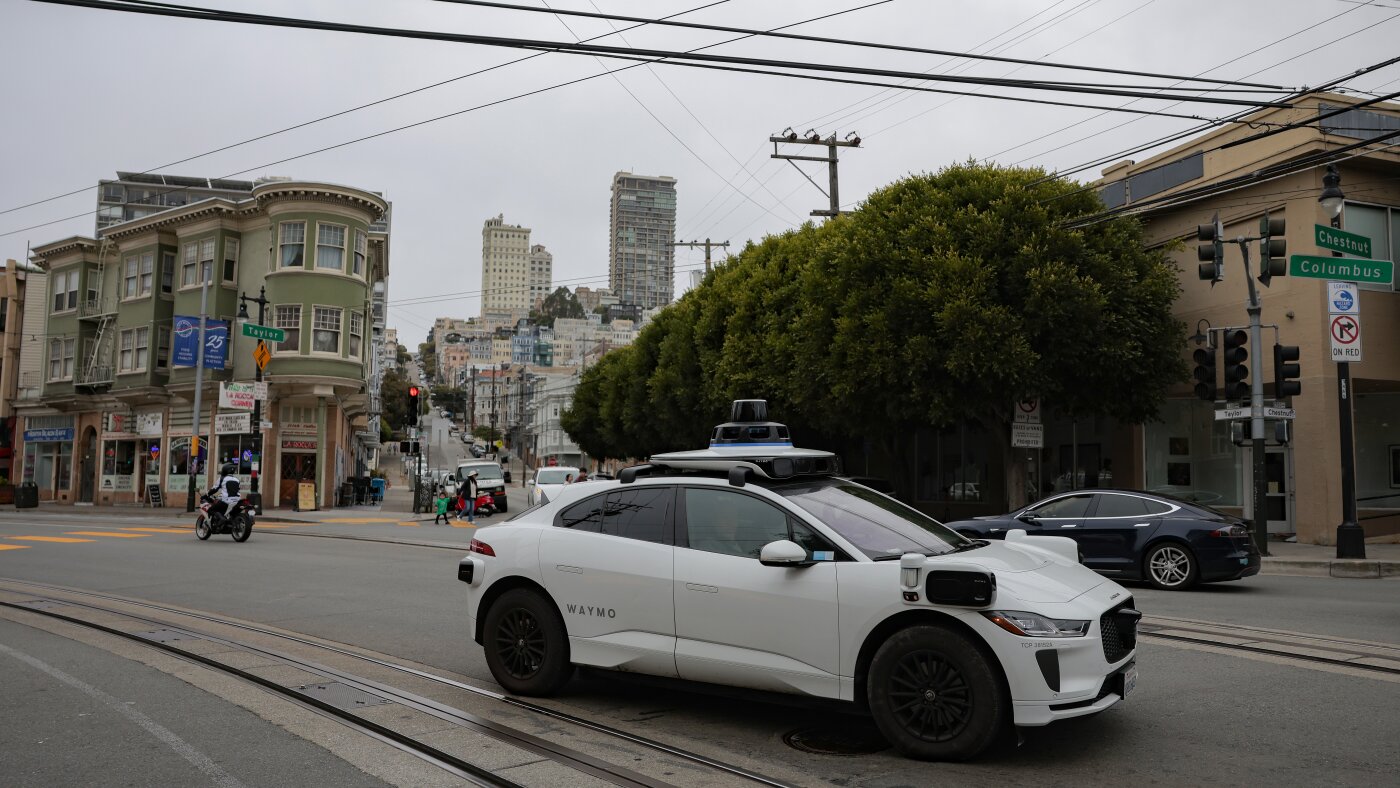
A Waymo robotaxi drives in San Francisco’s North Beach neighborhood this week.
Heather Diehl/Getty Images
hide caption
toggle caption
Heather Diehl/Getty Images
Police in San Mateo, Calif., posted Monday on social media that they had apprehended a pair of teenagers from a Waymo driverless robotaxi after the company alerted authorities to suspected criminal activity. It’s the latest incident involving video surveillance of passengers and others by autonomous vehicles — raising questions about the limits of privacy in such vehicles.
The Facebook post by the San Mateo County Police said: “Parents do you know where your teens are? @waymo does!”
The 15-year-olds were allegedly drinking alcohol and shooting toy guns from the car, according to the police. They said Waymo’s systems detected behavior that then triggered a safety response, after which the company disabled the vehicle and contacted police.
Waymo’s cars, equipped with an array of cameras, microphones and other sensors to monitor passengers and other nearby vehicles, are becoming more common in cities across the United States. Experts say the detention of the two teens in San Mateo highlights a potential — but not inevitable — trade-off between privacy and convenience. It also questions the extent to which companies similar to Waymo are required to hand over private data, including audio and video of passengers, in situations where a crime is suspected.
NPR reached out to Waymo, which is owned by Alphabet, the parent company of Google, for comment on the details of the San Mateo incident and how the company responded, but did not hear back. But on its website, the company says that as many as 29 cameras in its autonomous cars provide an all-around view and “are designed with high dynamic range and thermal stability, to see in both daylight and low-light conditions, and tackle more complex environments.”
“There already exist laws that govern duty to report or even duty to protect” for carriers such as Waymo, according to Alessandro Acquisti, a professor of information technology at the MIT Sloan School of Management. “The privacy problems arise when and if driverless carrier companies used such laws or ethical obligations as a pretext for blanket, indiscriminate accumulation of identifiable data for unspecified future purposes.”
That includes not just monitoring people inside the cars, but outside too. Take, for example, a hit-and-run investigation last year in Los Angeles. Media reported that the police inquiry was aided by video captured by a Waymo taxi that had a clear view of the crime. Critics suggested at the time that authorities were using the company’s vehicles as a mobile surveillance platform. And during 2025 protests in Los Angeles against Immigration and Customs Enforcement crackdowns, demonstrators vandalized Waymos, apparently angry that video recorded by the vehicles could be used by police, although there is no evidence that happened.
In a transparency report, Google says it received nearly 290,000 requests from governments worldwide in the first six months of 2025 for disclosure of user information across all its platforms, including Waymo. The company says that in more than 80% of the requests in those six months, some information was disclosed. “Google carefully reviews each request to make sure it satisfies applicable laws. If a request asks for too much information, we try to narrow it, and in some cases we object to producing any information at all,” the company says.
In an email to NPR, San Mateo Police Department spokesperson Jeanine Luna said that detaining the teens in the Waymo on Monday was “wholly appropriate” under the circumstances. “We received the call of a ‘firearm’ being shot from a moving vehicle,” she said. “Furthermore, the occupants were described as being possibly ‘intoxicated.’” she said.
“Being that the vehicle was disabled (the occupants had every right to exit the vehicle before police arrival, but they did not), a high-risk traffic stop was conducted to ensure the safety of all involved,” Luna added. “They were not arrested and were released to their parents, however, potential charges are still pending dependent on what the video from inside the vehicle shows.”
Autonomous taxis represent an ethical gray area
Robotaxis began to roll out across the U.S. in December 2018, when Waymo launched in Phoenix. These services have been used for less than a decade — so the norms surrounding them aren’t settled, experts agree.
The Facebook post may make Waymo passengers wonder what triggers a police intervention, says Irina Raicu, director of the Internet Ethics program at Santa Clara University. She has used Waymo’s driverless taxis and says ethically, the privacy issues surrounding them sit in a gray area. “There’s something about being in a car without another person that makes you think it’s private.”
“With all these recording devices, we don’t see them, [and] they’re not these obvious things being stuck in our faces,” Raicu adds.
That brings up a key issue: informed consent, Acquisti says.
“It is not clear the extent to which passengers … are reminded that when they step into the car, that they are being monitored, and most likely they are not told in its entirety how the data will be used,” he says.
Bruce Schneier, a cybersecurity and privacy expert and professor at the Munk School at the University of Toronto, believes that Waymo does have a compelling interest in protecting its vehicles. He compares monitoring a robotaxi via cameras to a human taxi driver keeping an eye on passengers in the rearview mirror.
“Maybe the driverless car comes back … and it has all of its cushions slashed, and it’s like, ‘Who the hell did that? Let’s go and look at the tape,’” Schneier suggests. “You can’t have sex in the back of a taxi, right? Someone would say, ‘Stop it.’”
He concludes that some supervision makes sense. In an Uber rideshare, he notes, “most of the time there’s a camera recording the back seat.” (Uber says on its website that it allows drivers to install such cameras for the purpose of “fulfilling transportation services.”)
Waymo robotaxis, while a fairly common sight in the San Francisco Bay Area, are still a novelty in much of the country. And many people are hesitant to ride in one, according to a Pew Research Center poll published this month. The survey found that only 5% of Americans had ever ridden in a driverless car. Meanwhile, 71% of those polled said they would feel uncomfortable in one, with only 7% saying they would be “extremely or very comfortable” riding in one.
For that reason, experts who spoke with NPR said they were optimistic that it’s not too late to shift gears on privacy norms and policies surrounding these vehicles.
Acquisti doesn’t see why privacy measures can’t be built into driverless vehicles.
“I would immediately challenge the notion that people have to be monitored,” he says, noting that privacy-preserving technologies exist and can be installed.
“Driverless cars are coming, but they don’t have to come in this particular incarnation,” Raicu says. “They’re still being designed and redesigned. It’s early days.”

Donald Trump has terminated the remaining members of the independent, federal commission that assists election administration officials nationwide just a few months before the midterm elections, multiple outlets reported Thursday.
The remaining three commissioners of the four-member bipartisan commission were forced out on Thursday in different ways. The one Republican appointee resigned and the other two, Democratic appointees were notified of their terminations via email from the White House presidential personnel office.
“On behalf of President Donald J Trump, I am writing to inform you that your position as Commissioner of the Election Assistance Commission is terminated, effective immediately. Thank you for your service,” the email, seen by Reuters, said.
The White House did not immediately respond to a request for comment.
The Election Assistance Commission serves as a “national clearinghouse of information on election administration”, accredits testing laboratories and certifies voting systems, and maintains the national mail-voter registration form developed by the National Voter Registration Act of 1993, according to the commission’s website. The terminations follow Trump and top administration officials’ advocacy to change vote-by-mail requirements and investigations into the 2020 election outcome, which Trump lost to Democrat Joe Biden.
“It is irresponsible and dangerous that this Administration remains dead set on causing chaos for our election officials across this country,” Arizona secretary of state Adrian Fontes said in a Thursday statement. “This move undermines the integrity of nonpartisan election administration.”
The 2002 law that established the commission, the Help America Vote Act, states the president can appoint replacements to the commission.
It is unclear how Trump will move ahead with the commission.
Reuters contributed reporting

Former U.S. Olympian David Hearn (left) walks with his attorney Norman Eisen to speak to reporters and protesters gathered after his arraignment at the Superior Court of the District of Columbia in Washington, D.C. on Thursday.
Finn Gomez/Getty Images
hide caption
toggle caption
Finn Gomez/Getty Images
Former U.S. Olympic canoeist David Hearn pleaded not guilty to damaging the Lincoln Memorial Reflecting Pool in D.C. Superior Court Thursday morning.
Federal prosecutors charged Hearn with a single count of destruction of property causing more than $1,000 in damage to the pool.

Hearn has previously claimed, which his attorneys repeated during a short press conference outside the court, that he simply touched the water in the pool out of curiosity.
The Trump administration had just completed a $14 million renovation of the pool.
But shortly after the work finished, peeling paint and algae gathered in the water. The remodel has been largely criticized as a massive failure and waste of taxpayer dollars.

Superior Court Judge Carmen McLean released Hearn on his own recognizance. His next hearing is scheduled for Aug. 5.
Norm Eisen, one of Hearn’s attorneys, spoke to reporters outside of court following the hearing. He said the administration is using Hearn as a “scapegoat … for their own failures.”
“It is not a crime to touch the reflecting pool, to touch water in the United States of America,” he said.
Prosecutors say there is a host of evidence against Hearn.
This is a developing story.
-

 West Virginia19 seconds ago
Helicopter crashes in Pocahontas County
-

 Wyoming3 minutes ago
Wyoming officials say Meta’s 715,000-square-foot data center is responsible for contaminating its water system with a rare bacterium | Fortune
-

 Crypto8 minutes ago
What Are KOLs Discussing About the Cryptocurrency Market Today?
-

 Finance15 minutes ago
From Love Island to Precious Metals, Prediction Markets Are Changing Finance | PYMNTS.com
-

 Fitness18 minutes ago
80-year-old fitness icon Joan MacDonald reveals her simple exercise for a stronger, more stable core
-

 Movie Reviews30 minutes ago
‘Gail Daughtry and the Celebrity Sex Pass’ Review: We’re Off to Hump the Wizard
-

 World38 minutes ago
Backlash on ethanol-blend fuel intensifies in India, puts carmakers in the dock
-
Politics48 minutes ago
Crews Drape Tarp Over White House in Latest Trump Restoration

