Connect with us

News

Starmer wields the knife after shaky 100 days in office

Published

on

Starmer wields the knife after shaky 100 days in office

Unlock the Editor’s Digest for free

After almost 100 days in office, Sir Keir Starmer on Sunday finally decided to get a grip on his stumbling administration. “Keir will always wield the knife when it needs to be done,” said one Labour MP. “Now he has.”

The departure of Sue Gray from her key role as Starmer’s chief of staff was the catalyst for Sunday’s complete overhaul of the Number 10 operation. Many were left wondering why it had taken the prime minister so long.

Starmer, who hired Gray in 2023 to help him prepare for government, had been loyal to his chief of staff in office, in spite of fierce internal criticism of her management style.

Advertisement

But those close to the prime minister say that a morose and fractious Labour conference in Liverpool last month convinced him he had to draw a line under the mis-steps that had dogged his first months in office.

“Keir came back from the conference pretty chastened,” said one Labour insider. “He realised he needed to get a grip on things.”

In Liverpool party members expressed their concern at how Starmer had cut winter fuel payments for 10mn pensioners, then appeared unable to contain a row over his receipt of £32,000 in “freebie” suits and glasses.

Gray had become a lightning rod for discontent, with hostile internal briefings about her £170,000 salary and alleged “control freakery”. Labour special advisers, or Spads, claimed she was partly responsible for holding down their salaries.

Gray’s allies said all of this was grotesquely unfair on a hard-working and loyal member of the Starmer team, a view shared by many cabinet members.

Advertisement

But one senior minister told the Financial Times: “It was only a question of when, not if. Not everything was her fault, but the transition to government, the situation with the Spads and the unending freebies clusterfuck were all on her and made her position untenable.”

A person close to the discussions over the Downing Street shake-up said that after returning from Liverpool — via the UN General Assembly in New York — Starmer began lamenting the fact that Gray had “become the story”. 

Gray acknowledged she had become a “distraction”. She will now take up a role as an adviser to Starmer on relations with the UK’s devolved nations and regions, but her grip on the levers of power in Number 10 is over.

The former civil servant was also blamed for being a bottleneck in appointing people to key jobs, a problem that was rectified by the prime minister on Sunday as he announced a dramatic overhaul of his team. 

Morgan McSweeney, who was on the long march in opposition with Starmer, replaces Gray as chief of staff. It was McSweeney who helped to slay the threat of the Corbynite left and then masterminded Labour’s landslide election victory in 2024.

Advertisement

But some question whether he is cut out to be a chief of staff, especially given his lack of Whitehall experience. “Morgan is very popular with Labour staffers — this is like a players’ revolt in a football dressing room,” said one Labour veteran. “But he’s not the sort of person who puts things down on paper.”

There was a long-standing narrative at Westminster that McSweeney was part of a “boys club” around Starmer that was treated with suspicion by Gray. 

Starmer appointed two women to work as deputy chiefs of staff alongside McSweeney — Vidhya Alakeson and Jill Cuthbertson — a move seen by some Labour MPs as a riposte to any suggestion that the boys club had won.

Gray did not have any deputy chiefs of staff, an omission seen in Labour circles as contributing to a lack of grip at the centre and a sign of her unwillingness to share responsibility with others. “That was her choice,” said one ally of Starmer.

While Alakeson and Cuthbertson are highly regarded in Number 10 — the former is Starmer’s political director and the latter is a long-term Starmer lieutenant — Gray’s departure leaves the centre decidedly short of Whitehall experience.

Advertisement

In despatching Gray to the UK’s regions and nations, he has brought into his inner circle people who were already part of his trusted gang. “It’s a circling of the wagons,” said one person close to Starmer.

The exception is James Lyons, a former Sunday Times political journalist, NHS communications chief and TikTok media executive hired by Starmer to beef up his media team, which will continue to be headed by director of communications Matthew Doyle.

Lyons will have a strategic comms role, including oversight of Downing Street’s “grid” of future announcements. It is a common complaint of Labour staffers that the grid, previously under Gray’s control, has been chaotic.

Pat McFadden, cabinet office minister and part of Starmer’s inner circle, is said by party insiders to have played a key role in the shake-up, being close to both McSweeney and Lyons. 

The result of Sunday’s upheaval is that Starmer ends his first 100 days in office with what looks more like a functioning Number 10 operation. Many Labour MPs, privately, believe it is not before time.

Advertisement

News

How a Beer Hall Keeps Up With a World Cup Crowd

Published

on

The fans see the games, the crowds, the food and the beer. But behind every World Cup watch party is a team working long before kickoff and well after the final whistle. We go behind the scenes at a beer hall in Brooklyn to see what it takes to serve a room full of soccer fans on game day.

Continue Reading

News

With the white nationalist group Patriot Front, what you see is not what you get

Published

on

With the white nationalist group Patriot Front, what you see is not what you get

Members of the group Patriot Front ride the subway as a commuter looks on, in Washington, D.C., on July 4.

Cheney Orr/Reuters


hide caption


toggle caption

Advertisement

Cheney Orr/Reuters

The sight of hundreds of masked men roaming the streets of Washington, D.C., on July Fourth weekend, wearing khakis, blue shirts and uniform patches, was chilling to some of the city’s residents.

For many Americans, it was the first they heard about Patriot Front, a white nationalist organization that was born out of the deadly 2017 Unite the Right rally in Charlottesville, Va. A now-viral Reuters photo prompted reflections on the experience of a lone African American woman who was photographed in a Metro subway car, surrounded by white supremacists.

The planned demonstration of force was timed to bring a fringe group of extremists into public view as the nation marked 250 years of its independence. Indeed, the stunt succeeded in earning the group media coverage across mainstream outlets, amplifying its brand and potential to reach new recruits. On this occasion, the members refrained from engaging in violence and property damage, projecting an image of law-abiding, orderly activism.

Advertisement

But those who are closely familiar with Patriot Front’s history and operations warn: Don’t believe what you see.

“That is not who they are in private,” said Len Kamdang, director of the Criminal Justice Project at the Lawyers’ Committee for Civil Rights Under Law. “Although they were on their best behavior [last] weekend, this is a dangerous group that commits acts of violence all over the country.”

Patriot Front’s history of violence and property damage

Kamdang’s organization sued members of Patriot Front for vandalizing a public mural dedicated to the tennis legend and Black activist Arthur Ashe in Richmond, Va., in 2021. Ashe, who was inducted into the International Tennis Hall of Fame in 1985, was born in Richmond and his legacy is a continuing source of pride to members of that community.

“A couple of Patriot Front members showed up under cover of night and vandalized the mural,” Kamdang said. “They painted white stencils all over. … They literally tried to whitewash him and they put their symbols of hate all over — their stencils, their slogans. And all the while they were caught on video. And that video leaked using some of the most horrible language that you can imagine.”

In many jurisdictions, law enforcement can seek additional hate crime charges or sentencing enhancements in cases where illegal acts appear to have been motivated by racial bias. But in this case, Kamdang said, Patriot Front members faced no criminal charges and their identities were only revealed when online activists later infiltrated the group and leaked internal records.

Advertisement
Continue Reading

News

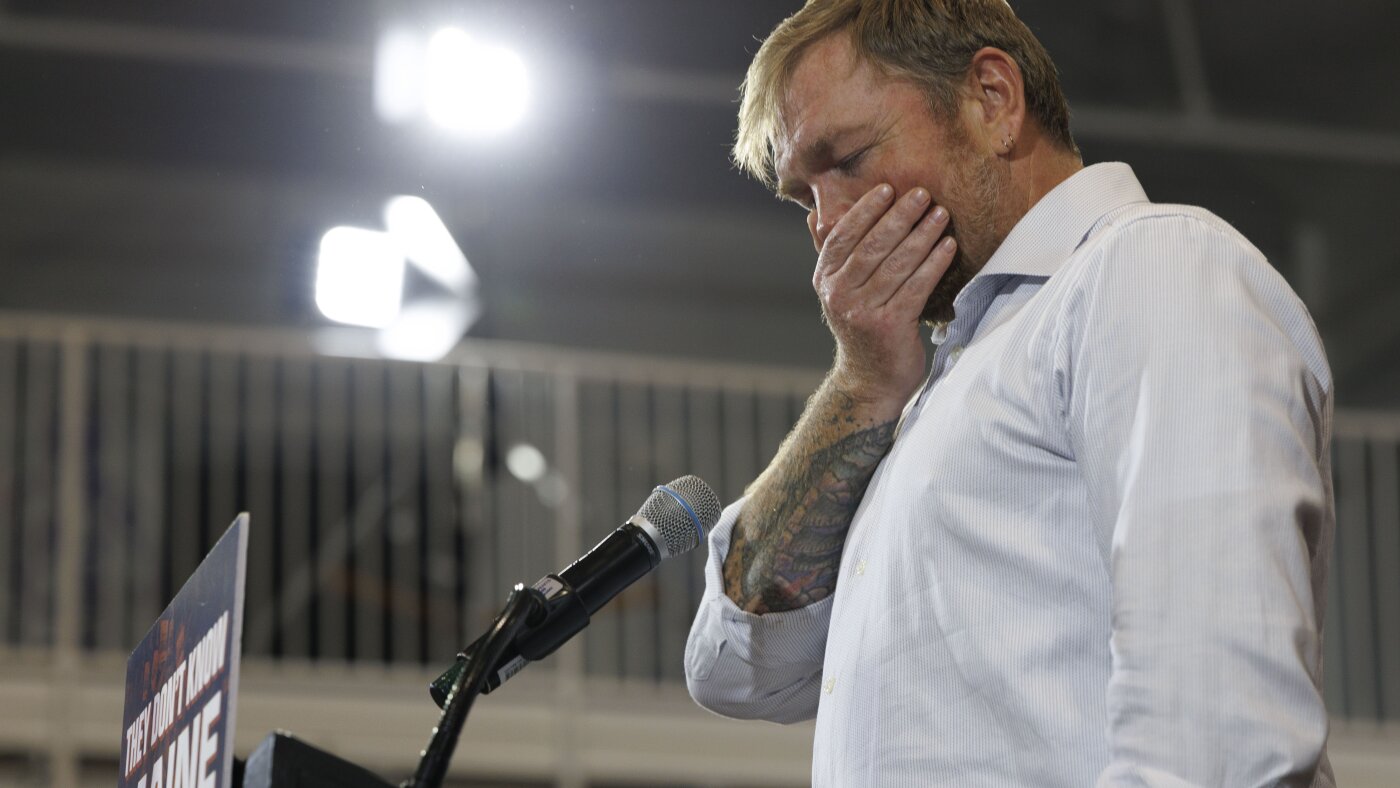
Graham Platner makes it official in Maine, submitting paperwork to leave Senate race

Published

on

Graham Platner makes it official in Maine, submitting paperwork to leave Senate race

Now-former Democratic Senate candidate Graham Platner speaks at his primary election night event on June 9 in Blue Hill, Maine. Platner officially dropped out of the race July 10 following rape allegations from a former romantic partner that he denies.

CJ Gunther/Getty Images


hide caption


toggle caption

Advertisement

CJ Gunther/Getty Images

Graham Platner, Maine’s Democratic nominee for Senate, is officially out of the race.

The Maine Secretary of State said Platner filed the necessary paperwork to withdraw his candidacy two days after he announced he planned to do so following an accusation of rape by a former romantic partner. Platner denies the allegation.

The Maine Democratic Party has until July 27 to pick Platner’s replacement.

Advertisement

In his withdrawal notice, Platner said “people are desperate for change” and that’s why they voted “for a new kind of politics” by making him the Democratic nominee. He expressed gratitude for those who supported his campaign and said that he will continue to fight for “the movement we have built together and the future we believe in.”

He ended his notice with a strong statement aligned with the progressive platform.

“F*ck ICE. Free Palestine. Up the Hearts.”

Platner announced his plan to withdraw from the race in an 11-minute video he posted to social media on July 8. He said he had no choice but to suspend his campaign, citing it was no longer viable financially.

Advertisement

“We are going to lose our ability to fundraise. We are going to lose our ability to access voter data. We are going to lose all of the things that any campaign needs on the basic level simply to function,” he said.

Platner added that dropping out was not an admission of guilt. Rather, the decision, he said, is to keep the progressive movement in Maine alive to defeat Republican Sen. Susan Collins in November. Platner blamed the “political establishment” for his downfall and argued the goal was to force him out of the race.

“We built a campaign. We engaged in electoral politics. We motivated people. We banded together. We did it the way that we were told we are supposed to make change and we won. And now they are not going to let us have it. Not if it’s me,” he said.

Continue Reading
Advertisement

Trending