Connect with us

News

Sinn Féin takes narrow lead in Ireland general election exit poll

Published

on

Sinn Féin takes narrow lead in Ireland general election exit poll

Unlock the Editor’s Digest for free

Ireland’s general election delivered an early surprise on Friday as Sinn Féin, the pro-reunification party, emerged with a narrow lead in an exit poll.

But the country’s main opposition party, which had rattled business leaders in the campaign with promises of policy changes, tax cuts and spending pledges, looked set to struggle to form a government, compared with the combined forces of outgoing partners Fine Gael and Fianna Fáil, who were only slightly behind.

Sinn Féin won 21.1 per cent of first preference votes under Ireland’s proportional representation system, according to the exit poll conducted by Ipsos B&A; the conservative Fine Gael was on 21 per cent and centrist party Fianna Fáil had 19.5 per cent in the same survey.

Advertisement

Matt Carthy, Sinn Féin’s director of elections, called it a “phenomenal result” for the nationalist party, which won the most first-preference votes at the last election in 2020, but has plummeted in the polls in the past year.

“Sinn Féin may emerge from these elections as the largest political party,” he told Irish public broadcaster RTÉ.

The result was unexpected since Prime Minister Simon Harris’s conservative Fine Gael — which has been in office since 2011 and is seeking a record fourth consecutive term — had been falling in opinion polls after a series of campaign mis-steps, and had been in third place going into the election. Fianna Fáil had been seen as being ahead of Sinn Féin in first place.

Some content could not load. Check your internet connection or browser settings.

Longtime rivals before teaming up in government in 2020, Fine Gael and Fianna Fáil had warned voters of the dangers of turfing them out given the risk of transatlantic trade shocks under a new term for Donald Trump.

Advertisement

Ireland has built its economic model on attracting foreign investment, including major US tech and pharma giants, whose huge corporation taxes have delivered eye-popping surpluses that could be at risk if the US president-elect follows through on tax and tariff threats.

Both Fianna Fáil and Fine Gael have vehemently ruled out any coalition with Sinn Féin, which was once the mouthpiece of IRA paramilitaries in Northern Ireland’s Troubles conflict. This would make its path to power complicated even if it emerges as the country’s most popular party.

Gary Murphy, politics professor at Dublin City University, said “on these numbers, a continuation of Fianna Fáil and Fine Gael and one other looks the most likely”.

But Aidan Regan, a professor of political economy at University College Dublin, wrote on social media platform X that “It will take four parties to form a stable government” given Ireland’s increasing political fragmentation.

Fianna Fáil’s director of elections, Jack Chambers, looked unperturbed.

Advertisement

“It’s all in the margin of error,” he told RTÉ. “It’s a three-way race now.” The exit poll had a margin of error of 1.4 per cent.

Damien English of Fine Gael called his party’s result “a very solid performance . . . Hopefully tomorrow will bring us even better news.”

Fine Gael Taoiseach Simon Harris voted with his family in his Wicklow constituency
Fine Gael leader Simon Harris only became prime minister in April this year after his predecessor abruptly resigned © Reuters

Vote counting begins on Saturday.

Under Ireland’s proportional representation system, voters rank candidates according to their preference. As such, the way that lower-preference votes are transferred between parties will determine the final outcome.

According to the exit poll, which was carried out on behalf of the Irish Times, broadcasters RTÉ and TG4 and Trinity College Dublin, Fianna Fáil and Fine Gael both scored 20 per cent of second-preference votes, ahead of Sinn Féin on 17 per cent.

Carthy said that if Sinn Féin’s lead was confirmed, there would be an “obligation” on other parties to “reflect on the new make-up of the Dáil [lower house of parliament]”.

Advertisement

Sinn Féin had campaigned to oust the two parties that have dominated Irish politics for a century and deliver sweeping change to end the country’s housing crisis.

But Fianna Fáil and Fine Gael will be eyeing potential junior partners among the smaller parties in a bid to secure the 88 seats needed to form a government.

The small leftist Social Democrats party scored 5.8 per cent; Labour had 5 per cent. The Green party, the junior member of the outgoing coalition, had 4 per cent, according to the exit poll. Independents also polled strongly.

Social Democrats leader Holly Cairns was unable to vote after giving birth on election day.

Advertisement

News

How a Beer Hall Keeps Up With a World Cup Crowd

Published

on

The fans see the games, the crowds, the food and the beer. But behind every World Cup watch party is a team working long before kickoff and well after the final whistle. We go behind the scenes at a beer hall in Brooklyn to see what it takes to serve a room full of soccer fans on game day.

Continue Reading

News

With the white nationalist group Patriot Front, what you see is not what you get

Published

on

With the white nationalist group Patriot Front, what you see is not what you get

Members of the group Patriot Front ride the subway as a commuter looks on, in Washington, D.C., on July 4.

Cheney Orr/Reuters


hide caption


toggle caption

Advertisement

Cheney Orr/Reuters

The sight of hundreds of masked men roaming the streets of Washington, D.C., on July Fourth weekend, wearing khakis, blue shirts and uniform patches, was chilling to some of the city’s residents.

For many Americans, it was the first they heard about Patriot Front, a white nationalist organization that was born out of the deadly 2017 Unite the Right rally in Charlottesville, Va. A now-viral Reuters photo prompted reflections on the experience of a lone African American woman who was photographed in a Metro subway car, surrounded by white supremacists.

The planned demonstration of force was timed to bring a fringe group of extremists into public view as the nation marked 250 years of its independence. Indeed, the stunt succeeded in earning the group media coverage across mainstream outlets, amplifying its brand and potential to reach new recruits. On this occasion, the members refrained from engaging in violence and property damage, projecting an image of law-abiding, orderly activism.

Advertisement

But those who are closely familiar with Patriot Front’s history and operations warn: Don’t believe what you see.

“That is not who they are in private,” said Len Kamdang, director of the Criminal Justice Project at the Lawyers’ Committee for Civil Rights Under Law. “Although they were on their best behavior [last] weekend, this is a dangerous group that commits acts of violence all over the country.”

Patriot Front’s history of violence and property damage

Kamdang’s organization sued members of Patriot Front for vandalizing a public mural dedicated to the tennis legend and Black activist Arthur Ashe in Richmond, Va., in 2021. Ashe, who was inducted into the International Tennis Hall of Fame in 1985, was born in Richmond and his legacy is a continuing source of pride to members of that community.

“A couple of Patriot Front members showed up under cover of night and vandalized the mural,” Kamdang said. “They painted white stencils all over. … They literally tried to whitewash him and they put their symbols of hate all over — their stencils, their slogans. And all the while they were caught on video. And that video leaked using some of the most horrible language that you can imagine.”

In many jurisdictions, law enforcement can seek additional hate crime charges or sentencing enhancements in cases where illegal acts appear to have been motivated by racial bias. But in this case, Kamdang said, Patriot Front members faced no criminal charges and their identities were only revealed when online activists later infiltrated the group and leaked internal records.

Advertisement
Continue Reading

News

Graham Platner makes it official in Maine, submitting paperwork to leave Senate race

Published

on

Graham Platner makes it official in Maine, submitting paperwork to leave Senate race

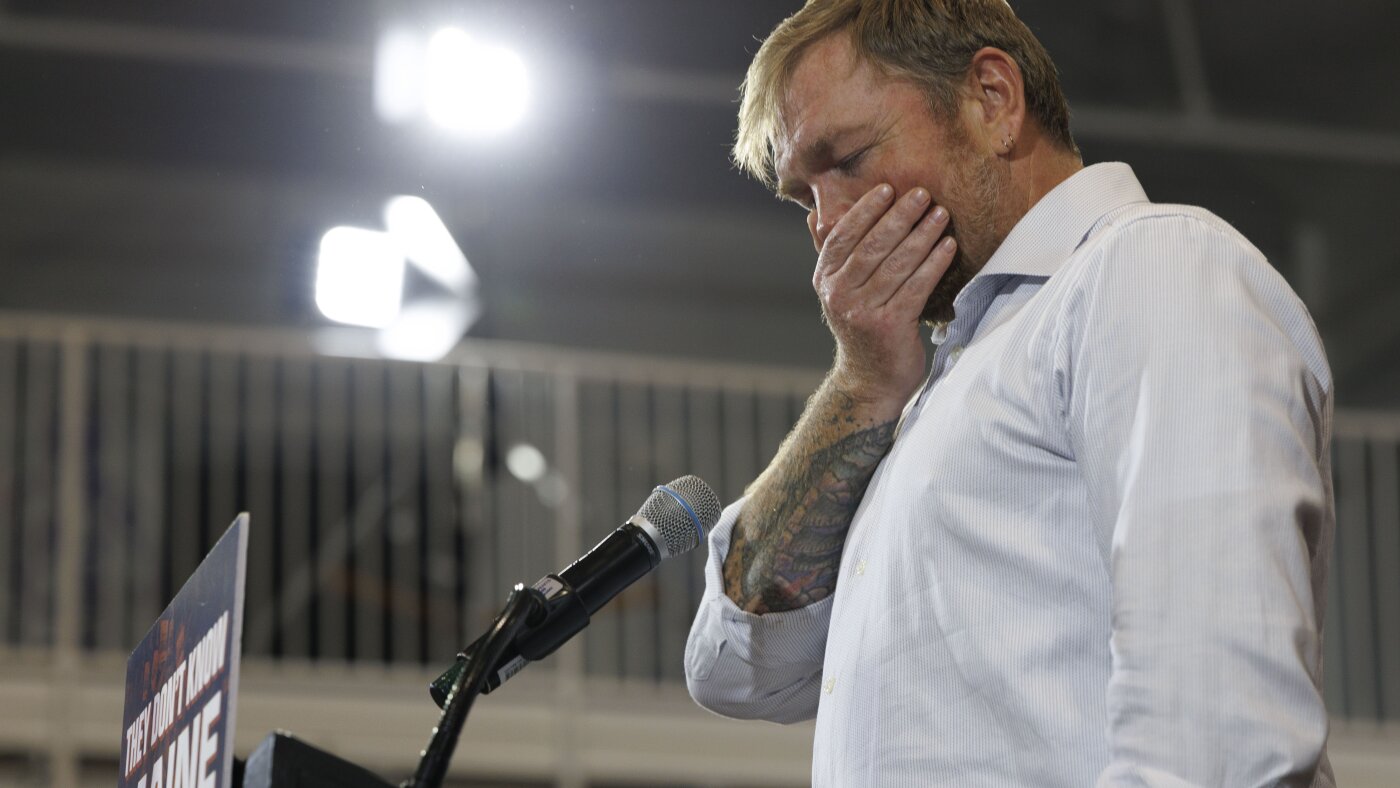
Now-former Democratic Senate candidate Graham Platner speaks at his primary election night event on June 9 in Blue Hill, Maine. Platner officially dropped out of the race July 10 following rape allegations from a former romantic partner that he denies.

CJ Gunther/Getty Images


hide caption


toggle caption

Advertisement

CJ Gunther/Getty Images

Graham Platner, Maine’s Democratic nominee for Senate, is officially out of the race.

The Maine Secretary of State said Platner filed the necessary paperwork to withdraw his candidacy two days after he announced he planned to do so following an accusation of rape by a former romantic partner. Platner denies the allegation.

The Maine Democratic Party has until July 27 to pick Platner’s replacement.

Advertisement

In his withdrawal notice, Platner said “people are desperate for change” and that’s why they voted “for a new kind of politics” by making him the Democratic nominee. He expressed gratitude for those who supported his campaign and said that he will continue to fight for “the movement we have built together and the future we believe in.”

He ended his notice with a strong statement aligned with the progressive platform.

“F*ck ICE. Free Palestine. Up the Hearts.”

Platner announced his plan to withdraw from the race in an 11-minute video he posted to social media on July 8. He said he had no choice but to suspend his campaign, citing it was no longer viable financially.

Advertisement

“We are going to lose our ability to fundraise. We are going to lose our ability to access voter data. We are going to lose all of the things that any campaign needs on the basic level simply to function,” he said.

Platner added that dropping out was not an admission of guilt. Rather, the decision, he said, is to keep the progressive movement in Maine alive to defeat Republican Sen. Susan Collins in November. Platner blamed the “political establishment” for his downfall and argued the goal was to force him out of the race.

“We built a campaign. We engaged in electoral politics. We motivated people. We banded together. We did it the way that we were told we are supposed to make change and we won. And now they are not going to let us have it. Not if it’s me,” he said.

Continue Reading
Advertisement

Trending