News
‘Ridiculous and just plain false’: FEMA administrator knocks Trump’s Hurricane Helene recovery claims


Trump returns to Butler, PA months after assassination attempt
Former president Donald Trump returned to the venue where he survived his first assassination attempt on July 13.
With the federal response to Hurricane Helene becoming a major focus of the presidential campaign in the home stretch, President Joe Biden’s administration continued to push back Sunday against former President Donald Trump’s unfounded claims about storm recovery.
Appearing on ABC’s “This Week” Sunday, Federal Emergency Management Agency Administrator Deanne Criswell said her agency has all the resources it needs to respond to Helene, which ravaged parts of Florida, Georgia, North Carolina and other states.
North Carolina and Georgia are key swing states, which has heightened the political stakes for the recovery effort and the jockeying around it.
Criswell defended FEMA’s response and shot down Trump’s claims that the agency is short on disaster relief funds because money has been diverted to help undocumented immigrants, and that help is being withheld from Republican areas, calling such assertions “frankly ridiculous and just plain false.”
“This kind of rhetoric is not helpful to people,” she added. “It’s really a shame that we’re putting politics ahead of helping people.”
Criswell noted that state and local officials have rebutted “this dangerous, truly dangerous narrative that is creating this fear.”
Trump has made a series of unfounded claims about Helene recovery at multiple events in recent days. He said at a rally in Saginaw, Michigan, Thursday that “Kamala spent all her FEMA money, billions of dollars, on housing for illegal immigrants.”
“They have almost no money, because they spent it all on illegal immigrants,” Trump said, adding that “They stole the FEMA money, just like they stole it from a bank, so they could give it to their illegal immigrants.”
FEMA does have a housing program, the Shelter and Services Program, that provides “financial support to non-federal entities to provide humanitarian services to noncitizen migrants following their release” from detention facilities, according to its website. It has $650 million in funding this year, but that money is separate from disaster relief funds.
“No money is being diverted from disaster response needs. None,” the White House said in a news release.
Department of Homeland Security Secretary Alejandro Mayorkas told reporters during a White House press briefing last week that FEMA has enough disaster relief money to meet current needs, but not for additional storms.
“We are meeting the immediate needs with the money that we have,” Mayorkas said. “We are expecting another hurricane hitting. We do not have the funds. FEMA does not have the funds to make it through the season and… what is imminent.”
Congress recently appropriated $20 billion in disaster funds, but Biden said in a letter this week that more is needed.
“Without additional funding, FEMA would be required to forego longer-term recovery activities in favor of meeting urgent needs,” Biden wrote, saying the Small Business Administration is particularly in need of funds.
Fact Check Image of Donald Trump wading through flood water is AI-generated
House Speaker Mike Johnson, R-La., was asked on “Fox News Sunday” about Biden’s letter and said “Congress will provide, we will help the people in these disaster prone areas.”
Johnson was pressed about Trump conflating FEMA funds for the Shelter and Services Program with disaster relief money and conceded that “the streams of funding are different, that is not an untrue statement of course.” But he argued FEMA shouldn’t be spending any money “for resettling illegal aliens who have come across the border.”
Trump continued to criticize the Helene recovery effort at a rally in Butler, Pennsylvania, Saturday. He zeroed in on the $750 payment FEMA offers disaster victims to help them with immediate needs.
“Remember, $750 to people whose homes have been washed away, and yet we send tens of millions of dollars to foreign countries that most people have never heard of,” Trump said. “They’re offering them $750 as they’ve been destroyed. “
The $750 Serious Needs Assistance helps “cover essential items like food, water, baby formula, breastfeeding supplies, medication and other emergency supplies,” according to the White House press release.
“There are other forms of assistance that you may qualify for to receive, and Serious Needs Assistance is an initial payment you may receive while FEMA assesses your eligibility for additional funds,” the release continues.
Republican National Committee co-chair Lara Trump, the daughter-in-law of the former president, also answered questions about Trump’s Helene claims during an appearance on CNN’s “State of the Union” Sunday. Host Dana Bash played a clip of Sen. Thom Tillis, R-N.C., praising the response to Helene.
“I’m actually impressed with how much attention was paid to region that wasn’t likely to have experienced the impact that they did,” Tillis said, adding “I’m out here to say that we’re doing a good job.”
‘Life-threatening’: Milton forecast to become hurricane, target battered Florida
Lara Trump defended the criticism of Helene recovery as “coming directly from people there.”
“You can go online, you can look at videos of people recording themselves and posting online saying: ‘We need help, no one has come here, we have nothing,” Trump said.



Washington — Republican Rep. Tom Kean Jr. of New Jersey will return to Congress on June 30, his spokesperson said, after being away since March in an unexplained absence that has confounded Capitol Hill.
“Congressman Kean is eager to return to in person work on June 30 and resume a full schedule,” Kean’s spokesperson, Harrison Neely, told CBS News on Thursday. The New Jersey Globe first reported on his return date.
Kean’s whereabouts since he last voted on March 5 have not been disclosed. When he first made a statement about the absence in late April, the New Jersey Republican said he was addressing a “personal medical issue.”
Kean said earlier this month that he would return to Washington within a matter of weeks, at which point he would provide more details about his health.
“Right now I am focused on my recovery and under the advice of healthcare professionals, I will transition from virtual work to in person work within a matter of weeks. At that time I will be completely transparent as to the nature of my medical condition,” Kean said in a June 2 statement released by his campaign.
The statement came hours before polls closed in New Jersey’s GOP primary for his seat, in which he ran unopposed.
He has missed more than 130 votes during his absence.
House Speaker Mike Johnson told reporters earlier this month that he had recently spoken with Kean. Johnson said he was aware of the health issue, but would not disclose the details.
“What he’s dealing with is not very common and not a big thing,” Johnson said.

new video loaded: Obama Presidential Center Opens in Chicago
By Shawn Paik
June 18, 2026

The National Constitution Center in Philadelphia offers guided tactile tours aimed at blind and low vision visitors in a gallery called Signers’ Hall. Museum educator Sydney Wharton traces visitor Tim Kelly’s Jr. hands over the statue of Benjamin Franklin as she leads him and his father, Tim Kelly Sr., through the gallery.
Rachel Wisniewski for NPR
hide caption
toggle caption
Rachel Wisniewski for NPR
Press the “Listen” button below to hear the story text, read by reporter Jonaki Mehta.
PHILADELPHIA — About a dozen visitors pause at the entrance to a gallery filled with statues of 42 men who had gathered here more than two centuries ago for the signing of the U.S. Constitution. The statues appear to be in motion, in conversation or deep in thought.
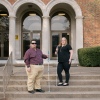
Standing among and touching their life-size figures, hands and faces drops visitors into that consequential historic moment.
“They feel like real people,” Grace Engle, a museum educator at the National Constitution Center (NCC), says to the tour group. “Except they might let you touch them a little more than your average individual might on a first meeting.”
As America recognizes 250 years of existence, this museum in the nation’s founding city has begun offering guided tactile tours aimed at blind and low vision visitors in a gallery called “Signers’ Hall.”

Left: Simon Bonenfant works with the organization Philly Touch Tours and helped train the museum educators leading the tours.
Right: Bonefant engages with George Washington’s face and head.
Rachel Wisniewski for NPR
hide caption
toggle caption
Rachel Wisniewski for NPR
The Americans with Disabilities Act (ADA) of 1990 required most public institutions like museums to make buildings themselves accessible, but access to exhibits inside is often still limited. The NCC joins a growing number of museums nationwide that have, in recent years, incorporated accessibility options like sensory-friendly days into their programming, though “touch tours” are less common.
Visitor Tim Kelly Jr. runs his fingers over Benjamin Franklin’s figure. “Everything feels so distinct on him,” he says. “He’s seated. I could also feel the wrinkles on his face because he was 81 years old at the time of the convention.”
Kelly says it’s refreshing to experience a tour tailored to the way he learns: The museum’s guides provide detailed descriptions of what can be seen and felt, while weaving in a history lesson. Pointing to Eldbridge Gerry in one corner of the room, Grace Engle says, “He is who you have to blame or thank for the beauty of gerrymandering,” explaining that Gerry had once redrawn a district in the shape of a salamander. “And so then a cartoonist deems it gerrymandering.”

The National Constitution Center in Philadelphia is participating in the nation’s 250th anniversary, in part, by expanding access to their exhibits to visitors with disabilities.
Rachel Wisniewski for NPR
hide caption
toggle caption
Rachel Wisniewski for NPR
At other moments, museum staff trace visitors’ hands over the expressive faces, clothing and hands of the statues, all while guiding them safely through the crowded space.
Kristina Marinello, senior director of museum experience, says this gallery has long invited touching. “Ben Franklin’s hands are super shiny because people have kind of always touched him no matter what. Kids like to sit on his lap.” But the center only began offering these tours officially in April, after staff trained with Philly Touch Tours, an organization that works with museums far and wide to make them more accessible.

Left: Replicas of artifacts are available as part of the tactile friendly tours the NCC now offers.
Right: Jeff and Sharon Clark touch the replica of an antique fabric. They have been to the NCC before it offered tactile tours and say the experience now is much improved.
Rachel Wisniewski for NPR
hide caption
toggle caption
Rachel Wisniewski for NPR
Trish Maunder, one of the group’s founders, says “Our mantra is ‘seeing may be believing, but when you touch, you know.’” Maunder, whose daughter is blind, calls touch the “mother sense,” one she thinks people lose connection with as they get older. She hopes tours like this become more prevalent and will help sighted and blind people alike reconnect with that sense. “Your body holds on to that sort of muscle memory, so now you carry that with you.”
Over the last two decades, museums around the country have incorporated accessibility into their programming, says Heather Pressman, who teaches courses on museums and accessibility at Johns Hopkins University. She says meeting ADA accessibility requirements “is the bare minimum.” Ensuring the artifacts in a museum are accessible takes more work, but it doesn’t have to cost much, she says. “Something super simple for people who have low vision is just creating large print labels.” Pressman says exhibits with calming sensory experiences for neurodivergent visitors are another cheap option that’s becoming more widespread. For museums with valuable, ancient artifacts, creating replicas that can be held is also a step toward accessibility.

Left: In addition to touch tours, the museum regularly holds “sensory-friendly” days for neurodivergent visitors with dimly lit rooms and sensory toys. They’re also often intended to be kid-friendly experiences.
Right: The theater in the Constitution Center is often reserved as a quiet room on sensory-friendly days.
Rachel Wisniewski for NPR
hide caption
toggle caption
Rachel Wisniewski for NPR
While accessibility programming is never complete, Pressman says it tends to open their doors to more people than museum staff may realize. “How many of us are now wearing glasses in our 40s? People can also temporarily have a disability, like you break your leg,” for example, she says. In fact, nearly a third of the U.S. population has disabilities.
Kristina Marinello says she has been working on expanding accessibility at the NCC in many ways, including through sensory-friendly days that include features like dimly lit, silent rooms. “Those first three words of the Constitution — ‘we the people’ — we want to stand by that and make sure everybody feels that,” she says.

Left: Akosua “Kosi” Asabere has been on a touch tour at the NCC once before. She says, for once, she doesn’t feel like an afterthought in a museum-going experience.
Right: Asabere feels the cuff of George Washington’s sleeve.
Rachel Wisniewski for NPR
hide caption
toggle caption
Rachel Wisniewski for NPR
As the Constitution Center’s most recent tactile tour comes to a close, second-time visitor Akosua “Kosi” Asabere shares some reflections. “Standing in Signers’ Hall and running my fingers over those bronze statues, I felt this profound sense of reverence, but I also felt deeply conflicted,” she says. Asabere is a software engineer who works on digital accessibility and says she can’t help but think about the nation’s founding document through that lens.
“It was a brilliant document, but it had massive systemic bugs. Women were left out. Black people were left out. Disabled people were left out.”
At the same time, she’s encouraged by places like the National Constitution Center, which she says are taking steps to ensure historically marginalized people, including those with disabilities, are no longer an afterthought.
Edited by: Nirvi Shah
Visual design and development by: LA Johnson
-
 Lifestyle28 minutes ago
The second life of a classic: ‘Amores Perros’ is remastered and back in theaters
-

 Technology37 minutes ago
Valve is so behind on Steam Controller orders that some won’t ship until 2027
-

 World43 minutes ago
From bear hugs to handshakes: How India lost its edge with Trump while Pakistan quietly gained ground
-

 Politics50 minutes ago
New poll reveals where Americans stand after Trump agreement with Iran
-

 Health53 minutes ago
No sex for 10 weeks? Championship team’s playoff strategy raises eyebrows
-

 Sports58 minutes ago
2026 FIFA World Cup Golden Boot Race Tracker: Lionel Messi Is Alone At The Top
-

 Technology1 hour ago
McDonald’s AI drive-thru may take your next order
-
Business1 hour ago
Uber, California lawyers say deal reached to avert dueling ballot initiative showdown


