News
Martin E. Marty, Influential Religious Historian, Dies at 97


Martin E. Marty, a pre-eminent religious historian, prolific author, dependable exponent of mainstream Protestantism and staunch champion of pluralism, died on Tuesday in Minneapolis. He was 97.
His death at a retirement home, where he had lived since 2022, was confirmed by his son Peter.
In more than 60 books, thousands of articles and as what he described as a “peregrinating lecturer,” Dr. Marty promoted what he called public theology, or the confluence of fundamental cultural and religious conventions for the common good.
He had “a knack for translating complex ideas into graspable takeaways for diverse audiences,” Peter Marty wrote in an online tribute. Time magazine said he was “generally acknowledged to be the most influential living interpreter of religion in the U.S.”
He disdained extremism and fundamentalism, both by Islamist terrorists and right-wing Protestants. And he warned, in “The One and the Many: America’s Struggle for the Common Good” (1997), that the culture wars had undermined the ideals of e pluribus unum and challenged Americans’ shared heritage.
The nation had fractured, he wrote, between “totalists,” who felt left behind and belittled, and “tribalists,” whose individual pride in race, religion, ethnicity and gender circumscribed their vision of the American mosaic.
The threat of such division to the American experiment was a theme he returned to frequently.
“Nothing is more important than to keep the richness of our pluralism alive,” Dr. Marty once wrote. “To be aware of many different people and different ways, and deal with it.”
In a review of Dr. Marty’s 1991 book, “Modern American Religion, Volume Two,” the Stanford historian David M. Kennedy wrote that “For all the raucous contention he chronicles, Mr. Marty remains an optimist. It is, he concludes in an eloquent peroration, with a nod to James Madison, precisely the plurality of religious voices that has insured the integrity of the social fabric by preventing the lasting dominance of any single group.”
Despite its historical ebb and flow, Dr. Marty insisted that mainstream Protestantism exerted profound influence over American public policy, particularly in the 19th century, though he predicted that no single denomination would ever exert the same degree of dominance again.
“Their winning — at least through their pioneering adventures on fronts dealing with civil rights, internationalism, ecumenism, many issues of sexuality and gender, friendliness to once-warred-against science, and much more — never meant complete victory,” he wrote in The Christian Century magazine in 2013.
“But it did mean,” he added, “that through the years, at least, significant leaders risked much to express their faith beyond church walls, in the larger culture.”
Dr. Marty was one of those leaders.
He marched for civil rights in Selma, Ala., with the Rev. Dr. Martin Luther King Jr., attended the Second Vatican Council as a Protestant observer, and helped found the antiwar organization Clergy and Laymen Concerned About Vietnam. He was president of the American Academy of Religion and the American Society of Church history,
His scholarly achievements were legion. With a former student, R. Scott Appleby, he directed the six-year Fundamentalism Project of the American Academy of Arts and Sciences beginning in 1988, which explored conservative religious movements.
“Only an intellectual giant with Marty’s combination of multidisciplinary fluency and vast erudition could have foreseen the inbreaking of wave upon wave of modern anti-pluralist, anti-modernist assaults upon the liberal worldviews and institutions from the ‘benighted’ margins of Western and westernized societies,” Professor Appleby, who teaches global affairs at the University of Notre Dame, said in a statement after Dr. Marty’s death.
“Marty stayed true to his instincts to come ‘not to condemn, not to praise, but to understand,’” Professor Appleby added.
In 1972 Dr. Marty won a National Book Award for “Righteous Empire: The Protestant Experience in America” (1971).
Among his other books were “A Short History of Christianity” (1959), “A Cry of Absence” (1983), “Pilgrims in Their Own Land: Five Hundred Years of Religion in America” (1984), and “A Short History of American Catholicism” (1995).
“His published output was not only breathtaking but unparalleled among religious historians of any field,” Grant Wacker, an emeritus professor of Christian history at Duke University and a biographer of the Rev. Billy Graham, said in an email. “His wit was legendary. And his heart overflowed with simple human kindness.”
Writing for a Divinity School bulletin in 2018, Professor Wacker quoted an example: “One of the real problems in modern life is that people who are good at being civil lack strong convictions and people who have strong convictions lack civility.”
Martin Emil Marty was born on Feb. 5, 1928, in West Point, Neb. His father, Emil, was a parochial school teacher and organist at Lutheran churches in Nebraska and Iowa. His mother was Anne Louise (Wuerdemann) Marty.
A graduate of a Lutheran preparatory school, he attended Concordia College, Washington University and Concordia Seminary, where he earned a bachelor’s in divinity in 1949 and a master’s in 1952. He received a Master of Sacred Theology degree from the Lutheran School of Theology at Chicago in 1954 and a doctorate from the University of Chicago in 1956.
As an ordained minister in the Evangelical Lutheran Church in America, he served as a pastor in Washington, D.C., Maryland and Chicago’s suburbs. In 1963, he was hired as an associate professor of religious history at the University of Chicago Divinity School, where he taught until 1998.
In 1952 he married Elsa L. Schumacher; she died in 1981. In 1982, he married Harriet J. Meyer, a voice coach and the widow of a seminary classmate.
In addition to his wife and his son Peter, the publisher of The Christian Century magazine, he is survived by three other sons from his first marriage, Joel, Micah and John, who is a Minnesota state senator; a foster daughter, Fran Garcia Carlson; a foster son, Jeff Garcia; a stepdaughter, Ursula Meyer; nine grandchildren and 18 great-grandchildren.
When he retired as a professor on his 70th birthday, the Divinity School honored him by naming the research center he founded in 1979 as the Martin Marty Center for the Public Understanding of Religion.
Asked by the University of Chicago Magazine in 1998 how he’d like to be remembered, he said: “That I was a good teacher.”
In the Mount Rushmore of American religious history and virtue, Professor Wacker once said fulsomely, Dr. Marty “might well rank as the fourth member,” after Dr. King, Billy Graham and Jonathan Edwards, the 18th-century Congregationalist theologian.
“For Marty, the only real swear word was tribalism — watching out for my interest, my family, my town, my country, my tribe — at the expense of others,” Professor Wacker said in an email. “Everyone, and he meant everyone, deserved a seat at the table of public discussion as long as they were willing to play by the rules of civility and reasoned examination of the evidence.”



US negotiators to head to Pakistan and Iranian cargo ship seized – a recappublished at 00:37 BST 20 April
Tankers in the Strait of Hormuz on Saturday
Here’s a recap of the latest developments.
US negotiators will head to Pakistan on Monday with the intention of holding further talks on ending the war, Trump says – but Iranian state media cites unnamed officials as saying Tehran has “no plans for now to participate”.
The prospect of further high-level negotiations – a White House official says Vice-President JD Vance will attend – comes amid reports of fresh attacks on commercial vessels.
Trump says the navy intercepted and took “custody” of an Iranian tanker attempting to pass through the US blockade, “blowing a hole” in the ship’s engine room in the process.
Earlier, in the same post announcing his representatives would travel for more talks, Trump renewed his threat to destroy Iranian energy sites and bridges if no deal is reached.
Reports in Iranian media over the weekend suggest Iran is continuing to work on plans to potentially apply a toll to ships passing through the strait – although it’s unclear if such a move will be implemented.
Iranian state TV cites unnamed officials as saying that “continuation of the so-called naval blockade, violation of the ceasefire and threatening US rhetoric” are slowing progress in reaching an agreement.
Trump also accused Iran of violating the ceasefire, saying more commercial ships have been attacked by Iran in the Strait of Hormuz.
A UK maritime agency reported two commercial ships came under fire in the strait on Saturday.
Iran’s foreign minister had said on Friday that the strait would be opened – which was shortly followed by Trump saying the US naval blockade of Iranian ports would remain in place until a deal is reached. Iran has since said the strait is closed again.

new video loaded: 8 Children Killed in Louisiana Shooting, Police Say
By Christina Kelso
April 19, 2026
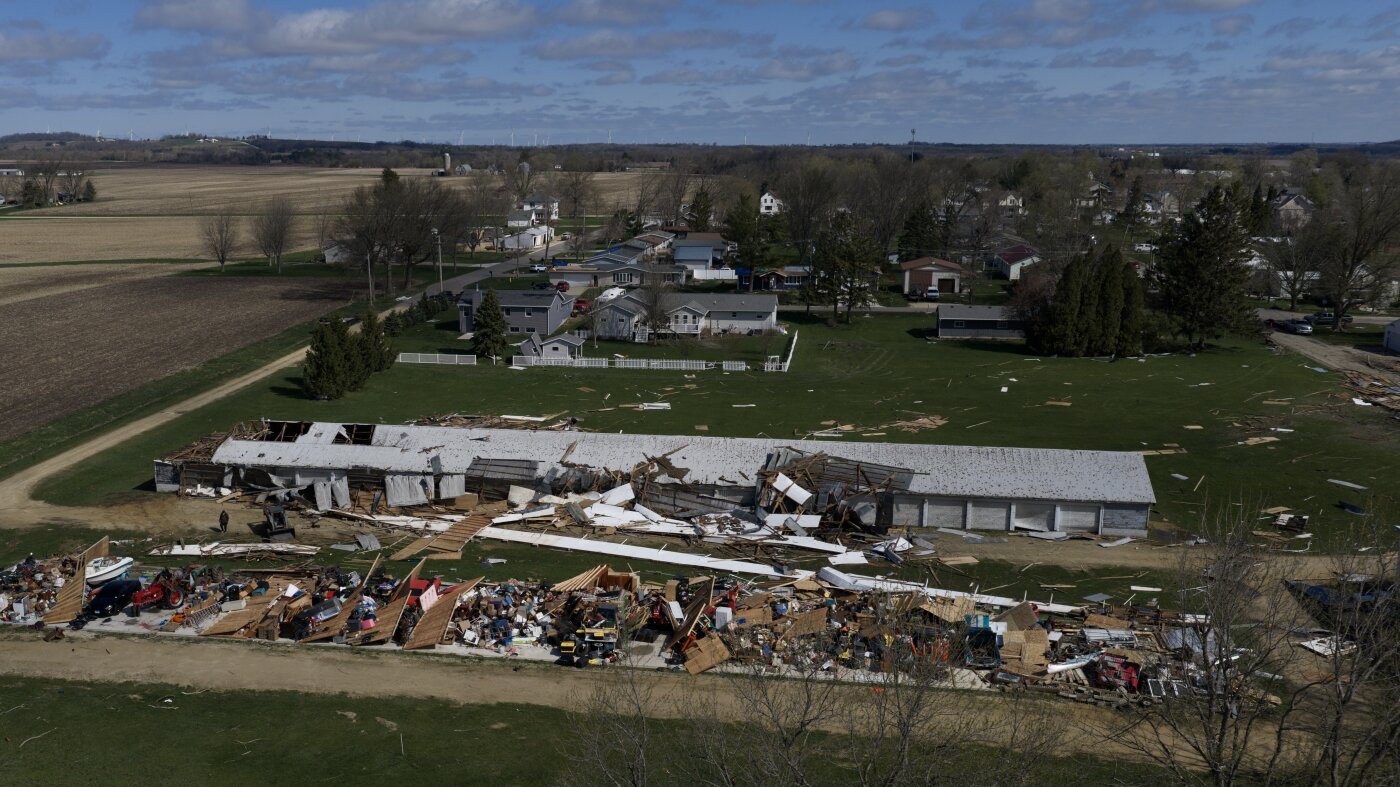
An aerial view shows damage from a tornado, on Saturday in Lena, Ill.
Scott Olson/Getty Images
hide caption
toggle caption
Scott Olson/Getty Images
Communities across the Upper Midwest are cleaning up after tornadoes and severe weather impacted the region over the weekend, damaging and destroying dozens of homes and knocking out power for tens of thousands.
“Numerous” severe storms were tracked across parts of Iowa, Illinois and Missouri on Friday, according to the National Weather Service. At least 66 tornado reports were submitted in multiple states including Oklahoma, Illinois, Missouri, Wisconsin and Iowa, the NWS Quad Cities IA/IL office said Sunday.
No deaths have been reported from the severe weather and tornado outbreak.
In Marion Township in Minnesota, about 30 homes were damaged and a dozen have significant damage because of a tornado, according to the Olmsted County Sheriff’s Office. The tornado also damaged at least 20 homes in Stewartville and there is a temporary shelter in Rochester for people displaced by the storms, according to MPR News.
“Tornado disaster recovery continues to occur at full speed,” the Olmsted County Sheriff’s Office said on Saturday.
In Illinois, McClean County officials declared a disaster emergency because of severe storms in Bloomington. “At this time, no injuries have been reported, and emergency response agencies remain actively engaged to ensure public safety and continuity of essential services,” officials said in a statement.
But further north in the village of Lena, an EF-2 tornado caused the “most significant damage” where “many homes and outbuildings were damaged, trees uprooted, and power lines downed,” the NWS said. Numerous roads have also been blocked by debris, the Stephenson County Sheriff’s Office also said.

People continue to clean up following a tornado, on Saturday in Lena, Ill.
Scott Olson/Getty Images
hide caption
toggle caption
Scott Olson/Getty Images
There have been no fatalities and no reports of serious injuries associated with the storm, Chief Deputy Andy Schroeder from the Stephenson County Sheriff’s Office told NPR on Sunday.
More than 43,000 customers lost power in Illinois but power was restored to almost all of them by Saturday night, according to electric utility ComEd.
Several tornadoes also occurred across Wisconsin, according to the NWS office in La Crosse. Twenty-six tornado warnings were issued by the office on Friday, the most in one day since the weather service office was built in 1995.

In one Marathon County town, 75 homes were destroyed by a tornado, according to Ringle Fire Chief Chris Kielman.
“It took out a whole residential area,” Kielman said, according to Wisconsin Public Radio.
The American Red Cross of Wisconsin said volunteers are helping those impacted by the storm with meals, shelter and support.
Parts of the state are still dealing with multiple rounds of severe weather and tornadoes from earlier in the week that brought flooding to some communities.
-

 Culture9 minutes ago
What America’s Main Characters Tell Us
-
 Lifestyle15 minutes ago
We beef with the Pope and admire the Stanley Cup : Wait Wait… Don’t Tell Me!
-

 Technology27 minutes ago
This pasta sauce wants to record your family
-

 World33 minutes ago
Massive 7.5-magnitude earthquake hits off Japanese coast, tsunami alert issued
-

 Politics39 minutes ago
US military announces another deadly strike against ‘narco-terrorists’
-

 Health45 minutes ago
Cancer tied to woman’s vaping habit since age 15 as she’s now given just months to live
-

 Sports51 minutes ago
Police report details Zachariah Branch’s arrest days before NFL Draft over sidewalk incident
-

 Technology57 minutes ago
BMW puts humanoid robots to work building EVs