News
Marathon Oil reaches a $241 million settlement with EPA for environmental violations


Pump jacks extract oil from beneath the ground in North Dakota on May 19, 2021. The federal government announced a $241.5 million settlement with Marathon Oil on Thursday for alleged air quality violations at the company’s oil and gas operations in the Forth Berthold Indian Reservation in North Dakota.
Matt Brown/AP
hide caption
toggle caption
Matt Brown/AP
The federal government announced a $241.5 million settlement with Marathon Oil on Thursday for alleged air quality violations at the company’s oil and gas operations on the Fort Berthold Indian Reservation in North Dakota.
The Environmental Protection Agency and Department of Justice said the settlement requires Marathon to reduce climate- and health-harming emissions from those facilities and will result in over 2.3 millions tons worth of pollution reduction.
“This historic settlement — the largest ever civil penalty for violations of the Clean Air Act at stationary sources — will ensure cleaner air for the Fort Berthold Indian Reservation and other communities in North Dakota, while holding Marathon accountable for its illegal pollution,” said Attorney General Merrick Garland.
Marathon officials did not immediately respond to a request for comment. Houston-based Marathon operates 169 well pads in North Dakota, where the company extracts oil and natural gas. A proposed consent decree for implementing the settlement says the company does not admit any liability over the allegations, but that the two sides agree it will avoid litigation and serve the public interest.
A spokesperson for the Mandan, Hidatsa and Arikara Nation based at the Fort Berthold Reservation did not immediately respond to a request for comment either.

While Marathon is the country’s 22nd-largest oil producer based on 2022 data, the federal agencies said, it’s also the seventh-largest emitter of greenhouse gas emissions in the oil and gas industry. Much of its emissions come from flaring, the industry practice of burning waste gases, including methane, which the EPA says is 25 times more potent of a contributor to climate change than carbon dioxide. While flaring burns off methane and other pollutants, it’s not completely efficient, so significant quantities still get released into the atmosphere, which the agencies said can have health impacts on nearby communities.
The settlement is part of an EPA climate change enforcement initiative that focuses in part on reducing methane emissions from oil and gas production and from landfills.
It calls for Marathon to eliminate the equivalent of over 2.25 million tons of carbon-dioxide emissions over the next five years, which the agencies said was tantamount to taking 487,000 cars off the road for one year, and will also eliminate nearly 110,000 tons of volatile organic compound emissions, which contribute to asthma and other respiratory diseases.
“This settlement is a major win for the health and future of our Tribal communities, including people and families who are often overburdened by pollution,” said KC Becker, the EPA’s regional administrator. “As a result of the agreement, Marathon has and will continue to take comprehensive measures to come into compliance and reduce harmful emissions across hundreds of production sources. These investments will improve air quality and reduce respiratory illnesses across the Fort Berthold Indian Reservation and western North Dakota.”
The agencies said the case is the first of its kind against an oil and gas producer for “violations of major source emissions permitting requirements under the Clean Air Act’s Prevention of Significant Deterioration program.” They also said the $64.5 million civil penalty Marathon must pay is the largest-ever penalty imposed for “stationary source violations,” which include facilities such as oil and gas tank systems.
The Justice Department said it’s the largest of 12 similar efforts by the Biden administration to target emissions from the oil and gas industry, with a penalty that’s more than double the 11 previous settlements combined.
Marathon also agreed to invest $177 million in extensive compliance measures, much of of it by the end of the year, that the agencies said will “significantly reduce” harmful emissions from 169 existing facilities on state land and on the reservation, as well as at new facilities built in North Dakota.
The settlement is part of a complaint and proposed consent decree officially filed Thursday in federal court in North Dakota. The complaint alleges that Clean Air Act violations at nearly 90 Marathon facilities resulted in thousands of tons of illegal pollution. And it alleges that Marathon submitted artificially low estimates of its emissions to avoid permitting requirements.
The consent decree is subject to a 30-day public comment period.

In May, ConocoPhillips said it was buying Marathon Oil in an all-stock deal valued at about $17.1 billion. The deal, worth $22.5 billion when including $5.4 billion in debt, comes as energy prices have surged and big oil companies have reaped huge profits. The acquisition was expected to close by the end of the year.
In its latest financial report, Marathon said it earned $297 million in the three-month period that ended March 31, posting revenue of $1.55 billion.
Thursday’s settlement did not appear to rattle investors. Marathon’s stock closed up 1.6% Thursday. It has risen about 18% so far this year.


Voting stickers are displayed on a table at a polling place inside City Hall, Tuesday, Nov. 5, 2024, in Las Vegas.
John Locher/AP Photo
hide caption
toggle caption
John Locher/AP Photo
Today’s primary contests stretch from Maine to North Dakota, South Carolina and Nevada, where voters will decide on races for the U.S. Senate, House, governor and more.
A lot is riding on the Senate race in Maine, where political newcomer Graham Platner, facing a series of controversies, is the presumptive Democratic nominee to take on Republican Sen. Susan Collins, who has had the job for 30 years.
Another Republican incumbent, Nevada’s Gov. Joe Lombardo, is facing a tough challenge in November.
And in a field of MAGA-devoted Republicans in South Carolina, Lt. Gov. Pamela Evette was the one to grab President Trump’s endorsement in the race for governor.
Here, reporters from the NPR network tell us about the key races to watch.
Maine U.S. Senate seat | Maine’s 2nd Congressional District | Maine governor | Nevada governor | South Carolina governor
You can also check out voter resources for the June 9 primaries from the NPR network.
Maine’s primary winners will set up crucial November races
— Kevin Miller and Steve Mistler, Maine Public
Maine’s U.S. Senate seat
If Democrats want control of the U.S. come November, they almost certainly need to take five-term Republican Sen. Collins’ seat in Maine.
The outcome of the pivotal race could hinge on whether voters value Collins’ clout and ability to secure federal dollars over Democratic insurgent Platner’s call to upend a political system he says is rigged against working-class Americans.
The first-time Democratic candidate has so far run a barnstorming campaign that’s already pushed his Democratic rival, Gov. Janet Mills, out of the race.
After recent accusations published by The New York Times that he was physically threatening in a past relationship, and previous revelations that he sexted with several women early in his marriage, some are wondering if he still has enough support to flip the seat in November. In an interview with Maine Public, Platner denied the accusations.
Maine’s 2nd Congressional District
In a district that has voted for Trump three times, four Democrats are vying to replace retiring Democratic Rep. Jared Golden. Whoever wins the primary will face former Republican Gov. Paul LePage in the fall.
The Democratic nominee in this congressional district will offer a sense of what kind of candidates primary voters think can succeed in hard-to-win seats.
Maine’s governor
The race to replace term-limited Democratic Gov. Janet Mills is likely to go to a Democrat, according to an analysis by the Cook Political Report, but it’s still a question of who. There is a five-way Democratic race for the nomination, seven active candidates on the GOP side and both races have the potential to go to a ranked-choice runoff.
The affordable housing crisis, rising property taxes, access to health care and standing up to President Donald Trump have emerged as central themes in the primary contest.
Recent polls show former Maine CDC Director Dr. Nirav Shah in the lead, though former Maine Senate President Troy Jackson appears to be surging in popularity ahead of the ranked-choice primary election.
The presumptive frontrunner in the GOP contest is Bobby Charles, an attorney and former Navy intelligence officer.
In November, State Sen. Rick Bennett will also be on the ballot running as an independent.
Nevada’s GOP governor faces a tough November
Paul Boger, Nevada Public Radio
Trump’s economic policies are so unpopular in Nevada that the incumbent governor, Republican Joe Lombardo, is facing what could be a tough November election. Cook rates the race as a toss-up, and the candidate who may have the best shot against Lombardo, former Clark County Sheriff, is the state’s top cop, Democratic Attorney General Aaron Ford.
With a sizeable war chest, Lombardo should sail through the primary. Still, it may not be enough in November to assuage Nevadans worried about increasing costs in a tourism-based economy that is welcoming fewer domestic and international visitors every month.
Ford’s path to the Democratic nomination isn’t guaranteed. He’s drawn criticism from Republicans for his extensive domestic and international travel as attorney general. And from his main Democratic opponent in the primary, Washoe County Commissioner Alexis Hill, for Ford’s support of data centers, which are an existential concern in the country’s driest state.
The governor’s race in South Carolina tests Trump’s endorsement power
— Gavin Jackson, South Carolina Public Radio
The crowded race for governor in South Carolina doesn’t have a clear frontrunner, even though the president has endorsed Republican Lt. Gov. Pamela Evette, a longtime supporter of his, in Tuesday’s primary.
Evette’s biggest challenger is another Trump enthusiast, four-term Attorney General Alan Wilson. Congresswoman Nancy Mace, who claims her vote for more transparency of the Epstein files cost her Trump’s endorsement, is also on the ballot. The race is widely expected to go to a runoff.
Three Democrats are vying for their party’s nomination: Columbia state Rep. Jermaine Johnson, Charleston lawyer Mullins McLeod and Greenville businessman Billy Webster.
After Trump lost his first primary endorsement race last week in Iowa, political watchers are sure to have a close eye on how votes shake out in South Carolina.
Voter resources for the June 9 primaries from the NPR Network
Maine | Nevada | North Dakota | South Carolina
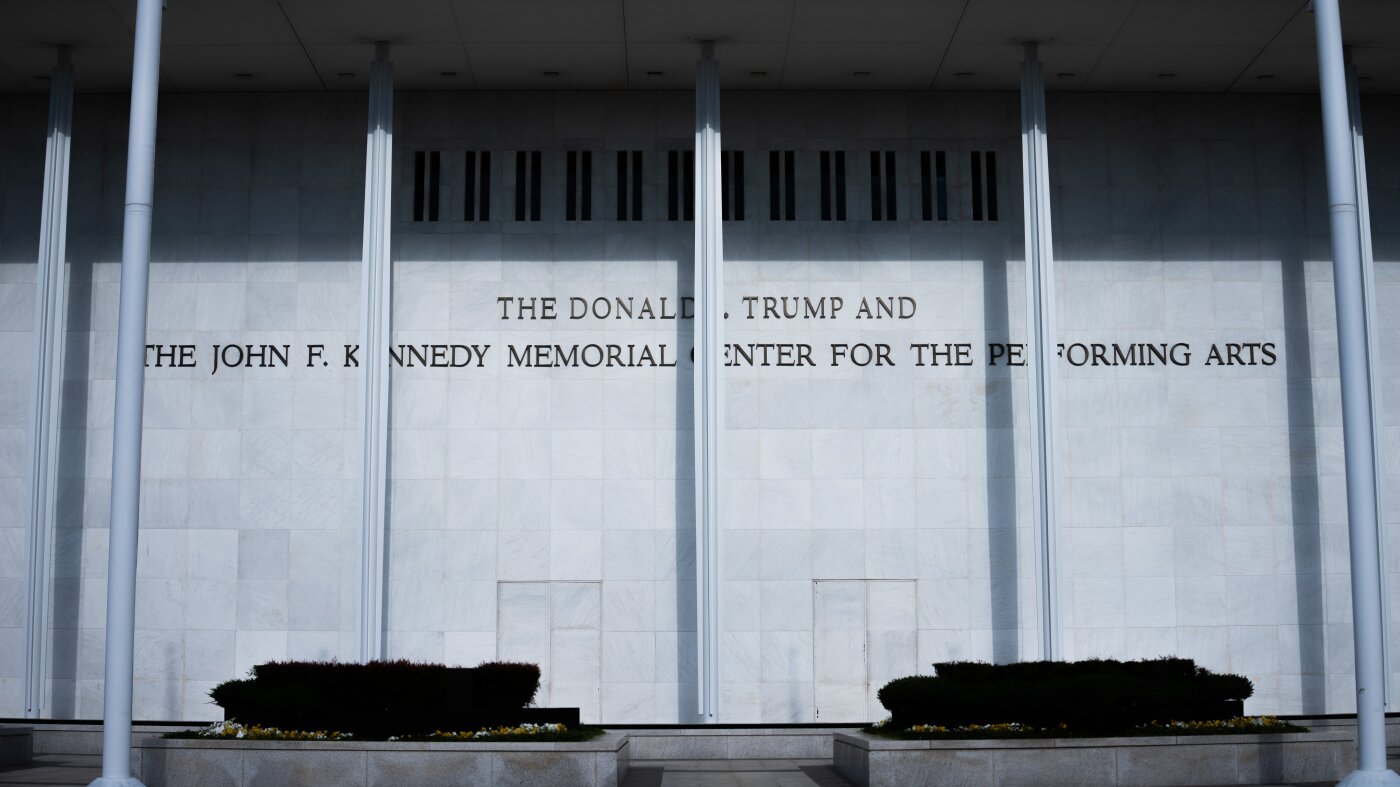
The facade of the John F. Kennedy Center for the Performing Arts is seen June 6 in Washington.
Aaron Schwartz/Getty Images
hide caption
toggle caption
Aaron Schwartz/Getty Images

After multiple setbacks in his effort to remake the Kennedy Center to his liking, including losses in several lawsuits, President Trump says he is handing operations of the center back to Congress. It is not clear what that means, since Congress does not actually run the cultural center.
The move comes after a judge in Washington, D.C., sided with jazz performer Chuck Redd, who canceled a 2025 holiday concert after Trump’s name was added to the building. The judge wrote that the Kennedy Center failed to prove the musician had signed a contract to perform.
Josef Palermo, a former curator of visual arts at the Kennedy Center, wrote about his experience in a piece for The Atlantic titled “What I Saw Inside the Kennedy Center.”
He told Morning Edition on Monday he joined at a time when others were quitting or being fired because he wanted to “run towards it as a sort of metaphorical first responder and try to save what I could.”
Palermo also said Trump’s Truth Social post about handing control back to Congress sounded like an attempt to distance himself from an institution. He adds that he believes the Trump administration has driven the center into bankruptcy. Programs such as the National Symphony Orchestra still do not have approved budgets.
In this interview, he talks about how the Kennedy Center’s leadership changed under Trump and how questions now surround the institution’s finances and future.
Listen to the interview by clicking play on the blue box above.
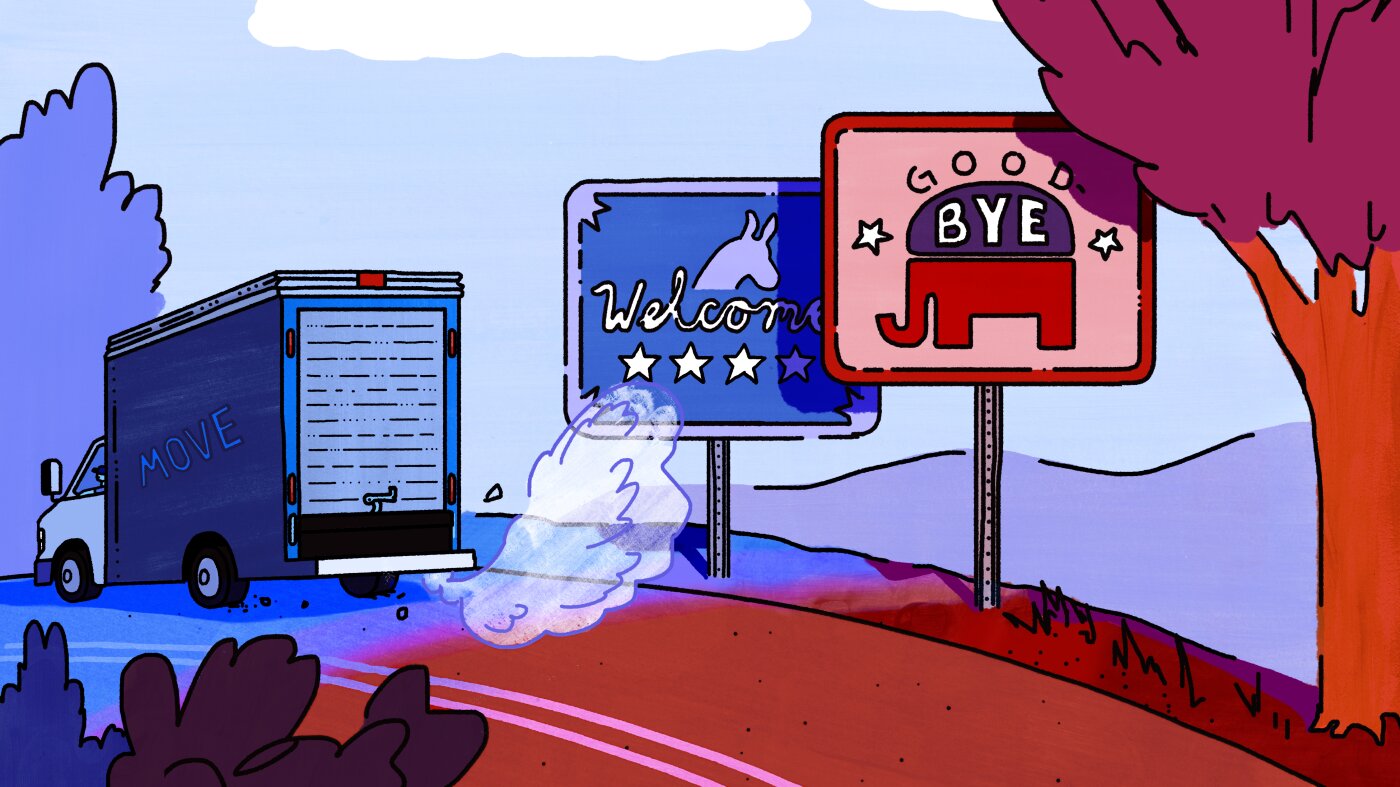
Illustration by Annelise Capossela for NPR
Three years ago, Jessa Davis had an epiphany: After she came out as a trans woman, remaining in deep-red Texas felt untenable. So, she sold her house in Odessa and moved to the liberal bastion of Seattle, Wash.
Davis describes herself as a trans refugee. Back in Texas, she says, lived in a “pretty hostile and frankly dangerous” place. “I had a lot of close calls, a lot of threats.”

Davis volunteered with organizations advocating for trans and queer rights in Odessa and remembers thinking, “I’ve got one life and I don’t want to spend the next 20 years of [it] fighting a battle that I’m not sure we’re going to win in a place like Texas.”
Her fight for LGBTQ rights continues, but it feels more manageable in a city she views as welcoming and supportive. After arriving, Davis quickly became active in local issues and now serves as co-chair on a commission advising the city on LGBTQ issues. She and other commissioners have urged Seattle to declare a state of emergency to provide more resources for the growing number of people relocating there to escape anti-LGBTQ laws and hostile social climates elsewhere in the country.

Jenna Davis in Seattle in a photo taken last month.
Cadence Sagan
hide caption
toggle caption
Cadence Sagan
Davis’ case reflects what sociologists call “ideological sorting” — the tendency to choose communities aligned with one’s political and cultural values. Popularized in the 2008 book The Big Sort, it sets out to explain the widening divide between red and blue America.
In a country that’s growing ever-more polarized, the shifting demographics cut in both directions — and it is happening across the country. In one study from 2022, researchers concluded that “at no point since the Civil War have partisans been as clustered within individual states as today.”
Research in recent years, however, suggests that the story is more complex and nuanced — and that simply seeking out like-minded neighbors is more often than not just one factor among several driving the shift.
From blue state to red
As Davis and others arrive in Seattle seeking refuge from hostile laws and rhetoric, some of Seattle’s longtime residents, like Kirby Wilbur, have moved out, fleeing to conservative enclaves.
Wilbur also describes himself as a “refugee.” He relates an experience that is a virtual mirror image of Davis’. In Seattle, the local conservative talk show host — who also briefly served as Washington state Republican chair — felt like a stranger in a strange land.
As he neared retirement, he and his wife Trina began thinking about an escape plan. A friend told them about McKinney, Texas, a conservative Dallas-Fort Worth suburb. Wilbur had never heard of McKinney, but decided to have a look.

Kirby Wilbur, with wife Trina, in a photo taken last year.
Courtesy of Kirby Wilbur
hide caption
toggle caption
Courtesy of Kirby Wilbur
“There were like 3,000 square foot homes with a pool for $300,000,” he says.
In Texas, Wilbur met with Paul Chabot in 2020, who runs a specialty realty service, Conservative Move. Started in 2017, the company has helped thousands of people relocate from blue states to red states, Chabot says.
But the Wilburs still weren’t ready. Then came the 2020 George Floyd protests in Seattle. Kirby Wilbur says after the mobs, looting and vandalism, he and Trina had their own epiphany. “We looked at each other and said, ‘No, we can’t live this way. This is it.’”
Chabot, a retired U.S. Navy commander, says Wilbur — who has since become a part-time realtor with Conservative Move — is like most of his clients, who “feel like they can’t talk politics with people on their street.”
Conservative Move assists a lot of families with children who say they want a better quality of life for their kids — things like lower crime, stronger schools and lower taxes, according to Chabot. They also want to be somewhere they don’t feel judged for their political beliefs, he says.

“It’s not like people are leaving just because they hate Democrats. They don’t like Democrat policies, but they really feel like they’re alone, alienated, ostracized,” he says.
Chabot’s counterpart on the left is Bob McCranie. In 2020, McCranie started a web page called Flee Texas. “Very quickly… it got overwhelmed by people from all sorts of other places saying, ‘Oh my gosh, talk to me,’” he says.
As a result, he broadened the reach a few years later, launching Flee Red States. Since then, he says he has 40 closings related to the project and more than 875 people on a mailing list. He says he’s even helped people move out of the country.
McCranie says for some of his clients, the stakes are much higher than simply whether they can have a political conversation over the back fence. “People are moving because they don’t feel safe in their own state, in their own country,” he says.
For instance, some conservative groups are trying to overturn Obergefell v. Hodges, the U.S. Supreme Court’s landmark 2015 ruling that established same-sex marriage as a constitutional right. McCranie says some of his clients are wondering, “Where would we be safe as a couple and as a family?”
U.S. Census Bureau data for 2024 indicates that almost exactly as many people moved from Texas to Washington as went the other direction. However, a nationwide Stateline analysis paints a more one-sided picture. Republican counties, defined by the 2020 presidential election vote, gained 3.7 million people from mid-2020 to mid-2023, while blue counties lost the same amount — a time period that encompasses pandemic dislocations and lockdowns and the rise of remote work, Stateline notes.
But those broad trends can belie individual experiences. Rachelle Vega, interviewed last year by NPR, moved from Austin — widely considered the most progressive city in Texas — to Santa Fe, N.M., which has some of the country’s strongest LGBTQ protections. Vega wanted a more welcoming environment for her two adult trans children. In her new home, “There’s this sense of live and let live that is pervasive,” she told NPR.

This political sorting is not only occurring from state to state, but on a city, county and neighborhood level, according to Bruce Desmarais, a professor of political science and social data analytics at Penn State University. In a 2019 study, Desmarais and colleagues found that “people tend to be moving from one very sort of left-leaning city to the next” — like Vega — and the same is true, Desmarais says, for people moving from one right-leaning area to another.
Ticking the boxes beyond party affiliation
Take Stefanie Chiappetta’s experience. Four years ago, she and her husband, Samuel, moved from Middleborough, Mass., to Conway, S.C., and politics were the main reason.
In solidly blue Massachusetts, the town of Middleborough is an exception. It went for President Trump over Vice President Kamala Harris by a comfortable margin in 2024.
Chiappetta says “more conservative” was “box one” on her list when looking for a fresh start after retirement. Second was taxes. She and her husband had been paying nearly $7,000 a year in property taxes in Massachusetts, but in Conway, it’s a fraction of that, she says. The last important item was the weather. Chiappetta says she and her husband both have back issues. The cold weather “was making us more miserable,” she says.

Although Chiappetta puts politics at the forefront, her weighting of other factors illustrates a key caveat, says Steven Webster, an associate professor of political science at Indiana University.
“Americans do have a preference for living near co-partisans,” Webster, who has also researched ideological sorting, says. However, “things like the affordability of homes [and] living in a good school district far outweigh any explicit partisan-based motivation for choosing one location over another.”
The neighbor agreeing with you about President Trump is “the cherry on top,” he says.
Just as Chiappetta gravitated to a lower-tax city and state — which often tend to be conservative — “a Democrat might move to an area with good access to public transportation,” Webster says.
“While desiring access to public transportation may correlate with being a Democrat, one’s decision to move to that area is based [on] that desire rather than being with other Democrats,” he says.
“Places shape people more than people sort into places,” he concludes.
Political birds of a feather
Some researchers put more weight on party realignment — a long-term shift in the political landscape caused by voters changing their allegiances – than voter migration to explain the biggest share of the ideological sorting.
“Southern whites converted Republican, suburbs of major cities converted Democratic, and the political map redrew itself without most people moving,” notes Josh Zhang, an assistant professor of sociology at Stony Brook University.
In 2023, Zhang and colleagues published a study that looked at ideological sorting on a granular level. Using anonymized cell-phone data and other real-time information, they found that “people in heavily Democratic or Republican neighborhoods tend to visit places — religious institutions, schools, restaurants — whose other visitors lean the same way.”
James Henson, director of the Texas Politics Project at the University of Texas at Austin, points out that while the general trend is understood, “geographic sorting is rarely, if ever, going to be absolute. Despite aggregate sorting, there are always going to be individual exceptions in a given area.”
Despite Wilbur’s decision to move to be closer to fellow conservatives, he readily acknowledges that such ideological sorting is a negative for the country as a whole. “Nobody talks to each other anymore,” he says. The divisions in our political discourse have increasingly led to physical division, he says.
Davis is also concerned about “isolating ourselves in bubbles” and recalls the rare occasions when she was able to break through to someone in Odessa. She argues that physical sorting reduces those opportunities for connection.
“That’s the importance of being able to sit down with someone, share a beer in a dive bar in West Texas, and have a conversation about why I’m leaving — what’s happening, and why I feel I have to go.”
-

 Sports1 minute ago
Knicks guard nearly wipes out Michael Bloomberg diving for loose ball during NBA Finals Game 3
-

 Technology7 minutes ago
AI voice scams can clone your family’s voice
-
 Business14 minutes ago
Commentary: Here’s how Musk’s SpaceX IPO could crash your 401(k)
-
 Entertainment16 minutes ago
6 television actors on being judged for their looks, why AI is ‘lame’ and more
-
 Politics28 minutes ago
New evidence confirms Edison’s idle line ignited Eaton fire, lawyers say
-
 Science31 minutes ago
Santa Monica Mountains’ last steelhead trout survived the Palisades fire — and even had babies
-
Sports43 minutes ago
Mexico and South Africa face off again to open World Cup after 16 years of challenges
-

 World51 minutes ago
Albania’s PM posts AI video of himself in bra in swipe at influencers


