News
Kash Patel’s Loyalty to Trump Raises Doubts Over F.B.I.’s Independence


Kash Patel spent years ingratiating himself with Donald J. Trump — regularly popping into the Oval Office in the first term, writing a children’s book starring “King Donald” during the interregnum, trailing him to rallies, banquets and bus tours on the bumpy ride back to power.
Few practitioners of the audience-of-one strategy have been quite so successful at translating loyalty and proximity to Mr. Trump into real influence. Fewer still are poised to be rewarded as significantly as Mr. Patel, 44, Mr. Trump’s pick to run the F.B.I., an agency with vast powers that he has vowed to radically overhaul.
What binds Mr. Trump and Mr. Patel is the shared conviction that the bureau has been weaponized against conservatives, including both of them. They argue it is politicized and the only way to fix it is to empower an outsider willing to faithfully execute the Trump agenda — a sharp divergence from the bureau’s historical norms and the decades-long practice of directors’ limiting contact with presidents.
The issue of Mr. Patel’s independence, or lack thereof, will be a flashpoint at a confirmation hearing scheduled for Thursday.
Mr. Patel’s embrace of Jan. 6 conspiracy theories and unflinching fealty are the coin of the realm in Mr. Trump’s orbit. But in the view of his many critics (and even some who publicly sing his praises), Mr. Patel’s oft-stated loyalty to the president poses one of the most significant challenges to the independence of the F.B.I. in the century since J. Edgar Hoover, its founding director, built an investigative citadel whose autonomy created leverage, and abuses of power.
Nominating Mr. Patel as F.B.I. chief is, above all, a defining example of Mr. Trump’s approach to exerting power in his second term. Not content to simply install subordinates to help enact an ideological agenda, the president is pushing hard to expand the post-Watergate limits on presidential authority. During his first term, demanding personal loyalty from appointees did not always work; making sure the top jobs are stocked with loyalists is the strategy now.
At the F.B.I., this entails bucking the bureau’s long institutional history, starting with Mr. Hoover and extending through James B. Comey’s rejection of Mr. Trump’s first-term demands for obeisance, a stance that prevented it from becoming the instrument of presidential whim.
Critics say Mr. Trump’s and Mr. Patel’s grievance that the bureau has been “politicized” against Republicans is an excuse to turn the F.B.I., whose agents have often tilted right, into a political weapon for Mr. Trump.
“Hoover would have been appalled at Patel’s sycophancy of Donald Trump,” said Beverly Gage, a professor at Yale and the author of a biography of Mr. Hoover.
“What’s new and alarming about Patel?” she added. “He’s so close to Donald Trump and is making no secret that he will use the bureau to punish Mr. Trump’s enemies. He’s coming in openly hostile to the institution. At the F.B.I., this is potentially earth-shattering.”
The president and Mr. Patel share not only a worldview, but also an enemies list. In 2022, Mr. Patel published a roster of 60 people he suggested should be investigated, prosecuted or otherwise reviled. It includes Christopher A. Wray, who stepped down this month as F.B.I. director before Mr. Trump could fire him, former Attorney General Merrick B. Garland, former Attorney General William P. Barr and a host of other federal officials and politicians he does not like.
Mr. Patel’s spokesman did not respond to questions.
But his defenders downplay his promises to rain hell as campaign-season fireworks, and say the list he published in his book “Government Gangsters” was just a litany of people he did not like, respect or trust. Behind closed doors, he has sought to reassure senators he intended only to underscore the need to reform the bureau and will run it responsibly if confirmed, according to people briefed on the interactions.
In at least one conversation, he has acknowledged that he amped up the verbiage in his polemical memoir for dramatic effect. In another, he apologized for the book, which served as a pugilistic takedown of government officials at the very institution he is eager to run.
“Like me, Kash Patel uses fiery rhetoric and hyperbole to break through,” said Mike Davis, a former Senate Republican staff member who is close to Mr. Patel. “But don’t let that fool anyone. Kash is a very serious, skilled and effective national security operator.”
The team overseeing Mr. Patel’s confirmation has emphasized his unique experience, particularly his work as a public defender, and varied assignments in national security posts.
Yet some Republicans in the Senate have quietly made it clear they want Mr. Trump to surround Mr. Patel with more conventional officials to offset his shortcomings.
Mr. Patel has given private assurances that his deputy director will be a special agent, with deep experience at the bureau, and not a political appointee, according to a person familiar with the matter.
At least two former F.B.I. veterans have been tapped to advise Mr. Patel, including one who recently served as a staff aide to Representative Jim Jordan. While he is seen as a stabilizing force, his past work for Mr. Jordan’s committee uncovering the so-called weaponization of government is in line with Mr. Patel’s worldview.
Mr. Trump is not likely to abide by norms adopted over the past half-century intended to prevent direct interference into federal law enforcement, regardless of who is on staff.
Case in point: The director Mr. Trump signaled he would replace, Mr. Wray, never met alone with Mr. Trump, according to people familiar with the situation. That did not stop Mr. Trump from trying to contact him anyway, at the exact moment the bureau was embarking on its investigation into his retention of national security documents.
In a handwritten note dated March 26, 2022, Mr. Trump congratulated Mr. Wray, whom he appointed in 2017, for an appearance on “60 Minutes,” according to a copy viewed by The New York Times.
“CHRIS – GREAT JOB ON 60 MINUTES LAST NIGHT. YOU ARE 100 % CORRECT ON CHINA (RUSSIA IS NOT SO WONDERFUL EITHER!).”
Mr. Trump does not need to use stationery to reach Mr. Patel.
As a senior director at the National Security Council during Mr. Trump’s first term, Mr. Patel seemed to always find himself invited to the Oval Office for meetings. He also had a knack for trolling Mr. Trump’s enemies — threatening, among other things, to sue the news media for unflattering stories. The president, over time, began to reach out to him for advice.
One former Trump administration official recalled that during the first term, Mr. Patel would head to lunch only to be interrupted by calls from the president to kibitz.
Mr. Patel loved it, the person recalled.
A Break With the Past
The F.B.I. has had a checkered relationship with politics that precedes Mr. Patel by 101 years.
The official origins of the F.B.I. date back to 1908, but its true inception came in 1924 when Mr. Hoover, then in his late 20s, was appointed director. From the start, its mission placed it at the hazardous intersection of politics and law enforcement: investigating, prosecuting and deporting left-wing radicals and anarchists after World War I.
Over the decades, Mr. Hoover leveraged his cache of investigative files into raw power. Toward the end of his 48-year tenure, he greenlit dozens of investigations of key figures in the civil rights movement — most infamously Martin Luther King Jr. — and offered political intelligence to presidents and their political adversaries.
Even while presiding over the bureau’s worst excesses, however, Mr. Hoover ensured that the agency remained independent from direct White House control. Directors who served after him sought to maintain that independence by keeping presidents at arm’s length, with the exception of his immediate successor, L. Patrick Gray.
“Integrity and independence make or break an F.B.I. director,” Louis J. Freeh, the bureau director whose relationship with President Bill Clinton turned rancid as he investigated the president and his associates, said in his memoir.
Mr. Clinton groused but did not seek to remove Mr. Freeh. Mr. Trump did both. In private meetings at the White House, Mr. Trump demanded the loyalty of Mr. Comey, a Republican, and suggested he end an investigation into the president’s former national security adviser. Mr. Comey stayed in office for nearly four months without giving it.
Mr. Comey was confident he could undertake investigations into top public figures, including Mr. Trump and Hillary Clinton, while defending the bureau’s integrity. That miscalculation led to a disastrous news conference in July 2016 at which he announced that although Mrs. Clinton had been “extremely careless” in handling classified information, she would not be prosecuted. Many Democrats believe the assertion ultimately contributed to her defeat.
His approach left the F.B.I. reeling, and Mr. Patel and many other Republicans cite Mr. Comey as one of the main reasons the bureau needs to be reshaped and more agents from its headquarters in Washington farmed out to field offices around the country.
Mr. Wray, who was appointed by Mr. Trump in mid-2017 for a 10-year term, took a much more cautious, conventional approach to Mr. Trump. Nonetheless, their relationship soured almost immediately.
Mr. Trump came close to firing Mr. Wray after he refused, among other things, to embrace the president’s lies about the 2020 election being stolen.
Agents who worked for Mr. Wray described him as fundamentally apolitical, focused on the threat posed by China and other foreign adversaries, and fixated on the minutiae of law enforcement — spending time in briefings on firearms testing, audits of secret surveillance warrants and information technology systems. One former F.B.I. official likened the meetings to watching paint dry, yet the director loved them.
But he could not escape politics. And his commitment to investigating Mr. Trump, including the execution of a search warrant at Mar-a-Lago, effectively doomed his directorship.
On a gray, snow-flecked day at the F.B.I.’s headquarters this month, national security leaders from the United States and Britain gathered to thank Mr. Wray, and to issue barely veiled warnings about what the future might hold if Mr. Trump succeeds in asserting control.
Former top F.B.I. officials were in attendance, including William H. Webster, who was appointed by President Jimmy Carter.
So was William J. Burns, the C.I.A. director, who said Mr. Wray’s greatest achievement was fulfilling a promise he made at his 2017 confirmation hearing to adhere to the “impartial pursuit of justice.”
When it came time for Mr. Wray to speak, he exhorted agents to stay and conduct their investigations with impartiality.
“That means following the facts wherever they lead, no matter who likes it, or doesn’t,” Mr. Wray said. “Because there’s always someone who doesn’t like it.”
A Precipitous Rise
Mr. Patel’s swift ascent in Mr. Trump’s orbit began in 2018. Then a little-known House Republican aide, Mr. Patel investigated the Justice Department’s efforts to obtain a secret surveillance warrant for a Trump adviser believed to be conspiring with the Russians during the 2016 campaign.
From there, he landed a succession of national security posts in rapid succession, serving his longest stint on the National Security Council (20 months) and the shortest as a top aide at the Pentagon (three months). He often communicated with the president directly, to the chagrin of his nominal superiors.
By the spring of 2020, Mr. Trump was eager to dismiss Mr. Wray, replace him with a senior intelligence official and install Mr. Patel as his top deputy in charge, a post typically reserved for a senior agent in a work force of 38,000.
Mr. Barr, then the attorney general, talked Mr. Trump down during a contentious meeting in the Oval Office. Mr. Barr would later write in his memoir that Mr. Patel was deeply unqualified and that the president “showed a shocking detachment from reality.”
People close to Mr. Barr said he was also concerned that Mr. Patel would have been too compliant to challenge Mr. Trump.
Early on, Mr. Wray concluded that limiting contact with the White House, or communicating through intermediaries, could ensure independence, a policy he maintained with Mr. Trump and President Joseph R. Biden Jr.
After Mr. Trump left office, he tapped Mr. Patel as one of his emissaries to the National Archives, thrusting Mr. Patel into the Trump classified documents investigation.
In August 2022, F.B.I. agents and federal prosecutors obtained a court-authorized warrant to search Mr. Trump’s Florida club and residence, including his bedroom. In his book, Mr. Patel said that the “Mar-a-Lago raid will go down in history as a sign of the destruction of our once great institutions of equal justice and fairness.”
During Mr. Trump’s time out of office, Mr. Patel cultivated relationships with the president’s sons, particularly Donald Trump Jr., and embraced online retail (under the brand “K$H”). He also hawked anti-vaccine diet supplements, pro-Trump T-shirts and a line of children’s books in which he portrayed himself as a wizard, wearing a midnight blue robe. Mr. Trump was depicted with a crown.
Mr. Patel, who is single, likes the nightlife. He was recently spotted posing for poolside photos with bikini-clad conservatives, and his Senate disclosure form revealed that he recently joined the Poodle Room, a members-only club near his residence in Las Vegas that has a $20,000 entry fee.
More than anything, he worked relentlessly to raise his profile in Trump circles, doing nearly 1,000 interviews and podcasts. On his Senate disclosure form, he said he “served as a surrogate” for Mr. Trump’s campaign from November 2022 to November 2024.
Mr. Trump has always been leery of subordinates who market themselves off their association with him. And his support of Mr. Patel has been somewhat tempered by doubts about his gravitas and experience. Mr. Trump’s 2024 campaign manager and the new White House chief of staff, Susie Wiles, told him the selection was too risky, associates of both men said.
But the only serious alternative to Mr. Patel that emerged, Missouri’s Republican attorney general, Andrew Bailey, seemed too laid-back and lackluster in face-to-face meetings.
Mr. Patel, always loyal — and always around — lobbied furiously for the job, and prevailed.
After his selection, Mr. Patel appeared to become more cognizant of his attack-dog reputation. Off camera he was more muted, self-effacing, funny and willing to compromise, which allayed the concerns of Ms. Wiles and other skeptics.
Moreover — despite Mr. Patel’s inflammatory public statements — his vetting did not reveal a knockout scandal comparable to the one that forced out Matt Gaetz, Mr. Trump’s initial pick for attorney general.
Mr. Trump did not consult with senators in his own party before nominating Mr. Patel, according to one senator and several aides. Nor did he apparently seek approval from Pam Bondi, his more conventional second choice for attorney general, according to people in his orbit.
The response to Mr. Patel’s appointment among Senate Republicans has been mixed, with some issuing emphatic endorsements and others taking a wait-and-see tack. To allay some concerns, former Representative Trey Gowdy, a former federal prosecutor from South Carolina who is friendly with Mr. Patel, has been furiously working the phones on his behalf, according to people familiar with the situation.
As he has so often done with top aides, Mr. Trump, a former reality TV star, fretted that Mr. Patel lacked the central-casting look the public had come to expect from an F.B.I. director, without either the imposing G-man appearance of a former director like Robert S. Mueller III or the bulldog mien of the bureau’s founder.
“He’s no J. Edgar Hoover,” Mr. Trump told an adviser.
Devlin Barrett and Jonathan Swan contributed reporting.



Algae turns the newly repainted Lincoln Memorial Reflecting Pool green on the National Mall on Tuesday in Washington, DC.
Chip Somodevilla/Getty Images
hide caption
toggle caption
Chip Somodevilla/Getty Images
WASHINGTON — The Lincoln Memorial reflecting pool is once again making headlines, this week for turning green.
The Washington, D.C. landmark was refilled with water earlier this month after President Trump had its neutral grey bottom repainted “American flag blue.” The multi-million dollar project produced subtle results in the eyes of many observers, even as Trump and Secretary of the Interior Doug Burgum — whose agency managed the renovation — touted its success.

In recent days, however, the pool has taken on a verdant hue — the result of algae blooms that experts say are to be expected in these conditions.
“It’s called ‘New Pond Syndrome,’” says Steve Goodale, a Canadian swimming pool specialist known online as “Swimming Pool Steve.” “It’s a known thing that happens when you take a natural, clear body of water like this that sits in an open air environment and you try to start it up, very often you end up with green water almost immediately.”
Goodale says the process took longer — a matter of days — to unfold in this case likely due to the sheer size of the pool, which measures 2,030 feet long and has a surface area of approximately 338,000 square feet.
“Excellent conditions” for algae growth
Rosalina Stancheva Christova, a professor of aquatic ecology at George Mason University in Virginia, took water samples from the pool on Tuesday. She confirmed the algae belongs to the genus Desmodesmus, which she said is “growing in excessive amounts” but is not toxic or harmful.
Christova says this kind of common green algae is found all over the region, especially this time of year. The reflecting pool in particular provides “excellent conditions” for algae growth, she said: shallow, stagnant water, strong sunlight and no shade.
“It could happen every single summer,” she added. “But it seems that the disturbance of the pond during the renovations [is] accelerating this process.”

Christova said last month’s renovations may have affected the balance of nutrients in the pool, potentially accelerating the algae blooms. Goodale similarly views the resurfacing as one of several contributing factors.
“The new, darker interior surface is going to absorb more sunlight,” Goodale says. “It is going to result in water that’s warmer, and that ultimately is going to lead to more prolific algae growth.”

A microscopic slide shows the Desmodesmus algae that quickly turned the Reflecting Pool’s water green. The new dark blue paint of the pool’s lining makes the water warmer and friendlier to the algae growth.
Rosalina Stancheva Christova, PhD.
hide caption
toggle caption
Rosalina Stancheva Christova, PhD.
The Trump administration has said the algae came from residual material in supply lines that had lain dormant for weeks. Their growth was likely exacerbated by the extreme temperatures that hit D.C. last week, bringing heat index values to 95 degrees and above.
Algae has resurfaced in the reflecting pool periodically over the years — including immediately after it reopened from its last major renovation in 2012, forcing the National Park Service to drain it, refill it and recalibrate its ozone level. And in 2019, crews had to drain four million gallons from the pool to fix a broken water line that had algae growing in it.
An Interior Department spokesperson told NPR over email that algae and other contaminants have “long plagued the Reflecting Pool since 1922,” pointing to the Obama-era renovation as an example.
“Unlike under Obama and Biden, the National Park Service is actually maintaining the beautifully completed Reflecting Pool,” they added.
Responding with tiny bubbles and big vacuums
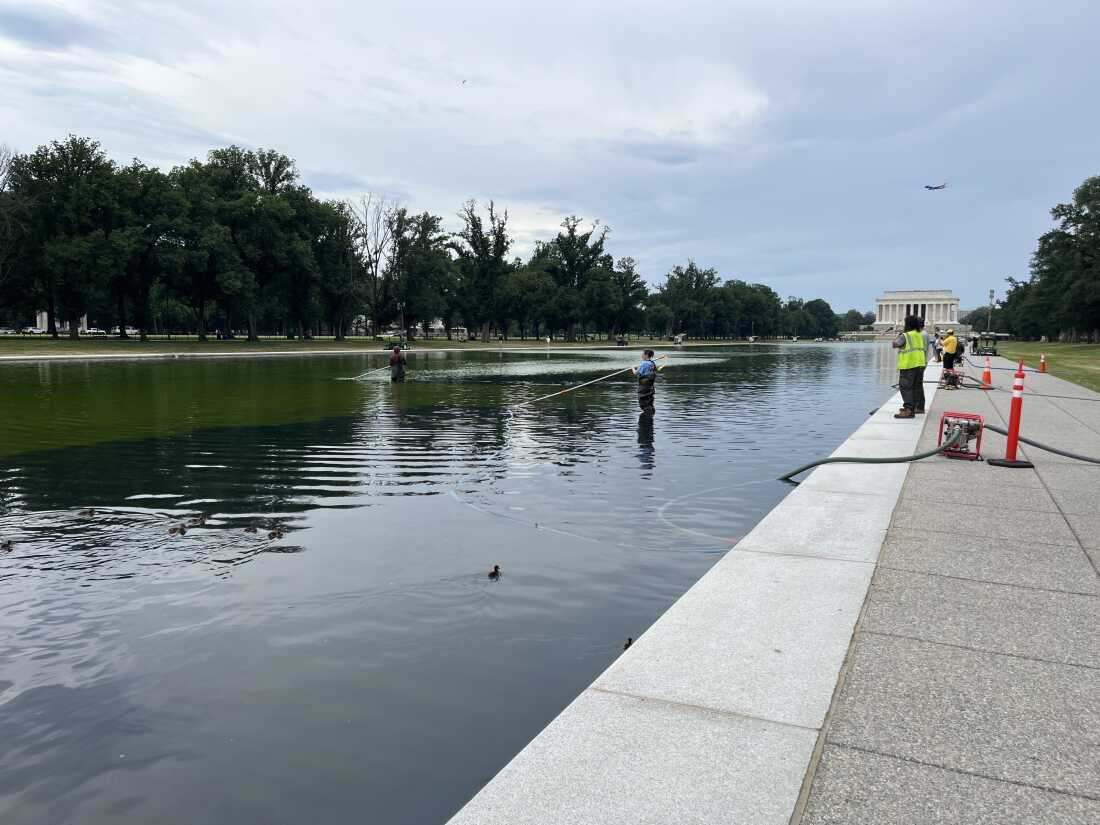
Workers battle the fast-growing common algae in the Lincoln Memorial Reflecting Pool on Thursday.
Rachel Treisman/NPR
hide caption
toggle caption
Rachel Treisman/NPR
The Trump administration is using a mix of mitigation strategies, including pouring hydrogen peroxide into the water to kill the algae.
The Interior Department says hydrogen peroxide is a “milder treatment than chlorine and is used in spas and specialty pools like natural swimming pools,” adding “there are no harmful side effects to marine life or to the environment.”
Workers are also deploying what the department calls “high-tech nanobubble ozone technology” to neutralize algae and other pathogens in the pool. The department says that approach is validated by several universities and the National Oceanic & Atmospheric Administration.
Those ozone bubbles are so tiny the human eye can’t even see them, Goodale says.
“The best way to describe it is that the bubbles are neutrally buoyant, so they won’t just rise to the surface and disappear readily,” he explains. “They can last for weeks, if not months in the water, doing their oxidizing thing and keeping the algae at bay.”
‘A monumental effort’
Goodale says it’s more complicated than treating the average backyard swimming pool, since the reflecting pool — despite its name — is actually more akin to a “manmade shallow lake.” He says it’s hard to predict just how long it will take to completely solve the algae problem, calling it “a monumental effort, literally.”
The Interior Department posted on X Wednesday that the nanobubble technology had “very effectively killed the algae,” and National Park Service crews would spend several days vacuuming up the dead algae from the bottom of the pool.
But as of Thursday morning, much of the pool — especially in the center — was still bright green.
Work continued on both ends of the pool. Nanobubble machines deposited their tubes into the water, as mobile vacuuming systems known as “trash pumps” hummed loudly from the shore. Handfuls of workers stood either in the pool or on the edge maneuvering long-handled vacuums back and forth. Their contents, including pistachio-colored water, poured out of hoses laying in the nearby grass.
The work zones were marked off by orange cones, but passersby walking the length of the pool appeared relatively unfazed. Some stopped to peer down and snap pictures of the water itself — including sections of paint that had visibly peeled off — while others were more focused on getting a photo of the Washington Monument in the background.
Loay Hidmi was walking deliberately along the edge of the pool closest to the Lincoln Memorial, hands clasped behind his back, looking over the ledge. The relatively new D.C. resident is a civil engineer who specializes in water treatment, and has been coming by the pool all week to see the progress for himself. He estimates it’s about 80% of the way there.
“I’m taking pictures of it … for the last week and I can see the gradual change,” he said. “So I’m hopeful. But we’ll have to see if it gets sustained.”
What happens next?
Hidmi worries that the algae could come back, given the favorable conditions posed by the sunny, shallow pool.
He acknowledges that’s mostly an aesthetic concern, given how much the administration has just spent on repainting the pool, but says it also raises questions about their process.
“In water systems, when you fix something, you need to look at the step before it and the step after,” he said.
Goodale agrees. He says that when a water system is taken offline, the pipes still remain full of water — “they don’t just gravity-drain away” — and need to be flushed out before any refilling. And he says eliminating algae is no substitute for dealing with underlying filtration issues.
“That’s like the equivalent of mowing the lawn when perhaps it needs to be something else that addresses the source nitrates and phosphorus, so that it’s more like pulling the weeds out by the root,” he says.

The algae doesn’t bother the ducklings swimming in the Reflecting Pool. Experts say the hydrogen peroxide used to get rid of the algae is safe for them, too.
Rachel Treisman/NPR
hide caption
toggle caption
Rachel Treisman/NPR
In the meantime, Christova, the algae expert, would like to see the water monitored weekly.
“If we don’t have any control over algal growth, we don’t know what is growing,” she said, adding that not all types of algae are as harmless as the one currently blooming in the pool.
When asked about plans for maintenance and algae prevention, White House spokesperson Taylor Rogers told NPR: “Thanks to President Trump, new lining and industrial grade materials will permanently seal the Reflecting Pool, which previously leaked 16 million gallons per year and wasted countless taxpayer dollars.”
Even after the Obama-era renovation, the reflecting pool suffered from broken pipes and water leaks requiring costly refills, according to a Department of the Interior report from fiscal year 2023. It called for new expansion joints, supply and return lines with thicker walls, saying “an improved distribution system will ensure the water can be circulated through the treatment plant, filtered, and treated with ozone.”
This latest renovation does not appear to have addressed the pipe problems, even though it did involve replacing failing expansion joints, resealing the pool, removing truckloads of garbage and “fixing the water system, drainage and so much more,” as Trump wrote on Truth Social in May.
Along the way, the cost of the project grew from Trump’s initial $2 million price tag to at least $14 million. Federal contract records show the government is paying $1.7 million to an Ohio-based company for the nanobubble technology alone.
“The scope of the Project has been greatly enlarged as we became involved because we realized how important it would be to Washington, D.C., and the record number of visitors coming to our now very safe Capital for all of the upcoming events in celebration of our 250th Anniversary,” Trump wrote.

The National Mall is hosting a number of semiquincentennial events on and around July 4, including a weekslong state fair that kicks off Wednesday evening.

Three San Francisco couples set out Monday for their annual road trip to Ashland, Ore., for the town’s famous Shakespeare festival. They drove separately and planned to meet at 6:30 p.m. on the terrace of their favorite Japanese restaurant there.
They had booked a table for six, but only four showed up for dinner.
Judith and Wylie Sheldon were found dead in their running car on the side of the road to Oregon, shocking their friends and family and leaving a hole in San Francisco’s arts and film world.
Ms. Sheldon, 84, was the daughter of William Wyler — who won three Oscars for best director — and chaired the board of the San Francisco Silent Film Festival. Mr. Sheldon, 86, was a prominent lawyer.
David Smith, who had befriended the couple more than 40 years ago, said in an interview that he and the others at the dinner table had grown nervous as time ticked on and their friends did not answer repeated calls to their cellphones. They learned they had not checked into their hotel either.
The friends eventually learned from one of the couple’s sons that the California Highway Patrol had found the couple at 5:46 p.m., both dead inside their running Jeep Compass. It was parked on the side of Interstate 5, north of Redding, Calif., more than 100 miles from their destination, the authorities said. Ms. Sheldon was driving, while Mr. Sheldon was in the passenger seat, according to the authorities.
The Redding area on Monday was under an extreme heat warning issued by the National Weather Service. Temperatures reached 109 degrees, according to the Weather Service.
Mr. Smith said he learned from the son that the couple had been found without any water or other liquids in the car. The fan was on high, but the air conditioning was not working, meaning they might have been blasted with hot air, Mr. Smith said. The windows were rolled down. The car had plenty of gas, and there were no signs of mechanical failure or foul play, Mr. Smith said the son told him.
“They didn’t crash. They stopped. They both just died there,” Mr. Smith said. “The entire thing is so bizarre. We’re still in a state of shock.”
The circumstances and cause of the couple’s death is under investigation but “appears to be medically related,” the Highway Patrol said in a statement.
Whether the heat contributed to the couple’s death “may be determined” by an autopsy, a spokesman for the Shasta County Sheriff’s Office said, adding that one had not been scheduled yet and could take several weeks to complete.
“We’ll just have to see,” the spokesman, Tim Mapes, said.
The Sheldons met at Stanford University and had two sons. They lived in a large home in San Francisco’s upscale Pacific Heights neighborhood that had views of the bay from the front and a garden out back.
They hosted many parties there on behalf of the San Francisco Silent Film Festival and sometimes let revelers pose for photos with Mr. Wyler’s Oscar statuettes. Ms. Sheldon fell in love with silent movies after first seeing those created by her father — before his better known blockbusters like “Ben-Hur” and “Roman Holiday” — only about 30 years ago, said Anita Monga, artistic director of the festival.
Stacey Wisnia, the festival’s executive director, said the couple was generous, delightful and unassuming.
Back in Ashland, Ore., Mr. Smith said the four remaining friends had distracted themselves from their grief by attending plays, including “A Midsummer Night’s Dream” and “Come From Away.” They were able to give away their friends’ tickets.
Ms. Monga had last seen Ms. Sheldon just last month at the film festival, which was held at the newly remade Castro Theater.
“This is such a shock,” Ms. Monga said of the deaths. “Also because it’s still a mystery.”

Luigi Mangione appears for a pretrial hearing at Manhattan Criminal Court in New York, June 17, 2026.
Angelina Katsanis/AP
hide caption
toggle caption
Angelina Katsanis/AP
New York — In a dramatic reversal, Luigi Mangione’s legal team on Thursday backed away from a plan to use a psychiatric defense when his case goes to trial in state court in September. Mangione has pleaded not guilty to murdering health insurance CEO Brian Thompson in 2024 on a Manhattan street.
At a hearing only a day earlier before state Judge Gregory Carro, Mangione’s attorneys confirmed that Mangione had been undergoing psychiatric evaluation. They signaled that his defense would be based at least in part on the argument that Mangione was experiencing “extreme emotional disturbance.”

But in a one-line letter sent to Carro on Thursday, Mangione’s team said that “at this time” they no longer intend to introduce psychiatric evidence during the trial. It’s unclear what sparked the shift. Mangione’s team didn’t respond to NPR’s request for comment.
Former Manhattan prosecutor and legal analyst Gary Galperin told NPR it was a “stunning reversal” for Mangione to withdraw from the psychiatric defense. “One can only speculate at this point as to the reasons,” he said.
“What remains, of course, at this point is the question of what defense they will pursue at trial,” he added.
This maneuver came after Carro ordered Mangione’s attorneys to quickly share psychiatric information with prosecutors.
“They need to know what the malady is that this defendant suffers and how that triggered extreme emotional distress,” he said, during Wednesday’s hearing. “I’m not going to let you surprise people on the eve of trial. Get it done.”
Assistant Manhattan District Attorney Joel Seidemann repeatedly complained that Mangione’s team was “stonewalling” the prosecution by withholding medical information about his psychiatric state. “We have gotten nothing,” Seidemann said.
Mangione’s lead attorney Karen Friedman Agnifilo denied her team was delaying the court process or improperly withholding information.
But legal analyst Richard Schoenstein says by withdrawing the psychiatric defense, Mangione’s team “is avoiding the court deadline to produce its psychiatric evidence.”
According to Schoenstein, this latest move “does not entirely foreclose” Mangione’s team from returning to some form of psychiatric argument during the trial, but he added that such a defense would now be far more difficult.
Mangione’s case has drawn worldwide attention. Legal experts say the 28-eight-year old has drawn an unusual level of public support because of his criticism of the health insurance industry. Thompson, a father of two, was CEO of UnitedHealthcare at the time of his murder.
During Wednesday’s hearing, Carro also indicated that a tranche of court documents would be made public that apparently relate to Mangione’s potential psychiatric defense. On Thursday, Carro reversed course.
In a signed order, he said that because Mangione will no longer present psychiatric evidence, “the court’s previous order sealing certain transcripts, emails, and documents, remains in effect.”
Mangione’s state trial is scheduled to begin in early September, with a federal trial expected to take place later.
-

 West Virginia2 minutes ago
Charleston commemorates Juneteenth with downtown parade and celebration – WV MetroNews
-
 Wyoming9 minutes ago
Gordon hosts panel on New World screwworm; no outbreaks in Wyoming
-

 Crypto12 minutes ago
Best Crypto Recovery Law Firms in 2026: Leading Cryptocurrency Lawyers for Asset Recovery, Fraud Investigations and Digital Asset Disputes
-

 Finance17 minutes ago
Homegrown Music Festival looks to right finances, hire new leadership
-

 Fitness24 minutes ago
Why this unexpected exercise is most effective for building arm muscle in your 50s – and how to do it properly
-

 Movie Reviews32 minutes ago
The Beautifully Handcrafted Rose of Nevada Is a Ghost Story Like No Other
-

 World42 minutes ago
On the South Lawn, a UFC fighter’s victory frames an unusual White House scene
-

 Politics54 minutes ago
Video: Demining the Strait of Hormuz

