News
House passes bill requiring warrant to purchase data from third parties


The House on Wednesday approved a bill that would limit how the government can purchase data from third parties — legislation that scored a vote after negotiations with a group of GOP colleagues who briefly tanked a vote on warrantless spy powers.
Dubbed the Fourth Amendment is Not For Sale, the legislation passed 219-199. It requires law enforcement and other government entities to get a warrant before buying information from third-party data brokers who purchase information gleaned from apps.
Division over the bill forged familiar fault lines to those seen in the debate over Section 702 of the Foreign Intelligence Surveillance Act (FISA), linking both conservatives and progressives who want greater privacy protections and pitting them against members from both parties who fear such protections could undercut an important law enforcement tool.
Those in favor of the bill argue the government should have to get a warrant before buying the commercially available information to carry out law enforcement activities.
“If the government wants to track a suspect today, they could go through the trouble of establishing probable cause and getting a warrant. Or federal law enforcement could simply purchase data from a third party about the target of their operation,” House Judiciary ranking member Jerry Nadler (D-N.Y.), a co-sponsor of the bill, said during debate.
“If that purchased data included location data for their subject, they would have no need for checks and balances, no need for a warrant, and during an ensuing criminal trial, no obligation even to tell the court how they obtained the initial data in the first place.”
“We have the Fourth Amendment for a reason,” Nadler continued. “If law enforcement wants to gather information about you, they should first obtain a warrant.”
Rep. Warren Davidson (R-Ohio), the sponsor of the bill, pegged it as a reinforcement of Fourth Amendment protections against unreasonable searches and seizures.
“The reality is the technology today effectively puts the government everywhere we go. We all essentially have a digital ID, a phone number. And we carry it with us. It’s tracked. It goes to your car. Your car spies on you as well. This data is being collected,” he said.
“Nothing in this bill would prohibit a search paid for or otherwise of public information. It would, however, restore privacy protections, grossly infringed by current practices.”
Still, it garnered pushback from House Intelligence Committee members, the White House and voices in the law enforcement community.
“It generally would prohibit the intelligence community and law enforcement from obtaining certain commercially available information — subject only to narrow, unworkable exceptions. It does not affect the ability of foreign adversaries or the private sector to obtain and use the same information, thus negating any privacy benefit to U.S. persons while threatening America’s national security,” the White House wrote in a statement of administrative policy.
“Responsible access to, and use of, commercially available information is critical to scores of vital missions carried out on behalf of the American people.”
House Intelligence Chair Mike Turner (R-Ohio) argued the bill was poorly written, with broad language and few exceptions.
“The bill bans law enforcement from paying for information available to any willing buyer in all contexts. There is no exception. Zero. There is no exception to even allow law enforcement to pay for stolen information to investigate and solve identity theft, data theft, data breaches, ransomware attacks. The bill will not make people safer,” he said.
The bill was a top priority of GOP privacy hawks in the House, who negotiated a stand-alone vote for the legislation after failing to attach it to the broader legislation reauthorizing FISA 702.
But Rep. Jim Himes (D-Conn.), ahead of its separation from FISA 702, said the fast-tracking of the bill left for little consideration of something that would have sweeping consequences.
“What are we going to do? We’re going to prohibit the CIA from buying data without ever having a hearing in Intel?” Himes said last week before it was clear the provision would get its own vote on the House floor.
“It’s very saddening because it’s a super interesting topic. We probably should regulate it maybe more than we are today. But it just should not be brought out of nowhere.”
Senior administration officials said the measure would blind U.S. intelligence outfits from getting information easily purchased by foreign intelligence operations.
“In practice, these standards make it impossible for the [intelligence community], law enforcement to acquire a whole host of readily available information that they currently rely on,” an administration official said.
“Covered customer records as defined in the bill is very broad and includes records pertaining to any U.S. person or indeed any foreigner inside the United States. And as a practical matter, there’s often no way to establish whether a particular individual was in the U.S. at a particular time a piece of data was created. Unless you did one thing, which is paradoxically to intrude further into their privacy just to figure out whether you could obtain some data.”
“It can be impossible to know what’s in a data set before one actually obtains a data set,” the official continued. “So you’d be barred from getting that which you don’t even know.”
Copyright 2024 Nexstar Media Inc. All rights reserved. This material may not be published, broadcast, rewritten, or redistributed.



new video loaded: How Trump’s Tariffs Affected the Economy After One Year
By Ana Swanson, Leila Medina and June Kim
February 2, 2026
News
Kennedy Center will close for 2 years for renovations in July, Trump says, after performers backlash

WASHINGTON (AP) — President Donald Trump says he will move to close Washington’s Kennedy Center performing arts venue for two years starting in July for construction.
Trump’s announcement on social media Sunday night follows a wave of cancellations since Trump ousted the previous leadership and added his name to the building.
Trump announced his plan days after the premiere of “Melania” a documentary of the first lady was shown at the storied venue. The proposal, he said, is subject to approval by the board of the Kennedy Center, which has been stocked with his hand-picked allies. Trump himself chairs the center’s board of trustees.
“This important decision, based on input from many Highly Respected Experts, will take a tired, broken, and dilapidated Center, one that has been in bad condition, both financially and structurally for many years, and turn it into a World Class Bastion of Arts, Music, and Entertainment,” Trump wrote in his post.
Leading performing arts groups have pulled out of appearances, most recently, composer Philip Glass, who announced his decision to withdraw his Symphony No. 15 “Lincoln” because he said the values of the center today are in “direct conflict” with the message of the piece.
Earlier this month, the Washington National Opera announced that it will move performances away from the Kennedy Center in another high-profile departure following Trump’s takeover of the U.S. capital’s leading performing arts venue.
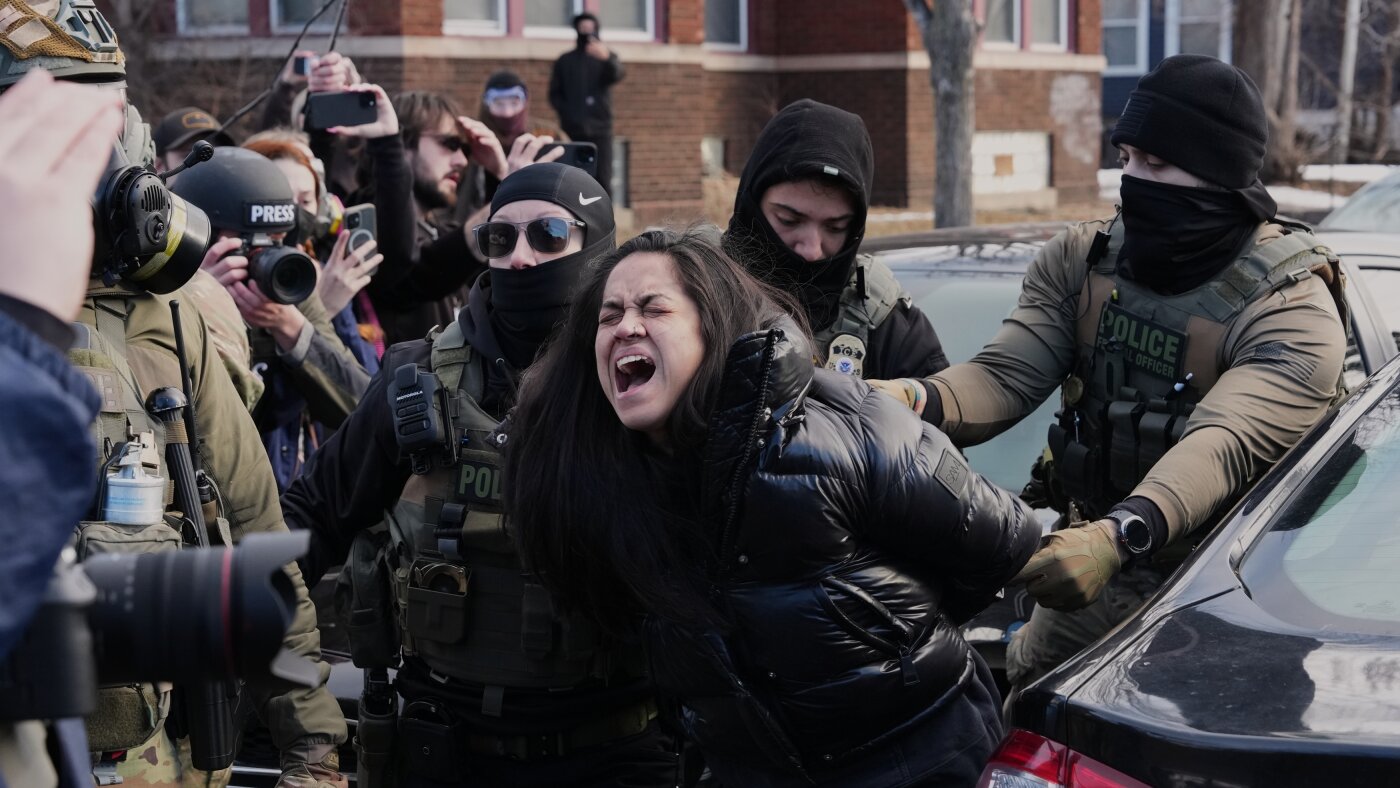
Aliya Rahman is detained by federal agents near the scene where Renee Macklin Good was fatally shot by an ICE officer on Jan. 13 in Minneapolis.
Adam Gray/AP
hide caption
toggle caption
Adam Gray/AP
It’s a video many saw on social media soon after it happened: Officers with Immigration and Customs Enforcement, or ICE, dragging a woman out of her car and forcing her to the ground.
The woman in the video is Aliya Rahman, a Bangladeshi-American and a U.S. citizen. The day she was arrested, Rahman was on her way to the doctor, when she came across an ICE operation and a group of people protesting. She said the ICE officers told her to move her car, but the scene was chaotic and she received multiple instructions at once.
The Department of Homeland Security said in an earlier statement they arrested Rahman because she “ignored multiple commands.” But Rahman, who is autistic and also recovering from a traumatic brain injury, says it sometimes takes her a moment to understand auditory commands. Before she knew it, the officers were carrying her away by her limbs.

“I thought I might well die,” Rahman said. She was placed in an SUV with three ICE officers.
“I heard the laughing driver radio in, ‘we’re bringing in a body,’” she recalled. It took her a second to realize they meant her.
In recent days, federal officials have signaled a willingness to reduce the large number of immigration agents in Minnesota, though they say any decrease will depend on state and local cooperation. Even if a draw-down occurs, they’ll leave behind a changed community, including many citizens questioned and detained by immigration officers in recent weeks.
Rahman was taken to the Whipple Federal Building in Minneapolis, where immigration agents have brought detainees before releasing them or sending them out of state. While at Whipple, Rahman experienced a severe headache, and asked for medical care for more than an hour. Eventually, she passed out. She says she woke up in a downtown hospital, where doctors told her she had suffered a concussion.
Her arrest was more than two weeks ago, but she can’t shake the fear.
“I do not feel safe being in my own home, driving these streets,” she said. “And even then, I am in a significantly better place than a lot of the other folks who have been detained.”

Rahman is far from the only U.S. citizen in Minnesota with such a story.
ChongLy Scott Thao, a Hmong man and U.S. citizen, was pulled from his home wearing only sandals, underwear and a blanket around his shoulders. Thao said the immigration agents drove him “to the middle of nowhere” and photographed him. He told reporters he feared they would beat him. They later brought him back to his house.
Mubashir Khalif Hussen, a Somali-American and U.S. citizen, also was detained by ICE.
“I wasn’t even outside for mere seconds before I seen a masked person running at me full speed,” Hussen said at a news conference last month. “He tackled me. I told him, ‘I’m a U.S. citizen.’ He didn’t seem to care. He dragged me outside to the snow while I was handcuffed, restrained, helpless and he pushed me to the ground.”
Hussen is now suing the Trump administration as part of a class action lawsuit, accusing it of racial profiling. According to the lawsuit, ICE eventually released Hussen outside the Whipple building, telling him to walk the seven miles back to where they detained him.
In a statement to NPR, the Department of Homeland Security said “allegations that ICE engages in ‘racial profiling’ are disgusting, reckless and categorically FALSE.”

But Walter Olson, a senior fellow with the Cato Institute, a libertarian think tank, says many legal experts are coming to a different conclusion.
“This is no longer just a series of accidents that could have been due to someone being badly trained or being a bad apple. This is a systematic assault on constitutional rights,” he said.
The Fourth Amendment protects people from being stopped without reasonable suspicion and arresting without probable cause, a higher standard. Courts in the U.S. have decided skin color alone does not meet either bar.
Last fall, however, the Supreme court ruled that “apparent ethnicity” could be used to determine reasonable suspicion, as long as there were other factors too. Legal experts say the decision may give ICE more discretion.
Olson says even if the Minnesota immigration crackdown eases, these same concerns could arise elsewhere. He noted that judges ruled against the federal government during its crackdowns in Los Angeles, Chicago and Portland.
“And they were not led to call off or rethink the campaign. They just regrouped and came back to another state,” Olson said.
Even citizens who were not arrested but still questioned are rattled after run-ins with immigration officers. Luis Escoto, the owner of El Taquito Taco Shop in West St. Paul, said immigration agents surrounded his wife Irma’s car in their restaurant’s alley when she went out to get more lettuce before the dinner hour. Escoto ran outside.
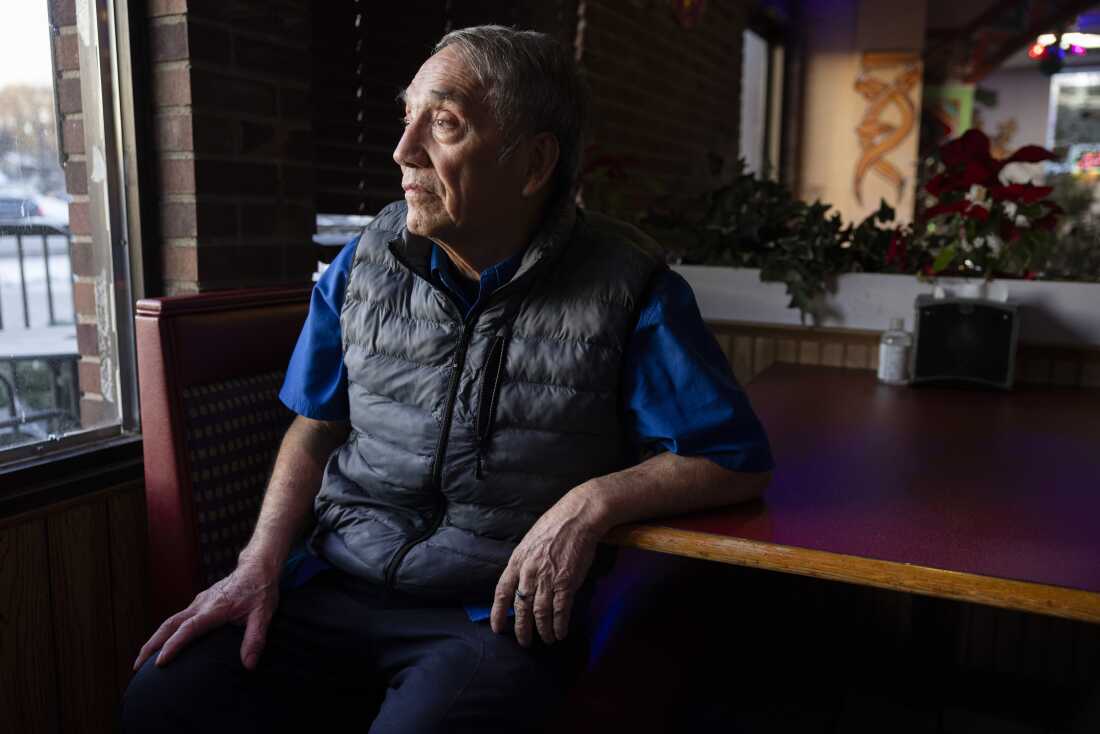
Luis Escoto poses for a portrait inside of his restaurant, El Taquito in West St. Paul, Minnesota.
Jaida Grey Eagle for NPR
hide caption
toggle caption
Jaida Grey Eagle for NPR
“I said, ‘Hey, hold on. That’s just my wife,’” Escoto said. “They said, ‘We need proof of U.S. citizenship,’ and I said, ‘She’s a U.S. citizen.’”
Luis and Irma Escoto are both citizens. Escoto showed one of the officers their passport cards, which he still had in his wallet after a recent trip to Mexico.
“He said, ‘Well, next time she should carry that all the time, because if she doesn’t have proof of citizenship we’re going to arrest her,’” Escoto recalled.
The immigration agents left. But weeks later, Escoto is still shaken and angry. Some of his customers are now escorting him and his wife home each night when the restaurant closes.
When he became a citizen 35 years ago, Escoto said he was nervous because the government took away his green card. He asked the judge about it.

Irma Escoto poses for a portrait inside of her restaurant, El Taquito in West St. Paul, Minnesota.
Jaida Grey Eagle for NPR
hide caption
toggle caption
Jaida Grey Eagle for NPR
“I said, ‘Sir, what happens if the immigration officers stop me?’ And he said ‘Well, today you’re proud to be a United States citizen,’” Escoto said.
The judge told him you don’t need documentation when you’re a citizen. But now, Escoto said, that doesn’t seem so true anymore.

‘Rock Springs’ Review: Kelly Marie Tran and Benedict Wong in a Fresh, Vivid Spin on Grief Horror

Trump orders DHS to stay away from protests in Democratic-led cities unless federal help is sought

Video: How Trump’s Tariffs Affected the Economy After One Year

Video: How the Supreme Court Made Itself More Secretive
After being hit by a car, she was saved by a lavender bunny

Florida High School Football Rankings: Top 25 teams – Oct. 21

Cleary's 21 help Le Moyne down Central Connecticut State 69-64 in OT

How old is Bo Nix? What to know about Oregon quarterback ahead of 2024 NFL Draft

99th annual Pony Swim held in Virginia

Indiana Members Credit Union announced as new anchor tenant at Bottleworks District
Video: How Trump’s Tariffs Affected the Economy After One Year

Portland mayor demands ICE leave city after federal agents use tear gas on protesters ‘Sickening decisions’

Cuba denies security threat accusations as US raises pressure

Kennedy Center will close for 2 years for renovations in July, Trump says, after performers backlash

Government shutdowns may be fewer, but they’re increasingly disruptive
-

 Massachusetts1 day ago
TV star fisherman, crew all presumed dead after boat sinks off Massachusetts coast
-

 Tennessee2 days ago
UPDATE: Ohio woman charged in shooting death of West TN deputy
-

 Pennsylvania7 days ago
Rare ‘avalanche’ blocks Pennsylvania road during major snowstorm
-

 Movie Reviews6 days ago
Vikram Prabhu’s Sirai Telugu Dubbed OTT Movie Review and Rating
-
 Science1 week ago
LAUSD says Pali High is safe for students to return to after fire. Some parents and experts have concerns
-
 Politics1 week ago
Trump’s playbook falters in crisis response to Minneapolis shooting
-
Austin, TX3 days ago
TEA is on board with almost all of Austin ISD’s turnaround plans
-

 Indiana8 hours ago
13-year-old rider dies following incident at northwest Indiana BMX park

