News
Hawaii Democratic Caucus Results


Hawaii’s in-person Democratic caucuses will run from 11 p.m. to 1 a.m. Eastern time. Only registered Democrats may participate, though same-day registration and party enrollment will be offered.
An option to vote “uncommitted” will appear on the ballot. In Tuesday’s primary in Minnesota, about 19 percent of Democrats voted “uncommitted” as part of a protest of President Biden’s policies toward Israel and the war in Gaza.


Visitors watch as National Park Service employees use vacuums to clean the Lincoln Memorial Reflecting Pool, Saturday, June 20, 2026, in Washington.
Mark Schiefelbein/AP
hide caption
toggle caption
Mark Schiefelbein/AP
President Trump has claimed that United States Park Police have made several arrests in connection with what he described as deliberate sabotage of the Lincoln Memorial Reflecting Pool in Washington D.C., which underwent a multimillion-dollar renovation earlier this year.
“The United States Park Police have arrested multiple individuals for vandalizing our Nations magnificent Reflecting Pool,” Trump wrote on Truth Social late Saturday evening. “These are very serious crimes having to do with the destruction of National Monuments. Years in jail! Work will begin immediately on its repair.”

In a second post on Saturday, Trump described the alleged damage in greater detail, saying more arrests had followed. He provided no evidence for any of his claims about the nature of the damage, and neither the Park Police nor any other law enforcement agency had publicly confirmed any arrests as of the time of publication.
On Friday, Maryland resident and former Olympian David Hearn was arrested and charged with destroying government property. Hearn says he merely reached into the pool to touch one of the already dislodged blue pieces, and denies the charge.
Trump said that the pool would be drained and repaired quickly, and framed the alleged vandalism as an affront to American history. “We met with contractors today, will probably be forced to release and drain much of the water in order to do the necessary repairs,” he wrote. “What these terrible Vandals have done is a true affront to both Presidents George Washington and Abraham Lincoln, and should be dealt with accordingly”.
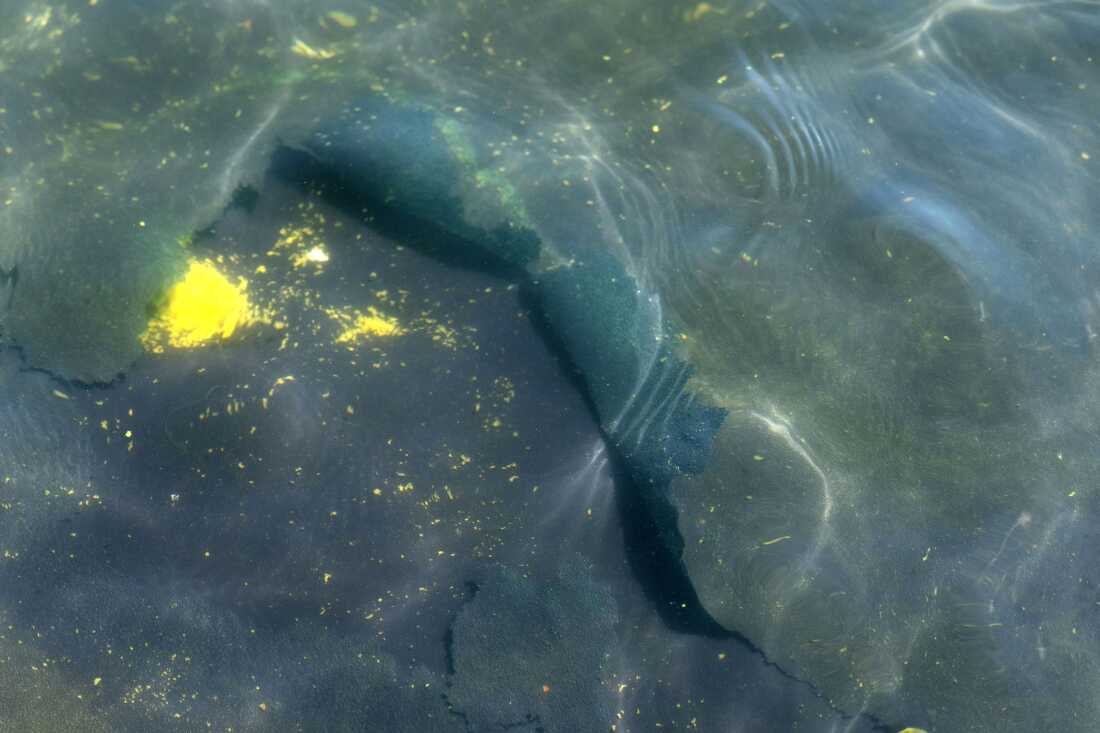
A peeling section of blue coating is seen in the Lincoln Memorial Reflecting Pool, Saturday, June 20, 2026, in Washington.
Mark Schiefelbein/AP
hide caption
toggle caption
Mark Schiefelbein/AP
‘A 250-foot long gash’
Trump described what he said was physical destruction to the pool’s newly renovated lining. “They took some form of knife or blade, and put a 250 foot long gash into the beautiful facade of what took so much work, competence, and money to build and complete,” he wrote Saturday. “They also poured corrosive and destructive chemicals into the Pool.”
The president connected the alleged vandalism to the recent green color of the pool — again, without evidence. The pool turned green last week after being refilled following its renovation, in which its floor was repainted in a shade Trump calls “American flag blue.”

Aquatic ecologists and pool specialists told NPR the discoloration was caused by a natural bloom of algae from the genus Desmodesmus — a process scientists say is common in shallow, sun-exposed bodies of water, and one that may have been accelerated by the renovation disturbing the nutrient balance of the water.
A George Mason University professor who took water samples confirmed the algae was not toxic.

Water from a vacuum line being used by National Park Service employees to clean the Lincoln Memorial Reflecting Pool pours into a nearby drain, Saturday, June 20, 2026, in Washington.
Mark Schiefelbein/AP
hide caption
toggle caption
Mark Schiefelbein/AP
A renovation that grew in scope and cost
In April, Trump revealed his plans for the pool to be made “American flag blue,” in time for the 250th anniversary of the Declaration of Independence on July 4. The president also posted a fake image of himself and several of his administration officials in swimsuits, along with an unidentified woman in a bikini lounging in the water.
Trump defended the recent work in his Saturday post, writing: “The Reflecting Pool was never so beautiful as it was just one week ago, even going back to 1922 when it opened.” The pool opened in 1923.

The renovation project expanded significantly beyond the initial public cost estimate of $2 million, to more than $14 million by the time work was completed. A Virginia-based contractor received the no-bid contract. A separate Ohio-based company was paid approximately $1.7 million for nanobubble ozone technology deployed to treat the algae bloom.
The project was also the subject of a lawsuit filed in May by the Cultural Landscape Foundation, a nonprofit that argued the administration had bypassed required historic preservation reviews. A federal judge had not yet ruled on the case by the time the administration notified the court that work had been completed.
The White House has also provided no evidence that vandalism caused the pool’s discoloration, or any of the structural damage the president has described.

Gov. Gavin Newsom declared a State of Emergency Saturday night as plumes of black smoke continue to rise from the Lineage Logistics warehouse fire, still burning on the 1400 block of South Los Palos Street in Boyle Heights.
The fire started inside a freezer area at the cold storage facility Wednesday afternoon and was initially extinguished before reigniting on Thursday, according to officials.
Newsom’s declaration allows the state to use additional funding for firefighting efforts, public health services and disaster recovery as Los Angeles continues to deal with the emergency.
“California is mobilizing to support Los Angeles as firefighters and emergency personnel continue their work to contain this fire and protect surrounding communities,” Newsom said in a statement Saturday. “While local officials continue to lead this response, the State of California is prepared to help safeguard public health, support emergency operations, and assist impacted residents. We are coordinating closely with our local partners, deploying specialized expertise, and pre-positioning critical supplies so communities have the support they need both now and throughout recovery.”
Although local officials have not asked for additional state resources at this time, Newsom preemptively made the declaration to provide the region with resources as soon as they are needed, California Governor’s Office of Emergency Services Director Caroline Thomas Jacobs said.
“Cal OES is working side-by-side with the City and County of Los Angeles and our regional partners to ensure they have the resources, information, and support necessary to respond to this incident,” Jacobs said. “The State of Emergency allows us to further streamline coordination efforts and leverage additional state capabilities as needed. Our focus remains on protecting communities and supporting locally led response operations.”
-

Smoke from Boyle Heights warehouse fire continues to blow over downtown Los Angeles on Saturday, June 20, 2026. (KTLA) -
A massive plume of toxic smoke is seen rising from a Boyle Heights cold storage facility fire on Wednesday, June 17, 2026. (KTLA) -
Crews work a warehouse fire in the Boyle Heights section of Los Angeles on Wednesday, June 17, 2026. (AP Photo/Jae C. Hong)


Resources available to Los Angeles following the declaration include:
- 5.5 million N95 respirator masks available for distribution to impacted communities.
- Commercial-grade air purifiers available for deployment to evacuation centers, community facilities, and other public spaces.
- Bottled water and other emergency supplies available through the state’s logistics network.
- Enhanced air quality monitoring and technical support resources.
Cal OES Fire and Rescue Branch leaders with specialized technical expertise are also available to consult L.A. fire officials on how to deal with the warehouse fire, if necessary. The state provided similar expertise to officials during the chemical tank failure in Garden Grove.
Air quality remains unhealthy in parts of Los Angeles due to the large amount of smoke produced by the fire.
“The warehouse fire has produced significant smoke and particulate matter that may affect air quality in surrounding neighborhoods,” the governor’s office stated. “To support public health monitoring efforts, the California Air Resources Board is coordinating with local and regional partners to ensure access to air quality information and technical expertise. State agencies continue to monitor conditions and stand ready to deploy additional monitoring resources if requested.”

The exterior of the Robert F. Kennedy Department of Justice building is pictured on May 4, 2021, in Washington, D.C.
Patrick Semansky/AP
hide caption
toggle caption
Patrick Semansky/AP
The Justice Department released a memo this week that quietly calls into question decades of civil rights protections for Americans with disabilities and stirred fear and anger among advocates and families.
The memo, an opinion from the Office of Legal Counsel, argues that states do not have to provide in-home or community-based care to people with disabilities who need support. These services allow many disabled Americans to continue to live, learn and work at home or in their own communities, among family and friends.
“It is now the position of the United States government that people with disabilities don’t have a right to be part of their communities,” says Alison Barkoff, a health law and policy professor at George Washington University who led disability law and policy efforts during both the Obama and Biden administrations. “I can’t overstate how significant this change in position is.“
Without the federal government requiring that states provide these services – to help disabled people integrate into their communities – advocates and legal experts warn that cash-strapped states could cut them and return to what was once common practice: de facto segregation of Americans with disabilities in nursing homes and large institutions.
Pushback from the disability community was swift.
“As America prepares to celebrate 250 years of independence, [this memo] threatens to drag our nation back to a dark and shameful era of ignorance and cruelty,” said the American Association of People with Disabilities. “This interpretation will open the doors for states to revert to warehousing people with disabilities out of sight and out of mind in institutions.”
“This opinion is a direct threat to decades of progress toward community living for people with disabilities,” said Shira Wakschlag of The Arc of the United States, a nonprofit disability advocacy group. “People with disabilities shouldn’t be forced into institutions because a state refuses to provide services in the community.”
The Justice Department did not respond to an NPR request that it explain its position as well as why it is changing course after decades of legal and bipartisan support for community services.
What the law says
This new memo calls into question what legal experts say has been settled law for decades.
Both Section 504 of the Rehabilitation Act and Title II of the Americans with Disabilities Act have long been interpreted to require that states provide services to Americans with disabilities in the most integrated setting appropriate. In short: Institutionalization should be a last resort.
In 1999, a case testing these protections made it to the U.S. Supreme Court. In Olmstead v. L.C., two women with mental disabilities sued Georgia, arguing that the state had failed its obligation to provide services that would allow them to return to their communities and that it had continued to institutionalize the women instead, thus violating their civil rights.
The court agreed that states have a legal responsibility to provide support that integrates disabled Americans into their communities, and for nearly three decades, courts across the country have embraced that interpretation.
By 2023, 8.4 million Americans were receiving home- and community-based services through Medicaid.
The new memo, written by Lanora Pettit, principal deputy assistant attorney general in the Office of Legal Counsel, argues that, while federal law prohibits discrimination on the basis of disability, it does not impose an “integration mandate” on states to provide these community services.
What’s more, the memo argues, the Supreme Court’s Olmstead decision “held only that a state cannot institutionalize such patients without justification.”
But, the memo adds: “What counts as adequate justification remains an open question.”
At one point, Pettit acknowledges the novelty of this reading: “We recognize that this view of Olmstead‘s import is out of step with the common understanding of that decision within the federal courts.”
Why it matters
“The United States government since 1977 has taken the position that [federal law] includes an integration mandate that requires services to be provided in the most integrated setting appropriate,” says professor Barkoff, who worked in the Obama Justice Department leading its Olmstead enforcement efforts.
For decades, Barkoff adds, both Republican and Democratic administrations, including the first Trump administration, proactively enforced federal disability law and repeatedly brought actions against states that relied too heavily on care in large, segregated settings that the law says should be a last resort.
The courts and Congress decided institutionalization should be a last resort because people’s personal liberty is at stake, says Jennifer Mathis of the Bazelon Center for Mental Health Law: “Who you can see, when you can go out, when you eat, what you eat. Who your roommate is, who you talk to, what your environment is. And for so many people who are institutionalized, their life is literally a hallway. I have been on those hallways with people. It is deadening.“
This memo signifies a dramatic change in the U.S. government’s official position.
“We are incredibly concerned that the message coming from the federal government in this memo is, ‘It’s fine to go back to the days that people were placed in institutions,’ even though they can be served in the community, even though they want to be and even though it’s more cost-effective,” Barkoff says.
The timing matters too. The memo arrives as a new case, Texas v. Kennedy, is making its way through the courts. The case, brought by Texas and several other states, is essentially a fresh challenge to the integration mandate on states.
With this memo, the federal government is aligning itself with the plaintiffs in the case. Though Mathis cautions: “It’s important to understand that [this memo] is not the law, that the Justice Department can’t change the law. Congress makes laws, not agencies.“
For now, it’s not clear what the immediate impact of the memo will be, though it seems the Justice Department will stop its enforcement efforts around Olmstead.
Why now?
The Justice Department memo appears to be the latest salvo in a broader effort that began on July 24, 2025, when President Trump issued an executive order intended to make it easier for state and local governments to police homelessness.
“Endemic vagrancy, disorderly behavior, sudden confrontations, and violent attacks have made our cities unsafe,” the order argues, going on to claim that “the overwhelming majority of these individuals are addicted to drugs, have a mental health condition, or both.”
The administration’s solution: Involuntary institutionalization. “Shifting homeless individuals into long-term institutional settings for humane treatment through the appropriate use of civil commitment will restore public order,” the order reads.
In a 2023 campaign video, President Trump himself pledged: “For those who are severely mentally ill and deeply disturbed, we will bring them back to mental institutions, where they belong.”
A conservative Texas think tank, the Cicero Institute, has been a driving force behind recent efforts to forcefully combat homelessness, including through institutionalization.
One serious obstacle to large-scale institutionalization of the unhoused is federal disability law that has long required home- or community-based services instead, when appropriate. A footnote in the Justice Department’s new memo appears to suggest these laws have contributed to the rise in chronic homelessness.
To the contrary, Barkoff says, the Olmstead decision “has been one of the most effective tools in providing services and stable housing to people who are homeless.”
NPR has previously reported that the Trump administration’s push for institutionalization faces another big obstacle: An acute shortage of beds at these specialized facilities.
The memo arrives as Republicans have also passed deep cuts to Medicaid, which is the primary source of funding for community-based services many disabled Americans rely on.
Multiple legal experts tell NPR that, in response to last year’s One Big Beautiful Bill Act, states must now make deep cuts to a whole range of services previously funded by Medicaid. The Trump administration’s memo, they add, essentially gives states permission to cut these localized supports and, instead, rely on institutionalization – even though research shows the latter is considerably more expensive for states to provide.
This comes as disability advocates were already pushing back against the Trump administration’s announcement on Tuesday that it would move federal administration of special education programs out of the Department of Education and into the Department of Health and Human Services – a change that, as with the new Justice Department memo, raised fears of a rollback of the enforcement of longstanding civil rights protections.
-

 World10 minutes ago
Mourners gather to remember Lebanese conservationist killed by Israel
-
News33 minutes ago
Trump claims vandals damaged D.C. Reflecting Pool, and says it will be drained again
-

 Los Angeles, Ca2 hours ago
31st annual Rodeo Drive Concours d’Elegance provides perfect Father’s Day activity
-

 Detroit, MI2 hours ago
3 Isaiah Stewart Trade Packages That Would Make Sense for Detroit Pistons
-

 San Francisco, CA2 hours ago
Giants Reach Franchise Milestone Never Before Seen in San Francisco
-

 Dallas, TX2 hours ago
Mavericks’ Potential 2026 NBA Draft Trade Down Target Revealed
-

 Miami, FL3 hours ago
Could the Heat bring Duncan Robinson back in a Deal for Giannis Antetokounmpo?
-

 Boston, MA3 hours ago
Volunteer rescuer seriously injured Friday helping unresponsive teenage hiker in NH – The Boston Globe

