News
Greenland: JD Vance takes ominous message to Danish territory


 Reuters
A green shimmer, like a curtain of light being drawn across the night sky, formed beside the impossibly bright stars above Nuuk late on Friday evening.
The appearance of the spectacular northern lights – a common wonder in these parts – seemed to mark the end of a hugely significant day in the arctic, one that brought icebound Greenland’s hopes and challenges into the sharpest relief.
It was a day in which an acquisitive foreign power had sent an uninvited delegation to the world’s largest island with an uncomfortable message.
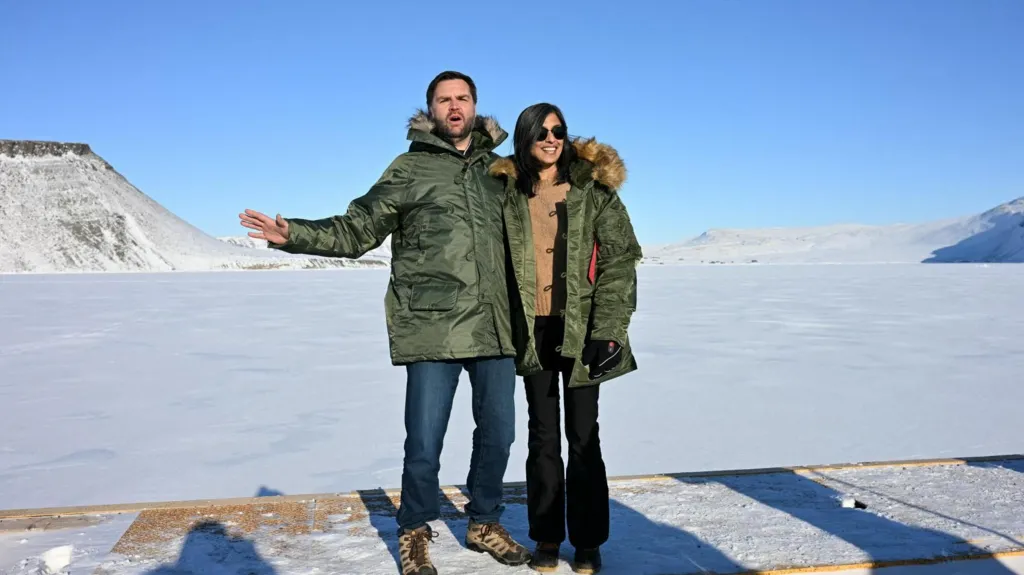
On a brief visit to a remote US military base in the far north of Greenland, US Vice-President JD Vance may have tried at times to soften his boss’s stated aim of simply annexing the autonomous Danish territory.
“We do not think that military force is ever going to be necessary,” Vance said, perhaps attempting to sound reassuring.
But the vice-president’s overarching message remained stark and intimidating: the world, the climate, and the Arctic region are changing fast, and Greenland needs to wake up to threats posed by an expansionist China; long-standing Western security partnerships have run their course; the only way the island can protect itself, its values and its mineral wealth is by abandoning weak and miserly Danish overlords and turning instead to the muscular and protective embrace of the US.
“We need to wake up from a failed, 40-year consensus that said that we could ignore the encroachment of powerful countries as they expand their ambitions.
“We can’t just bury our head in the sand – or, in Greenland, bury our head in the snow – and pretend that the Chinese are not interested in this very large landmass,” Vance told US troops at the Pituffik base.
If you look at a map of the world that has the north pole at its centre, rather than the equator, it is easy to see how Greenland suddenly switches from being a bland, easily overlooked smudge of uninhabited territory and into a key strategic landmass at the heart of what many analysts now accept as an emerging power struggle between China, the US, and Russia, for control of the arctic, its minerals and its shipping lanes.
But the speed and contempt with which the Trump White House has rejected its traditional reliance on Western allies – Nato in particular – has left its partners bewildered.
“Not justifiable,” was the bristling response of Danish Prime Minister Mette Frederiksen after hearing Vance attack her government as he stood on its sovereign territory.
‘Like a threat’
But 1,500km (930 miles) south of America’s Pituffik base, in Greenland’s capital, Nuuk, the American story vied for attention with a very different local event on Friday.
“We will prevail,” a smiling crowd sang, at a ceremony to celebrate the formation of a new coalition government for Greenland.
The mood felt mostly joyful and communal, with people locking arms and swaying gently as a band played inside the town’s house of culture.
It was a powerful reminder of the shared values that bind Greenland’s tiny, and overwhelmingly native Inuit population together – the need for consensus and co-operation in an often hostile natural climate, the desire to protect and celebrate Inuit culture and the wish to be respected by outsiders, be they from familiar but distant Denmark or marginally closer America.
“There are many ways to say things. But I think the way [Trump] is saying it is not the way. It’s like a threat,” said Lisbeth Karline Poulsen, 43, a local artist attending the ceremony.
Her reaction appeared to capture the broader mood here – a recent poll showed just 6% of the population support the idea of being part of the US.
The journey to independence
Under its new government, and with overwhelming public support, Greenland is beginning a slow, very cautious move towards full independence from Denmark.
It’s a process that will likely take many years, and which will involve lengthy dialogue with both Copenhagen and with Washington.
After all, Greenlanders well understand that their economy needs to be far more developed if their bid for independence is to stand any realistic chance of success.
But they need to balance that development against realistic fears of exploitation by powerful outside commercial forces.
Which brings us to the fundamental confusion, in Greenland and beyond, about the Trump administration’s approach towards their territory.
What does America want?
On his visit, Vance mentioned Greenland’s aspirations for independence, and implied that America’s real intention was not a sudden annexation of the island, but something far more patient and long-term.
“Our message is very simple, yes, the people of Greenland are going to have self-determination. We hope that they choose to partner with the United States, because we’re the only nation on earth that will respect their sovereignty and respect their security.”
If that is genuinely the American pitch – Mr Trump’s messaging remains more aggressive than Mr Vance’s – then Greenlanders can surely relax a little and take their time.
There are still large reserves of goodwill towards the US here, and a keen interest in doing more business with American companies.
On the security front, a 74-year-old treaty with Denmark permitting the US to increase its military presence in Greenland at any time – from new bases to submarine harbours – should surely take care of Washington’s concerns about countering the threat from China, just as it did during the Cold War years.
What remains puzzling is Donald Trump’s impatience – the same impatience he’s displayed in attempting to negotiate an end to the war in Ukraine.
Short of owning Greenland, America could get everything it desires and needs from this vast island without much difficulty. Instead, many people in Nuuk feel they’re being bullied.
It’s a deeply counterproductive approach, which has already forced Washington into one humiliating climbdown – cancelling a planned cultural tour by Vance’s wife, Usha, to Nuuk and another town in the face of planned local protests.
A slower, more respectful, behind-the-scenes sort of engagement would, surely, make more sense.
But that’s not to every politician’s taste.



PORTLAND, Ore. (AP) — Federal immigration officers shot and wounded two people in a vehicle outside a hospital in Portland, Oregon, on Thursday, a day after an officer shot and killed a driver in Minnesota, authorities said.
The Department of Homeland Security described the vehicle’s passenger as “a Venezuelan illegal alien affiliated with the transnational Tren de Aragua prostitution ring” who had been involved in a recent shooting in Portland. When agents identified themselves to the vehicle occupants Thursday afternoon, the driver tried to run them over, the department said in a written statement.
“Fearing for his life and safety, an agent fired a defensive shot,” the statement said. “The driver drove off with the passenger, fleeing the scene.”
There was no immediate independent corroboration of those events or of any gang affiliation of the vehicle’s occupants. During prior shootings involving agents involved in President Donald Trump’s surge of immigration enforcement in U.S. cities, including Wednesday’s shooting by an Immigration and Customs Enforcement officer in Minneapolis, video evidence cast doubt on the administration’s initial descriptions of what prompted the shootings.
READ MORE: What we know so far about the ICE shooting in Minneapolis
According to the the Portland Police bureau, officers initially responded to a report of a shooting near a hospital at about 2:18 p.m.
A few minutes later, police received information that a man who had been shot was asking for help in a residential area a couple of miles away. Officers then responded there and found the two people with apparent gunshot wounds. Officers determined they were injured in the shooting with federal agents, police said.
Their conditions were not immediately known. Council President Elana Pirtle-Guiney said during a Portland city council meeting that Thursday’s shooting took place in the eastern part of the city and that two Portlanders were wounded.
“As far as we know both of these individuals are still alive and we are hoping for more positive updates throughout the afternoon,” she said.
The shooting escalates tensions in an city that has long had a contentious relationship with President Donald Trump, including Trump’s recent, failed effort to deploy National Guard troops in the city.
Portland police secured both the scene of the shooting and the area where the wounded people were found pending investigation.
“We are still in the early stages of this incident,” said Chief Bob Day. “We understand the heightened emotion and tension many are feeling in the wake of the shooting in Minneapolis, but I am asking the community to remain calm as we work to learn more.”
Portland Mayor Keith Wilson and the city council called on U.S. Immigration and Customs Enforcement to end all operations in Oregon’s largest city until a full investigation is completed.
“We stand united as elected officials in saying that we cannot sit by while constitutional protections erode and bloodshed mounts,” a joint statement said. “Portland is not a ‘training ground’ for militarized agents, and the ‘full force’ threatened by the administration has deadly consequences.”
The city officials said “federal militarization undermines effective, community‑based public safety, and it runs counter to the values that define our region. We’ll use every legal and legislative tool available to protect our residents’ civil and human rights.”
They urged residents to show up with “calm and purpose during this difficult time.”
“We respond with clarity, unity, and a commitment to justice,” the statement said. “We must stand together to protect Portland.”
U.S. Sen. Jeff Merkley, an Oregon Democrat, urged any protesters to remain peaceful.
“Trump wants to generate riots,” he said in a post on the X social media platform. “Don’t take the bait.”
A free press is a cornerstone of a healthy democracy.
Support trusted journalism and civil dialogue.

new video loaded: What Trump Told Us About the ICE Shooting

By Zolan Kanno-Youngs, Alexandra Ostasiewicz, Nikolay Nikolov and Coleman Lowndes
January 8, 2026

Good morning. You’re reading the Up First newsletter. Subscribe here to get it delivered to your inbox, and listen to the Up First podcast for all the news you need to start your day.
Today’s top stories
An Immigration and Customs Enforcement officer shot and killed 37-year-old Renee Nicole Good, a Minneapolis woman, yesterday. Multiple observers captured the shooting on video, and community members demanded accountability. Minnesota law enforcement officials and the FBI are investigating the fatal shooting, which the Trump administration says was an act of self-defense. Meanwhile, the mayor has accused the officer of reckless use of power and demanded that ICE get out of Minneapolis.
People demonstrate during a vigil at the site where a woman was shot and killed by an immigration officer earlier in the day in Minneapolis, Minnesota, on Jan. 7, 2026. An immigration officer in Minneapolis shot dead a woman on Wednesday, triggering outrage from local leaders even as President Trump claimed the officer acted in self-defense. Minneapolis Mayor Jacob Frey deemed the government’s allegation that the woman was attacking federal agents “bullshit,” and called on Immigration and Customs Enforcement (ICE) officers conducting a second day of mass raids to leave Minneapolis.
Kerem Yucel/AFP via Getty Images
hide caption
toggle caption
Kerem Yucel/AFP via Getty Images
- 🎧 Caitlin Callenson recorded the shooting and says officers gave Good multiple conflicting instructions while she was in her vehicle. Callenson says Good was already unresponsive when officers pulled her from the car. Homeland Security Secretary Kristi Noem claims the officer was struck by the vehicle and acted in self-defense. In the video NPR reviewed, the officer doesn’t seem to be hit and was seen walking after he fired the shots, NPR’s Meg Anderson tells Up First. Anderson says it has been mostly peaceful in Minneapolis, but there is a lot of anger and tension because protesters want ICE out of the city.
U.S. forces yesterday seized a Russian-flagged oil tanker in the north Atlantic between Iceland and Britain after a two-week chase. The tanker was originally headed to Venezuela, but it changed course to avoid the U.S. ships. This action comes as the Trump administration begins releasing new information about its plans for Venezuela’s oil industry.
- 🎧 It has been a dramatic week for U.S. operations in Venezuela, NPR’s Greg Myre says, prompting critics to ask if a real plan for the road ahead exists. Secretary of State Marco Rubio responded that the U.S. does have a strategy to stabilize Venezuela, and much of it seems to involve oil. Rubio said the U.S. would take control of up to 50 million barrels of oil from the country. Myre says the Trump administration appears to have a multipronged strategy that involves taking over the country’s oil, selling it on the world market and pressuring U.S. oil companies to enter Venezuela.
Health Secretary Robert F. Kennedy Jr. released new dietary guidelines for Americans yesterday that focus on promoting whole foods, proteins and healthy fats. The guidance, which he says aims to “revolutionize our food culture,” comes with a new food pyramid, which replaces the current MyPlate symbol.
- 🎧 “I’m very disappointed in the new pyramid,” Christopher Gardner, a nutrition expert who was on the Dietary Guidelines Advisory Committee, tells NPR’s Allison Aubrey. Gardner says the new food structure, which features red meat and saturated fats at the top, contradicts decades of evidence and research. Poor eating habits and the standard American diet are widely considered to cause chronic disease. Aubrey says the new guidelines alone won’t change people’s eating habits, but they will be highly influential. This guidance will shape the offerings in school meals and on military bases, and determine what’s allowed in federal nutrition programs.
Special series

Trump has tried to bury the truth of what happened on Jan. 6, 2021. NPR built a visual archive of the attack on the Capitol, showing exactly what happened through the lenses of the people who were there. “Chapter 4: The investigation” shows how federal investigators found the rioters and built the largest criminal case in U.S. history.
Political leaders, including Trump, called for rioters to face justice for their actions on Jan. 6. This request came because so few people were arrested during the attack. The extremists who led the riot remained free, and some threatened further violence. The government launched the largest federal investigation in American history, resulting in the arrest of over 1,500 individuals from all 50 states. The most serious cases were made by prosecutors against leaders of the Proud Boys and Oath Keepers. For their roles in planning the attack against the U.S., some extremists were found guilty of seditious conspiracy. Take a look at the Jan. 6 prosecutions by the numbers, including the highest sentence received.
To learn more, explore NPR’s database of federal criminal cases from Jan. 6. You can also see more of NPR’s reporting on the topic.
Deep dive

U.S. President Donald Trump speaks during a news conference in the Roosevelt Room of the White House in Washington, DC.
Andrew Harnik/Getty Images
hide caption
toggle caption
Andrew Harnik/Getty Images

U.S. President Donald Trump speaks during a news conference in the Roosevelt Room of the White House in Washington, DC.
Andrew Harnik/Getty Images
Trump takes 325 milligrams of daily aspirin, which is four times the recommended 81 milligrams of low-dose aspirin used for cardiovascular disease prevention. The president revealed this detail in an interview with The Wall Street Journal published last week. The U.S. Preventive Services Task Force recommends that anyone over 60 not start a daily dose of aspirin to prevent cardiovascular disease if they don’t already have an underlying problem. The group said it’s reasonable to stop preventive aspirin in people already taking it around age 75 years. Trump is 79. This is what you should know about aspirin and cardiac health:
- 💊 Doctors often prescribe the low dose of aspirin because there’s no benefit to taking a higher dose, according to a large study published in 2021.
- 💊 Some people, including adults who have undergone heart bypass surgery and those who have had a heart attack, should take the advised dose of the drug for their entire life.
- 💊 While safer than other blood thinners, the drug — even at low doses — raises the risk of bleeding in the stomach and brain. But these adverse events are unlikely to cause death.
3 things to know before you go

When an ant pupa has a deadly, incurable infection, it sends out a signal that tells worker ants to unpack it from its cocoon and disinfect it, a process that results in its death.
Christopher D. Pull/ISTA
hide caption
toggle caption
Christopher D. Pull/ISTA
- Young, terminally ill ants will send out an altruistic “kill me” signal to worker ants, according to a study in the journal Nature Communications. With this strategy, the sick ants sacrifice themselves for the good of their colony.
- In this week’s Far-Flung Postcards series, you can spot a real, lone California sequoia tree in the Parc des Buttes Chaumont in Paris. Napoleon III transformed the park from a former landfill into one of the French capital’s greenest escapes.
- The ACLU and several authors have sued Utah over its “sensitive materials” book law, which has now banned 22 books in K-12 schools. Among the books on the ban list are The Perks of Being a Wallflower and Wicked: The Life and Times of the Wicked Witch of the West. (via KUER)
This newsletter was edited by Suzanne Nuyen.

Kansas ag officials take comment on proposed water rules

Louisiana task force confronts future of Greek life, pushes new hazing safeguards

After feds cut key food insecurity survey, Maine lawmaker urges state to fill data void

Md. Gov. Moore touts public safety funding increase, even with crime continuing to drop – WTOP News

Applications for spring turkey season in Michigan is open through Feb. 1. What to know

Florida High School Football Rankings: Top 25 teams – Oct. 21

Cleary's 21 help Le Moyne down Central Connecticut State 69-64 in OT

How old is Bo Nix? What to know about Oregon quarterback ahead of 2024 NFL Draft

99th annual Pony Swim held in Virginia

Video: ‘It Didn’t Have to Happen This Way:’ U.Va. Faculty Call for Review of Police Response to Protests

Trump plans to meet with Venezuela opposition leader Maria Corina Machado next week

Trump says meeting Iran’s ‘Crown Prince’ Pahlavi would not be appropriate

Federal immigration agents shoot 2 people in Portland, Oregon, police say

Video: What Trump Told Us About the ICE Shooting

Trump calls for $1.5T defense budget to build ‘dream military’
-

 Detroit, MI5 days ago
2 hospitalized after shooting on Lodge Freeway in Detroit
-

 Technology3 days ago
Power bank feature creep is out of control
-

 Dallas, TX4 days ago
Defensive coordinator candidates who could improve Cowboys’ brutal secondary in 2026
-

 Health5 days ago
Viral New Year reset routine is helping people adopt healthier habits
-

 Nebraska2 days ago
Oregon State LB transfer Dexter Foster commits to Nebraska
-

 Iowa3 days ago
Pat McAfee praises Audi Crooks, plays hype song for Iowa State star
-
 Nebraska3 days ago
Nebraska-based pizza chain Godfather’s Pizza is set to open a new location in Queen Creek
-
 Entertainment2 days ago
Spotify digs in on podcasts with new Hollywood studios