
Connect with us

News

Federal judge strikes down Trump order targeting the law firm Perkins Coie

Published

on

Federal judge strikes down Trump order targeting the law firm Perkins Coie

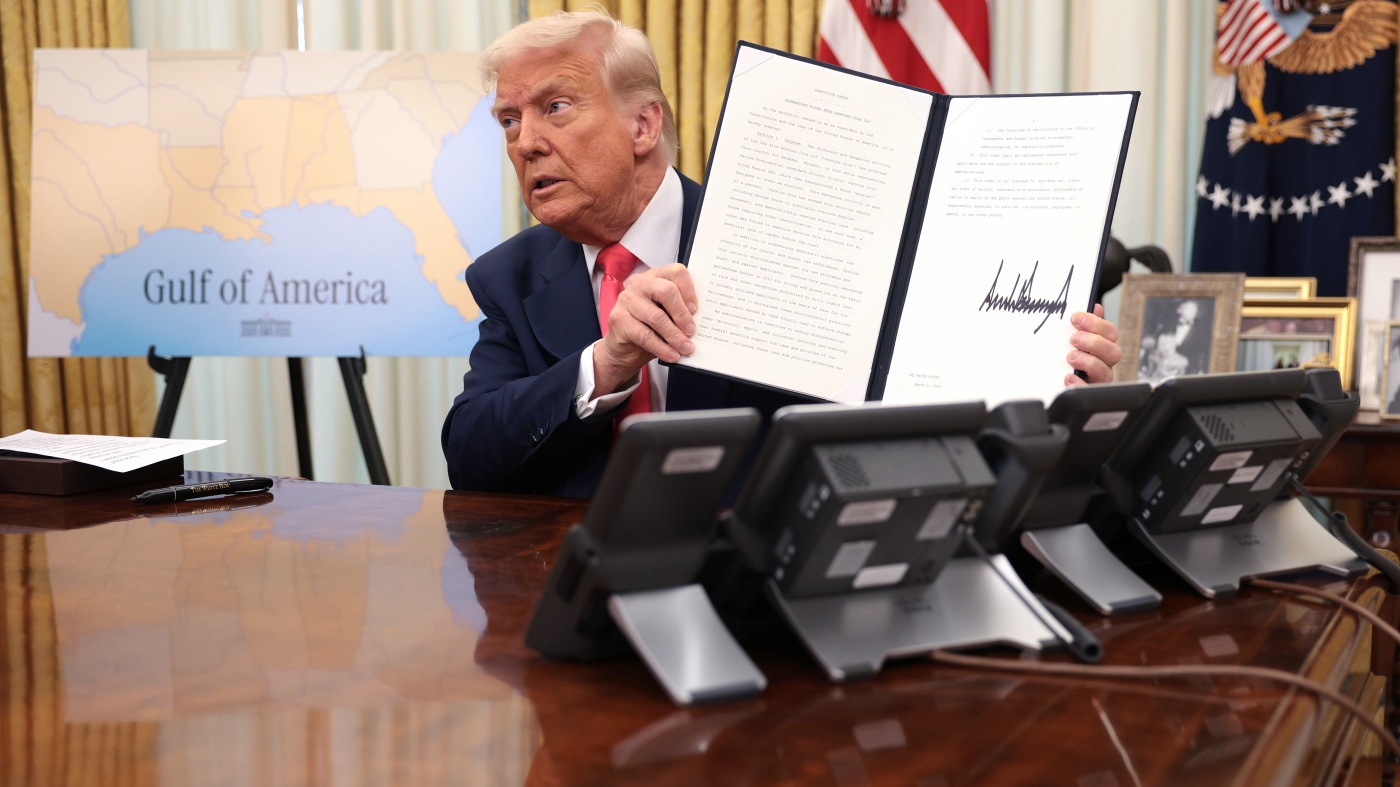
President Donald Trump signs executive orders in the Oval Office of the White House on March 6, including an order terminating the security clearances of those who work at the law firm Perkins Coie.

Alex Wong/Getty Images


hide caption

toggle caption

Advertisement

Alex Wong/Getty Images

A federal judge on Friday struck down President Trump’s executive order targeting the prominent law firm of Perkins Coie, finding it unconstitutional and declaring it an attack on the foundational principles of the American legal system.

The ruling from U.S. District Judge Beryl Howell is the first to permanently block an executive order issued by Trump punishing a law firm for representing clients or causes that he dislikes.

“No American President has ever before issued executive orders like the one at issue in this lawsuit targeting a prominent law firm with adverse actions to be executed by all Executive branch agencies,” Howell wrote in her 102-page ruling.

Advertisement

“But, in purpose and effect, this action draws from a playbook as old as Shakespeare, who penned the phrase: ‘The first thing we do, let’s kill all the lawyers.’”

Perkins Coie was the first law firm targeted with a sweeping executive order that imposed potentially existential punitive measures on it. Trump’s order suspended security clearances for the firm’s employees, barred its attorneys from access to government buildings and officials, and ended government contracts with the firm.

Trump has issued similar executive orders against several other prominent law firms that he views as political enemies. Three of those firms, in addition to Perkins Coie, have sued to challenge Trump’s actions, and won court orders temporarily blocking enforcement of the orders.

Perkins Coie’s case is the first to be permanently blocked.

In her ruling, Judge Howell framed the targeting of Perkins as an attack on the independence of the legal profession and the judicial system.

Advertisement

“The importance of independent lawyers to ensuring the American judicial system’s fair and impartial administration of justice has been recognized in this country since its founding era,” she said in her ruling.

This case, she added, “presents an unprecedented attack on these foundational principles.”

Trump’s order, the judge wrote, “stigmatizes and penalizes a particular law firm and its employees,” from partners through mailroom attendants because of the firm’s representation of clients pursuing claims and taking positions that Trump doesn’t like.

“In a cringe-worthy twist on the theatrical phrase ‘let’s kill all the lawyers,’” she adds, Trump’s executive order “takes the approach of ‘let’s kill the lawyers I don’t like,’ sending the clear message: lawyers must stick to the party line, or else.”

Perkins Coie welcomed her ruling.

Advertisement

“This ruling affirms core constitutional freedoms all Americans hold dear, including free speech, due process, and the right to select counsel without the fear of retribution,” a spokesperson said in a statement. “We are pleased with this decision and are immensely grateful to those who spoke up in support of our positions. As we move forward, we remain guided by the same commitments that first compelled us to bring this challenge: to protect our firm, safeguard the interests of our clients, and uphold the rule of law.”

The Justice Department did not immediately respond to a request for comment.

While Perkins and three other firms have challenged Trump’s orders, at least nine other firms have either cut deals with the president to get him to lift an order against them or to avoid the possibility of one. In return, they’ve agreed to provide hundreds of millions of dollars combined in free legal work on causes they and the president support.

News

GOP gearing up to face tough midterms. And, Pentagon reviews women in ground combat

Published

on

GOP gearing up to face tough midterms. And, Pentagon reviews women in ground combat

Good morning. You’re reading the Up First newsletter. Subscribe here to get it delivered to your inbox, and listen to the Up First podcast for all the news you need to start your day.

Today’s top stories

President Trump continues to suggest that the U.S. will have a lengthy and active role in Venezuela after capturing the ousted president Nicolás Maduro. Trump has proposed several plans for Venezuela’s future government and economy. In those proposals, U.S. companies are expected to play a key role.

President Trump dances as he departs after speaking during a House Republican retreat at The John F. Kennedy Center for the Performing Arts on Jan. 6, 2026, in Washington, DC. House Republicans will discuss their 2026 legislative agenda at the meeting.

Alex Wong/Getty Images


hide caption

Advertisement

toggle caption

Alex Wong/Getty Images

  • 🎧 Trump and his aides are unclear about the future of Venezuela, NPR’s Franco Ordoñez tells Up First. When the president says the U.S. will run the country, many eyes are on Stephen Miller, Trump’s deputy chief of staff for policy. Miller, known for his stringent immigration policies, is one of the U.S. officials overseeing Venezuela. Ordoñez also says Miller has more recently described ruling over the hemisphere by force.
  • ➡️ Last night, Trump posted on social media that Venezuela will turn over between 30 million and 50 million barrels of sanctioned oil to the U.S. While seizing current oil production is one thing, overhauling Venezuela’s oil industry requires a far greater effort. Here’s why.

While meeting with House Republicans yesterday, Trump attempted to offer his party a roadmap to victory in this year’s midterm elections. The president acknowledged the possibility of his party losing the majority in the House this year. Trump said in his speech that the president’s party often loses the midterms.

  • 🎧 NPR’s Domenico Montanaro says that while it’s true the midterms are hard on the president’s party, it is even worse when a president’s approval rating is below 50%. Trump is facing his lowest second-term approval ratings, largely due to the rising cost of living. During yesterday’s speech, the president didn’t offer much on the topic. When he did discuss the economy, it was about how the stock market is at historic highs. He also touted his tariffs, which have actively raised prices on many things. People have informed pollsters for months that they believe the president’s policies have harmed the economy. Montanaro says one area where Trump and Republicans could take action is legislation on health care.

The Pentagon is preparing a six-month review to evaluate what it calls the military “effectiveness” of women serving in ground combat roles. Undersecretary Anthony Tata requested that the Army and Marine Corps submit data on the readiness, training, performance, casualties and command climate of ground combat units and personnel by Jan. 15. The effort aims to determine how gender integration has influenced operational success over the last decade.

Special series

j6_pod_1_wide.png

Trump has tried to bury the truth of what happened on Jan. 6, 2021. NPR built a visual archive of the attack on the Capitol, showing exactly what happened through the lenses of the people who were there. “Chapter 3: Assault on the Capitol,” lays out the timeline of key moments throughout the day as the riot unfolded.

Advertisement

On the morning of Jan. 6, 2021, Trump held a “Save America” rally at the Ellipse, a site near the White House and U.S. Capitol. Multiple speakers promoted voter fraud myths and urged Vice President Mike Pence to overturn the election. Meanwhile, a group of 200 Proud Boys marched toward the Capitol. Before Trump’s speech ended, violence erupted on Capitol grounds. The Jan. 6 attack on the Capitol “was the most videotaped crime in American history, if not world history,” according to Greg Rosen, a former federal prosecutor who led the Justice Department unit that investigated the riot. But conspiracy theories still falsely label the assault a “normal tourist visit.” NPR’s review of thousands of court videos shows rioters assaulting officers with weapons, calling for executions and looting the building. These videos show the exact timing of events as they occurred. Corresponding maps show the locations where the conflict took place.

To learn more, explore NPR’s database of federal criminal cases from Jan. 6. You can also see more of NPR’s reporting on the topic.

Picture show

The tin soldier, a marionette puppet made by Nicolas Coppola and the main character in "The Steadfast Tin Soldier" show at Puppetworks.

The tin soldier, a marionette puppet made by Nicolas Coppola and the main character in “The Steadfast Tin Soldier” show at Puppetworks.

Anh Nguyen for NPR


hide caption

Advertisement

toggle caption

Anh Nguyen for NPR

For more than 30 years, Puppetworks has staged classics like The Tortoise and the Hare, Pinocchio, Aladdin and more in Brooklyn’s Park Slope neighborhood. Every weekend, children gather on foam mats and colored blocks to watch wooden renditions of the shows. The company’s founder and artistic director, 90-year-old Nicolas Coppola, has been a professional puppeteer since 1954. The theater has puppets of all types, including marionettes, swing, hand, and rod. They transport attendees back to the 1980s, when most of these puppets were made. Over the years, Coppola has updated the show’s repertoire to better meet the cultural moment. Step inside his world with these images.

3 things to know before you go

An overhead view of Ascot Hills Park in Los Angeles, CA. A 10,000 square foot patch of green stands out against a dirt path and brown weeds.

This tiny forest in Los Angeles, CA is one of many micro-forests around the world offering green space and contributing to local biodiversity.

Demian Willette/Loyola Marymount University

Advertisement


hide caption

toggle caption

Demian Willette/Loyola Marymount University

Advertisement
  1. Scientists are establishing micro-forests in big cities to boost biodiversity and rejuvenate compromised land. Short Wave producer Rachel Carlson visited California’s largest micro-forest. Tune in to hear her account of the experience.
  2. The Hungarian arthouse director Béla Tarr has died at 70. He’s best known for his bleak, existential, and challenging films, including Sátántangó.
  3. While we often associate serendipity with luck or happy accidents, its origin suggests it’s more than just happenstance. This week, NPR’s Word of the Week explores the historical impact of serendipity and offers tips on how to cultivate it.

This newsletter was edited by Suzanne Nuyen.

Continue Reading

News

Amazon accused of listing products from independent shops without permission

Published

on

Amazon accused of listing products from independent shops without permission

Unlock the Editor’s Digest for free

Amazon has been accused of listing products from independent retailers without their consent, even as the ecommerce giant sues start-up Perplexity over its AI software shopping without permission.

The $2.5tn online retailer has listed some independent shops’ full inventory on its platform without seeking permission, four business owners told the Financial Times, enabling customers to shop through Amazon rather than buy directly.

Two independent retailers told the FT that they had also received orders for products that were either out of stock or were mispriced and mislabelled by Amazon leading to customer complaints.

Advertisement

“Nobody opted into this,” said Angie Chua, owner of Bobo Design Studio, a stationery store based in Los Angeles.

Tech companies are experimenting with artificial intelligence “agents” that can perform tasks like shopping autonomously based on user instructions.

Amazon has blocked agents from Anthropic, Google, OpenAI and a host of other AI start-ups from its website.

It filed a lawsuit in November against Perplexity, whose Comet browser was making purchases on Amazon on behalf of users, alleging that the company’s actions risked undermining user privacy and violated its terms of service.

In its complaint, Amazon said Perplexity had taken steps “without prior notice to Amazon and without authorisation” and that it degraded a customer shopping experience it had invested in over several decades.

Advertisement

Perplexity in a statement at the time said that the lawsuit was a “bully tactic” aimed at scaring “disruptive companies like Perplexity” from improving customers’ experience.

The recent complaints against Amazon relate to its “Buy for Me” function, launched last April, which lets some customers purchase items that are not listed with Amazon but on other retailers’ sites.

Retailers said Amazon did not seek their permission before sending them orders that were placed on the ecommerce site. They do not receive the user’s email address or other information that might be helpful for generating future sales, several sellers told the FT.

“We consciously avoid Amazon because our business is rooted in community and building a relationship with customers,” Chua said. “I don’t know who these customers are.”

Several of the independent retailers said Amazon’s move had led to poor experiences for customers, or hurt their business.

Advertisement

Sarah Hitchcock Burzio, the owner of Hitchcock Paper Co. in Virginia, said that Amazon had mislabelled items leading to a surge in orders as customers believed they were receiving more expensive versions of a product at a much lower price.

“There were no guardrails set up so when there were issues there was nobody I could go to,” she said.

Product returns and complaints for the “Buy for Me” function are handled by sellers rather than Amazon, even when errors are produced by the Seattle-based group.

Amazon enables sellers to opt out of the service by contacting the company on a specific email address.

Amazon said: “Shop Direct and Buy for Me are programmes we’re testing that help customers discover brands and products not currently sold in Amazon’s store, while helping businesses reach new customers and drive incremental sales.

Advertisement

“We have received positive feedback on these programmes. Businesses can opt out at any time.”

Continue Reading

News

Trump says Venezuela will turn over 30 million to 50 million barrels of oil to US | CNN Business

Published

on

Trump says Venezuela will turn over 30 million to 50 million barrels of oil to US | CNN Business

President Donald Trump said Tuesday night that Venezuela will turn over 30 million to 50 million barrels of oil to the United States, to be sold at market value and with the proceeds controlled by the US.

Interim authorities in Venezuela will turn over “sanctioned oil” Trump said on Truth Social.

The US will use the proceeds “to benefit the people of Venezuela and the United States!” he wrote.

Energy Secretary Chris Wright has been directed to “execute this plan, immediately,” and the barrels “will be taken by storage ships, and brought directly to unloading docks in the United States.”

CNN has reached out to the White House for more information.

Advertisement

A senior administration official, speaking under condition of anonymity, told CNN that the oil has already been produced and put in barrels. The majority of it is currently on boats and will now go to US facilities in the Gulf to be refined.

Although 30 to 50 million barrels of oil sounds like a lot, the United States consumed just over 20 million barrels of oil per day over the past month.

That amount may lower oil prices a bit, but it probably won’t lower Americans’ gas prices that much: Former President Joe Biden released about four to six times as much — 180 million barrels of oil — from the US Strategic Petroleum Reserve in 2022, which lowered gas prices by only between 13 cents and 31 cents a gallon over the course of four months, according to a Treasury Department analysis.

US oil fell about $1 a barrel, or just under 2%, to $56, immediately after Trump made his announcement on Truth Social.

Selling up to 50 million barrels could raise quite a bit of revenue: Venezuelan oil is currently trading at $55 per barrel, so if the United States can find buyers willing to pay market price, it could raise between $1.65 billion and $2.75 billion from the sale.

Advertisement

Venezuela has built up significant stockpiles of crude over since the United States began its oil embargo late last year. But handing over that much oil to the United States may deplete Venezuela’s own oil reserves.

The oil is almost certainly coming from both its onshore storage and some of the seized tankers that were transporting oil: The country has about 48 million barrels of storage capacity and was nearly full, according to Phil Flynn, senior market analyst at the Price Futures Group. The tankers were transporting about 15 million to 22 million barrels of oil, according to industry estimates.

It’s unclear over what time period Venezuela will hand over the oil to the United States.

The senior administration official said the transfer would happen quickly because Venezuela’s crude is very heavy, which means it can’t be stored for long.

But crude does not go bad if it is not refined in a certain amount of time, said Andrew Lipow, the president of Lipow Oil Associates, in a note. “It has sat underground for hundreds of millions of years. In fact, much of the oil in the Strategic Petroleum Reserve has been around for decades,” he wrote.

Advertisement
Continue Reading

Trending
