News
DOGE keeps gaining access to sensitive data. Now, it can cut off billions to farmers


The Department of Government Efficiency, or DOGE, recently gained high-level access to a database that controls government payments and loans to farmers and ranchers across the U.S.
Christian Blaza for NPR
hide caption
toggle caption
Christian Blaza for NPR
A staffer from the Department of Government Efficiency, or DOGE, recently got high-level access to view and change the contents of a payments system that controls tens of billions of dollars in government payments and loans to farmers and ranchers across the United States, according to internal access logs reviewed by NPR.
“When we talk about farm loan application records, there is no more personal information anywhere than in that database,” Scott Marlow, a former senior official in the U.S. Department of Agriculture, told NPR. “The farmer’s entire financial life and the life of their kids and their family, every time they’ve missed a payment, every time they’ve had a hard time, every time they’ve gotten in financial trouble … it’s there.”

With DOGE’s initial de facto leader, Elon Musk, engaged in an on-again, off-again feud with the president and no longer a constant presence in the White House, some of DOGE’s work has faded from view. But DOGE very much continues in Musk’s absence. In some cases, including at the USDA, the team’s access appears to have only deepened in recent months. Indeed, sources across government agencies who spoke to NPR say the impacts of DOGE’s plans and cuts have only just begun to play out.
DOGE at USDA
A source working for the USDA provided evidence of DOGE’s high-level access to the payments system called the National Payment Service. The access is a highly privileged level of permissions that the USDA employee says no other individual at the agency has and goes against normal access protocols. With that access, DOGE can view and modify data entries inside the system, giving them a view into sensitive personal information and the power to outright cancel loans.
It’s unclear whether staffers previously employed by DOGE are now full-time employees at USDA. Another USDA employee who requested anonymity fearing retribution said that the group is now internally referred to as the Efficiency Team, or the “E team.”
The move is in line with an early command by Secretary of Agriculture Brooke Rollins to give DOGE “full access and transparency,” though it may run counter to the agency’s long-standing policies around data protection and privacy. DOGE’s near unfettered access to sensitive data at other agencies like the Treasury Department and the Social Security Administration continues to be challenged in court due to privacy, security and legal concerns.

Secretary of Agriculture Brooke Rollins testifies before the Senate Appropriations Committee on May 6.
Kevin Dietsch/Getty Images
hide caption
toggle caption
Kevin Dietsch/Getty Images
The news of DOGE’s access and scope of potential use of farmers’ personal and economic data comes at a time when the United States’ agricultural producers face multiple financial challenges, including concerns over President Trump’s tariffs, rising production costs and climate-related disasters.
The National Payment Service system is housed at the Farm Service Agency (FSA) — a part of the USDA primarily tasked with keeping American farmers and ranchers afloat with programs like disaster relief, conservation grants and loans.

Many across the political spectrum, including USDA insiders, acknowledge that the Farm Service Agency systems are complex and archaic and that some of its systems are in need of reform. But they say making changes would require a massive bureaucratic and political effort led by experts with intimate knowledge of USDA’s programs and technology. Making changes quickly and haphazardly could lead to disruption of services to agriculture producers, which could be crippling, especially to small, family-owned farms.
Those disruptions, along with potential violations of privacy, might provoke outrage from constituents in rural areas — many of whom make up an important part of Trump’s political base.
NPR spoke to nine sources, including current USDA employees, former FSA officials, farm advocacy representatives and staffers on Capitol Hill who expressed concerns about DOGE’s access to sensitive data on farmers and ranchers.
Given the complexities of USDA’s programs, the myriad challenges facing farmers and the lack of oversight over DOGE’s activities, it may be hard to unravel what the direct impacts of DOGE’s activities are for years to come.
“Putting aside the serious privacy concerns, we’ve also seen what happens when DOGE gets its hands on federal assistance programs,” said Sen. Ron Wyden, a Democrat from Oregon who frequently works on agricultural issues. “Funding gets cut off altogether with no warning or it comes in months too late. Letting DOGE staff — who have zero expertise in [agriculture] — call the shots on who gets a financial lifeline is an outright attack on rural America,” he concluded in a statement provided to NPR.
The White House, DOGE, USDA and FSA did not respond to a request for comment.
Sensitive data at the Farm Service Agency

There’s a fair amount of publicly available information about the farms and ranches that receive government subsidies. It’s unclear why DOGE might need access to additional information.
Christian Blaza for NPR
hide caption
toggle caption
Christian Blaza for NPR
In early April, Jordan Wick, a former software engineer for the self-driving car company Waymo who has been identified in the media and court documents as a DOGE staffer, got high-level access to the National Payment Service system, the USDA staffer told NPR, sharing access logs as evidence. The source requested anonymity because they were not authorized to speak to the press and feared retaliation from the Trump administration.
That level of access would allow Wick to both view and modify all the data entries inside the system, which tracks payments and information about loans for farmers, ranchers and agricultural producers across the United States. He could outright cancel payments or deny loans. Those payments include various different government subsidies, ranging from emergency or disaster assistance after extreme weather events, to incentives for conservation practices or participating in one of FSA’s many other programs. FSA has 51 separate state offices and over 2,000 county offices.

There’s a fair amount of publicly available information about the farms and ranches that receive government subsidies, published on the FSA’s website and tracked by state by advocacy organizations like the Environmental Working Group. Local FSA administrators gather a lot of data about efficiency, profits and productivity in their regions.
It’s unclear why DOGE might need access to additional information.
But the data housed inside the National Payment Service system is almost certainly more detailed and sensitive than what is available publicly, particularly when it comes to private personal and financial data required to apply for an FSA loan.
“Basically, what’s in the [National Payment Service system] is everything,” said Marlow, who served as the deputy FSA administrator for farm programs under President Joe Biden. “I cannot understate the emphasis and the seriousness with which USDA had historically taken the handling of private information.”
Farmers are already wary of sharing information with the government, according to the farmers and advocates interviewed by NPR. “Farmers tend to be more skeptical about sharing information and data,” shared one farm advocacy expert who declined to speak on the record to protect the farmers their organization represents as well as ongoing efforts to secure funds from USDA. If farmers can’t trust that their most sensitive information isn’t being shared with outside parties, there’s even less incentive to fully cooperate with government research like the five-year agricultural census conducted by USDA, the expert said.
In addition to sensitive personal and financial information tied to loans, the dataset may also include information that could be used to target people based on their race or immigration status. That could include demographic details about farmers and ranchers who applied for financial assistance after experiencing discrimination, a well-documented, decades-long problem that has led to a number of high profile lawsuits against USDA. There may also be some information about farms and ranches who employ seasonal workers under temporary immigration status.

A person walks with an umbrella as rain falls on the Department of Agriculture building in Washington, D.C., on April 11.
Kayla Bartkowski/Getty Images
hide caption
toggle caption
Kayla Bartkowski/Getty Images
Meanwhile, the payments system could expose business secrets or sensitive information about producers’ outside contracts.
“Imagine if we had access to Domino’s or PepsiCo’s business plan and loan information,” Vanessa García Polanco, the government relations director of the National Young Farmers’ Coalition, told NPR. “That’s a lot of information.” García Polanco added that her organization is the most concerned about the Trump administration potentially abusing demographic information in a way that could harm small farms owned and operated by farmers of color.
It’s unclear what DOGE is doing with the data it now has access to and how its employees are protecting it from theft.
NPR spoke to a whistleblower in April who shared evidence that someone may have removed sensitive data about federal labor investigations while DOGE was supposed to be on site at the National Labor Relations Board, just hours before someone with an IP address in Russia tried to log on to the internal government systems. If outside parties got access to sensitive data about U.S. agriculture, they could take advantage of that data to better understand U.S. food security and areas of vulnerability, or further consolidate agricultural businesses and land ownership.

“USDA has a lot of data that people should be very concerned about protecting for a lot of different reasons,” said one current USDA employee who requested anonymity due to ongoing fear of retaliation. “Farmers’ financial and production data should be protected at all costs, for privacy reasons and because of competition. If you got access to disaster payments, you would be able to layer a lot of data and arrive at a lot of valuable conclusions about productivity and U.S. farmland, futures markets, and commodity prices. You can hedge a lot of bets and make a lot of money if you know what’s happening with U.S. agriculture.”
If DOGE were to combine that sensitive data with other sources of government information that it has sought access to, such as Internal Revenue Service and Social Security records, it could create an incredibly detailed dossier of farmers’ and ranchers’ lives, along with their networks and the people they employ, sell to and contract with.
“If [the Biden] administration had said, we’re going to share all your information with somebody that has access to everything across the federal government, it would probably have resulted in people with pitchforks and torches outside my office,” said Zach Ducheneaux, former administrator of the FSA and a rancher from South Dakota.
Changing the data

If farmers don’t think they’ll receive loans or payments they were counting on, it could disrupt entire growing seasons.
Christian Blaza for NPR
hide caption
toggle caption
Christian Blaza for NPR
For the agricultural community, what’s perhaps even more concerning than DOGE’s unfettered access to sensitive data is the capacity to change it or even deny and cancel payments.
The White House already appears to be heavily scrutinizing loans and payments to agricultural producers, further delaying meticulously planned agricultural work and provoking outrage from some Democratic lawmakers.
On April 29, a memo went out to USDA staffers notifying them that DOGE employees would be reviewing all farm loans and loan guarantees above $500,000, as well as any agricultural loans to “formal entities” ranging from corporations to small groups of individuals. USDA’s loan officers already go through multiple years of training and the funds provided to farmers and ranchers across the country are authorized by Congress. NPR was provided a copy of that memo by another USDA official who requested anonymity because they said USDA staffers have been threatened with severe consequences for speaking to the media.
According to the USDA staffer who shared evidence of DOGE’s access to the system, Wick’s activities are not monitored or logged in a way that would allow others to detect unusual activity.
“If someone is able to go into the system and change the file itself, it’s going to be very difficult to identify the impacts …. farmers are going to know they’re not getting paid,” explained Scott Marlow, but they might not know why or what went wrong “unless the farmer was very aggressive about holding on to a hard copy of their file,” he said.
Marlow and others have been urging farmers and ranchers they’re working with to keep a close eye on their records, and keep hard copies of their files, to identify any problems or changes and be able to challenge them.
There are some changes that might already be underway.
For one, according to the USDA staffer who shared evidence of DOGE’s growing access to the agency, there was a recent internal request made to identify and correct information about all loans disbursed to recipients whose birthdate is listed as “1900” within FSA’s payment system. DOGE staffers did similar searches on Social Security databases to try and deny people benefits, asserting they had found evidence of fraud or proof that someone was “deceased” and still receiving payments, though very little evidence has surfaced for this kind of fraud.
Farmers have to fill out complex paperwork that makes its way through a series of agencies — starting at the local level and transiting through the IRS before a payment or loan is ultimately issued. That increases the chances of typos or paperwork errors, like incorrect birth data, which in turn could now lead to the loans being rejected.
In late May, over 200 loan recipients had their date of birth data voided, the USDA source explained, meaning that their loan accounts with FSA will likely be cancelled.
“Either they are trying to fix bad data…or they are stopping loans for people who did not have proper birth records or had some kind of error,” the source continued.
Other changes made to loan terms or subsidiary payments might not take immediate effect for farmers and ranchers, as some payments are made seasonally.

But some producers are already struggling thanks to other Trump administration moves and delays. And because of the complexities of how some FSA programs are run, they might not even know they were supposed to get government assistance.
If farmers don’t think they’ll receive loans or payments they were counting on, it could disrupt entire growing seasons.
If a farmer is delayed planting their crops by “even a day,” said Ducheneaux, the former FSA administrator, “that [could’ve] been the one good day to get the crops in,” he said. “And now you get a week and a half of rain. You’re 10 growing days behind. We’re behind the curve that actually impacts outcomes in the future. It’s why these timely decisions are so critical.”
Farmers are still reeling from the effects of disasters from years past.
“I met last week with a farmer who came into town who said, if we don’t get assistance from the 2023 and 2024 disasters, I’m gone and all the guys in my area are gone. We’re done,” said Marlow. “They shared that they were having to make some very difficult decisions. So it was a very real and very immediate situation.”
Further disruption to FSA payments and loans will only make things worse for farmers and ranchers during a challenging time, says Ducheaneux, the former FSA administrator.
“I’m a child of the farm financial crisis during the 1980s as a result of poorly carried out federal policy. My family nearly lost the ranch,” he recalled. “We’ve all heard Secretary Rollins often say we are going to be ‘farmer first,’ … but the actions have to align with what you’re saying,” he said. “Otherwise, it creates further uncertainty.”
NPR’s Michele Keleman and Ximena Bustillo contributed reporting.
Are you a farmer or rancher impacted by recent changes at USDA? Do you have information or evidence to share about DOGE’s access to data inside the federal government? Reach out to the author, Jenna McLaughlin, through encrypted communications on Signal at jennamclaughlin.54.


At least about two dozen people have died amid the perilous climate crisis-driven heatwave that has scorched swaths of the US with record temperatures.
As a huge heat dome sits over the county’s eastern half, extreme heat gripped millions of people in the days leading up to the US’s semiquincentennial on Saturday – and beyond it. More than 20 states experienced have reported stifling temperatures more than 100F (38C), marring celebrations. And more than 140 million people remained under active heat alerts across the US on Sunday.
Officials in New Jersey believe the extreme heat was a factor in the deaths of 22 people across 10 counties there, mostly in central and northern parts of the state. Many of the individuals were found in homes with no air conditioning, outside their residences, on the street and in parked cars, according to officials.
The first of those deaths occurred on Thursday, and the ages of the deceased in question mostly range from their mid-30s to their 80s. Preliminary findings cause investigators to believe the deaths are heat-related, though the chief state medical examiner for New Jersey would later determine the exact cause of death for each.
“This is not a typical summer heatwave,” the New Jersey department of public health said in a statement. “This type of heat can quickly become life-threatening to humans and to animals of all ages.”
The National Weather Service (NWS) has said cool air from the north in the coming days is going to lower some of the most extreme temperatures in the region, including New Jersey. The Fifa World Cup final is scheduled to be held in the New Jersey city of East Rutherford on 19 July.
Elsewhere, a heat-related death was reported in Cook county, Illinois, Natalia Derevyanny, a government spokesperson, told NBC News. The cause of that death was recorded as organic cardiovascular disease – with heat stress as a contributing factor.
Hinds county in Mississippi reported the death of 74-year-old Mitchell Ray Cooley due to heat exposure on Thursday, state officials said. Cooley had been reported missing, and his body was found the next day behind a gas station, the county coroner said in a statement.
“Mr Cooley suffered from a medical condition that impaired his judgment,” the coroner’s office said. “Based on the investigative findings, scene examination, and subsequent evaluation, the cause of death has been determined to be weather-related heat exposure. At this time, there is no indication of foul play.”
Meanwhile, on 27 June, Martha Irene Van Egmond, 83, died in Bolton, Mississippi, after falling in her garden. When her husband, Rick, tried to help her up, he fell too. The couple were unable to get up and spent hours in the heat.
Rick Van Egmond said he and his wife called out for help, and eventually two men from a nearby apartment complex came – but it was too late for Martha. She died surrounded by flowers, doing what she loved, he said to local news outlet WAPT.
Jeramiah Howard, Hinds county’s chief death investigator, attributed her death to the heat combined with her age, WAPT reported.
after newsletter promotion
As Donald Trump spoke during rain-dampened celebrations in Washington DC on Saturday, emergency services there had treated 51 people with heat-related issues as of 8pm ET, with 12 taken to nearby hospitals, according to local emergency response officials.
Other events scheduled for Saturday – including the Independence Day parade in DC – were cancelled amid the blistering heat. Among other weather-related disruptions, Trump’s so-called Great American State Fair on the National Mall also temporarily closed down on Friday after reports that 44 visitors had been treated for heat-related illnesses.
The worst of the heat started moving out of the US’s north-east and midwest regions by Sunday, shifting farther south into the mid-Atlantic and south-eastern parts of the country.
But scientists warn that heatwaves with extreme temperatures are indications that the world must lower the greenhouse gas pollution driving the global climate crisis.
The NWS is urging the public to avoid heat sickness by drinking plenty of fluids as well as staying out of the sun and in air-conditioned environments. Officials have also asked people to check on relatives and neighbors.
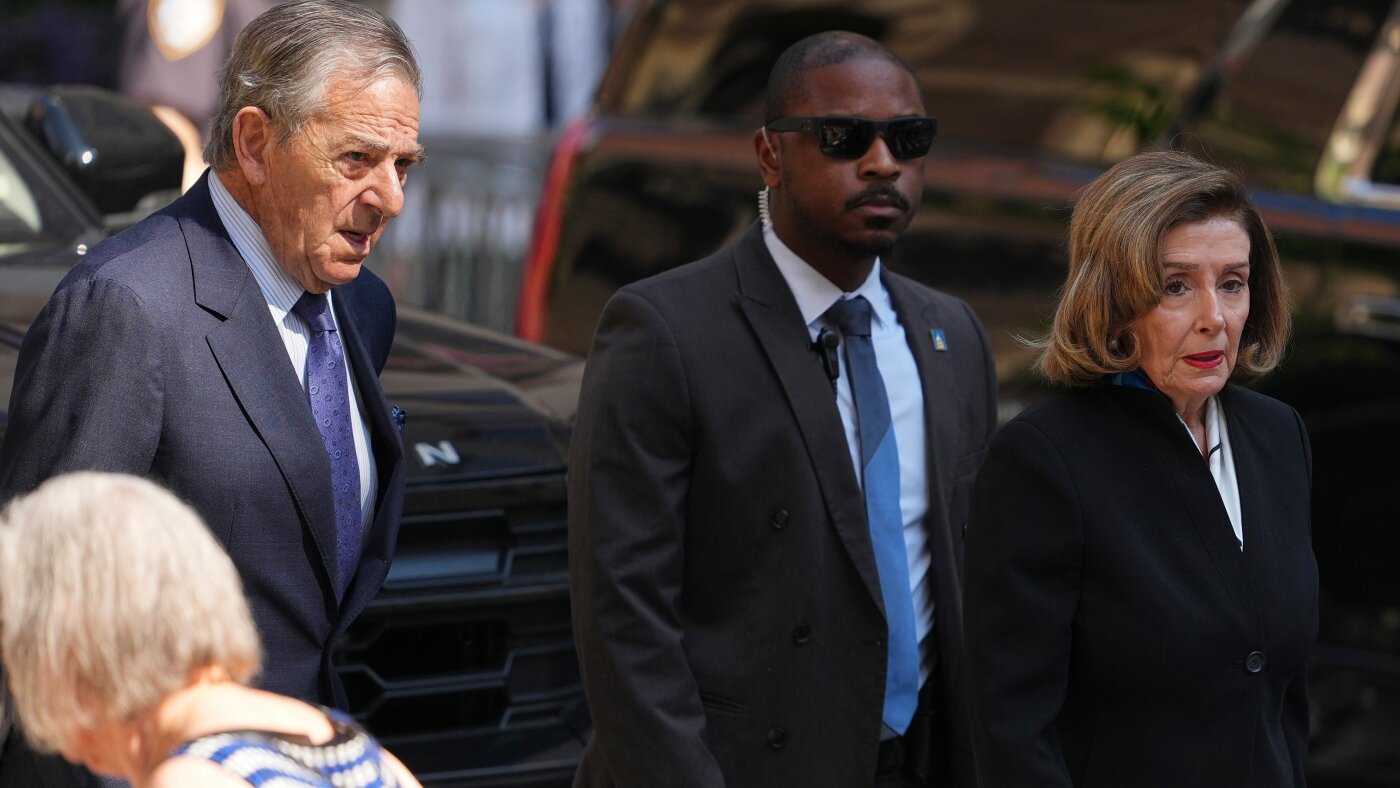
Rep. Nancy Pelosi, D-Calif., and her husband Paul arrive at the funeral services for Clive Davis at Central Synagogue in New York, Monday, June 29, 2026.
Adam Gray/AP
hide caption
toggle caption
Adam Gray/AP
LOS ANGELES — The husband of former House Speaker Nancy Pelosi was involved in a hit-and-run in California that left a parked car with “major” damage authorities said Saturday, and he could face misdemeanor charges.
Paul Pelosi was driving his brown convertible Friday in Yountville, a town in the heart of wine country, when he struck a legally parked car on the side of the road, briefly stopped and then drove away, the Napa County Sheriff’s Office said in a statement. No injuries were reported.

A witness saw the collision and called 911. Shortly afterward sheriff’s deputies found Pelosi with damage to the front of his car on a road roughly a quarter of a mile away. He reportedly told officers he knew he hit something but was not sure when or what caused the damage.
Pelosi, 86, did not have any alcohol in his system, according to the statement. The sheriff’s office referred him to the Department of Motor Vehicles for a process to determine whether he may continue to drive — something that officials say is common for older drivers.
Pelosi was not arrested, and because no one was injured, the sheriff’s office recommended a misdemeanor charge for fleeing the scene of an accident.
A staffer for Nancy Pelosi did not immediately respond to an email seeking comment.
Paul Pelosi pleaded guilty in 2022 to misdemeanor charges of driving under the influence in Napa County and was sentenced to five days in jail and three years of probation. However, he served only two days in jail and received good conduct credit for two other days, leaving just one day to serve in a work program at the courthouse.
As part of his probation, Pelosi was required to attend a three-month drinking driver class and install an ignition interlock device, which forces drivers to provide a breath sample to prove sobriety before the engine will start. He also was ordered to pay about $5,000 in victim restitution for medical bills and lost wages, along with nearly $2,000 in fines.
That same year he was attacked and severely beaten with a hammer at the couple’s San Francisco home.

WASHINGTON (7News) — The thousands of people attending the Great American State Fair and other areas around the National Mall are being ordered to evacuate as stormy weather approaches.
The National Weather Service previously announced a Severe Thunderstorm Warning in the District. Officials are asking attendees to seek shelter.
SEE ALSO: Historic Fourth of July fireworks to light up National Mall: How to watch live
The DC Homeland Security & Emergency Management released a list of places where the crowds can go to get out of the weather:
Federal Buildings:
- Ronald Reagan Building – 100 Pennsylvania Ave NW
- Dept. of Commerce – 1401 Constitution Ave NW
- Dept. of Agriculture – 1400 Independence Dr SW
- Dept. of Education – 400 Maryland Ave SW
- Internal Revenue Service – 1111 Constitution Ave NW
- Voice of America – 330 Independence Ave SW
- Thomas Jefferson Memorial – 16 E Basin Dr SW
Museums:
- National Museum of American History – 1300 Constitution Ave NW
- National Museum of Natural History – 1000 Constitution Ave NW
- National Museum of African American History and Culture – 1400 Constitution Ave NW
Freedom 250 organizers released this statement:
“The safety of our guests, performers, and staff is our top priority. Due to approaching severe storms, Freedom 250, United States Secret Service, United States Park Police, National Park Service, the Federal Emergency Management Agency, and all public safety partners are asking all guests to evacuate event grounds and seek temporary shelter in a nearby building. Available shelter locations include the Department of Commerce, Department of Education, Department of Agriculture, Internal Revenue Service, VOA Building, Thomas Jefferson Memorial, National Museum of American History, National Museum of Natural History, the African American Museum, and the Ronald Reagan Building. Please remain calm, follow the directions of law enforcement and event staff, and stay tuned to Freedom 250’s official channels for updates. Freedom 250 will share updates on programming and doors reopening — please stay close to our official channels for updates.”
The Secret Service said they have suspended screening on the National Mall.
“Security screening on the National Mall has been suspended due to dangerous storms,” the Secret Service said. “If you are already on the grounds, follow directions from officers and event staff and move to shelter immediately. Do not shelter under trees.”
BE THE FIRST TO COMMENT
Metro riders are also asked to seek shelter. Commuters should expect heavy crowds at stations near the National Mall and are asked to consider using L’Enfant Plaza, Metro Center, Archives, Federal Triangle or Federal Center SW stations to avoid congestion.
-

 New York5 minutes ago
10-Minute Challenge: The Ceiling at Grand Central
-

 Los Angeles, Ca12 minutes ago
1 killed, multiple people injured in Tarzana 4-car crash
-

 Detroit, MI30 minutes ago
Power outage forces flaring at Marathon’s Detroit refinery; portion of Schaefer Road closed
-

 San Francisco, CA42 minutes ago
San Francisco’s fireworks show ends in hours of gridlock involving Waymo cars
-

 Dallas, TX45 minutes ago
FIFA Fan Fest in Dallas paused due to lighting in the area Sunday evening
-

 Miami, FL50 minutes ago
Venezuelan Independence Day: Aid efforts continue after devastating earthquake
-

 Boston, MA57 minutes ago
Timeline: Looking back on Jaylen Brown’s Celtics career – The Boston Globe
-

 Denver, CO1 hour ago
Denver police arrest suspect in fatal July 4 triple stabbing

