Connect with us

News

Chinese stock rally cools after Beijing holds off on fiscal stimulus

Published

on

Chinese stock rally cools after Beijing holds off on fiscal stimulus

Unlock the Editor’s Digest for free

Chinese shares jumped upon reopening after a weeklong holiday on Tuesday but officials stopped short of unveiling more fiscal stimulus measures, limiting further gains after a blistering market rally.

Investor expectations had built up that President Xi Jinping’s economic planners would on Tuesday detail their plans for greater fiscal spending to complement a monetary stimulus that propelled Chinese equities to their best week since 2008.

Zheng Shanjie, chair of the National Development and Reform Commission, China’s state economic planner, told reporters at a press conference in Beijing that he had “full confidence” the economy would reach its official full-year growth target of about 5 per cent.

Advertisement

However, markets were disappointed by the lack of significant new fiscal spending announcements from the NDRC, analysts said.

The blue-chip CSI 300 index of Shanghai- and Shenzhen-listed stocks opened 10.8 per cent higher on Tuesday before falling back to trade 4 per cent higher in early afternoon trading.

Hong Kong’s Hang Seng index fell as much as 9 per cent after rising 11 per cent over the previous five days.

“This is what happens when you feed the monster,” said Alicia García-Herrero, chief Asia-Pacific economist at Natixis. “Every day you need to increase the amount of food or it turns against you.”

Tuesday’s market moves came after institutions including Goldman Sachs, Citi and HSBC raised their targets for Chinese equity performance. The CSI 300 has risen more than 33 per cent over the past month.

Advertisement

Zheng said Chinese authorities would continue to issue ultra-long-dated sovereign bonds in 2025, an indication of more support for the economy. He also said the government would accelerate bond issuance to support growth, front-loading about Rmb200bn ($28bn) from next year’s budget for spending and investment projects.

He also pledged to prioritise consumption and expand domestic demand, which has lagged expectations, as well as strengthen support for China’s poor and students.

Chi Lo, senior Asia-Pacific strategist at BNP Paribas Asset Management, said the “core” fiscal stimulus measures observers had hoped for “weren’t really there today”.

“There is not enough conviction [in the market] that the Chinese authorities were coming out with forceful fiscal spending, accompanied by monetary easing, to get the system out of the doldrums.”

In response to a question about whether there would be new special local government bond issuance in the final two months of 2024 — an indication of greater fiscal support for ailing local administrations — NDRC deputy head Liu Sushe said policymakers were focused on realising the proceeds of existing special bonds.

Advertisement

Ting Lu, China economist at Nomura, forecast fiscal measures and other supportive policies in the next several months.

“The eventual scale and content of the fiscal package might be quite improvised and uncertain due to the brewing stock bubble and still-controversial debates on what Beijing should focus on,” he said.

China’s prospects of hitting its full-year GDP growth target, which is the lowest in decades, have been called into doubt this year as Xi’s administration struggles to reignite confidence among consumers and businesses in the world’s second-biggest economy.

Earlier on Tuesday, the World Bank said it was maintaining its 4.8 per cent growth projection for China’s economy for 2024. The multilateral lender projects China’s GDP growth to slow next year to 4.3 per cent.

Industrial metal prices, which are affected by expectations for China’s construction sector, dropped on Tuesday. CME copper futures fell about 2 per cent, while Dalian iron ore futures were down 1 per cent.

Advertisement

Aaditya Mattoo, the bank’s chief economist for east Asia and the Pacific, said the stimulus measures of recent weeks were “not a substitute for the deeper structural reforms needed to boost longer-term growth”.

“Given the lead time for fiscal policy implementation, most of the measures [and] bond proceeds will carry over into next year,” he said. “And even then, consumers may be reluctant to splurge because a one-time transfer would not boost longer-term incomes or address concerns about ageing, illness and unemployment.”

Analysts at Morgan Stanley suggested China’s finance ministry might hold a “follow-up press conference” to provide details on new measures.

But they added that there was “limited chance of meaningful demand stimulus” focused on consumers in the near term, adding that “sustainable reflation” still required a fiscal package of about Rmb10tn focused on consumption, debt restructuring and property.

Advertisement

News

How a Beer Hall Keeps Up With a World Cup Crowd

Published

on

The fans see the games, the crowds, the food and the beer. But behind every World Cup watch party is a team working long before kickoff and well after the final whistle. We go behind the scenes at a beer hall in Brooklyn to see what it takes to serve a room full of soccer fans on game day.

Continue Reading

News

With the white nationalist group Patriot Front, what you see is not what you get

Published

on

With the white nationalist group Patriot Front, what you see is not what you get

Members of the group Patriot Front ride the subway as a commuter looks on, in Washington, D.C., on July 4.

Cheney Orr/Reuters


hide caption


toggle caption

Advertisement

Cheney Orr/Reuters

The sight of hundreds of masked men roaming the streets of Washington, D.C., on July Fourth weekend, wearing khakis, blue shirts and uniform patches, was chilling to some of the city’s residents.

For many Americans, it was the first they heard about Patriot Front, a white nationalist organization that was born out of the deadly 2017 Unite the Right rally in Charlottesville, Va. A now-viral Reuters photo prompted reflections on the experience of a lone African American woman who was photographed in a Metro subway car, surrounded by white supremacists.

The planned demonstration of force was timed to bring a fringe group of extremists into public view as the nation marked 250 years of its independence. Indeed, the stunt succeeded in earning the group media coverage across mainstream outlets, amplifying its brand and potential to reach new recruits. On this occasion, the members refrained from engaging in violence and property damage, projecting an image of law-abiding, orderly activism.

Advertisement

But those who are closely familiar with Patriot Front’s history and operations warn: Don’t believe what you see.

“That is not who they are in private,” said Len Kamdang, director of the Criminal Justice Project at the Lawyers’ Committee for Civil Rights Under Law. “Although they were on their best behavior [last] weekend, this is a dangerous group that commits acts of violence all over the country.”

Patriot Front’s history of violence and property damage

Kamdang’s organization sued members of Patriot Front for vandalizing a public mural dedicated to the tennis legend and Black activist Arthur Ashe in Richmond, Va., in 2021. Ashe, who was inducted into the International Tennis Hall of Fame in 1985, was born in Richmond and his legacy is a continuing source of pride to members of that community.

“A couple of Patriot Front members showed up under cover of night and vandalized the mural,” Kamdang said. “They painted white stencils all over. … They literally tried to whitewash him and they put their symbols of hate all over — their stencils, their slogans. And all the while they were caught on video. And that video leaked using some of the most horrible language that you can imagine.”

In many jurisdictions, law enforcement can seek additional hate crime charges or sentencing enhancements in cases where illegal acts appear to have been motivated by racial bias. But in this case, Kamdang said, Patriot Front members faced no criminal charges and their identities were only revealed when online activists later infiltrated the group and leaked internal records.

Advertisement
Continue Reading

News

Graham Platner makes it official in Maine, submitting paperwork to leave Senate race

Published

on

Graham Platner makes it official in Maine, submitting paperwork to leave Senate race

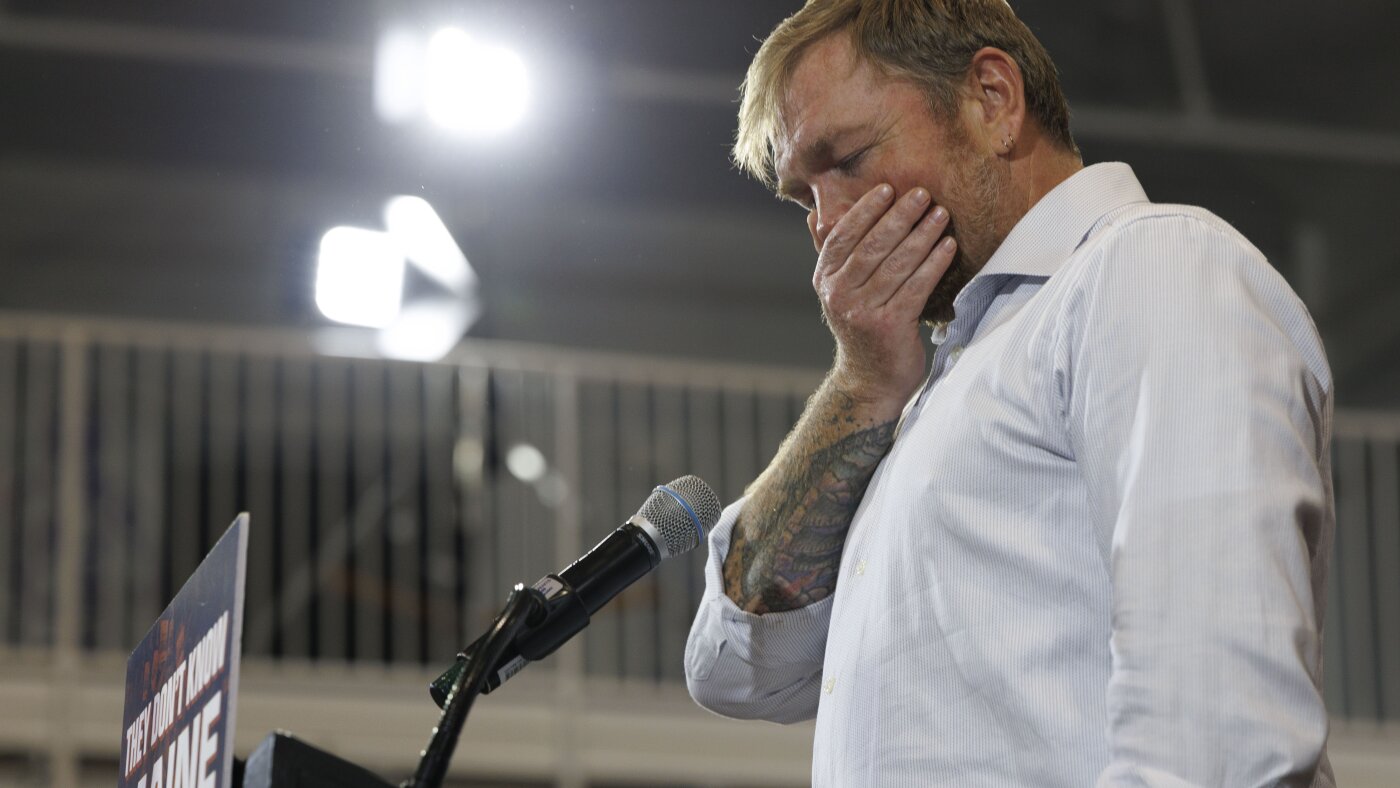
Now-former Democratic Senate candidate Graham Platner speaks at his primary election night event on June 9 in Blue Hill, Maine. Platner officially dropped out of the race July 10 following rape allegations from a former romantic partner that he denies.

CJ Gunther/Getty Images


hide caption


toggle caption

Advertisement

CJ Gunther/Getty Images

Graham Platner, Maine’s Democratic nominee for Senate, is officially out of the race.

The Maine Secretary of State said Platner filed the necessary paperwork to withdraw his candidacy two days after he announced he planned to do so following an accusation of rape by a former romantic partner. Platner denies the allegation.

The Maine Democratic Party has until July 27 to pick Platner’s replacement.

Advertisement

In his withdrawal notice, Platner said “people are desperate for change” and that’s why they voted “for a new kind of politics” by making him the Democratic nominee. He expressed gratitude for those who supported his campaign and said that he will continue to fight for “the movement we have built together and the future we believe in.”

He ended his notice with a strong statement aligned with the progressive platform.

“F*ck ICE. Free Palestine. Up the Hearts.”

Platner announced his plan to withdraw from the race in an 11-minute video he posted to social media on July 8. He said he had no choice but to suspend his campaign, citing it was no longer viable financially.

Advertisement

“We are going to lose our ability to fundraise. We are going to lose our ability to access voter data. We are going to lose all of the things that any campaign needs on the basic level simply to function,” he said.

Platner added that dropping out was not an admission of guilt. Rather, the decision, he said, is to keep the progressive movement in Maine alive to defeat Republican Sen. Susan Collins in November. Platner blamed the “political establishment” for his downfall and argued the goal was to force him out of the race.

“We built a campaign. We engaged in electoral politics. We motivated people. We banded together. We did it the way that we were told we are supposed to make change and we won. And now they are not going to let us have it. Not if it’s me,” he said.

Continue Reading
Advertisement

Trending