News
Boeing cleaned up on Air Force parts, including soap dispensers marked up 8,000%

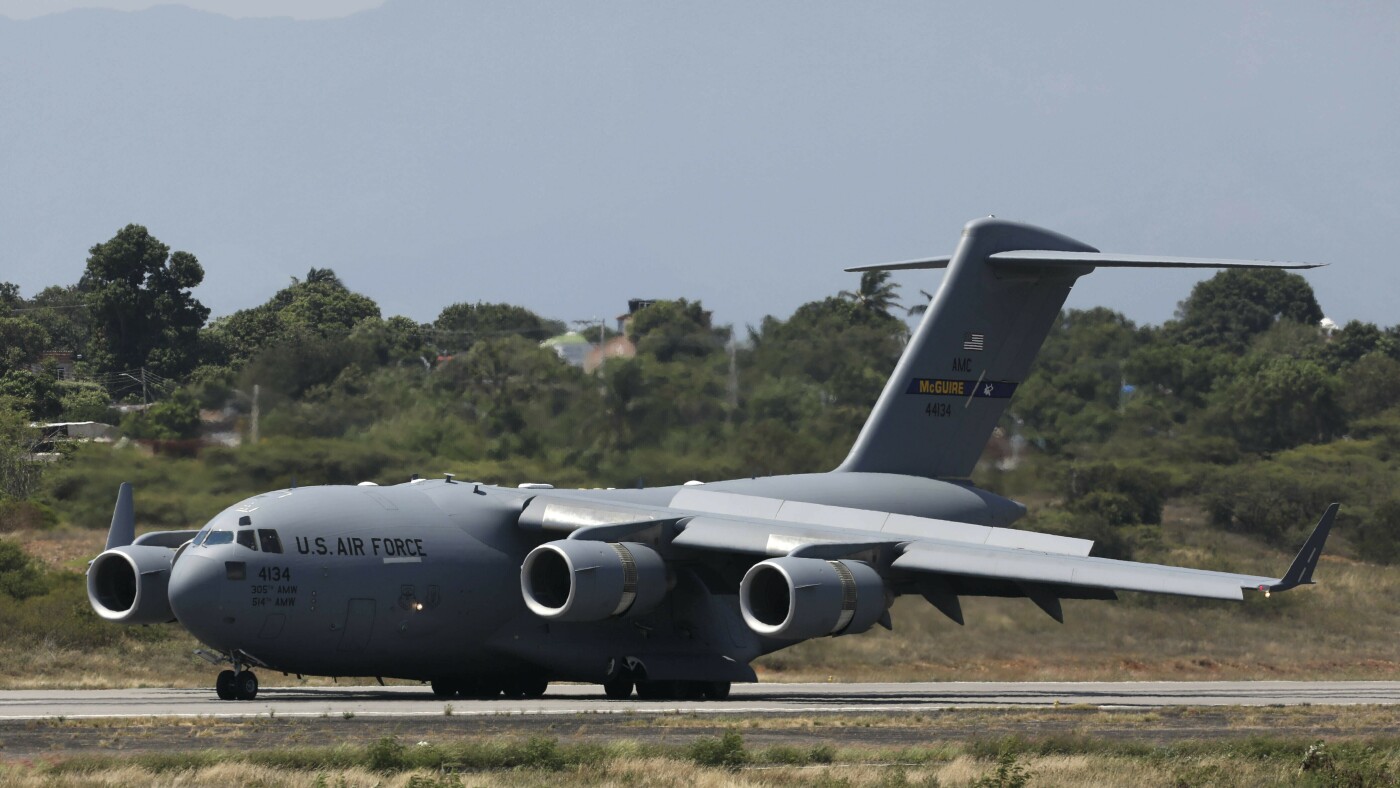
A United States Air Force C-17 cargo plane loaded with humanitarian aid lands at Camilo Daza airport in Cucuta, Colombia, on Feb. 16, 2019.
Fernando Vergara/AP
hide caption
toggle caption
Fernando Vergara/AP
WASHINGTON — Boeing overcharged the Air Force nearly $1 million for spare parts on C-17 cargo planes, including an 8,000% markup for simple lavatory soap dispensers, according to the Pentagon’s inspector general.
The Defense Department’s auditor reviewed prices paid for 46 spare parts on the C-17 from 2018 to 2022 and found that 12 were overpriced and nine seemed reasonably priced. It couldn’t determine the fairness of prices on the other 25 items.
The Office of the Inspector General said it reviewed the soap dispenser prices after getting a hotline tip.
Boeing disputed the findings.
“We are reviewing the report, which appears to be based on an inapt comparison of the prices paid for parts that meet aircraft and contract specifications and designs versus basic commercial items that would not be qualified or approved for use on the C-17,” Boeing said in a statement. “We will continue to work with the OIG and the U.S. Air Force to provide a detailed written response to the report in the coming days.”
The C-17 Globemaster is one of the military’s largest cargo aircraft. It can carry multiple military vehicles, large pallets of humanitarian supplies or, in extreme circumstances, hundreds of people. The Air Force flew C-17s nonstop for two weeks during the hectic August 2021 withdrawal from Afghanistan, evacuating more than 120,000 civilians fleeing the Taliban.
Since 2011, the U.S. government has awarded Boeing more than $30 billion in contracts to purchase needed spare parts for the C-17 and be reimbursed by the Air Force.
Boeing is still trying to recover from financial and reputational damage caused by two deadly crashes in 2018 and 2019 of its bestselling airline jet, the 737 Max.
This has been a particularly volatile year for the aerospace giant. It came under renewed scrutiny and federal investigations after a door plug flew off a 737 Max during an Alaska Airlines flight in January. Federal regulators limited Boeing production of the plane.
In July, Boeing agreed to plead guilty to a felony count of conspiracy to defraud the government for misleading regulators who approved pilot training rules for the Max. That plea deal is pending before a federal judge in Texas.
Boeing is on its third chief executive in five years, having hired an outsider who joined the company in August. Last week, Boeing reported a third-quarter loss of more than $6 billion because of charges for several commercial, defense and space programs.
A strike by 33,000 union machinists is now seven weeks old and has crippled production of 737s, 777s and 767 freighters, cutting off much-need cash. New CEO Kelly Ortberg has announced roughly 17,000 layoffs, and the company will issue new stock to raise up to $19 billion to shore up its debt-laden balance sheet.


The US congressman Ro Khanna says armed Israeli settlers detained him during a visit to the Israel-occupied West Bank recently, describing the experience as a first-hand view of the realities faced by Palestinians living under occupation.
In an interview with Reuters on Thursday from a Palestinian village, the progressive US House Democrat from California said his detention happened the previous day while his delegation visited an area of the southern West Bank that has experienced repeated attacks by Israeli settlers.
Khanna recounted how settlers carrying US-made M4 rifles surrounded the group’s van.
“We were at a village that Israeli settlers had destroyed – they had destroyed the school, they had destroyed that village, and we were just looking at it,” Khanna said.
Referring to the Israel Defense Forces, which is funded in part by US military aid, Khanna continued: “And these hoodlums … detain us. They block off the road. And then they call the IDF and the IDF is on their side, not on the side of the Americans.”
Khanna also told Reuters, “I saw the arrogance in the eyes of those settlers, 21- and 22-year-olds with guns, laughing that they had detained us, the arrogance of those young IDF soldiers that my tax dollars are funding – having no respect for the fact that they were detaining Americans, no respect that there was an American congressperson in that bus, and laughing when our translator told them that there are Americans there and the American embassy is concerned.”
Khanna aide Cameron Kasky wrote on X that he was there when the congressman’s group was detained, saying: “The IDF showed up to back up the settlers, not the US congressman.”
Khanna added that the encounter illustrated “the arrogance of power – of a power that has had no accountability, total impunity – and it’s created a toxic culture of oppression”.
The New York Times first reported Khanna’s account on Saturday morning. He told the outlet: “I felt powerless in that situation, which is not an easy thing, as I have a lot of privilege in life.
“Imagine how people feel every day, Palestinians under the occupation, if they could make an American congressperson feel powerless for 90 minutes.”
Khanna said he and his group were ultimately able to continue traveling after contacting the US embassy and Israeli police.
The Israeli military said troops and police responded after receiving a report that settlers were obstructing vehicles near Khirbet Zanuta, according to Reuters.
Khirbet Zanuta is a Palestinian hamlet whose residents were forced to leave in the wake of violent settler raids after the Hamas attacks on Israel in October 2023.
Asked by Reuters whether he intends to run for president, Khanna replied: “I’m strongly considering it. And I’m more resolved to consider it after this trip.”
More than 700,000 Israelis reside in settlements across the occupied West Bank including East Jerusalem. The United Nations considers Israeli settlements in the West Bank to be illegal, and Israel has faced repeated criticism over violence and other actions by settlers in the territory.
Since Israel took control of the West Bank in 1967, restrictions imposed there have prevented the territory from developing a self-sustaining economy. Those restrictions intensified significantly after the deadly 7 October 2023 Hamas attacks on Israel.
Nearly 300,000 Palestinians have lost employment in the West Bank and Israel.
A June report issued by a UN independent international commission of inquiry concluded that “Israeli authorities and security forces have deliberately targeted Palestinian children resulting in genocide, crimes against humanity, and war crimes in the Gaza Strip and war crimes in the West Bank”.
According to data from human rights organisation Yesh Din, no Israeli has been indicted for the killing of a Palestinian since October 2023.
Khanna has been one of the most outspoken critics in the US Congress of the war in Gaza and the occupation of the West Bank, often clashing with his own party’s establishment. In May, he released a video criticizing the Democratic National Committee’s incomplete postmortem report on the defeat that the party suffered at the hands of Donald Trump in the 2024 presidential election.
The postmortem did not mention Gaza. In his video, Khanna said: “As someone who campaigned in Michigan and Wisconsin, let me tell you – one of the reasons we lost is our blank check to Israel and [prime minister Benjamin] Netanyahu while they committed genocide in Gaza.
“We must speak and confront hard truths if this party is to win” the 2028 presidential election, he added.
Reuters contributed reporting
The fans see the games, the crowds, the food and the beer. But behind every World Cup watch party is a team working long before kickoff and well after the final whistle. We go behind the scenes at a beer hall in Brooklyn to see what it takes to serve a room full of soccer fans on game day.

Members of the group Patriot Front ride the subway as a commuter looks on, in Washington, D.C., on July 4.
Cheney Orr/Reuters
hide caption
toggle caption
Cheney Orr/Reuters
The sight of hundreds of masked men roaming the streets of Washington, D.C., on July Fourth weekend, wearing khakis, blue shirts and uniform patches, was chilling to some of the city’s residents.
For many Americans, it was the first they heard about Patriot Front, a white nationalist organization that was born out of the deadly 2017 Unite the Right rally in Charlottesville, Va. A now-viral Reuters photo prompted reflections on the experience of a lone African American woman who was photographed in a Metro subway car, surrounded by white supremacists.
The planned demonstration of force was timed to bring a fringe group of extremists into public view as the nation marked 250 years of its independence. Indeed, the stunt succeeded in earning the group media coverage across mainstream outlets, amplifying its brand and potential to reach new recruits. On this occasion, the members refrained from engaging in violence and property damage, projecting an image of law-abiding, orderly activism.
But those who are closely familiar with Patriot Front’s history and operations warn: Don’t believe what you see.
“That is not who they are in private,” said Len Kamdang, director of the Criminal Justice Project at the Lawyers’ Committee for Civil Rights Under Law. “Although they were on their best behavior [last] weekend, this is a dangerous group that commits acts of violence all over the country.”
Patriot Front’s history of violence and property damage
Kamdang’s organization sued members of Patriot Front for vandalizing a public mural dedicated to the tennis legend and Black activist Arthur Ashe in Richmond, Va., in 2021. Ashe, who was inducted into the International Tennis Hall of Fame in 1985, was born in Richmond and his legacy is a continuing source of pride to members of that community.
“A couple of Patriot Front members showed up under cover of night and vandalized the mural,” Kamdang said. “They painted white stencils all over. … They literally tried to whitewash him and they put their symbols of hate all over — their stencils, their slogans. And all the while they were caught on video. And that video leaked using some of the most horrible language that you can imagine.”
In many jurisdictions, law enforcement can seek additional hate crime charges or sentencing enhancements in cases where illegal acts appear to have been motivated by racial bias. But in this case, Kamdang said, Patriot Front members faced no criminal charges and their identities were only revealed when online activists later infiltrated the group and leaked internal records.

In another civil case, Patriot Front was ordered to pay almost $2.76 million to an African American musician whom they assaulted in Boston in 2022, at another July flash rally they staged. Despite a police detective concluding that the attack “appeared to be more likely than not motivated in whole or in part by Anti-Black bias,” nobody was criminally prosecuted.
Neo-Nazi ideology in patriotic colors
In 2020, Kristofer Goldsmith said that a fellow veteran invited him to partner up on infiltrating Patriot Front. Goldsmith, who later established the Task Force Butler Institute to recruit Army veterans to counter fascist groups through open source online research, was not closely familiar with the group at the time.
“Frankly, when my friend used the term ‘neo-Nazi,’ I thought he was using hyperbole,” Goldsmith said. “It wasn’t until I saw them doing things like debating the merits of national socialism versus fascism versus monarchy that I truly understood that neo-Nazi was not hyperbole, that these people actually praise Hitler. … These people have dedicated their lives to promoting white nationalist, fascist and genocidal ideology.”
Patriot Front’s founder, Thomas Rousseau, was formerly a leader of a group called Vanguard America, which was prominent in planning and a presence at the 2017 Unite the Right rally. That gathering, the largest public white nationalist event in generations, turned fatal when one extremist drove a car through a crowd of counterprotesters, killing Heather Heyer. Ultimately, Goldsmith said that rally further smeared public perception of the white nationalist movement as violent and un-American — lessons that Rousseau took to heart.
“Rousseau needed to rebrand Vanguard America,” Goldsmith said. “So he basically stole all of its assets, its digital assets … and made it into Patriot Front and literally painted everything in red, white and blue so that it would be more attractive.”
The group has also shown up at natural disaster sites, namely in Central Texas last summer, ostensibly to assist local residents. Goldsmith said these missions and the group’s outward aesthetic are meant to project an idea of patriotism and service. He said the group maintains a strict code of conduct. Among other things, they do not display swastikas or give Hitler salutes in public.
“The goal of their propaganda, of their public actions like this, is to beat MAGA and conservatives and Republicans into defending them and to saying, ‘I don’t see anything wrong with this group. They clearly love America,’” he said.
Patriot Front described as a “cult” and a “pyramid scheme”
The show of force in D.C. has raised questions about the group’s financing, and whether members’ travel was sponsored by outside individuals or groups. In fact, Goldsmith and Kamdang said that members of Patriot Front appear almost entirely to shoulder the cost of operations and Rousseau’s lifestyle. They said it’s most likely that those who traveled to D.C. had to cover their costs themselves.
“All of them funnel resources to the top,” Kamdang explained about the group’s general financial structure. “In order to be a Patriot Front member, you have to engage in acts of what they call ‘activism.’ And usually what that means is vandalism: putting up banners, spreading the slogans of hate all over the country. And in order to do that, they will have stickers, stencils, branding. All of that has to be approved from the top down, and all of it has to be purchased from the top down. So all the members who do this multiple times a month send cash to Thomas Rousseau for essentially stickers and stencils.”
Goldsmith said that from his time infiltrating the group, the costs could run up to hundreds of dollars a month per member. Kamdang, who said that attorneys are actively seeking to collect judgment in the settlement over the Arthur Ashe mural, noted that Rousseau appears not to hold any additional paying jobs.
“This seems to be what he’s doing full time,” Kamdang said. “So he appears to be being propped up full time by his members.”
Goldsmith likened the financial operation to a pyramid scheme. But he said even more substantial than the financial investment that Patriot Front members are required to make to retain membership is the control they give up over their time and personal choices.
“I describe it as a cult, not to be offensive, but because it is like Rousseau needs to have complete control of all of his members,” Goldsmith said. “[The group] requires its members to give up all of their lives, all of their relationships. All of their priorities in life need to be focused towards growing the organization or continuing the organization [and] enriching its leadership. So, it’s costly.”
NPR reached out to Patriot Front for comment. The group did not respond by deadline.
Goldsmith also noted that Rousseau often gives lengthy speeches that members are expected to listen to, via online platforms.
To Kamdang, the publicity that Patriot Front earned through the group’s D.C. stunt presents a danger: It amplified a presentation of the group that was deliberately crafted to make Patriot Front appear orderly and patriotic.
“I think the reason why it got a lot of attention is because Patriot Front was very careful in their language,” he said. “They try to mask their replacement theory, the white supremacy and in ‘Americana’ terms and patriotism. But that is not who these guys are.”
-
 Sports1 minute ago
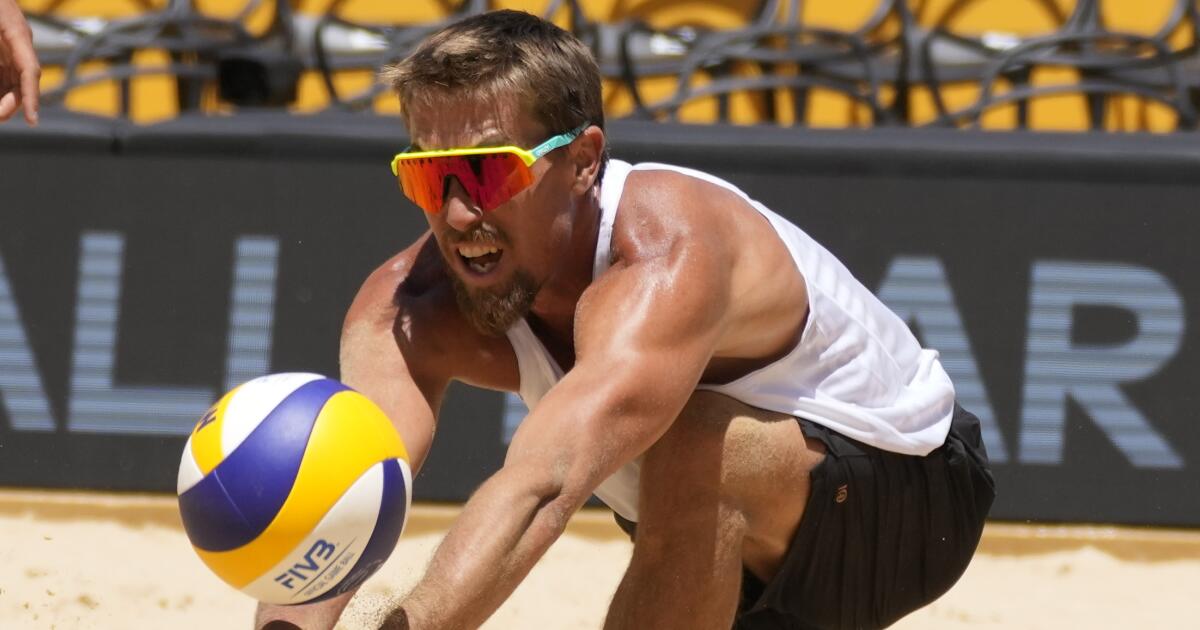
Q&A: Partner, chance to play in Long Beach reignited AVP star Taylor Crabb’s Olympic fire
-

 World11 minutes ago
Moldova president nominates pro-European businessman Tofan for PM
-

 News38 minutes ago
US congressman says he was detained by armed Israeli settlers in occupied West Bank
-

 Los Angeles, Ca2 hours ago
New details emerge in fatal stabbing of boy in El Monte
-

 Detroit, MI2 hours ago
1 dead, 1 injured after two-vehicle crash at Collingwood and Belleterre in Detroit
-

 San Francisco, CA2 hours ago
4 arrested, 3 cited after brawl following Giants vs. Rockies game at Oracle Park
-

 Dallas, TX3 hours ago
Mark Cuban takes legal action against Dallas Mavericks ownership over potential new arena deal
-

 Miami, FL3 hours ago
South Florida Dirt: A timeline of the Vacchi vs. Stern legal battle

