News
Body camera video shows Sonya Massey's final moments before she was fatally shot by a deputy


Authorities released body camera footage Monday of Sonya Massey’s final moments before she was fatally shot by law enforcement at her home in Springfield, Illinois.
Massey, 36, was killed July 6 after she called the Sangamon County Sheriff’s Office because she was afraid there might be a prowler outside, according to an attorney for her family and Illinois State Police.
Former Sangamon County Deputy Sean Grayson is accused of shooting Massey in the face after he and another deputy were dispatched to her home shortly before 1 a.m.
Grayson has been indicted on charges of first-degree murder, aggravated battery with a firearm and official misconduct, said Sangamon County State’s Attorney John Milhiser.
Grayson pleaded not guilty last week, according to his lawyer, Dan Fultz, who declined to comment after the body camera footage was released.
In the footage, Grayson and a second deputy can be seen knocking on Massey’s door a few times until Massey opens it.
“Please don’t hurt me,” Massey is heard saying to Grayson. The second deputy was not identified by authorities.
“Why would I hurt you? You called us,” Grayson responds.
The deputies tell Massey they checked the area around her house and didn’t see anybody, and then ask if she needs help with anything else. Grayson also asks Massey if she’s doing OK mentally, to which she answers, “Yes.”
“I love ya’ll, thank ya’ll,” Massey says as she’s closing her door. The deputies ask her if a black SUV in her driveway with a smashed window is hers, to which she says no and that someone brought it there.
The deputies then go into Massey’s house, where they ask her for her name so they “can get out of your hair.”
Massey then moves to her stove, where she picks up a pot from a burner. The situation escalates when she moves the pot from the stove.
“Where you goin’?” she asks the deputies.
“Away from your hot, steaming water,” Grayson responds.
“I rebuke you in the name of Jesus,” she says.
Massey does not approach the deputies with the pot and stays in her kitchen.
“You better f—— not I swear to God I’ll f——- shoot you in your f——- face,” Grayson says before pulling out his gun.
“OK, I’m sorry!” Massey says as she ducks.
The second deputy also pulls out his gun.
“Drop the f——- pot!” Grayson screams.
Three gunshots are heard as Grayson continues to yell at Massey to drop the pot. Massey cannot be seen from behind the kitchen counter, but video from Grayson’s body camera shows that Massey had let go of the pot when she ducked.
The deputies called for emergency personnel.

The second deputy says he’s going to get his kit.
“Nah, headshot dude, she’s done,” Grayson says to him. “You can go get it but that’s a headshot.”
“Yeah I’m not taking f——- boiling hot water to the f——- head,” Grayson continues. “Hey look, it f——- came right to our feet too.”
He then goes to get his medical kit, saying, “I mean, there’s not much we can do.”
“We can at least try and hold the, stop the blood,” the second deputy says. He then goes into the kitchen, finds a towel and holds it to Massey. Massey is blurred out in the footage, but a large pool of blood can still be seen near her head, and she can be heard gasping.
When Grayson makes his way back into the home, he asks another deputy who has since entered, “Is there anything we can do for her?” The deputy responds, “No.”
“All right, I’m not even going to waste my med stuff then,” Grayson says.
The deputy asks Grayson, “Where’s the gun?”
“No, she had boiling water and came at me with boiling water,” Grayson says.
When Grayson leaves the house, a member of law enforcement standing outside asks him if he’s OK.
“Yeah I’m good. This f——- b—- is crazy,” he responds and walks to his vehicle shortly afterward.
The second deputy stays with Massey, holding the towel to her head until medical help arrives. Grayson is not seen trying to aid Massey.
Massey was taken to a hospital, where she was declared dead, according to state police.
A use-of-force review conducted by state police found that while Grayson did not attempt to de-escalate the encounter, he was justified in pointing his service weapon at Massey to get her to comply. But it found the shooting was not justified because Grayson advanced toward Massey and put himself in a position where he could have been injured.
Sangamon County Sheriff Jack Campbell said in a statement last week that Grayson had been fired because it was clear he “did not act as trained or in accordance with our standards.”
Milhiser said a review of the state police investigation, including body camera footage, “does not support a finding that Deputy Sean Grayson was justified in his use of deadly force.”
Grayson’s next court date is scheduled for Aug. 26.



new video loaded: Airports Struggle to Staff T.S.A. During Partial Government Shutdown

March 8, 2026

Screenshots of a cruise missile hitting a compound where an Iranian girl’s school was struck killing around 175.
Screenshots by Geoff Brumfiel for NPR/ Mehr News on X
hide caption
toggle caption
Screenshots by Geoff Brumfiel for NPR/ Mehr News on X
A new video released by Iranian state media shows what appears to be a U.S. cruise missile striking a compound where around 175 Iranian students and staff were killed at a girl’s school a little over a week ago.
The seven-second video was posted by Mehr News, an Iranian state news agency. It shows the missile slamming into a building inside a walled compound – likely a health clinic that was also inside the perimeter of what was at one point an Iranian Revolutionary Guard naval base.
The strike appears to have taken place shortly after the girl’s school was hit. In the new video, smoke is already visibly rising from the part of the compound where the school was located. State media reports put the death toll from the bombing at somewhere between 165 and 180, many of them students.
Although the quality of the video makes precisely identifying the munition difficult, the missile appears consistent with a Tomahawk cruise missile, according to Jeffrey Lewis, a professor of global security at Middlebury College. The U.S. is the only country known to have Tomahawk missiles, and U.S. officials say the military was operating in the south of the country at the time of the strike.
“The first shooters at sea were Tomahawks unleashed by the United States Navy,” Gen. Dan Caine, the chairman of the Joint Chiefs of Staff said in a press conference on the Monday after the strike.
Speaking aboard Air Force One on Saturday, President Trump accused Iran of being responsible for the school bombing.
“Based on what I’ve seen, I think it was done by Iran,” Trump said. “Because they’re very, inaccurate as you know, with their munitions. They have no accuracy whatsoever. It was done by Iran.”
Lewis, however, said that the missile in the video did not appear to be consistent with known, Iranian-made cruise missile designs.
NPR was able to verify the location of where the video was shot to a housing development under construction across the street from the compound. Numerous details, including the sign at the clinic entrance, matched known details about the compound where the school was located. The video was first geolocated by the online research group Bellingcat.
The short video appeared to be authentic. While AI-generated videos have been posted online during the latest conflict with Iran, they typically do not contain details of a specific location, unless it is already well known, like a major landmark. Many also contain errors in physics or other inaccuracies when showing a missile or rocket attack.
The Pentagon did not immediately respond to NPR’s request for a comment about the video.
NPR was the first to report on satellite imagery from the company Planet that suggested multiple buildings, including the clinic, were hit in what appeared to be a precision strike that resulted in the deaths at the school. In total, seven buildings were hit in the strike on the complex, which at one point had been an Iranian Revolutionary Guard (IRGC) naval base.
The base, located in the southeastern city of Minab, appeared to be a relatively minor facility. NPR was able to find one video shot at the base during a 2010 military exercise that showed members of the Iranian Revolutionary Guard flying an Ababil-3 drone from an airfield directly across from the compound.
But historic satellite imagery showed little activity at the airfield in the years following that demonstration. NBC News has reported that local officials say the base was abandoned for over a decade, but NPR has not been able to independently verify those claims.
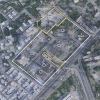
The school was separated from the compound by a wall between 2013 and 2016, according to satellite imagery. Satellite imagery also shows the airstrip was removed in 2024. Online posts from a local construction firm and verified by NPR show the land where the runway once stood was being turned into a housing development. The clinic was walled off between 2023 and 2024, and opened in 2025, according to a local press report from Fars News Agency-Hormozgan, reviewed by NPR.
The opening indicated that the site still had ties to the Iranian Revolutionary Guard. According to the reports, the clinic was opened by IRGC chief Hossein Salami, who was killed in an Israeli strike later that year. A photo appeared to show Salami cutting a ribbon at the clinic.
Lewis said that it’s possible the school and clinic were struck as a result of outdated targeting information.
Speaking beside Trump on Saturday, Defense Secretary Pete Hegseth said the U.S. was continuing to look into what happened at the school. “We’re certainly investigating,” he said. “But the only side that targets civilians is Iran.”
NPR’s RAD team contributed to this report.
Contact Geoff Brumfiel on Signal at gbrumfiel.13

The body in charge of selecting a new supreme leader for Iran says it has reached a decision – although the name was not immediately announced.
Israel has warned it would target any figure chosen to replace Ali Khamenei, who was killed in joint US-Israeli strikes on the first day of the war with Iran.
“The most suitable candidate, approved by the majority of the Assembly of Experts, has been determined,” Mohsen Heydari, a member of the selection body, said on Sunday, according to Iran’s ISNA news agency.
Another member, Mohammad Mehdi Mirbagheri, confirmed in a video carried by Iran’s Fars news agency that “a firm opinion reflecting the majority view has been reached”.
Ayatollah Mohsen Heidari Alekasir suggested the figure chosen to succeed the supreme leader would most probably be someone opposed by Washington.
He said the “Great Satan” – Iran’s term for the US – had inadvertently done the assembly “a kind of service” by publicly criticising certain candidates. His remarks appeared to refer to comments by Donald Trump, who said it would be unacceptable for clerics to select Khamenei’s son Mojtaba as successor.
“Someone opposed by the enemy is more likely to benefit Iran and Islam,” Heidari Alekasir said.
The Israeli military warned it would continue pursuing every successor of Iran’s late supreme leader. In a post on X in Farsi, the Israeli military also said it would pursue every person who sought to appoint a successor for Khamenei.
In recent days, Mojtaba Khamenei, 56, emerged as an early frontrunner. His appointment is far from certain as critics would view the move as entrenching a regime accused by rights groups of killing at least 7,000 people in recent months. In addition, a father-to-son succession is also frowned upon within Iran’s Shia clerical establishment, particularly in a republic born from the overthrow of a monarchy in 1979.
Under Iran’s constitution, the 88-member Assembly of Experts is responsible for selecting the country’s supreme leader. Khamenei, who ruled Iran for 37 years, was killed in a US-Israeli strike on Tehran on 28 February.
The clerical meeting to appoint a new leader happened as fighting between Israel and Iran intensified over the weekend. Iranian strikes have hit energy infrastructure across the Gulf and Israeli attacks have targeted oil storage and fuel facilities inside Iran.
A fresh wave of Iranian strikes hit the Gulf on Sunday, with Saudi Arabia, the United Arab Emirates, Qatar, Bahrain and Kuwait all reporting attacks. Saudi Arabia said it intercepted 15 drones, while strikes in Bahrain caused “material damage” to an important desalination plant.
According to reporting by the Washington Post, Fox News, and other US media organisations, Russia has been providing Iran with intelligence that could help it target US military assets in the region. The Guardian is unable to confirm this.
The recent attacks on Gulf states appear to highlight a clash within Iran’s leadership, contradicting remarks made on Saturday by the president, Masoud Pezeshkian, who apologised to countries on the Arabian peninsula and suggested strikes against them would end, provided their airspace and US bases were not used against Iran.
According to analysts, Pezeshkian’s pledge not to strike Gulf states exposed rare public rifts within the ruling elite with Iran’s leadership showing signs of strain, as officials of the regime scrambled to explain and reinterpret the president’s words, which appeared to anger the country’s more conservative factions.
Nonetheless, the Iranian military continued striking the neighbouring countries.
Overnight, US and Israeli strikes hit five oil facilities around Tehran, an Iranian official said, adding that the sites were damaged but the resulting fires were brought under control. Explosions in the capital’s nearby city of Karaj reverberated across the region, and left the area under smoke. Fuel depots on the outskirts of Tehran were set ablaze early on Sunday as US and Israeli forces widened their campaign against Iranian infrastructure.
The news agency Axios reported that the US and Israel had discussed sending special forces into Iran to secure its stockpile of highly enriched uranium at a later stage of the war, according to four sources with knowledge of the discussions.
Throughout the day, Iran launched intermittent barrages of ballistic missiles towards Tel Aviv and central Israel. At least one person was seriously injured after a residential building was hit, according to Magen David Adom, the country’s ambulance service. Most of the missiles were intercepted by Israeli air defences and caused no casualties.
Meanwhile, Israel’s war on multiple fronts continued, with the Israel Defense Forces launching intense strikes on Lebanon, where the Iran-backed armed group Hezbollah is based.
Israel’s assault on Lebanon left four people dead in a hotel blast in Beirut and killed a further 12 in strikes on southern areas of the country. Israel said it was targeting “key commanders” in the Iranian military’s Quds Force.
Lebanon’s health ministry said at least 339 people had been killed in the conflict. The Norwegian Refugee Council said about 300,000 people had fled their homes.
AFP contributed to this report

Detroit water main break snarls travel on East Jefferson Monday morning

Soak up sunlight in SF with these 18 fun events

Dallas weather: Storms return this week with large hail and tornado threat

Miami Dolphins releasing quarterback Tua Tagovailoa, team says

Boston’s season stays alive with dramatic buzzer-beater to advance to conference title game

Florida High School Football Rankings: Top 25 teams – Oct. 21

Cleary's 21 help Le Moyne down Central Connecticut State 69-64 in OT

How old is Bo Nix? What to know about Oregon quarterback ahead of 2024 NFL Draft

99th annual Pony Swim held in Virginia

Indiana Members Credit Union announced as new anchor tenant at Bottleworks District

Video: Airports Struggle to Staff T.S.A. During Partial Government Shutdown

Before-and-after satellite imagery offers a rare look at damage inside Iran
Hungary's opposition leader Péter Magyar calls on Russia to refrain from election interference
Video appears to show U.S. cruise missile striking Iranian school compound

Trump vows block on signing new laws until SAVE America Act passes Senate
-

 Wisconsin1 week ago
Setting sail on iceboats across a frozen lake in Wisconsin
-

 Massachusetts6 days ago
Massachusetts man awaits word from family in Iran after attacks
-

 Maryland1 week ago
AM showers Sunday in Maryland
-

 Florida1 week ago
Florida man rescued after being stuck in shoulder-deep mud for days
-

 Pennsylvania4 days ago
Pa. man found guilty of raping teen girl who he took to Mexico
-

 Oregon1 week ago
2026 OSAA Oregon Wrestling State Championship Results And Brackets – FloWrestling
-

 News1 week ago
2 Survivors Describe the Terror and Tragedy of the Tahoe Avalanche
-

 Sports4 days ago
Keith Olbermann under fire for calling Lou Holtz a ‘scumbag’ after legendary coach’s death