Midwest
US northern border faces Great Lakes threat from ‘bad actors’ pressing waterfront weaknesses: expert

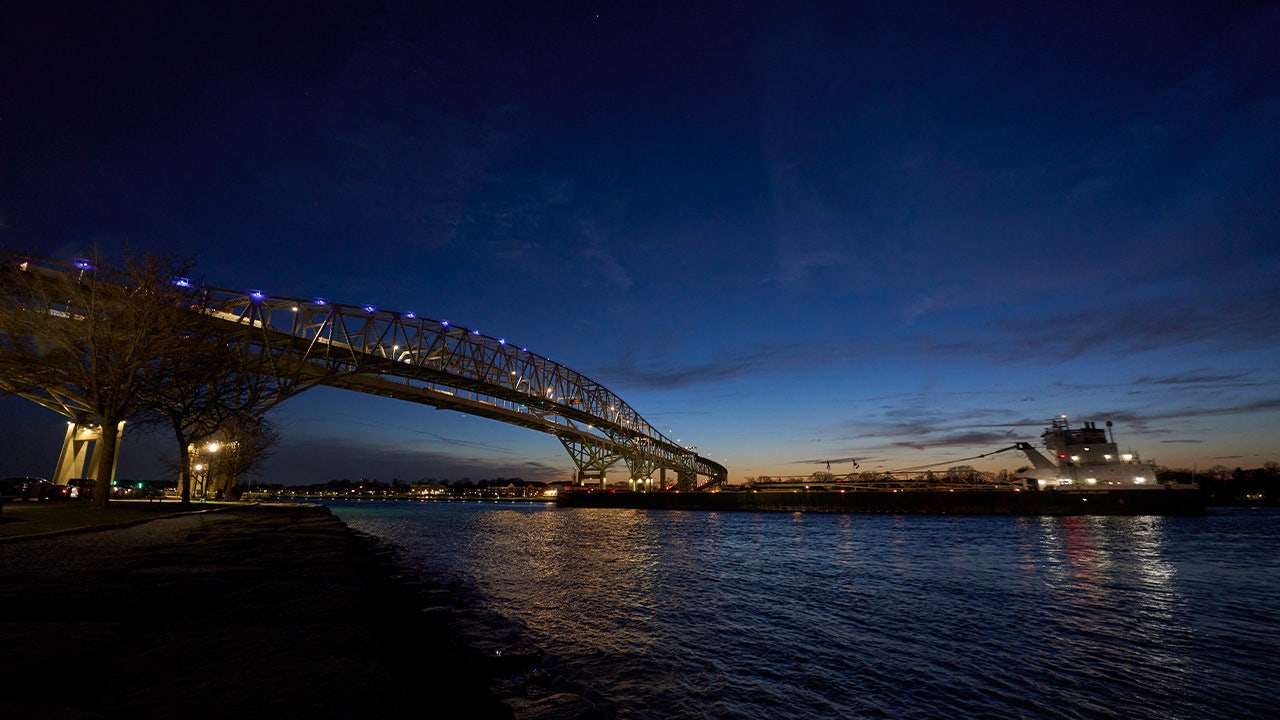
As the White House focuses on cracking down on illegal immigration on the southern border, an expert warns that the maritime industry along the northern border faces threats from bad actors and the risk of foreign influence.
Fox News Digital spoke with Jim Weakley, president of the Lake Carriers’ Association and retired U.S. Coast Guard officer, about national security risks along the Great Lakes and the Detroit Sector of U.S. Customs and Border Protection (CBP), which covers parts of Michigan and northern Ohio along the U.S.-Canada border.
“What people outside our region or outside of law enforcement often don’t understand is that border security—or any type of perimeter security—is a lot like a tube of toothpaste: if you apply pressure in one area, such as the southern border, the threat simply shifts to another part of the perimeter,” he said.
“So, as we—rightfully, in my view—reinforce our southern border, which has proven to be significantly lax, bad actors looking to smuggle terrorists, humans, fentanyl, or other contraband will likely redirect their efforts to our northern border.”
NORTHERN BORDER ‘QUIET CRISIS’ BREWS AS EXPERT FLOATS UNCONVENTIONAL SOLUTION TO COMBAT HUMAN SMUGGLING
A ship sails down the St. Clair River under the Blue Water Bridge border crossing between Canada and the U.S. near Sarnia, Ontario, on April 3, 2025. (Geoff Robins/AFP via Getty Images)
Weakley said that the lower standards in Canada serve as a national security risk in the U.S., due to the stricter inspection and manning regulations.
“To work on a U.S. vessel, officers must be U.S. citizens and most crew must be at least green card holders, with limits on how many non-citizens can be on board. In contrast, Canada allows sailors and officers from a wide range of countries, including the Philippines, Jamaica and Ukraine.”
“Canadian companies can also issue pilotage endorsements, unlike the U.S., where it’s tightly regulated by the U.S. Coast Guard. That means a Canadian vessel, even on Lake Michigan—where there’s no Canadian border—could be operated by foreign nationals with minimal oversight. They also carry fewer pilots and use cheaper, Chinese-subsidized ships, which further lowers their costs.
Weakley argued that the standards are a national security risk and a major reason why Canada dominates 90% of the cross-lake shipping market, putting U.S. carriers at a disadvantage.
Crew members of the U.S. Coast Guard cutter Katmai Bay prepare to return to port following ice-clearing operations near Lake Huron in Sault Sainte Marie, Michigan, on March 15, 2023. (Matthew Hatcher/Bloomberg via Getty Images)
As the Great Lakes region plunges into the wintry weather, the lakes freeze over and provide human smugglers with another way to traverse across to America, Weakley explained.
“The vastness of the Great Lakes makes border security and law enforcement far more complex, especially when the Canadians aren’t pulling their weight,” he said. “In fact, I don’t believe they have any law enforcement presence on the Great Lakes during the winter.”
When the ice melts, the Royal Canadian Mounted Police or the Ontario Provincial Police operate patrol boats, he explained.
“We’re doing much more to secure the border on both sides. However, the Canadians are doing less, which forces the U.S. to take on a greater share of the responsibility. And as we strengthen our southern border, the threat along the northern border is only going to grow.”
US NORTHERN BORDER SEES ROMANIAN ILLEGAL IMMIGRANT INFLUX AS EXPERT PREDICTS WHAT COULD BE DRIVING THEM
A tugboat pulls a barge along the St. Clair River between Michigan and Ontario, Canada. (Wolfgang Kaehler/LightRocket via Getty Images)
By the numbers
During testimony in front of the House Intelligence Committee, FBI Director Kash Patel told lawmakers adversaries such as China and Russia have started to target the northern U.S. border with Canada.
“The enemy adapts,” Patel said.
The Trump administration has overseen a dramatic shift at the U.S. southern border since taking office in January, with the number of CBP recorded encounters plummeting by 90% in most sectors compared to the same time period last year. The administration has poured in resources to stop the spiraling immigration situation at the southern border.
The sudden silence there came after record-setting numbers of illegal crossings during the four years of the Biden administration, a trend that also saw a dramatic increase in attempted crossings by immigrants outside of North and Latin America.
WATCH: Chinese migrants are cause for concern, expert warns
Chinese nationals were among the most likely to attempt illegal crossings, with the number of crossings from citizens of the country rising to over 24,000 in 2023, a more than 5,200% increase from the 450 encounters just a year earlier, according to CBP data.
Overall, Patel told lawmakers that between 2022 and 2025, roughly 178,000 Chinese nationals attempted to cross the southern border.
ILLEGAL-SMUGGLING COYOTES NOW ADVERTISING AT CANADA BORDER AMID TRUMP MIGRANT CRACKDOWN: REPORT
Detroit Sector
CBP declined to comment but pointed to data that depicted encounters at the Northern Land Border in the Detroit Sector, broken down by fiscal year (FY) and demographic group.
FY 2024 had the highest monthly peaks, especially in May (139 encounters) and July (74). FY 2022 had consistently very low encounter counts, never surpassing 35 per month.
FY 2025 saw a large jump in February (139) compared to only 53 the same month in FY 2024.
Read the CBP data. Mobile users click here
Single adults consistently dominated the encounters in the Detroit Sector, data showed. Single adults peaked in FY 2024, with 604 encounters.
The trend is continuing into FY 2025, with 338 encounters to date, suggesting it could surpass previous years if the trend continues.
Read the full article from Here


MADISON, Wis. – Walleye and musky fishing season will proceed as normal on Wisconsin’s lakes, despite resolutions by a local Tribe to restrict fishing on certain lakes.
On Friday, May 1, the federal Western District of Wisconsin issued a temporary restraining order that stopped the Lac du Flambeau Band of Lake Superior Chippewa Indians from restricting fishing of walleye and musky on certain lakes.
According to the Wisconsin Department of Natural Resources (DNR), over the past month, the Lac du Flambeau Band of Lake Superior Chippewa Indians have passed resolutions and made public statements that attempted to prohibit non-tribal members from fishing walleye and musky on nineteen lakes within the external boundaries of the Band’s reservation and from using forward trolling and forward-facing sonar on all lakes within the external boundaries of the Band’s reservation.
The State of Wisconsin filed a federal complaint in the Western District of Wisconsin to prevent the Lac du Flambeau Band of Lake Superior Chippewa Indians from enforcing these resolutions against licensed anglers.
FREE DOWNLOAD: Get breaking news alerts in the FOX LOCAL Mobile app for iOS or Android
Where to fish
What we know:
The federal court issued a restraining order against the tribe, which means that non-tribal anglers may fish as normal in the following lakes:
- Big Crawling Stone Lake
- Big Crooked Lake
- Bolton Lake
- Fat Lake
- Fence Lake
- Flambeau Lake
- Ike Walton Lake
- Little Crawling Stone Lake
- Little Sand Lake
- Long Lake
- Pokegama Lake
- Poupart Lake
- Signal Lake
- Stearns Lake
- Sugarbush Chain (Upper, Middle and Lower)
- White Sand Lake
- Whitefish Lake
The DNR says it remains committed to collaborating with the Lac du Flambeau Band of Lake Superior Chippewa Indians on important conservation work to protect the walleye and musky fisheries.
Anglers are also reminded to follow all fishing regulations and bag limits for lakes across Wisconsin, and everyone is encouraged to be respectful of all tribal harvesters, anglers, and recreators.
Head to the DNR’s website to check out the full fishing season schedule.
The Source: The Wisconsin Department of Natural Resources (DNR) sent FOX6 a news release.


What is the PWHL playoff format?
USAT’s Sam Cardona-Norberg breaks down all the rules you need to know for the start of the 2026 PWHL Playoffs.
Sports Seriously
Is a professional women’s hockey team coming to Detroit?
The answer is not fully clear yet, but the buzz for Hockeytown to get a Professional Women’s Hockey League (PWHL) team very soon is real.
Denise Ilitch, who’s family owns the Detroit Red Wings, the Tigers and Little Caesars Arena (her brother Christopher Ilitch runs the day-to-day operations), predicted the PWHL was coming to Detroit earlier this year.
“I believe we’ll be getting a team in Detroit soon, which really excites me,” Ilitch said on her “Denise Ilitch Show” podcast on March 31.
Ilitch also serves on the Board of Regents at the University of Michigan and has been a strong advocate for a U-M women’s hockey team in recent years.
Media reports from the New York Times and The Hockey News also indicate that Detroit may be next in line for an expansion team, after the league added two teams last month in Seattle and Vancouver. The league is looking to 2-4 teams by 2026-27.
The PWHL has made tour stops to Detroit four times in the last three years and some of the best women’s hockey players in the nation are from Michigan, including Megan Keller, who was the hero for Team USA women’s hockey at the 2026 Winter Olympics.
During the 2023-24 season, 13,736 hockey fans set an attendance record at the time for a professional women’s hockey game in the United States.
The PWHL, which celebrated its first season in 2023-24, has gained extra interest since the 2026 Winter Olympics.
If Detroit got a PWHL team, some fans hope that could push the University of Michigan and Michigan State University to eventually add Division I women’s hockey programs.
The league’s last appearance in Detroit on March 28, 2026, featured a 3-1 Montreal Victoire win over the New York Sirens in front of 15,938 fans at Little Caesars Arena.
The Free Press reached out to officials with the city of Detroit, but they did not immediately provide comment.
Free Press reporter Helene St. James contributed reporting.
Jalen Williams is a trending reporter at the Detroit Free Press. Contact him at jawilliams1@freepress.com.

Milwaukee Police Department (MPD)
MILWAUKEE – One person was killed in a shooting in Milwaukee early Saturday morning, May 2.
According to the Milwaukee Police Department, just after 1 a.m., an 18-year-old was shot in the area of 62nd and Arthur (near the border between Milwaukee and West Allis).
The shooting victim died from their injuries.
FREE DOWNLOAD: Get breaking news alerts in the FOX LOCAL Mobile app for iOS or Android
MPD tips
What you can do:
Milwaukee police are looking for those responsible.
Anyone with information is asked to contact Milwaukee police at 414-935-7360 or to remain anonymous, contact Crime Stoppers at 414-224-Tips or use the P3 Tips app.
The Source: The Milwaukee Police Department sent FOX6 the information.
-

 Utah5 minutes ago
POST-GAME: Mikhail Sergachev 5.1.26 | Utah Mammoth
-

 Vermont12 minutes ago
Vermont high school sports scores, results, stats for Saturday, May 2
-
 Virginia18 minutes ago
Virginia comedian Winston Hodges is a finalist on Kevin Hart’s Netflix series ‘Funny AF’
-

 Wisconsin30 minutes ago
Walleye and musky fishing season now open on Wisconsin lakes
-

 West Virginia36 minutes ago
West Virginia Supreme Court Considers Whether Smell Of Marijuana Can Be Basis For Police To Search Homes – Marijuana Moment
-

 Wyoming42 minutes ago
Wyoming Downs, 307 Horse Racing invest $180M in new facilities in Laramie, Uinta counties
-

 Crypto48 minutes ago
Whale Pulls 1,051 BTC Worth $82.35M From Binance in Single Transaction
-

 Finance53 minutes ago
Finance tips for when you’re caring for aging family members