Midwest
Underdog Dem using Dave Chappelle show to gain edge in pivotal swing state

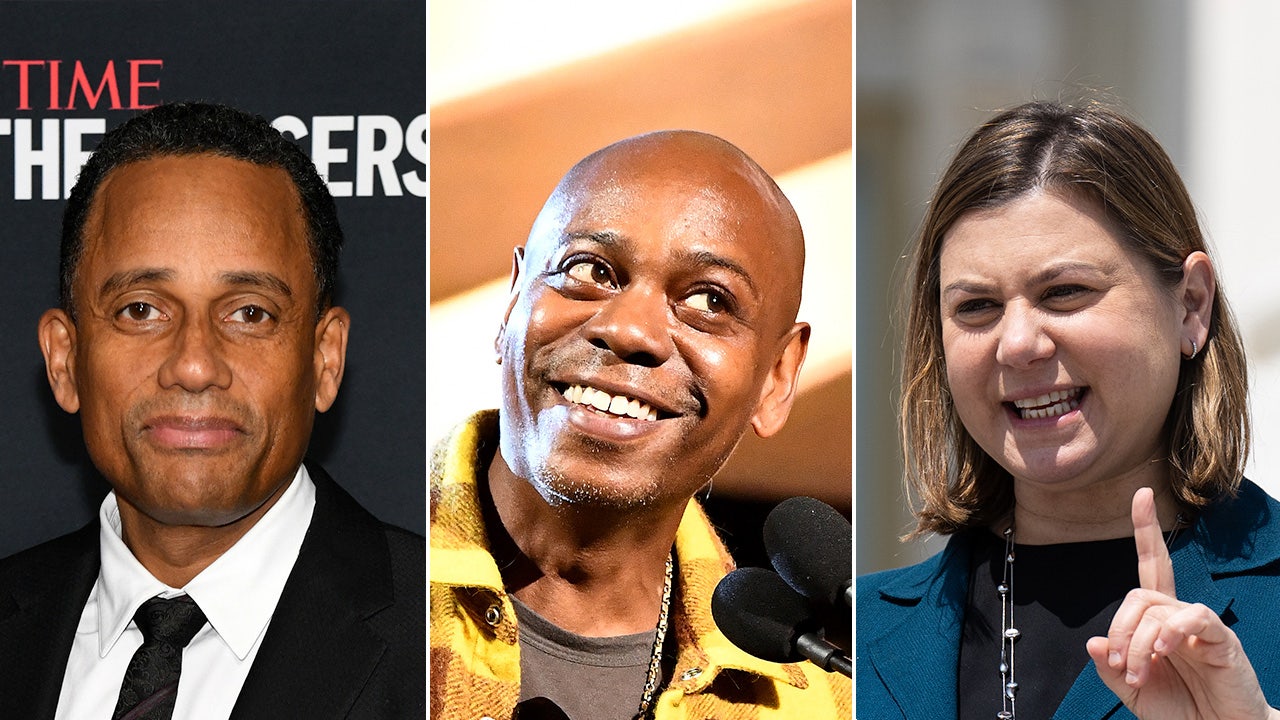
A Democrat Senate primary candidate is selling tickets to comedian Dave Chappelle’s show in Detroit this month to raise money for his underdog campaign against Rep. Elissa Slotkin, D-Mich.
In an event advertised on fundraising platform ActBlue, actor Hill Harper’s campaign invited donors to a live show on July 11.
The Democrat candidate described Chappelle as an “old friend” in a statement to the Detroit News.
PRESSURE MOUNTS ON BATTLEGROUND STATE DEMS AFTER BIDEN DEBATE DISASTER
Comedian Dave Chappelle, center, is performing a show for the benefit of Hill Harper, left, ahead of the U.S. Senate primary in Michigan against Democrat Rep. Elissa Slotkin. (Getty Images/File)
A representative for Chappelle told Fox News Digital that the show was just like any of the comedian’s other planned shows and Harper’s campaign had purchased a number of tickets to resell for his election effort, with Chappelle’s approval.
Harper’s campaign was contacted by Fox News Digital.
A poster for the event says it is paid for by “Harper for Michigan” and the event is set to be at St. Andrews Hall.
“We are thrilled to extend an exclusive invitation to you for an unforgettable evening with comedy icon Dave Chappelle! Join us for a live show in Detroit on Thursday July 11th. Doors open at 6:00 PM, and the show starts at 7:30 PM,” the invitation reads.
GOP SENATE CANDIDATE TIES OPPONENT TO BIDEN DEBATE: BOB CASEY KNEW
Dave Chappelle (Mike Coppola/File)
Guests can buy tickets for as much as $3,300 for “Gold Circle + VIP Reception,” which allows them to attend an event after the show with Harper. The least expensive tickets for the event cost $250 for balcony seating.
Cellphones are restricted at the performance, which is common for Chappelle’s shows.
Slotkin, considered the front-runner in the Michigan Democrat primary, is a current House member who previously flipped a Republican district in the swing state. With the retirement of Sen. Debbie Stabenow, D-Mich., the state’s Senate race is rated “Lean Democratic” by nonpartisan political handicapper the Cook Political Report.
CONGRESSIONAL DEMS BLAST RULING ON TRUMP IMMUNITY: ‘EXTREME RIGHT-WING SUPREME COURT’
Rep. Elissa Slotkin, D-Mich. (Getty Images/File)
The Senate primary elections in Michigan will be held on Aug. 6.
On the Republican side, former Rep. Mike Rogers, businessman Sandy Pensler and former Rep. Justin Amash are competing for the party’s nomination. Rogers appears to have a significant edge over his opponents with the support of former President Trump and the National Republican Senatorial Committee.
TRUMP ALLIES CELEBRATE BLOW TO ‘SENSELESS LAWFARE’ IN SUPREME COURT IMMUNITY DECISION
Former President Trump listens as Senate candidate and former Rep. Mike Rogers speaks at a campaign rally in Freeland, Michigan, on May 1, 2024. (AP Photo/Paul Sancya)
Michigan is expected to play a pivotal role in deciding both the presidential election and which party will control the Senate in 2025. The state’s significant Arab population has posed an issue for some Democrats already, including President Biden, as many have expressed frustration over his handling of the war between Israel and terrorist group Hamas in Gaza.
Harper has seized on Slotkin’s reluctance to call for a cease-fire in Gaza, previously claiming she wouldn’t do so because of “checks.”
Chappelle has been vocal about the war in Gaza, reportedly calling it a “genocide” during a show in Abu Dhabi, United Arab Emirates, last month.
Slotkin’s campaign did not provide comment to Fox News Digital in time for publication.
Get the latest updates from the 2024 campaign trail, exclusive interviews and more at our Fox News Digital election hub.
Read the full article from Here

Illinois
Who is running for Illinois governor in 2026? What to know as primary Early Voting sites open

With Election Day for the 2026 Primary quickly approaching, many voters are considering who to mark their support for when they cast their ballot.
There are several big races on the ballot, including the gubernatorial race that has the potential to make history.
Though rumors are swirling that sitting Governor J.B. Pritzker has his eyes on a potential run for president in 2028, he’s still in the running for re-election. If he retains his seat, he’ll be the first Democratic governor to secure a third term in office in Illinois history.
While Pritzker is the only Democrat aiming for governor on the ballot, there is a slew of Republican candidates vying for a face-off with the incumbent in November.
Voters with their mind made up on which candidate they support can head to their local early voting site to cast their ballot before Election Day.
Though downtown sites and some across the suburbs have been open since early February, early voting sites will open in all 50 of Chicago’s and in several suburb on Monday, March 2.
For those still deciding how to mark their ballot, here’s a look at the gubernatorial candidates.
Democrats:
Governor J.B. Pritzker and Christian Mitchell
Current Governor of Illinois J.B. Pritzker is taking aim at a third term, promising to continue building on the work of his first two terms. According to his campaign website, some of his intentions for a third term include “[tackling] the affordability crisis,” continuing to protect access to reproductive health care in Illinois, and investing in education.
Chrisitan Mitchell is running alongside Pritzker for lieutenant governor. After representing the 26th District in the Illinois House of Representatives from 2013 to 2019, Mitchell served as deputy governor to Pritzker from 2019 to 2023. Mitchell led efforts to ban assault weapons, make Illinois a leader in clean energy and create jobs through infrastructure projects as deputy governor, according to his campaign bio.
Republicans:
Ted Dabrowski and Dr. Carrie Mendoza
Ted Dabrowski is a Wilmette resident and former president of Wirepoints, a media outlet focused on conservative economic policies and financial data. From 2011 to 2017, Dabrowski worked as a spokesperson and Vice President of Policy at the Illinois Policy Institute, a right-leaning think tank.
Dabrowski, who has never previously held political office, aims to cut and cap property tax rates, veto any and all tax increases, and repeal both Illinois’ sanctuary laws and zero-emissions energy policy, according to his campaign website.
“We must return power to the people, remove barriers to prosperity, embrace educational freedom, push political power down to its lowest level and restore the rule of law,” his campaign website says.
Dr. Carrie Mendoza, a Chicago-native with more than 25 years of experience as a physician, is running to be Dabrowski’s lieutenant governor, according to her campaign biography. Like Dabrowski, Mendoza has never held political office. Her campaign biography says she is “driven by innovation and a passion for justice.”
James Mendrick and Dr. Robert Renteria
The first Republican candidate to enter the race, DuPage County Sheriff James Mendrick is campaigning on a push for public safety initiatives.
Sheriff since 2018, Mendrick has partnered with DuPage County Health Department to provide Medicated Assisted Treatment to inmates fighting opioid addiction and advocated for the use of a drug deactivation pouch system to protect people and the state’s waterways from dangerous medications, according to his campaign website.
“He is committed to ending soft-on-crime policies, defending parental rights, and delivering quality education to every child in the state,” his campaign website says.
Dr. Roberta Renteria veteran of the U.S. Army and is a prolific author and activist, according to his campaign biography.
“Dr. Renteria uses his personal story, business acumen and leadership skills to address bullying, gangs, violence, drugs, suicides and school dropout,” his campaign biography says. His books and curriculums are taught in 25 countries around the world, and he has given many Ted Talks.
Darren Bailey and Aaron Del Mar
Former state senator Darren Bailey, who unsuccessfully ran for governor of Illinois in 2022, is giving another go at assuming the political seat. A third-generation downstate farmer, Bailey’s campaign is focused on reducing government spending, cutting taxes, and cracking down on crime, according to his campaign website.
In addition to his farm work, Bailey founded a private Christian school with his wife Cindy.
He fought against spending, raising taxes and sanctuary state policies while in the Illinois House and later in the State Senate.
Aaron Del Mar is an entrepreneur who became the youngest-ever Councilman for the Village of Palatine at 29 years old in 2016. He oversees public safety and infrastructure and guides community organizations in the position, according to his campaign biography.
Rick Heidner and Christina Neitzke-Troike
Though businessman Rick Heidner has never held office, he has led several notable companies, including Gold Rush Gaming, Ricky Rocket’s Fuel Centers, Prairie State Energy, and Heidner Properties, according to his campaign website.
A lifelong Illinoisian, Heidner is “running to make Illinois safe again, affordable again, and full of opportunity again,” his website says.
Christina Neitzke-Troike is looking to step up into the lieutenant governor seat from her current role as Mayor of Homer Glen after nearly two decades in several elected positions.
Neitzke-Troike hopes to bring her “unparalleled understanding of how state mandates affect local budgets, property taxes, and public services” to Springfield, according to her campaign biography.

NEW ORLEANS, LOUISIANA – DECEMBER 20: Ethan Thompson #55 of the Indiana Pacers takes a shot over Derik Queen #22 of the New Orleans Pelicans during the second half of a game at Smoothie King Center on December 20, 2025 in New Orleans, Louisiana. (Photo by Tyler Kaufman/Getty Images)
Getty Images
WASHINGTON – The Indiana Pacers have a player availability puzzle to put together down the stretch of the 2025-26 season, and it involves all three of their players on two-way contracts.
Currently, the Pacers have Jalen Slawson, Ethan Thompson, and Taelon Peter signed to two-way deals. Thompson and Peter have been helpful at different points this season, and all three players are healthy right now. They each project to have a bigger role in the Pacers’ final outings of the season.
But they can’t all play in every game thanks to two-way contract rules, and the Pacers will have to juggle the availability of each player. Indiana has already played multiple games since the All-Star break with just one or two or their two-way contract signees available to play.
That’s because two-way agreements come with a limit – players on such contracts can only be active in 50 games per season (or a proportionate ratio of 50/82 games at the time of signing based on the number of days left in the season). The Pacers couldn’t get by without their two-way contract players at various moments this season due to injuries, with Peter being active for 23 of the team’s first 25 games and Thompson during every game from December 1 through January 17.
During those stretches, Indiana needed their two-way players to field a team or a rotation that actually made sense. It wasn’t a poor use of their active days. But that two-way usage early in the season now requires the Pacers to be strategic down the stretch of 2025-26. They have 22 more games this season but won’t be able to use their two-way talents in all of them.
Peter, a rookie selected in the second round of last June’s NBA Draft, had a rush of games to open the campaign, and he’s allowed to suit up 14 more times this league year. “He’s figuring out what being a professional basketball player is about,” Pacers head coach Rick Carlisle said of Peter and his in-season growth earlier this month. “It’s about being who you are all the time, regardless of make or miss. Just keep playing, just keep staying aggressive.”
Thompson was signed on November 30, which permitted him to appear in 39 games this season. He’s only got 10 left – Thompson was effective right away with the Pacers and played often after his signing. He was named to the NBA G League Next Up game, effectively the G League All-Star game, for his performances this campaign.
INDIANAPOLIS, INDIANA – OCTOBER 13: Taelon Peter #4 of the Indiana Pacers takes a shot against the San Antonio Spurs at Bankers Life Fieldhouse on October 13, 2025 in Indianapolis, Indiana. (Photo by Justin Casterline/Getty Images) Getty Images
Slawson signed his contract earlier today and is eligible for 13 appearances the rest of the way for the Pacers. So, with 22 games remaining, none of the team’s two-way contract players can be active for each remaining game. The team will have to figure out the best strategy when it comes to managing two-way player availability during the final months of the season.
Another consideration for the franchise is that two-way players, by virtue of their contract, can be transferred down to the G League at any time. Peter, Slawson, and Thomspon have combined for 64 appearances with Indiana’s G League affiliate team, the Noblesville Boom, this season. Once the Boom’s season ends – their final scheduled game is March 26 but the team currently holds a playoff spot – then the G League is not an option for two-way players.
So the Pacers have to figure out the best way to deploy, and evaluate, their two-way contract signees during March and April. It’s a lot to manage.
“We’re trying to save games for him,” Carlisle said of the Pacers decision to keep Quenton Jackson, who was previously on a two-way contract, inactive for a game earlier this month. “We want to conserve those games as much as possible.”
Jackson had his contract converted from a two-way deal to a standard deal earlier today, and Slawson filled his two-way slot. It was sharp business for the Pacers, but they lost some available two-way days as a result – Jackson had more than 13 games remaining, but Slawson gets fewer because of the day he signed his contract.
“Two-way guys, your life is a lot of unpredictability of where you’re going to be from day to day,” Pacers general manager Chad Buchanan shared in February.
If the Pacers want to keep their two-way talents around the NBA club as much as possible, their best course of action could be to keep two of the three active in every game and occasionally just have one of the three available. If the team can get to a spot in which they have 15 games left on the schedule and all of their two-way talents have 10+ games left in which they could be active, two of the three could play every night during the final 15 outings. Using all three at once could be difficult, though Indiana may choose to deploy each of Thompson, Peter, and Slawson on the second night of back-to-backs as they manage injuries down the stretch. Putting any of the trio in the G League for a few days is an option, too, but comes with injury risks.
Slawson has not appeared in a game for the Pacers yet this season. Peter is averaging 3.3 points per game while shooting 35.8% from the field while Thompson is posting 4.9 points per contest and knocking down 36.7% of his shots. The Pacers are 15-45 with three back-to-backs remaining and three games left against teams near them in the inverse standings.

The Class 1A and Class 2A Iowa high school boys basketball state tournament brackets are now official following substate action.
The Iowa High School Athletic Association Boys State Tournament begins Monday, March 9 from the Casey’s Center in Des Moines, Iowa.
St. Edmond, the top-seed in 1A, gets Woodbine in a rematch of a quarterfinal from a year ago. Woodbine ended the run of defending state champion Madrid in a substate final on the same court that St. Edmond qualified on when they defeated Riverside.
Burlington Notre Dame plays Bellevue, MMCRU meets Boyden-Hull and Bishop Garrigan battles Bellevue Marquette Catholic in the other elite eight games.
The other substate finals saw Burlington Notre Dame defeat Calamus-Wheatland, MMCRU eliminated North Union, Bishop Garrigan downed South Winneshiek, Bellevue bested East Marshall and Bellevue Marquette Catholic topped Montezuma.
In 2A, Kuemper Catholic is the No. 1 seed and will face Union Community in the opening game on Wednesday, March 11. The other quarterfinals see Treynor vs. Grundy Center, Unity Christian vs. defending state champion Western Christian and Iowa City Regina vs. Aplington-Parkersburg.
Kuemper Catholic survived vs. Roland-Story, Union knocked off Pella Christian in a nail-biter, Treynor bested Underwood, Grundy Center downed Beckman Catholic, Unity Christian handled Southeast Valley, Western Christian ran past Tri-Center, Iowa City Regina downed Northeast and Aplington-Parkersburg defeated Cascade.
Here are the Iowa High School Athletic Association Boys State Basketball Tournament pairings for Class 1A and Class 2A.
Quarterfinals
Tuesday, March 10
Semifinals
Thursday, March 12
Championship
Friday, March 13
Wednesday, March 11
Semifinals
Thursday, March 12
Championship
Friday, March 13

Who is running for Illinois governor in 2026? What to know as primary Early Voting sites open

Indiana Pacers Must Manage Two-Way Contract Player Availability Down Stretch

Iowa Boys High School State Basketball Tournament Sets Two Classes

Why Matthew Driscoll continues to say Kansas State is ‘close’

Three NKY girls wrestlers win titles, including a third for Emma Moore

Florida High School Football Rankings: Top 25 teams – Oct. 21

Cleary's 21 help Le Moyne down Central Connecticut State 69-64 in OT

How old is Bo Nix? What to know about Oregon quarterback ahead of 2024 NFL Draft

99th annual Pony Swim held in Virginia

Indiana Members Credit Union announced as new anchor tenant at Bottleworks District

Mamdani’s response to Trump’s Iran strike sparks conservative backlash: ‘Rooting for the ayatollah’

Activists hail ‘historic’ EU’s decision on accessible abortion

A long-buried recording and the Supreme Court of old (CT+) : Consider This from NPR

2 Survivors Describe the Terror and Tragedy of the Tahoe Avalanche

Iran fires missiles at US bases across Middle East after American strikes on nuclear, IRGC sites
-

 World3 days ago
Exclusive: DeepSeek withholds latest AI model from US chipmakers including Nvidia, sources say
-

 Massachusetts4 days ago
Mother and daughter injured in Taunton house explosion
-

 Montana1 week ago
2026 MHSA Montana Wrestling State Championship Brackets And Results – FloWrestling
-

 Louisiana6 days ago
Wildfire near Gum Swamp Road in Livingston Parish now under control; more than 200 acres burned
-

 Denver, CO3 days ago
10 acres charred, 5 injured in Thornton grass fire, evacuation orders lifted
-

 Technology1 week ago
YouTube TV billing scam emails are hitting inboxes
-

 Technology1 week ago
Stellantis is in a crisis of its own making
-

 Politics1 week ago
OpenAI didn’t contact police despite employees flagging mass shooter’s concerning chatbot interactions: REPORT