Midwest
Serial killer known as ‘Hollywood Ripper’ extradited to Illinois for 1993 murder of his teen neighbor

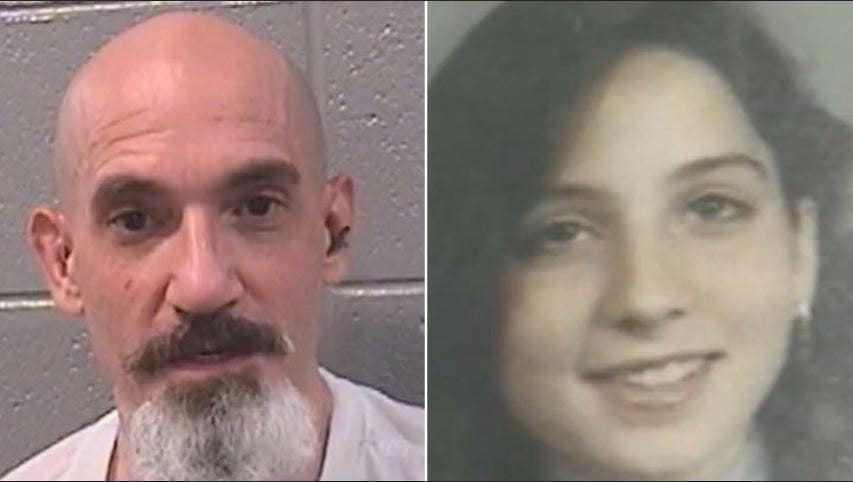
A serial killer known as the “Hollywood Ripper” and the “Boy Next Door Killer,” who has already been sentenced to death for two murders in Southern California in 2001 and 2005, has been extradited to Illinois for the 1993 murder of an 18-year-old.
Michael Gargiulo, 48, has been charged with the August 1993 murder of Tricia Pacaccio, 18, who was found by her father outside of her home in Fairview, Illinois, after spending an evening with friends, according to FOX 32.
“Michael Gargiulo, was a friend and classmate of the victim’s brother. The defendant’s residence was located one block from the Pacaccios,” Cook County Assistant State’s Attorney Ethan Holland told reporters from the courthouse in Skokie, Illinois, on Friday.
Gargiulo was a suspect during the initial investigation, but he wasn’t linked to the crime through DNA until after he had left for California where he killed Ashley Ellerin, 22, in 2001 and Maria Bruno, 32, a mother of four whose breasts were cut off during her killing, in 2005.
CIGARETTE BUTT HELPS WASHINGTON POLICE HUNT 1980 MURDER SUSPECT ACROSS COUNTRY: ‘I WAS HOOKED IN THIS CASE’
Michael Gargiulo has been charged in the 1993 murder of 18-year-old Tricia Pacaccio outside of her home. (FOX 32)
Actor Ashton Kutcher testified at Gargiulo’s trial for Ellerin’s murder that he was supposed to pick her up for a date that night in 2001, but she had been murdered by the time he arrived at her house. She was stabbed 47 times.
Gargiulo allegedly also attempted to murder another woman in the Los Angeles area in 2008.
‘HOLLYWOOD RIPPER’ MICHAEL GARGIULO ‘LIKED TO WATCH DEATH’ AFTER INFLICTING PAIN ON HIS VICTIMS: ‘IT’S EVIL’
A sketch of Gargiulo in court on Friday. (FOX 32)
After those murders, Holland said more witnesses came forward. “These witnesses indicated that in the late 1990s Michael Gargiulo had admitted that he had killed a girl in Chicago.”
Holland said someone known as “Witness A” “accompanied Gargiulo, and another individual to get rid of knives that Gargiulo possessed. Gargiulo admitted to witness ‘A’ that he was afraid that police were coming after him.”
Pacaccio was found dead outside of her home in August 1993. (FOX 32)
He added that another person who came forward, known as “Witness C,” said that Gargiulo had told him he had “buried the b—-. When pressed by witness ‘C’ to tell the truth, Gargiulo said that he was only kidding and he had actually ‘left the b—- on step for dead.’”
Gargiulo was finally charged with Pacaccio’s murder in 2011, but wasn’t extradited until he was sentenced in California.
Gargiulo is being held without bond and is due back in court on Sept. 20.
Fox News Digital has reached out to the Cook Country State’s Attorneys Office.
Read the full article from Here


Celebrations around the country recall not only the events leading up to the adoption of the Declaration of Independence by the Continental Congress on July 4, 1776, but also look forward and aim to make the 4th of July weekend a massive, multigenerational cultural moment focused on community connections and charitable giving.
America’s Block Party, an unprecedented coast-to-coast initiative, is one of the signature events of America 250, the congressionally chartered nonprofit overseeing the semiquincentennial celebration.
A Times Square Ball Drop, a rolling series of ball drops, timed to occur at midnight on July 3 in every U.S. time zone from Guam to American Samoa, is part of the “Giving 4th Broadcast Benefit Show,” creating a nearly 24-hour celebration of the 250th anniversary. It’s part of the broader “Giving 4th” initiative that aims to make and establish Independence Day the biggest annual day of giving.
A time capsule will be buried in Philadelphia to be opened in 2276 on July 4. It contains a carefully curated collection of letters and artifacts reflecting the leadership, institutions, and communities that shape the country today. It will include contributions from all three branches of the U.S. federal government and submissions from each of the 50 states, Washington D.C., and five territories.
Separately, the White House’s Freedom 250’s biggest spectacles are the Great American State Fair on the National Mall, running June 25 to July 10; the July 4 Salute to America Fireworks, also on the National Mall; “Sail 4th 250,” billed as the largest-ever flotilla of tall ships from around the world in New York Harbor; and Rushmore 250, an iconic 4th of July fireworks on July 3 alongside military concerts and live presidential reenactors.

After bouncing between nine different cities in the years following the nation’s founding on July 4, 1776, the United States’ capital finally settled into its permanent home in Washington, D.C. on December 1, 1800.
That same year, Indiana gained the first of its three capitals at a former French trading post near the site of a pivotal battle in the Revolutionary War.
The journey of Indiana’s seat of government from Vincennes to Indianapolis via a stop in Corydon reflects the growth of the state in the early years of the nation’s history.
Founded by French explorers in 1732, Vincennes was Indiana’s first permanent European settlement. France ceded control to the British in 1763, who built Fort Sackville in 1777 to protect the Western front during the Revolutionary War. Americans took over the fort in 1778, but lost it to the British a few months later.
Then in 1779, Lieutenant Colonel George Rogers Clark successfully led a daring expedition 180 miles across the flooded plains from Kaskaskia, Illinois, to recapture Fort Sackville for the United States and secure the area that would later become the Northwest Territory.
In 1800, Congress carved out the western portion of the Northwest Territory to create the new Indiana Territory which encompassed Indiana, Illinois, Wisconsin and parts of Michigan. Vincennes was named the capital of the Indiana Territory.
By 1810, the size of the Indiana Territory had shrunk to the state’s current boundaries. Lawmakers sought to move the territorial capital to a new location in the southeastern part of the state where the center of population had shifted. Madison, Charlestown, Lawrenceburg, Clarksville and Jeffersonville were all in the running for the prized seat of government, but Corydon eventually won out in 1813 because of its centralized location and its new limestone courthouse that would make an ideal site for the legislature to meet.
After serving three years as the territorial capital, Corydon became the first official state capital when Indiana was granted statehood in 1816. Under the state constitution this was a temporary arrangement that would end in 1825 when a permanent state capital would be established on land the federal government had donated.
In 1820, a group of commissioners met at William Conner’s house near Noblesville to begin their search for a new capital that would be carved out of the wilderness. Two sites landed on their short list – a well-known waystation for travelers on the bluffs of the White River in present-day Morgan County and a small pioneer settlement at the confluence of the White River and Fall Creek. The latter was approved by the commissioners on June 7, 1820 partly because they mistakenly believed that the White River was deep enough to serve as a major artery for commercial shipping.
The General Assembly approved the commissioners’ recommendation on January 6, 1821. After rejecting “Tecumseh” and “Suwarrow,” lawmakers named the new capital “Indianapolis,” for city of Indiana. Because most of its residents were sick with malaria during the summer of 1821, the city’s first Fourth of July celebration was held in 1822. The entire town was invited, and a freshly killed buck was barbecued in the middle of Washington Street. Near the end of the day and after much alcohol was consumed, pioneer leader Calvin Fletcher offered the following toast: “Indianapolis. May it not prove itself unworthy of the honor the state has conferred upon it by making it her seat of government.”
As it turned out, however, being designated the state capital and becoming the state capital were two different things. The Indiana General Assembly needed to pass legislation to relocate state government from Corydon to Indianapolis, but southern Indiana lawmakers balked at relinquishing their power base. And so the nascent city of Indianapolis lacked representation in the General Assembly until 1823. Finally in January 1824, state lawmakers authorized the move and later that year the official relocation began.
On a sunny day in October 1824, a small wagon train led by State Treasurer Samuel Merrill left Corydon to begin the arduous journey through the backwoods to Indianapolis. A large covered wagon carried important state documents and a strong box containing the state treasury.
As later recounted by Merrill’s son, the party made quite an impression when it reached Indianapolis after 11 days on the road.
Feeling like this was the proudest day of his life, the wagon driver decked out the horses with sleigh bells as they approached the city and asked a man who passed them on horseback to ride forward and let the townspeople know that the seat of government was coming.
According to Samuel Merrill, Jr.’s account, “At the word, out poured most of the five hundred inhabitants – boys, girls, men and women – to see a sight that will never again be seen in Indiana.”
The capital had finally arrived.
Libby Cierzniak is a retired attorney who has written extensively about Indianapolis history for HistoricIndianapolis.com and in her own blog, Indypolitan.com. She is a frequent guest on Hoosier History Live and a regular contributor to Retro Indy. Contact her via Indypolitan.com.


See how Iowa DNR conducts beach monitoring tests at Iowa’s lakes
The Iowa Department of Natural Resources conducts weekly tests to monitor beach water quality at 39 state-owned beaches.
High temperatures over the Fourth of July weekend might have you looking to take a dip in one of Iowa’s lakes. But, you’ll want to be sure the water is safe for swimming before getting into the water.
A total of 11 state beaches are not recommended for swimming ahead of the holiday, up from 10 beaches last week.
The Iowa Department of Natural Resources provides weekly updates on which state beaches are experiencing high levels of E. coli or algae that can be dangerous to swimmers. You can check the latest reports on the DNR website or by calling (515) 725-3434.
The DNR collects weekly samples at 41 state-owned swimming beaches to determine the public’s risk of coming in contact with waterborne diseases. Testing starts a week before Memorial Day and runs through Labor Day.
What Iowa DNR beaches are not recommended for swimming?
Backbone Beach
- Beach classification: Vulnerable
- Last test date: July 1
- Test results: Exceeded single-sample limit and five-sample Geomean standard for E. coli
Beeds Lake Beach
- Beach classification: Vulnerable
- Last test date: June 30
- Test results: Exceeded single-sample limit for E. coli
Big Creek Beach
- Beach classification: Less vulnerable
- Last test date: June 30
- Test results: Exceeded single-sample limit for E. coli
Black Hawk Beach
- Beach classification: Less vulnerable
- Last test date: June 30
- Test results: Exceeded single-sample limit and five-sample Geomean standard for E. coli
Emerson Bay Beach
- Beach classification: Vulnerable
- Last test date: July 1
- Test results: Exceeded single-sample limit and five-sample Geomean standard for E. coli
Lake Darling Beach
- Beach classification: Vulnerable
- Last test date: June 30
- Test results: Exceeded single-sample limit and five-sample Geomean standard for E. coli
Lake of Three Fires Beach
- Beach classification: Less vulnerable
- Last test date: July 1
- Test results: Exceeded algal toxin action level
Nine Eagles Beach
- Beach classification: Vulnerable
- Last test date: July 1
- Test results: Exceeded five-sample Geomean standard for E. coli
North Twin Lake West Beach
- Beach classification: Less vulnerable
- Last test date: June 30
- Test results: Exceeded five-sample Geomean standard for E. coli
Pine Lake South Beach
- Beach classification: Vulnerable
- Last test date: June 30
- Test results: Exceeded single-sample limit and five-sample Geomean standard for E. coli
Prairie Rose Beach
- Beach classification: Vulnerable
- Last test date: June 30
- Test results: Exceeded single-sample limit and five-sample Geomean standard for E. coli
Which Iowa beaches have improved to ‘OK for swimming’?
Two beaches have made it back onto the OK for swimming list since June 26:
- North Twin Lake East Beach
- Pleasant Creek Beach
Which Iowa beaches have special statuses?
- Blue Lake Beach: Monitoring by DNR is currently suspended due to low lake water conditions and the closure of Lewis and Clark State Park.
- Lake Keomah: Monitoring by DNR is currently suspended due to low lake water conditions. The DNR drained the lake in July 2024 for a major renovation and water quality improvement project that was set to last through spring 2026. The DNR warns people to stay out of the lake bed, which might look dry, but is soft and could quickly entrap people.
How does the Iowa DNR classify Iowa’s beaches based on their water quality?
DNR officials classify state park beaches into one of three categories annually based on their history of bacteria results in recent years:
- Vulnerable: Beaches are considered vulnerable when the geometric mean standard is exceeded in three or more of the five most recent sampling seasons.
- Transitional: The beach’s geometric mean standard is exceeded in two or fewer sampling seasons of the five most recent years of monitoring and was listed as “vulnerable” in the past monitoring seasons.
- Less vulnerable: The beach’s geometric mean standard is exceeded in two or fewer sampling seasons of the five most recent years of monitoring and was listed as “transitional” or “less vulnerable” in past monitoring seasons.
Brian Smith is a senior editor and audience strategist at the Des Moines Register. Contact him at bsmith@dmreg.com.
-

 Colorado2 minutes ago
Suspect arrested after starting vehicle fire in Colorado Springs
-

 Connecticut5 minutes ago
Motorcyclist seriously injured after crashing into parked, unoccupied vehicle in Meriden
-

 Delaware10 minutes ago
Delaware Man Killed by Falling Camel
-

 Florida17 minutes ago
Florida Supreme Court reverses rule on knock-and-announce evidence
-

 Georgia20 minutes ago
FBI assigns 260 staffers to Georgia election investigation
-

 Idaho20 minutes ago
Trump OKs disaster declaration for northern Idaho counties
-

 Hawaii22 minutes ago
Hawaii commemoration of America’s birthday funded on a shoestring – The Garden Island
-

 Illinois32 minutes ago
Fireworks Near Me: July 4th Events Around Chicago Heights For 2026

